

Master Formal Korean Business Greetings: How to Say 반갑습니다 Without Freezing Up
Phase 1: Empathy (Story-Driven Opening)
안녕하세요! 매일한글 에디터입니다. (Hello! I am your Daily Hangul editor.)
Picture this: You just stepped out of an elevator on the 18th floor of a sparkling glass tower in Teheran-ro, Gangnam. The polished marble floors reflect the morning sun, and your suit feels just a little too crisp. You’ve binge-watched K-dramas like Misaeng and King the Land, but today is not fiction. The double glass doors swing open, and standing there is Director Park (박 부장님 – Bak bujangnim), ready to welcome you to your first partnership kickoff.
Your palms sweat. Your mind races through everything you’ve memorized. Should you say “안녕” (Annyeong)? Definitely not—unless you want the meeting to end before it begins! Is “안녕하세요” (Annyeonghaseyo) enough? It is polite, but in a formal Korean boardroom, you want to convey executive competence, poise, and genuine respect.
If you have ever felt paralyzed trying to remember when to bow, which greeting fits a boardroom, or how to say “Pleased to meet you” without sounding like an automated translation app, take a deep breath. Over the past decade, I have guided hundreds of global business professionals through this exact high-stakes moment. Today, you are going to master the art of the formal Korean greeting—flawlessly and confidently.
Phase 2: Core Expressions Deep Dive
Here are the three foundational phrases that will instantly elevate your professional presence in any Korean business setting.
1. 만나서 반갑습니다 (Mannaseo bangapseumnida)
- Pronunciation: [Mah-nah-seo bahng-gahp-seum-nee-dah] (Sounds like: “Manna” + “saw” + “Bhang” + “Gop” + “Sim-nee-da”)
- Meaning: Literal: “Meeting you, I am glad” vs. Actual Nuance: “Pleased to meet you / It is an honor to make your acquaintance.”
- K-Culture Moment: The moment two founders shake hands across a conference table in Start-Up after finalizing their deal.
- Editor’s Insight: The ending -습니다 (-seumnida) is the gold standard of formal high respect (Hapsyo-che). It builds an immediate shield of professionalism around you.
- Situation Spectrum: Casual: 🚫 | Semi-formal: ⚠️ | Formal: ✅
- 🤔 Think About It: In English, we use “Nice to meet you” with both a barista and a CEO. Why do you think Korean society preserves a distinct linguistic tier strictly for formal public relationships?
2. 처음 뵙겠습니다 (Cheo-eum boepgesseumnida)
- Pronunciation: [Chuh-eum boep-get-seum-nee-dah] (Sounds like: “Chuh-um” + “Bwep” + “get-seem-nee-da”)
- Meaning: Literal: “I see you for the first time” vs. Actual Nuance: “How do you do? / It is an honor to meet you for the first time.”
- K-Culture Moment: Handing over a business card at a corporate reception in Search: WWW.
- Editor’s Insight: The verb 뵙다 (boepda) is the humble form of “to see/meet.” By using it, you lower yourself slightly to elevate the person in front of you. Crucial rule: Never say this to someone you have met before!
- Situation Spectrum: Casual: 🚫 | Semi-formal: ⚠️ | Formal: ✅
- 🤔 Think About It: Notice how Korean creates a specific phrase exclusively for the very first encounter. What does this suggest about the weight placed on first impressions (첫인상 – cheot-insang) in Korea?
3. 잘 부탁드립니다 (Jal butakdeurimnida)
- Pronunciation: [Jahl boo-tahk-deu-reem-nee-dah] (Sounds like: “Jahl” + “Boo-tahk” + “Doo-rim-nee-dah”)
- Meaning: Literal: “I politely ask a good favor” vs. Actual Nuance: “I look forward to working with you / Please treat our collaboration favorably.”
- K-Culture Moment: The phrase every rookie employee bows and utters to the team on day one in Misaeng.
- Editor’s Insight: This phrase has no true one-word English equivalent. It signals: “We are entering a cooperative relationship, and I will do my best—please support me as well.”
- Situation Spectrum: Casual: 🚫 | Semi-formal: ⚠️ | Formal: ✅
- 🤔 Think About It: Why is asking for mutual support considered a sign of strength and humility in Korean teamwork, rather than a sign of dependency?
Phase 3: Textbook Korean vs. Real Korean
Many language apps teach robotic translations that feel unnatural in real corporate Seoul. Let’s look at the difference.
Situation 1: Meeting a Partner for the First Time
- 📖 교과서 한국어 (Textbook): 당신을 만나서 기쁩니다. (Dangsin-eul mannaseo gippeumnida.) — “I am glad to meet you.”
- 🗣️ 진짜 한국어 (Real-World): 처음 뵙겠습니다. 반갑습니다! (Cheo-eum boepgesseumnida. Bangapseumnida!) — “How do you do? Pleased to meet you!”
- 💡 왜 다를까? (Why the difference?): In real Korean business, the pronoun 당신 (dangsin – you) is almost never used—it can sound aggressive or like a bad movie translation. Native speakers omit the pronoun entirely and combine 처음 뵙겠습니다 with 반갑습니다 for a crisp, natural intro.
Situation 2: Introducing Your Name and Company
- 📖 교과서 한국어 (Textbook): 나의 이름은 마이클입니다. (Na-ui ireum-eun Maikeul-imnida.) — “My name is Michael.”
- 🗣️ 진짜 한국어 (Real-World): ABC 컴퍼니의 마이클입니다. 잘 부탁드립니다. (ABC Keompeoni-ui Maikeul-imnida. Jal butakdeurimnida.) — “I am Michael from ABC Company. I look forward to working with you.”
- 💡 왜 다를까? (Why the difference?): Saying “나의 이름은” feels stiff and grade-school. In Korean workplace culture, your organizational affiliation precedes your personal identity. Mention your company first, followed by your name and 잘 부탁드립니다.
Phase 4: K-Culture Deep Dive & Non-Verbal Manners
Language is only 50% of communication in Korea. The remaining 50% is non-verbal etiquette (눈치 – Nunchi and body language).
4-1. Nunchi & Body Language Rules
- The 30-Degree Bow: When saying “만나서 반갑습니다”, accompany it with a smooth 30-degree bow from the waist. Keep your neck aligned with your back—do not look up at the person while bending down.
- The Two-Handed Handshake: If the Korean counterpart extends a hand first, take it with your right hand while gently placing your left hand under your right wrist or against your lower abdomen. This traditional gesture signals respect and transparency.
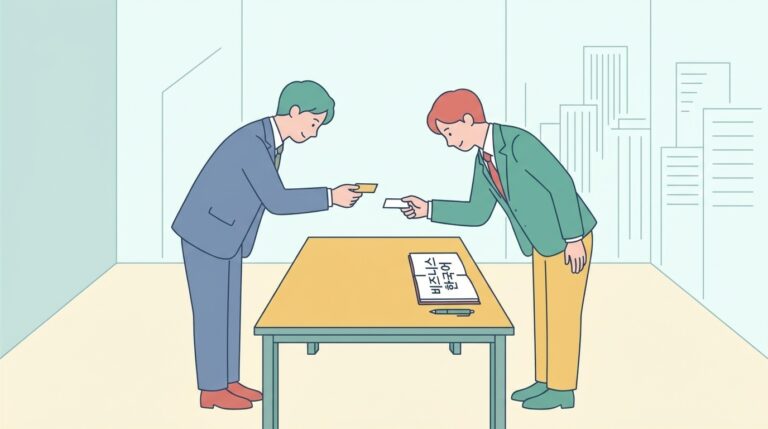
- Business Card (명함 – Myeongham) Sanctity: Never slide a business card into your back pocket! Present your card with two hands, print facing them. When receiving their card, take it with two hands, read their name and title quietly for 3 seconds, and place it neatly on the meeting table next to your notepad.
4-2. The Workplace Cultural Code
In Korean corporate life, hierarchy is not meant to oppress; it creates predictability and order. By speaking in formal Korean (-습니다 style) during introductions, you show the room that you respect their organizational structure. It immediately puts your Korean counterparts at ease because they recognize you understand professional decorum.
Phase 5: Real-Life Roleplay Scenario
Setting: Room 1402, a sunlit conference room overlooking the Han River. You have just arrived to pitch a project to Tech Korea.
Characters:
* You: Project Director
* 박민준 팀장 (Team Leader Min-jun Park): A sharp, polite 38-year-old manager wearing a trim navy suit.
- Turn 1 (박민준): 어서 오세요! 먼 길 오시느라 고생 많으셨습니다.
(Eoseo oseyo! Meon gil osineura gosaeng maneusyeosseumnida.)
(Welcome! Thank you for making the long journey here.)
🎭 따뜻한 미소를 지으며 일어서서 맞이한다.(Stands up with a warm smile to greet you.) -
Turn 2 (You): 초대해 주셔서 감사합니다, 팀장님.
(Chodaehae jusyeoseo gamsahamnida, timjangnim.)
(Thank you for inviting me, Team Leader Park.)
🎭 가볍게 목례를 하며 방으로 들어선다.(Gives a light nod/bow while walking into the room.) -
Turn 3 (박민준): 처음 뵙겠습니다. 테크 코리아의 박민준 팀장입니다.
(Cheo-eum boepgesseumnida. Tekeu Koria-ui Bak Min-jun timjang-imnida.)
(How do you do? I am Team Leader Min-jun Park from Tech Korea.)
🎭 두 손으로 정중하게 명함을 건넨다.(Politely hands over his business card with both hands.) -
Turn 4 (You): 만나서 반갑습니다. 글로벌 솔루션즈의 알렉스입니다.
(Mannaseo bangapseumnida. Geullobeol Sollusyeonjeu-ui Alekseu-imnida.)
(Pleased to meet you. I am Alex from Global Solutions.)
🎭 두 손으로 명함을 받으며 공손히 30도 허리를 숙인다.(Receives the card with both hands while bowing 30 degrees.) -
Turn 5 (박민준): 알렉스 님, 한국 방문은 이번이 처음이신가요?
(Alekseu nim, Hanguk bangmun-eun ibeon-i cheo-eum-isingayo?)
(Alex, is this your first time visiting Korea?)
🎭 명함을 탁자 위에 가지런히 올려놓으며 묻는다.(Asks while placing your card neatly on the table.) -
Turn 6 (You): 네, 출장으로는 처음입니다. 서울이 정말 멋집니다.
(Ne, chuljang-euro-neun cheo-eum-imnida. Seour-i jeongmal meotjimnida.)
(Yes, it is my first time on a business trip. Seoul is truly wonderful.)
🎭 편안한 눈빛으로 상대방을 바라본다.(Maintains warm, relaxed eye contact.) -
Turn 7 (박민준): 그렇게 말씀해 주시니 기쁘네요. 오늘 미팅이 기대됩니다.
(Geureoke malsseumhae jusini gippeuneyo. Oneul miting-i gidaedoemnida.)
(I am glad to hear that. I look forward to our meeting today.)
🎭 자리를 권하며 손짓한다.(Gestures toward your seat.) -
Turn 8 (You): [Your turn! Choose how to conclude the introduction below]
🔀 Interactive Decision Point
How will you conclude your greeting before sitting down?
- Option A: “잘 부탁드립니다! 오늘 좋은 논의 나누면 좋겠습니다.” (Jal butakdeurimnida! Today I hope we have great discussions.)
- Outcome (Best): 🌟 Perfect! You expressed mutual cooperation and set a warm, professional tone. Team Leader Park smiles with deep satisfaction.
- Option B: “반가워! 바로 시작하자.” (Bangawo! Let’s start right away.)
- Outcome (Bad): 🚨 Catastrophic! You used banmal (informal speech). The temperature in the room instantly drops 10 degrees.
- Option C: Say nothing, sit down immediately, and shove his business card into your wallet.
- Outcome (Risk): ⚠️ Cultural misstep. Skipping 잘 부탁드립니다 and neglecting card etiquette makes you appear abrupt and disengaged.
Phase 6: 10-Second Emotion Shadowing Drill
Train your muscle memory with these rhythmic pauses (/) and emotional tone cues. Repeat them aloud 3 times each!
- [💼 격식 있고 신뢰감 넘치게 – Crisp & Professional]
처음 뵙겠습니다 / 만나서 / 반갑습니다.
(Cheo-eum boepgesseumnida / mannaseo / bangapseumnida.)
“How do you do? / It is / a pleasure to meet you.” -
[🤝 겸손하고 진정성 있게 – Humble & Sincere]
잘 / 부탁드립니다.
(Jal / butakdeurimnida.)
“I truly look forward / to working with you.” -
[😊 밝고 반가운 미소로 – Bright & Warm]
만나 뵙게 되어 / 정말 / 영광입니다.
(Manna boepge doe-eo / jeongmal / yeong-gwang-imnida.)
“To meet you in person / is truly / an honor.”
Phase 7: K-Culture Mini Dictionary
Four essential workplace terms you will encounter in any Korean business environment:
- 명함 (Myeongham) | Business Card
- The physical embodiment of a professional’s identity in Korea. Always treat it with two hands and respect.
- 팀장님 (Timjangnim) | Team Leader / Manager
- The most common managerial title. Koreans prefer addressing coworkers by title rather than first name (e.g., Park Timjangnim).
- 인사 (Insa) | Greeting / Bow
- Encompasses both verbal greetings and physical bows. In Korean offices, a timely insa establishes your overall character.
- 첫인상 (Cheot-insang) | First Impression
- The make-or-break moment in Korean business negotiations, heavily influenced by punctuality and courteous language.
Phase 8: Survival Kit for Travelers
Top 3 Business Survival Phrases
- 명함 한 장 부탁드립니다. (Myeongham han jang butakdeurimnida.)
- Pro Tip: Use this when you want to politely request someone’s business card: “May I please have your business card?”
- 감사합니다. (Gamsahamnida.)
- Pro Tip: The universal “Thank you.” Deliver it with a brief head nod whenever coffee or documents are offered.
- 실례합니다. (Sillyehamnida.)
- Pro Tip: Say this when entering an executive’s office or excusing yourself from a conference table.
Editor’s Travel Note
- Getting to the Meeting on Time: Seoul traffic can be unpredictable. Instead of relying on Western mapping apps which often fail inside multi-level office complexes, complete your Naver Map app download before landing at Incheon. It provides subway car transfer hacks down to the exact door.
- Lobby Security: Most Gangnam corporate towers require you to tap your passport or ID at the front desk to receive a visitor lanyard (방문증 – bangmunjeung). Arrive 15 minutes early!
Phase 9: “One Step Deeper” (Reflective Thought)
In Western business culture, meetings frequently start with informal small talk about sports or the weather to create a relaxed atmosphere of equals. Korean business, rooted in centuries of Confucian relationship frameworks, approaches connection differently.
By leading with formal honorifics like 반갑습니다 and 잘 부탁드립니다, you are not building a wall of cold distance; you are providing psychological safety. You are stating: “I acknowledge your position, I respect this collaborative space, and you can rely on my professionalism.” Once that mutual respect is anchored, Korean business partners often become some of the warmest, most fiercely loyal colleagues you will ever have.
💬 Your Turn: What is the standard greeting ritual in your home country’s business meetings? How does it compare to the Korean two-handed bow and card exchange? Share your thoughts below!
Phase 10: FAQ & Avoiding Misunderstandings
Q: Can I just say “안녕하세요” instead of “반갑습니다” in a business meeting?
A: Yes, “안녕하세요” (Annyeonghaseyo) is completely polite and acceptable. However, pairing it with “처음 뵙겠습니다, 반갑습니다” shows higher linguistic maturity and instantly signals that you take the professional occasion seriously.
Q: Should I initiate a handshake, or wait for my Korean counterpart?
A: In Korean etiquette, handshakes are traditionally initiated by the person of higher seniority, age, or status. Wait for your host or senior partner to extend their hand first. If they do not, a clean 30-degree bow is universally respected.
Q: Is “반가워요” (Bangawoyo) acceptable in a formal meeting?
A: Absolutely not! While “반가워요” is polite enough for casual social gatherings among peers, it lacks the corporate gravity needed for clients, bosses, or partners. Stick firmly to “반갑습니다”.
🚨 Common Mistakes Warning Board
- Mistake: Shoving a received business card immediately into your pants pocket.
- Correct Action: Place it carefully on the desk in front of you during the meeting, or slide it into a dedicated card wallet.
- Mistake: Offering a one-handed greeting with your other hand deep in your suit pocket.
- Correct Action: Keep both hands visible in front of you, arms relaxed, or gently clasping your lower torso.
- Mistake: Calling a Korean partner by their bare first name (e.g., “Min-jun, let’s look at slide 3”).
- Correct Action: Attach their job title or the polite suffix -님 (-nim), as in “팀장님 (Timjangnim)” or “민준 님 (Min-jun nim)”.
Phase 11: Action Mission & Engagement
- 🥉 Bronze Mission (Solo Practice): Stand in front of a mirror. Practice a 30-degree bow while saying: “처음 뵙겠습니다. 반갑습니다!” Repeat 5 times until the words flow without hesitation.
- 🥈 Silver Mission (Social Connection): Drop a comment below writing your name and company using the formula:
[Company]의 [Name]입니다. 잘 부탁드립니다! - 🥇 Gold Mission (Real-World Execution): Next time you meet a Korean speaker in a professional setting or online networking event, deliver this exact phrase sequence with two hands clasped.
- 🎮 K-Culture Mission: Watch the opening 10 minutes of Episode 1 of Misaeng (Incomplete Life) or Start-Up. Count how many times characters bow and say 잘 부탁드립니다!
Phase 12: Interactive Quiz Challenge
Test what you’ve learned! Answer the three questions, then click the toggle to check your score.
Question 1 (Scenario Judgment)
You are attending a project kickoff meeting with a new client in Seoul. Which phrase should you say right after introducing your company?
* A) 안녕, 친구들! (Annyeong, chin-gudeul!)
* B) 처음 뵙겠습니다. 잘 부탁드립니다. (Cheo-eum boepgesseumnida. Jal butakdeurimnida.)
* C) 밥 먹었어요? (Bap meogeosseoyo?)
Question 2 (Fill-in-the-Blank)
Complete the quintessential first-encounter business greeting:
“만나서 ____________.”
Question 3 (True or False)
True or False: In a Korean meeting, it is customary to write meeting notes directly on the back of someone’s business card right after they hand it to you.
👉 Click here to reveal the answers and explanations!
-
Answer: B
Explanation: “처음 뵙겠습니다. 잘 부탁드립니다” is the ultimate polite combo for a first business meeting. Option A is informal talk among children, and Option C is an informal casual icebreaker. -
Answer: 반갑습니다 (Bangapseumnida)
Explanation: The complete phrase is “만나서 반갑습니다” (Mannaseo bangapseumnida), meaning “Pleased to meet you.” -
Answer: False
Explanation: Never write notes on a business card in front of the owner! A person’s business card represents their face (체면 – chemyeon). Keep it spotless on your desk.






