

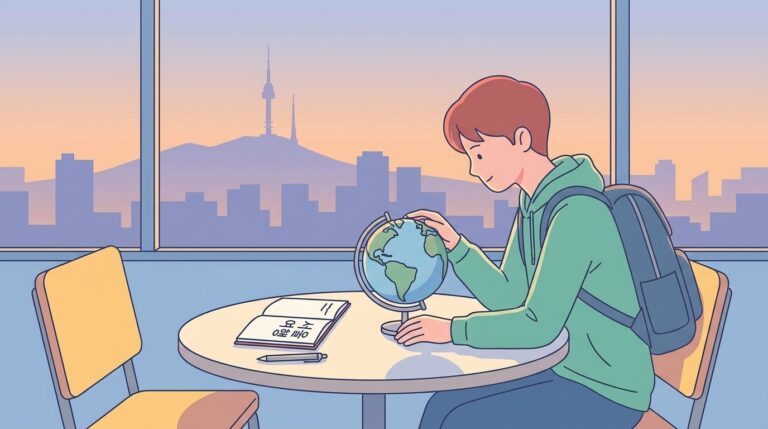
안녕하세요! 매일한글 에디터입니다.
Picture this: you are sitting at a cozy pojangmacha (street food stall) near the Han River with a couple of Korean friends. The autumn breeze is crisp, the tteokbokki is steaming, and someone clinks their glass against yours before asking: “너는 앞으로 꿈이 뭐야?” (What’s your dream for the future?)
You take a sip, clear your throat, and your brain frantically searches your mental textbook vocabulary. You proudly blurt out: “저의 희망은 전 세계를 여행하는 것입니다!”
Suddenly, the lively table goes dead quiet for a split second before your friends burst into fond chuckles. Did you say something wrong? Not grammatically! But to native ears, you just sounded like an elementary school student reading a formal essay aloud in front of the entire school assembly.
Expressing your heartfelt desires, bucket lists, and life plans is an intimate social currency in Korean culture. When you tell someone your dream is to travel the world (세계 일주), you aren’t just sharing an itinerary—you are revealing your philosophy on life, balance, and freedom. Over the past decade tutoring intermediate learners, I’ve seen countless students get trapped in stiff textbook grammar that builds an invisible emotional wall between them and their Korean peers. In this guide, tailored specifically for B1-level speakers, we will transform your rigid expressions into warm, genuine, and relatable conversational Korean that makes native speakers say, “와, 공감해요!” (Wow, I totally relate!).
1. 세계 일주를 하는 게 제 꿈이에요 (Segye iljureul haneun ge je kkum-ieyo)
- Pronunciation: [Se-gye il-ju-reul ha-neun ge je kkum-i-e-yo] (Think of se-gye like ‘say-gay’, and kkum rhymes with ‘room’ but starting with a crisp, punchy double ‘k’)
- Meaning: “Traveling around the world is my dream.” (Literal: The thing of doing a world tour is my dream.)
- K-Culture Moment: Often heard in travel variety shows like Youth Over Flowers (꽃보다 청춘) or travel vlogs when someone shares their true north star while watching a sunset.
- Editor’s Insight: Notice the grammar
-는 게(contracted form of-는 것이). Using-는 것이 제 꿈입니다sounds like an interview answer at a conglomerate. Replacing it with-는 게 제 꿈이에요strikes the sweet spot of respectful friendliness for B1 learners. - Situation Spectrum: Casual (✅ with close friends: ~게 내 꿈이야), Semi-formal (✅ ~게 제 꿈이에요), Formal (⚠️ in job interviews, use ~하는 것이 제 목표입니다)
- 🤔 Think About It: In English, we often say “I want to…” casually. Why do you think Korean specifically uses the word 꿈 (dream) even for achievable adult milestones?
2. 꼭 한 번 가보고 싶어요 (Kkok han beon gabogo sipeoyo)
- Pronunciation: [Kkok han beon ga-bo-go si-peo-yo] (Kkok sounds like the English word ‘coke’ without the final ‘e’, snapped sharply at the back of your throat)
- Meaning: “I would absolutely love to go there at least once.”
- K-Culture Moment: When a friend mentions a breathtaking destination in Jeju or Europe on Instagram, you lean in with your eyes sparkling and utter this exact phrase.
- Editor’s Insight: The magic word here is 꼭 (without fail / definitely). Pairing 꼭 with 한 번 (once) softens the statement from an aggressive demand into a passionate, yearning wish that invites the listener to share their own travel stories.
- Situation Spectrum: Casual (✅), Semi-formal (✅), Formal (✅)
- 🤔 Think About It: Why does adding 한 번 (one time) make a desire sound more humble and polite in Korean conversation?
3. 언젠가는 배낭여행을 떠날 계획이에요 (Eonjenganeun baenang-yeohaeng-eul tteonal gyehoek-ieyo)
- Pronunciation: [Eon-jen-ga-neun bae-nang-yeo-haeng-eul tteo-nal gye-hoek-i-e-yo] (Tteonal starts with a tense double ‘t’, like the Spanish ‘t’ in ‘taco’)
- Meaning: “Someday, I plan to set off on a backpacking trip.”
- K-Culture Moment: Featured in coming-of-age K-Dramas where a burnt-out protagonist looks at a pin-up map on their wall before handing in their resignation letter.
- Editor’s Insight: The verb 떠나다 (to leave/set off) carries far more emotional weight and romantic wanderlust than simply saying 가다 (to go). It implies breaking away from the routine.
- Situation Spectrum: Casual (✅ 떠날 계획이야), Semi-formal (✅), Formal (✅ 떠날 계획입니다)
- 🤔 Think About It: Compare “I plan to travel” with “I plan to set off”. How does the verb choice alter your perception of the speaker’s emotional state?
Phase 3: Textbook Korean vs. Real Korean
Situation 1: Talking About Your Ultimate Bucket List
- 📖 교과서 한국어: 저는 세계 일주를 하고 싶습니다. (Jeoneun segye iljureul hago sipseumnida.) — “I wish to do a world tour.”
- 🗣️ 진짜 한국어: 제 버킷리스트 1순위가 세계 일주예요! (Je beokit-riseuteu il-sun-wiga segye iljuyeyo!) — “Number one on my bucket list is traveling around the world!”
- 💡 왜 다를까?: Modern Koreans, particularly in their 20s to 40s, routinely use the loanword 버킷리스트 (bucket list) coupled with 1순위 (top priority) to frame future dreams with authentic enthusiasm instead of cold textbook declarations.
Situation 2: Explaining How You Intend to Make It Happen
- 📖 교과서 한국어: 저는 내년에 돈을 모아서 외국으로 갈 것입니다. (Jeoneun naenyeone doneul moaseo oegugeuro gal geosimnida.) — “I shall save money and go abroad next year.”
- 🗣️ 진짜 한국어: 내년에 돈 바짝 모아서 세계 일주 떠나려고요! (Naenyeone don bajjak moaseo segye ilju tteonaryeogoyo!) — “I’m going to save up aggressively next year and set off on a trip around the world!”
- 💡 왜 다를까?: The mimetic adverb 바짝 (intensely / tight to the bone) and the intention ending
-려고요show proactive, living drive rather than mechanical future-tense endings like-ㄹ 것입니다.
Phase 4: K-Culture Deep Dive & Non-Verbal Manners
4-1. 눈치 (Nunchi) & Gestures
When discussing grandiose personal dreams like quitting your job or circumnavigating the globe, Korean social dynamics require a careful balance of passion and modesty.
* The Soft Smile & Gaze: Avoid staring unblinkingly at the person when declaring a huge life dream. Direct, unyielding eye contact can be interpreted as defensive or argumentative. Instead, tilt your head slightly, let your gaze wander slightly upward as if visualizing the dream, and deliver the line with a warm smile.
* The Double-Hand Clasp: When saying “꼭 가보고 싶어요”, gently clasping your hands together near your chest conveys genuine sincerity without coming off as boastful.
4-2. The Cultural Phenomenon of “퇴사 후 세계여행”
In South Korea’s high-speed society, characterized by intense study hours and rigorous corporate life, taking off to travel the world is no ordinary holiday. It is viewed as an act of profound courage. There is even a widespread publishing and YouTube genre called 퇴사 후 세계여행 (Traveling the world after quitting my company). When you tell a Korean friend that you dream of a world tour, they will likely admire your bravery and might respond with “대단하시네요!” (That’s incredible!) or “부러워요!” (I’m so envious!).
Phase 5: Real-Life Roleplay Scenario
Setting: A trendy rooftop cafe in Euljiro, Seoul during sunset. You are chatting with Ji-min (지민), an avid backpacker and old friend.
- 지민: 여기 노을 진짜 예쁘다. 너 해외여행 좋아하지? (Yeogi noeul jinjja yeppeuda. Neo haeoeyeohaeng joahaji?)
🎭 Gazing at the orange skyline, leaning forward on the table.
“The sunset here is gorgeous. You love traveling abroad, right?” -
나 (Learner): 응, 엄청 좋아해! 언젠가는 꼭 배낭 메고 세계 일주를 하는 게 내 꿈이야. (Eung, eomcheong joahae! Eonjenganeun kkok baenang mego segye iljureul haneun ge nae kkumiya.)
🎭 Smiling wistfully with eyes lighting up.
“Yeah, I love it so much! Someday, slinging on a backpack and traveling around the world is my dream.” -
지민: 와, 세계 일주? 진짜 멋지다! 버킷리스트 중에 제일 먼저 가고 싶은 나라는 어디야? (Wa, segye ilju? Jinjja meotjida! Beokit-riseuteu junge jeil meonjeo gago sipeun naraneun eodiya?)
🎭 Clapping hands in surprise and genuine excitement.
“Wow, world travel? That’s so cool! Which country is at the very top of your bucket list?” -
나 (Learner): 남미 쪽! 볼리비아 우유니 사막에 꼭 한 번 가보고 싶어. (Nammi jjok! Bolivia Uyuni samage kkok han beon gabogo sipeo.)
🎭 Tracing an imaginary map on the wooden table.
“South America! I’d love to go to the Uyuni Salt Flats in Bolivia at least once.” -
지민: 우유니? 대박… 내 친구도 작년에 다녀왔는데 인생 여행지래. 언제쯤 갈 계획이야? (Uyuni? Daebak… Nae chin-gudo jaknyeone danyeowanneunde insaeng yeohaengjirae. Eonjejjeum gal gyehoegiya?)
🎭 Nodding enthusiastically with wide eyes.
“Uyuni? Awesome… My friend went there last year and said it was the trip of a lifetime. When are you planning to go?” -
나 (Learner): 돈 바짝 모아서 2년 뒤에는 꼭 떠나려고 해. (Don bajjak moaseo i-nyeon dwie-neun kkok tteonaryeogo hae.)
🎭 Clenching a small fist in playful determination.
“I’m going to save aggressively and definitely set off in about two years.” -
지민: 진짜 응원할게! 나도 돈 열심히 모아서 너 여행할 때 중간에 합류할까? (Jinjja eung-wonhalge! Nado don yeolsimhi moaseo neo yeohaenghal ttae junggane hamnyuhalkka?)
🎭 Laughing heartily, pointing playfully at you.
“I’m rooting for you! Should I save up too and rendezvous with you somewhere in the middle?” -
나 (Learner): 완전 좋지! 생각만 해도 너무 설렌다. (Wanjeon joji! Saenggangman haedo neomu seolleda.)
🎭 Raising coffee glass for an impromptu toast.
“I’d love that! Just thinking about it gives me butterflies.”
🔀 Interactive Choice
Ji-min asks: “그런데 회사나 일은 어떻게 하고 떠나게?” (But what are you going to do about your job/work before leaving?)
- Choice A: “퇴사하고 갈 생각이에요. 인생은 한 번뿐이잖아요!” (Toesahago gal saenggagieyo. Insaeng-eun hanbeonppun-ijanhayo! – I’m thinking of quitting. You only live once!)
- Choice B: “저는 회사가 싫어서 도망가는 것입니다.” (Jeoneun hoesaga silheoseo domang-ganeun geosimnida. – I am running away because I hate the company.)
- Choice C: “글쎄요, 아직 아무 생각도 없어요.” (Geulsse-yo, ajik amu saenggakdo eopseoyo. – Well, I haven’t thought about anything yet.)
Analysis:
* Choice A (Best!): Shows confidence, utilizes relatable culture points (퇴사, 인생은 한 번뿐), and keeps the conversation inspiring.
* Choice B (Risk): Too blunt, negative, and uses overly dramatic vocabulary (도망가다) that will make your friend worry about your mental well-being.
* Choice C (Bad): Shuts down the sparkling energy of the conversation and makes your dream sound like empty talk.
Phase 6: 10-Second Emotional Shadowing Drill
Practice these lines aloud, matching the pause markers (/) and the emotional cues:
[✨ 눈을 반짝이며 설레는 목소리로]
세계 일주를 하는 게 / 제 오랜 버킷리스트예요.
(Segye iljureul haneun ge / je oraen beokit-riseuteuyeyo.)
“Traveling around the world / is my longtime bucket list dream.”-
[🔥 다부지고 단호하게 결의를 다지며]
내년에는 / 돈 바짝 모아서 / 꼭 떠나려고요.
(Naenyeon-eneun / don bajjak moaseo / kkok tteonaryeogoyo.)
“Next year, / I will save up tightly / and definitely set off.” -
[🥺 진심을 담아 따뜻하게 공감하며]
상상만 해도 / 가슴이 벅차오르네요.
(Sangsangman haedo / gaseumi beokchaoreuneyo.)
“Just picturing it / fills my heart with joy.”
Phase 7: K-Culture Mini Dictionary
- 버킷리스트 (Beokit-riseuteu) | Bucket List | Borrowed from English, it is universally used in Korean media, resumes, and daily life to denote aspirational goals and travels.
- 배낭여행 (Baenang-yeohaeng) | Backpacking Trip | Literally “backpack travel.” Seen as an essential rite of passage for youth to build resilience before entering the structured corporate workforce.
- 힐링 여행 (Hilling Yeohaeng) | Healing Vacation | A journey focused entirely on quiet rest, nature, and escaping burnout rather than frantic sightseeing.
- 탕진잼 (Tangjin-jaem) | The Joy of Splurging | A popular slang blending 탕진 (dissipation of funds) and 재미 (fun). Often used half-jokingly when spending hard-earned savings on flight tickets.
Phase 8: Survival Kit for Travelers
TOP 3 Survival Phrases
- “여기서 사진 한 장만 찍어주실 수 있나요?”
(Yeogiseo sajin han jangman jjigeojusil su innayo?)
Pro Tip: Koreans are renowned world-class photographers for strangers! Handing your phone to someone in their 20s or 30s with this polite phrase practically guarantees an aesthetic Instagram shot. - “이 근처에 로컬 찐 맛집 추천해 주실래요?”
(I geuncheoe rokeol jjin matjip chucheonhae jusillaeyo?)
Pro Tip: Adding 찐 (authentic/real) filters out commercial tourist traps and leads you straight to where the neighborhood locals eat. - “언젠가 꼭 다시 오고 싶어요.”
(Eonjenga kkok dasi ogo sipeoyo.)
Pro Tip: Say this to guesthouse hosts or friendly cafe owners before leaving; it immediately warms their hearts.
Editor’s Travel Note
- When navigating public transport or finding secluded gems across Seoul, Busan, or Jeju, Google Maps often lags due to local map data regulations. For precise walking routes and real-time subway alerts, consult the 네이버 지도 앱 다운로드 가이드.
- Most Korean shops and taxis are 100% cashless, so always keep a reliable transit card (like T-money or WOWPASS) charged.
Phase 9: “One Step Deeper” (Reflections on Dreams)
In traditional Korean culture, personal ambitions were historically intertwined with the collective: making one’s parents proud, securing stability, and contributing to the community. However, for modern generations, dreaming of 세계 일주 (world travel) signifies a quiet revolution—a declaration that one’s life belongs to oneself. When you articulate your dreams in Korean, you are taking part in this evolving cultural narrative of personal freedom and self-discovery.
💬 Your Turn: What is the number one country or experience on your bucket list? Write it in the comments below using the pattern: [장소]에 꼭 가보고 싶어요! Let’s practice together!
Phase 10: FAQ & Avoiding Misunderstandings
Q: Can I say “제 꿈은 세계 일주입니다” to friends?
A: You can, but it sounds like a scripted speech or a formal interview at a company. To sound natural among friends, use the conversational pattern: “세계 일주를 하는 게 제 꿈이에요” or “버킷리스트 1순위예요”.
Q: What is the difference between “바라다” and “꿈꾸다” when wishing for something?
A: 바라다 translates to “to wish/hope for a specific outcome” (e.g., 건강하길 바라요 – I wish you health). 꿈꾸다 means “to dream of a life vision or grand ideal” (e.g., 새로운 삶을 꿈꿔요 – I dream of a new life).
Q: Is the word “버킷리스트” considered slang?
A: No, it is standard conversational Korean and is even used in television documentary titles, news articles, and university discussions.
🚨 Common Mistakes
- ❌ Mistake 1: Saying “저는 세계 여행을 원해요.” (Literal translation of “I want world travel”).
👉 Correct Action: Say “세계 일주를 꼭 해보고 싶어요.” Korean rarely uses 원하다 for everyday personal wishes. - ❌ Mistake 2: Mixing up 세계 여행 (World travel) and 세계 일주 (Traveling around the globe / Round-the-world tour).
👉 Correct Action: If your goal is a continuous around-the-world journey, use 세계 일주. - ❌ Mistake 3: Using plain speech (반말) like “내 꿈이야” with someone older or someone you just met.
👉 Correct Action: Always keep the polite -요 ending intact: “제 꿈이에요”.
Phase 11: Action Mission & Engagement
- 🥉 Bronze Mission (Solo): Stand in front of your mirror, smile, and say: “세계 일주를 하는 게 제 꿈이에요!” three times with the emotional pauses.
- 🥈 Silver Mission (Social Media): Post a travel photo on your Instagram story with the caption: “언젠가는 꼭 가보고 싶어요 ✈️ #매일한글 #버킷리스트”.
- 🥇 Gold Mission (Real-world Chat): Next time you talk with a Korean tutor or language exchange partner, ask them: “버킷리스트 1순위가 뭐예요?” and follow up with your own dream.
- 🎮 K-Culture Mission: Watch an episode of a Korean travel vlog on YouTube and comment below when you spot the keyword 버킷리스트 or 떠나다!
Phase 12: Interactive Quiz Challenge
1. Situation Challenge: You are talking over dinner with an acquaintance you met last week. How should you say “My dream is to travel around the world” respectfully yet naturally?
* A) 세계 일주를 하고 싶다.
* B) 세계 일주를 하는 게 제 꿈이에요.
* C) 나는 세계 일주를 원합니다.
2. Fill-in-the-Blank: Complete the sentence meaning “I definitely want to go to South America at least once.”
남미에 [ ] 한 번 가보고 싶어요.
3. True or False: In Korea, telling someone “버킷리스트 1순위가 세계 일주예요” sounds overly rude and informal in casual settings.
* True / False
👉 Click to reveal answers & explanations!
- Answer: B (It uses the natural conversational nominalizer -는 게 paired with polite -제 꿈이에요).
- Why not A? That is blunt written form (해라체), which feels cold in conversation.
- Why not C? 원합니다 sounds like an ultimatum or a petition letter!
-
Answer: 꼭 (Kkok). 꼭 한 번 is the quintessential formula for “at least once without fail.”
-
Answer: False. It is exceptionally natural, upbeat, and very warmly received among peers and acquaintances!







