Phase 1: Empathy (Story-Driven Opening)
안녕하세요! 매일한글 에디터입니다. (Annyeonghaseyo! I am your Daily Hangul editor.)
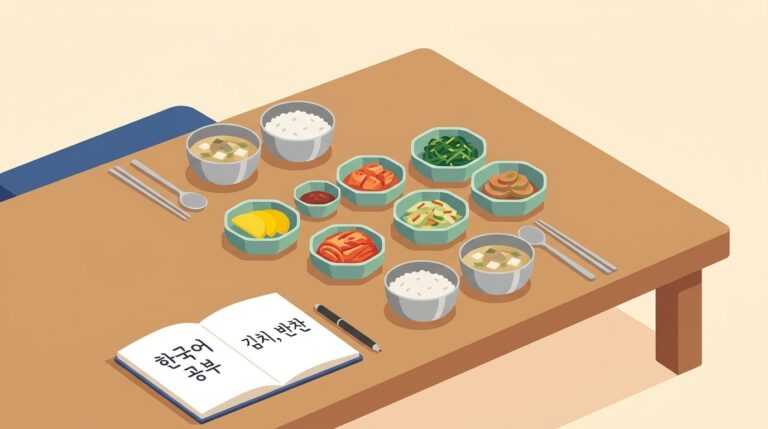
Picture this: You are sitting in a bustling, fragrant Korean restaurant in Seoul. The sizzling aroma of grilled meat fills the air, and your table is covered with five charming little ceramic plates filled with savory banchan—spicy kimchi, sweet braised potatoes (gamja-jorim), and crunchy seasoned bean sprouts. You take a bite of the braised potatoes, and your eyes widen. It is heavenly. In exactly forty seconds, the tiny dish is completely empty.
You want more. Your stomach demands more! But suddenly, your palms get a little sweaty. You freeze. Is banchan really free? Will the staff think I’m greedy if I ask for a second plate? What if I shout the wrong word and the whole restaurant stares at me? You catch the eye of the busy auntie (Imo) carrying three bubbling stews at lightning speed, get intimidated, and quietly look back down at your empty plate.
Take a deep breath—you are definitely not alone! This exact dilemma is one of the top three awkward moments shared by hundreds of our Daily Hangul beginner students. Here is the golden secret: in Korea, asking for more side dishes is not just allowed—it is warmly welcomed as a compliment to the chef! Today, we are going to unlock the exact, natural phrases and cultural secrets that will have you ordering refills like a true local, without a single drop of dining anxiety.
Phase 2: Core Expressions Deep Dive
1. 반찬 좀 더 주세요 (Banchan jom deo juseyo)
- Pronunciation: [Ban-chan jom deo ju-se-yo] (Sounds like: “Bahn-chahn zohm duh joo-seh-yoh”—think of “deo” as an exclamation of wanting “duh, more!”)
- Meaning: Literal: “Side dishes a little more please.” / Real Nuance: “Could we please have some more side dishes?”
- K-Culture Moment: In practically every K-Drama family dinner or office team meal (hoesik), someone happily hands empty dishes to the server while chanting this friendly phrase.
- Editor’s Insight: The magic word here is 좀 (jom). Literally meaning “a little,” it acts like an emotional cushion in Korean. It softens your request so you never sound demanding, even when asking for the third time!
- Situation Spectrum:
- Casual (friends/peers): ⚠️ 반찬 좀 더 줘 (Banchan jom deo jwo)
- Semi-formal (restaurants/daily life): ✅ 반찬 좀 더 주세요 (Banchan jom deo juseyo)
- Formal (official dining): ✅ 반찬 좀 더 주시겠어요? (Banchan jom deo jusigesseoyo?)
- 🤔 Think About It: In English, asking “Give me more food” sounds abrupt without “Could you possibly…”. Why do you think adding one tiny syllable (좀) completely transforms Korean courtesy?
2. 이거 리필 되나요? (Igeo ripil doenayo?)
- Pronunciation: [I-geo ri-pil doe-na-yo?] (Sounds like: “Ee-guh ree-peel dway-nah-yoh”)
- Meaning: Literal: “This one, refill possible?” / Real Nuance: “Is this side dish refillable?”
- K-Culture Moment: When ordering special premium dishes like seasoned raw crab (yangnyeom-gejang) or rolled omelets (gyeran-mari), variety show hosts frequently ask this cautious question before devouring it.
- Editor’s Insight: Most basic banchan are 100% free and unlimited, but expensive specialty side dishes occasionally have an extra charge. Use this phrase when pointing at a dish you suspect might be a premium item.
- Situation Spectrum:
- Casual: ⚠️ 이거 리필 돼? (Igeo ripil dwae?)
- Semi-formal: ✅ 이거 리필 되나요? (Igeo ripil doenayo?)
- Formal: ✅ 이 반찬 리필 가능합니까? (I banchan ripil ganeunghamnikka?)
- 🤔 Think About It: Korean borrowed the English noun “refill” and turned it into an active dining verb. How does your language adapt foreign words for fast-paced dining?
3. 셀프바는 어디에 있어요? (Selpeubaneun eodie isseoyo?)
- Pronunciation: [Sel-peu-ba-neun eo-di-e it-seo-yo?] (Sounds like: “Sell-poo-bah-noon uh-dee-eh eet-s’uh-yoh”)
- Meaning: Literal: “Self-bar where is?” / Real Nuance: “Where is the self-service side dish bar?”
- K-Culture Moment: You will spot neon or chalk signs in trendy casual eateries saying 추가 반찬은 셀프 (Chuga banchaneun selpeu – Additional side dishes are self-service).
- Editor’s Insight: Many modern Korean restaurants now keep their banchan in chilled open buffet counters. Asking this saves you from waiting for a server when you could just grab tongs and get your own kimchi instantly!
- Situation Spectrum:
- Casual: ⚠️ 셀프바 어디 있어? (Selpeuba eodi isseo?)
- Semi-formal: ✅ 셀프바는 어디에 있어요? (Selpeubaneun eodie isseoyo?)
- Formal: ✅ 셀프바 위치가 어디입니까? (Selpeuba wichiga eodiimnikka?)
- 🤔 Think About It: Self-service counters reflect Korea’s emphasis on speed (ppalli-ppalli) and eating as much as you like without waiting. Do casual restaurants in your home country provide unlimited self-service bars?
Phase 3: Textbook Korean vs. Real Korean
Situation 1: Asking for more Kimchi
- 📖 교과서 한국어 (Textbook Korean):
김치를 더 주실 수 있습니까? (Gimchireul deo jusil su itseumnikka?)
“Are you able to grant me more kimchi?” - 🗣️ 진짜 한국어 (Real-life Korean):
사장님, 김치 좀 더 주세요~ (Sajangnim, gimchi jom deo juseyo~)
“Boss, could we get a little more kimchi please~” - 💡 왜 다를까? (Why is it different?):
Textbooks teach stiff grammar formulas (-ㄹ 수 있습니까), but in real Korean dining, warmth and address titles like 사장님 (Sajangnim – store owner/boss) create instant friendly rapport.
Situation 2: Checking if side dishes are self-serve
- 📖 교과서 한국어 (Textbook Korean):
반찬은 손님이 직접 가져다 먹는 것입니까? (Banchaneun sonnimi jikjeop gajyeoda meongneun geosimnikka?)
“Is side dish consumption directly executed by the customer?” - 🗣️ 진짜 한국어 (Real-life Korean):
반찬 더 갖다 먹으면 돼요? (Banchan deo gatda meogeumyeon dwaeyo?)
“Can I just help myself to more side dishes?” - 💡 왜 다를까? (Why is it different?):
Native speakers prefer quick, active verbal phrases (갖다 먹다 – to bring and eat) rather than long, passive grammatical constructions.
Phase 4: K-Culture Deep Dive & Non-Verbal Manners
4-1. 눈치 (Nunchi) & Gestures
Calling for a refill in Korea is a fine art of subtle body language and social timing (Nunchi):
1. The Table Bell (호출벨 – Hochul-bel): Look at the table edge or the napkin holder first! If there is a small round button, do not shout across the room. Simply press it once. You will hear a pleasant “Ding-dong!” and the staff will glance at the table display board.
2. Hand Gesture: If there is no bell, raise your hand gently to shoulder height—palm facing forward, fingers together. Never whistle, click your fingers, or wave frantically over your head.
3. Plate Presentation: When the server approaches your table, politely pick up the empty banchan dish with both hands and extend it slightly toward them. This small two-handed gesture shows immense respect for their hard work.
4-2. The Cultural Code: “Jeong (정)” on a Small Plate
Why are banchan refills free in Korea when almost everything in Western dining costs extra? The answer lies in 정 (Jeong)—Korea’s unique cultural concept of deep, unconditional bonding, hospitality, and shared affection. Historically, serving a generous table with overflowing plates proved that the host cared deeply for the guest’s well-being. Letting a guest leave hungry was considered the ultimate shame. When you ask for a refill with a smile, Korean restaurant owners do not see an added expense; they see someone who truly enjoys their cooking!
Phase 5: Real-Life Roleplay Scenario
Setting: Halmeoni-ne Sikdang (Grandma’s Alleyway Restaurant) near Hongdae. Sizzling Kimchi-jjigae bubbling on a tabletop stove. The air is cozy and smells of toasted sesame oil.
Characters:
* You (A2 Korean Learner): Ready to conquer your side dish fear.
* Imo (Friendly Restaurant Auntie): Wearing a bright apron, moving swiftly between tables with a kind smile.
Turn 1
* You: 저기요~ 사장님! (Jeogiyo~ Sajangnim!)
🎭 Action: Raising your hand calmly to chest level while smiling politely.
“Excuse me, owner!”
Turn 2
* Imo: 네~ 뭐 더 드릴까요? (Ne~ mwo deo deurilkkayo?)
🎭 Action: Wiping hands on her apron and walking over cheerfully.
“Yes~ what more can I get for you?”
Turn 3
* You: 이 어묵 반찬 너무 맛있어요! (I eomuk banchan neomu masisseoyo!)
🎭 Action: Pointing gently at the empty stir-fried fish cake dish.
“These fish cake side dishes are so delicious!”
Turn 4
* Imo: 아이고, 입에 맞아요? 참 잘 먹네! (Aigo, ibe majayo? Cham jal meongne!)
🎭 Action: Chuckling warmly and nodding with pride.
“Oh my, it suits your taste? You eat so well!”
Turn 5
* You: 네! 이거 반찬 좀 더 주세요. (Ne! Igeo banchan jom deo juseyo.)
🎭 Action: Lifting the small empty bowl with both hands and handing it to her.
“Yes! Could we please have a little more of this side dish?”
Turn 6
* Imo: 당연하지! 듬뿍 갖다 줄게요. (Dangyeonhaji! Deumpuk gatda julgeyo.)
🎭 Action: Taking the bowl and heading to the kitchen station.
“Of course! I’ll bring you a generous heap.”
Turn 7
* Imo: 자, 여기 많이 담았어요. 천천히 먹어요. (Ja, yeogi mani damasseoyo. Cheoncheonhi meogeoyo.)
🎭 Action: Placing a piled-high dish of warm fish cakes back on your table.
“Here you go, I put a lot in. Eat comfortably.”
Turn 8
* You: 와, 정말 감사합니다! 잘 먹겠습니다! (Wa, jeongmal gamsahamnida! Jal meokgetseumnida!)
🎭 Action: Giving a cheerful 15-degree bow of gratitude.
“Wow, thank you so much! I will enjoy this meal!”
🔀 Interactive Decision Point
The fish cakes were amazing, but now you notice a stainless steel counter across the room with large containers of kimchi and pickled radish. What do you do?
- Choice A: You press the table call bell and shout: “반찬 더 가져와! (Banchan deo gajyeowa!)”
- Choice B: You walk up to the counter with your empty bowl, look for tongs, and whisper to a nearby staff member: “여기 셀프예요? (Yeogi selpeuyeyo?)”
- Choice C: You leave your table, walk straight into the private kitchen area, and start opening closed refrigerator doors.
Feedback on Choices:
* Choice A [BAD]: Saying 가져와 is aggressive non-honorific language (informal panmal), and yelling across the room ruins the dining atmosphere.
* Choice B [BEST]: Asking 여기 셀프예요? (Is it self-service here?) is courteous, natural, and saves everyone time. If it is self-serve, you fill what you need; if not, they will serve you.
* Choice C [RISK]: Entering commercial kitchen spaces poses major safety and hygiene risks in Korea! Never walk past the swinging kitchen doors.
Phase 6: 10-Second Emotion Shadowing Drill
Read these aloud while mirroring the emotional tags and pauses marked by /.
- [😊 Friendly & Polite]
저기요~ / 사장님, / 반찬 좀 / 더 주세요!
(Jeo-gi-yo~ / Sa-jang-nim, / ban-chan jom / deo ju-se-yo!) -
[😋 Delighted & Complimentary]
이거 / 너무 맛있어요! / 리필 / 되나요?
(I-geo / neo-mu ma-si-sseo-yo! / ri-pil / doe-na-yo?) -
[🧐 Curious & Observant]
실례지만, / 셀프바는 / 어디에 있어요?
(Sil-lye-ji-man, / sel-peu-ba-neun / eo-di-e it-seo-yo?)
Phase 7: K-Culture Mini Dictionary
-
반찬 (Banchan)
Translation: Side dishes.
Usage: Small communal dishes served alongside rice and soup. Always shared, almost always refilled for free. -
이모님 / 사장님 (Imonim / Sajangnim)
Translation: Respected Auntie / Respected Store Boss.
Usage: Calling female restaurant servers “Imo” or “Imonim” establishes a fond, family-like dynamic. If unsure, “Sajangnim” works safely for everyone. -
셀프 (Selpeu)
Translation: Self-service (Konglish).
Usage: Frequently paired with water (물은 셀프 – Mureun selpeu) or side dishes (반찬은 셀프 – Banchaneun selpeu). -
무한리필 (Muhan-ripil)
Translation: Unlimited refill (All-you-can-eat).
Usage: Found on signs for barbecue, pork cutlet, or seafood restaurants offering unlimited main courses for a flat price.
Phase 8: Traveler’s Survival Kit
Top 3 Survival Expressions
- 김치 좀 더 주세요 (Gimchi jom deo juseyo)
Pronunciation: Gim-chi jom deo ju-se-yo
Pro Tip: Replace “Kimchi” with any dish name (깍두기 좀 더 주세요 = more cubed radish kimchi, please). - 물 좀 더 주세요 (Mul jom deo juseyo)
Pronunciation: Mul jom deo ju-se-yo
Pro Tip: If water bottles aren’t self-serve in the fridge, use this phrase to request cold water. - 다 먹었어요, 계산해 주세요 (Da meogeosseoyo, gyesanhae juseyo)
Pronunciation: Da meo-geot-seo-yo, gye-san-hae ju-se-yo
Pro Tip: “We are finished eating, check please!” Said when walking up to the cash register by the exit.
Editor’s Travel Note
- Finding Great Local Joints: Skip tourist traps by searching on the Naver Map app on the iOS App Store or Android Play Store. Look for places rated 4.3 stars or higher with tags like “반찬이 맛있는” (great side dishes).
- Payment & Tipping: In Korea, tipping is 0%. Excellent service and banchan refills are included in the menu price. You pay at the front counter counter on your way out, not at your dining table.
Phase 9: “One Step Deeper” (Reflections on Language & Society)
In many Western cultures, dining out is transactional: you order an item, it has an itemized price, and anything extra adds to your bill. Korean dining culture, however, is fundamentally grounded in communal sharing. Eating from the same array of side dishes builds an invisible bond between diners and the restaurant host. Asking for more food signals that you feel at home in their space, transforming an ordinary meal into an exchange of warmth.
💬 Your Turn: What side dish in your home culture would you love to see offered as an “unlimited free refill”? Share your favorite comfort food in the comments below!
Phase 10: FAQ & Common Mistakes
Q: Can I ask for a refill of every single banchan on the table?
A: Yes! You can ask for refills on standard banchan (kimchi, namul, tofu, fish cakes, salad). However, it is polite to only refill what you know you will actually finish. Leaving giant piles of refilled food uneaten is considered wasteful (nanggbi).
Q: Are meat or seafood side dishes free to refill too?
A: Small portions of rolled eggs (gyeran-mari) or seasoned raw crab (gejang) are sometimes charged an extra 2,000–3,000 KRW for a refill. When in doubt, ask: “이거 리필 되나요?” (Is this dish refillable?).
Q: Should I call the waitress “Ajumma” (아줌마)?
A: Never use “Ajumma”! While technically meaning middle-aged woman, it can sound harsh and disrespectful. Always use 이모님 (Imonim – Auntie) or the fail-safe 사장님 (Sajangnim – Boss/Proprietor) instead.
🚨 흔한 실수 (Common Mistakes) Warning Box
- Mistake: Shouting “여기요!” at maximum volume in a quiet dining room.
Correct Action: Look for the table call bell first, or make eye contact and raise your hand gently. - Mistake: Using informal speech like “반찬 더 줘!”
Correct Action: Always end your request with polite honorifics: “-주세요” (Juseyo). - Mistake: Waving an empty plate in the air like a flag to get attention.
Correct Action: Keep the dish resting on the table until the staff approaches, then hand it over using both hands.
Phase 11: Action Missions
- 🥉 Bronze Mission (Solo Practice): Stand in front of your mirror with an empty small bowl. Practice saying “사장님, 반찬 좀 더 주세요~” three times with a bright smile.
- 🥈 Silver Mission (Social Share): Snap a photo of your favorite homemade or takeout side dish and post it to Instagram or X with the caption: “반찬 좀 더 주세요! Practicing my Korean dining skills with @DailyHangul!”
- 🥇 Gold Mission (Real-World Test): Visit a local Korean restaurant or grocery food court. Politely ask for a banchan refill in Korean without switching to English!
- 🎮 K-Culture Mission: Watch an episode of a Korean variety food show (like Jinny’s Kitchen or Street Food Fighter). Count how many times customers press the call bell or ask for extra side dishes!
Phase 12: Interactive Quiz Challenge
Test your dining instincts! Select your answers before revealing the solutions below.
- Situational Judgment: You want more of the spicy shredded radish, but the restaurant is very noisy and the server is far away. What is the most polite action?
- (A) Bang your metal chopsticks against the table.
- (B) Check your table for a call bell (호출벨), press it once, and wait.
- (C) Stand up and yell: “아줌마! 빨리 와요!”
- Fill in the Blank: Fill in the magic polite softening word:
“사장님, 김치 [______] 더 주세요!”
(Hint: Sounds like “zohm”, means “a little”) -
True or False: In modern Korean restaurants, if you see a sign that says “추가 반찬은 셀프”, you must wait at your seat for the server to bring you more side dishes.
- [True / False]
👉 Click here for Answers and Explanations!
-
Answer: (B)
Explanation: Always look for the call bell first! Banging utensils or yelling “Ajumma, come quickly!” is extremely impolite. -
Answer: 좀 (jom)
Explanation: 좀 cushions requests and makes them instantly warm and friendly (김치 좀 더 주세요). -
Answer: False
Explanation: 셀프 (Selpeu) means self-service! You should take your empty plate to the counter and serve yourself using the provided tongs.