

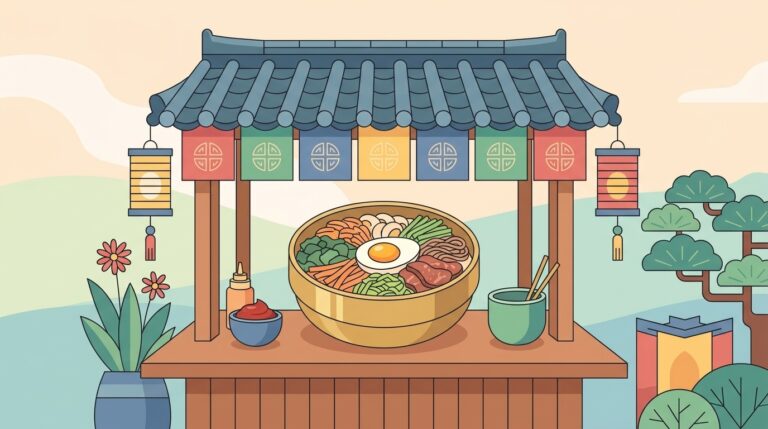
Phase 1: 공감 (Immersive Opening)
안녕하세요! 매일한글 에디터입니다.
Picture this: You are standing right in the bustling heart of the Jeonju Hanok Village during the annual Jeonju Bibimbap Festival. The irresistible aroma of toasted wild sesame oil (deulgireum) drifts past your nose, while massive brass cauldrons sizzle with colorful namul vegetables and seasoned beef. You have been studying Korean diligently, but the moment you approach a crowded food tent, the vendor auntie turns to you with a lightning-fast question: “Gochujang da neoheulkka, animyeon ttarojulkka?” Your mind blanks out. Do you want it mixed? On the side? And wait—how do you ask for that legendary yukhoe (beef tartare) topping without sounding like a textbook robot?
So many intermediate (B2) learners hit this exact wall. You know grammar patterns like -eul su ittta and formal polite endings, but festival street stalls run on real-time sensory vocabulary, rapid customization, and cultural nuance. Through hundreds of hours coaching travelers who visit Jeollabuk-do, I have distilled the exact conversational rhythm you need to glide through food stalls smoothly. By the end of this guide, you won’t just order food—you will converse like a true Korean foodie (mat-jal-al), earning approving smiles and extra toppings from local vendors.
Phase 2: 핵심 표현 3선 심층 분석 (3 Core Expressions)
1. 밥보다 고명이 더 푸짐하네요! (Bapboda gomyeongi deo pujimhaneyo!)
- Pronunciation: [Bap-bo-da go-myeong-i deo pu-jim-ha-ne-yo] (Rhymes intuitively with “Bop-bo-dah go-myung-ee duh poo-jeem-ha-neh-yo”)
- Meaning: Literal: “There are more toppings than rice!” / Real Nuance: “Wow, you are so remarkably generous with the garnishes!”
- K-Culture Moment: Often uttered by celebrity hosts on Korean gourmet variety shows like Baek Jong-won’s Alley Restaurant when a chef serves an overwhelmingly lavish bowl.
- Editor’s Insight: In Jeonju bibimbap, the gomyeong (artistic garnish) represents pride and hospitality. Complimenting the ratio of toppings over rice (bap) instantly signals that you understand authentic Korean culinary craftsmanship.
- Situation Spectrum: Casual: ✅ | Semi-formal: ✅ | Formal: ⚠️
- 🤔 Think About It: In your culture, do you compliment the chef on ingredient portion sizes, or does that sound impolite? Notice how in Korea, praising hearty portions (pujimhada) is the ultimate flattery.
2. 양념장은 따로 덜어 주실 수 있나요? (Yangnyeomjangeun ttaro deoreo jusil su innayo?)
- Pronunciation: [Yang-nyeom-jang-eun tta-ro deo-reo ju-sil su in-na-yo] (Sound analogy: “Yahng-nyum-jahng-eun tah-ro duh-ruh joo-sheel soo een-nah-yo”)
- Meaning: Literal: “Can you separate the seasoned sauce and give it to me?” / Real Nuance: “Could you serve the spicy chili sauce on the side, please?”
- K-Culture Moment: When K-pop idols who cannot handle heavy spice (mapbuji) visit regional street markets on YouTube vlogs, this exact polite phrasing saves the day.
- Editor’s Insight: At high-volume festival stalls, cooks instinctively drop a massive dollop of gochujang right on top. Using ttaro deoreo juda (to portion out separately) prevents spice shock without making you sound picky.
- Situation Spectrum: Casual: ⚠️ | Semi-formal: ✅ | Formal: ✅
- 🤔 Think About It: Notice the compound verb deoreo juda (to ladle/scoop out for someone). How does adding juda (to give) soften an imperative request into a considerate social inquiry?
3. 젓가락으로 살살 비벼야 제맛이죠! (Jeotgarageuro salsal bibyeoya jemasijyo!)
- Pronunciation: [Jeot-ga-rag-eu-ro sal-sal bi-byeo-ya je-ma-si-jyo] (Sound analogy: “Jut-gah-rahg-oo-ro sahl-sahl bee-byuh-yah jeh-mah-she-jyo”)
- Meaning: Literal: “Only when you mix gently with chopsticks is it the real taste!” / Real Nuance: “Chopsticks are the only true way to mix bibimbap properly!”
- K-Culture Moment: A classic scene in K-Dramas where a local foodie scolds a city newcomer for crushing delicate warm rice grains with a heavy metal spoon.
- Editor’s Insight: The mimetic word salsal (gently, lightly) paired with -ya jemada (that’s the true flavor) elevates your Korean to native-tier cultural fluency. It shows you respect the texture of each ingredient.
- Situation Spectrum: Casual: ✅ | Semi-formal: ✅ | Formal: 🚫
- 🤔 Think About It: Why do Korean foodies obsess over texture retention in mixed dishes rather than mashing everything into a paste?
Phase 3: 교과서 한국어 vs 진짜 한국어 (Textbook vs. Real-World)
Situation 1: Adjusting spice levels
- 📖 교과서 한국어: 고추장을 조금만 넣어 주세요. (Gochujangeul jogeumman neoheo juseyo.) — “Please put in only a little chili paste.”
- 🗣️ 진짜 한국어: 양념은 반만 살짝 둘러주세요! (Yangnyeomeun banman saljjak dulleojuseyo!) — “Just a light half-swirl of the sauce, please!”
- 💡 왜 다를까?: In active kitchens, vendors move at lightning speed. Saying banman saljjak dulleojuseyo gives the cook a precise, physical cooking gesture (dulleojuda = drizzle in a circle), preventing overly spicy mishaps much more effectively than the abstract word jogeum (a little).
Situation 2: Expressing appreciation after the first bite
- 📖 교과서 한국어: 이 음식은 정말 맛있습니다. (I eumsigeun jeongmal masitseumnida.) — “This food is truly delicious.”
- 🗣️ 진짜 한국어: 와, 재료 식감이 하나하나 살아있네요! (Wa, jaeryo sikgami hanahana sarainneyo!) — “Wow, every single ingredient retains its crisp, distinct texture!”
- 💡 왜 다를까?: At B2 level, repetitive praise like masisseoyo sounds monotonous. Highlighting the texture (sikgam) of festival bibimbap shows genuine culinary literacy that immediately flatters the proud Jeonju artisan.
Phase 4: K-Culture 딥다이브 & 비언어적 매너 (Deep Dive & Etiquette)
4-1. 눈치 (Nunchi) & Festival Street Gestures
At the Jeonju Bibimbap Festival, lines move fast and vendors manage heavy brass bowls (notgeureut) heated to keep rice warm.
* The Two-Handed Receive: When handed your bowl or wooden tray, always support it with both hands or hold your left hand under your right wrist. Never grab it one-handed while checking your smartphone.
* The Brass Bowl Warning: Traditional Jeonju bibimbap bowls hold heat surprisingly well. If an elder vendor says “Tteugeowoyo!” (It’s hot!), acknowledge immediately with a nod and step back slightly to clear space for fellow diners.
* Disposal Manners: Once finished, never leave your napkins or disposable utensils inside the brass bowl. Vendors collect reusable dishware and separate trash meticulously.
4-2. Cultural Code Analysis: The Harmony of Obangsaek (오방색)
Jeonju bibimbap is not merely street food; it is an edible manifestation of traditional Korean philosophy. The toppings represent Obangsaek—the five cardinal colors symbolizing nature’s balance:
* Green (East / Wood): Spinach, zucchini, or wild herbs.
* Red (South / Fire): Chili paste or fresh raw beef (yukhoe).
* Yellow (Center / Earth): Hwangpo-muk (yellow mung bean jelly) and egg yolk.
* White (West / Metal): Bean sprouts, radish, and white rice.
* Black (North / Water): Shiitake mushrooms, bracken (gosari), or roasted seaweed.
When vendors meticulously layer these colors, mixing them at the table represents blending diverse elements into harmonious unity—a core value in Korean social culture.
Phase 5: 실전 롤플레이 시나리오 (Real-Life Roleplay Scenario)
- Setting: A buzzing open-air tent stall at the Jeonju Bibimbap Festival decorated with red-and-blue silk lanterns.
- Character: Park Imo-nim (박 이모님), a vivacious veteran chef with 30 years of Jeonju culinary experience, stirring seasoned mountain herbs in an oversized wooden basin.
- 이모님: 어서 와요, 학생! 우리 집 육회비빔밥 먹어봤어? 오늘 나물이 기가 막혀! (Eoseo wayo, haksaeng! Uri jip yukhoebibimbap meogeobwasseo? Oneul namuri giga makhyeo!)
🎭 Wiping down the stainless counter with a bright smile and motioning toward the steaming rice.
“Welcome, dear! Have you tried our beef tartare bibimbap? The herbs today are unbelievable!” -
학습자: 냄새가 너무 좋아서 그냥 지나칠 수가 없었어요. 육회비빔밥 한 그릇 부탁드려요! (Naemsaega neomu joaseo geunyang jinachil suga eopseosseoyo. Yukhoebibimbap han geureut butakdeuryeoyo!)
🎭 Leaning in curiously with hands politely clasped.
“The smell was so incredible that I couldn’t just walk past. One bowl of beef tartare bibimbap, please!” -
이모님: 탁월한 선택이네! 고추장 양념은 듬뿍 넣어줄까, 아니면 좀 덜 맵게 해줄까? (Tagwolhan seontaegine! Gochujang yangnyeomeun deumpuk neoheojulkka, animyeon jom deol maepge haejulkka?)
🎭 Hovering a wooden spoon filled with glistening red pepper sauce over the bowl.
“Excellent choice! Should I scoop a generous dollop of chili sauce, or make it less spicy?” -
학습자: 양념장은 따로 덜어 주실 수 있나요? 제가 매운 걸 아주 잘 먹지는 못해서요. (Yangnyeomjangeun ttaro deoreo jusil su innayo? Jega maeun geol aju jal meokjineun motheseoyo.)
🎭 Smiling sheepishly and making a small cupping gesture with both hands.
“Could you serve the sauce on the side? I can’t handle extreme spice very well.” -
이모님: 아이고, 당연하지! 여기 종지에 담아줄 테니 입맛대로 슥슥 비벼 먹어. (Aigo, dangyeonhaji! Yeogi jongjie damajul teni immadaero seukseuk bibyeo meogeo.)
🎭 Scooping the deep red sauce into a small side dish and setting down a gleaming brass spoon.
“Oh goodness, of course! I’ll put it in this small dish, so mix it in gradually to suit your taste.” -
학습자: 와, 밥보다 고명이 더 푸짐하네요! 정성이 가득 담긴 게 느껴져요. (Wa, bapboda gomyeongi deo pujimhaneyo! Jeongseongi gadeuk damgin ge neukkyeojyeoyo.)
🎭 Admiring the immaculate layout of five colored herbs with wide eyes.
“Wow, there are more toppings than rice! I can really feel the meticulous care put into this.” -
이모님: 학생이 뭘 좀 아네! 숟가락으로 꾹꾹 누르지 말고, 젓가락으로 살살 비벼야 밥알이 살아! (Haksaengi mwol jom ane! Sutgarageuro kkukkkuk neureuji malgo, jeotgarageuro salsal bibyeoya babari sara!)
🎭 Handing over a pair of long metal chopsticks with a satisfied, hearty laugh.
“You really know your food! Don’t press down hard with the spoon; mix gently with chopsticks so the rice grains stay intact!” -
학습자: 네, 이모님 말씀대로 젓가락으로 살살 비벼볼게요. 정말 감사합니다! (Ne, imonim malsseumdaero jeotgarageuro salsal bibyeobolgeyo. Jeongmal gamsahamnida!)
🎭 Receiving the chopsticks with both hands and executing a grateful 15-degree bow.
“Yes, Imo-nim, I’ll mix gently with chopsticks just like you taught me. Thank you so much!”
🔀 Interactive Decision Branch
What do you do when Imo-nim hands you your customized brass bowl?
* Choice A: You grab it with one hand while holding your smartphone camera in the other, immediately pressing down into the rice with your metal spoon.
Feedback (Bad): High risk of dropping the hot brass bowl! Also, mashing the rice with a spoon flattens the fluffiness, disappointing Imo-nim.
* Choice B: You accept the hot bowl with both hands, bow politely, and immediately say: “우와, 젓가락으로 비비면 되죠? 감사합니다!” (Uwa, jeotgarageuro bibimyeon doejo? Gamsahamnida!)
Feedback (Best): Perfect cultural etiquette! Shows attentiveness to both physical safety and the chef’s culinary advice.
* Choice C: You ask her to stir the whole bowl for you because your hands feel full.
Feedback (Risk): While she might laugh and help out of grandmotherly kindness, at a packed festival stall this delays the line and comes across as slightly entitled.
Phase 6: 10초 감정 섀도잉 드릴 (10-Second Emotion Shadowing Drill)
Practice reading these out loud at intermediate speed, focusing on breathing pauses marked by /.
[😊 감탄하며 / Admiring & Delighted]
와! / 밥보다 고명이 / 훨씬 더 푸짐하네요!
(Wa! / Bapboda gomyeongi / hwolssin deo pujimhaneyo!)
Pause naturally after ‘Wa!’ to let your genuine enthusiasm resonate.-
[🙏 조심스럽고 공손하게 / Polite & Inquiring]
혹시 / 양념장은 / 작은 종지에 따로 주실 수 있나요?
(Hoksi / yangnyeomjangeun / jageun jongjie ttaro jusil su innayo?)
Soften the pitch at ‘Hoksi’ and maintain a gentle rising tone toward ‘innayo?’. -
[😎 자신감 넘치고 유쾌하게 / Savvy & Playful]
비빔밥은 역시 / 숟가락 말고 / 젓가락으로 살살 비벼야 제맛이죠!
(Bibimbabeun yeoksi / sutgarak malgo / jeotgarageuro salsal bibyeoya jemasijyo!)
Stress ‘yeoksi’ and bounce rhythmically across ‘salsal bibyeoya’.
Phase 7: K-Culture 미니 사전 (Mini Dictionary)
- 고명 (Gomyeong) | Noun: Garnish / Topping
Real-World Usage: Refers specifically to visually arranged toppings that finish a Korean dish. At the festival, asking “고명 추가 가능한가요?” (Can I add extra garnish?) shows sophisticated food vocabulary. - 놋그릇 (Notgeureut) | Noun: Traditional Korean bronzeware
Real-World Usage: Renowned for natural antimicrobial properties and thermal insulation. Serving bibimbap in notgeureut maintains temperature without burning the rice crust. - 감칠맛 (Gamchilmat) | Noun: Umami / Savory depth
Real-World Usage: Used when describing naturally fermented sauces or dried kelp broth. When praising Jeonju culinary broth, say: “감칠맛이 깊네요.” (The umami is deep.) - 육회 (Yukhoe) | Noun: Korean seasoned beef tartare
Real-World Usage: Prime lean beef marinated in sesame oil, soy sauce, garlic, and julienned Korean pear. Jeonju’s signature bibimbap is often distinguished by fresh yukhoe over cooked bulgogi.
Phase 8: 여행자를 위한 생존 키트 (Traveler’s Survival Kit)
Top 3 Survival Phrases
- 1. 종이컵 하나만 더 주실 수 있어요? (Jong-ikeop hanaman deo jusil su isseoyo?)
Pro Tip: Stalls often offer free warm soup (kongnamul-guk). Asking for an extra paper cup allows you to share broth comfortably with a travel partner. - 2. 이거 계좌이체나 카드 결제도 되나요? (Igeo gyejwa-iche-na kadeu gyeoljedo doenayo?)
Pro Tip: While most festival pop-ups accept domestic cards, foreign credit cards occasionally fail on portable terminals. Knowing how to ask about bank transfer (gyejwa-iche) saves unexpected payment embarrassment. - 3. 덜 맵게 해달라고 부탁드렸는데, 맞나요? (Deol maepge haedallago butakdeoryeonneunde, mannayo?)
Pro Tip: Use this polite confirmation sentence when your bowl looks suspiciously fiery red before you walk away from the pickup counter.
Editor’s Travel Note
- Navigation Guide: When wandering through Jeonju Hanok Village’s alleys, Google Maps often lags or displays outdated stall locations. Install and search using the official 네이버 지도 앱 다운로드 (Naver Map application) for real-time booth locations and verified local food reviews.
- Transit & Footwear: Take the KTX to Jeonju Station, then hop on bus routes 119 or 535 straight to the Hanok Village entrance. Wear comfortable slip-on sneakers—several traditional bibimbap heritage houses require removing your shoes at the entrance.
Phase 9: “한 발 더 깊이” (Cultural Essay)
In contemporary Western dining, ingredients are frequently separated on the plate to celebrate their individual minimalism. In contrast, Korean bibimbap reflects the profound communal concept of Dae-dong (대동)—bringing distinct elements together in harmonious coexistence. The carrot does not surrender its crunch, the spinach does not lose its earthy perfume, and the fermented gochujang binds everything without erasing individual flavors. Mixing bibimbap at a lively festival table is therefore an act of cultural immersion: individual flavors becoming more vibrant precisely because they blend with others.
💬 Your Turn: Have you ever eaten bibimbap with chopsticks instead of a spoon? What is a traditional dish from your hometown that celebrates mixing ingredients together? Share your thoughts below in Korean or English!
Phase 10: FAQ & 오해 방지 (FAQ Schema)
Q: Is it rude to ask the stall vendor to omit certain toppings in my bibimbap?
A: Not at all! Korean vendors are very accommodating if communicated politely. Simply point to the ingredient and say: “이 나물은 빼고 비벼주실 수 있나요?” (Could you please prepare it without this herb?). However, asking for multiple ingredient substitutions during peak rush hour might test the vendor’s patience, so keep requests concise.
Q: Should I really mix Jeonju bibimbap with chopsticks instead of a spoon?
A: Yes, ideally! Using chopsticks separates the sticky short-grain rice gently without crushing the tender grains or bruising delicate blanched greens like bean sprouts and crown daisies. Use chopsticks to distribute the sauce evenly, then switch to your spoon for a hearty bite!
Q: What should I do if the vendor doesn’t understand my spice preference?
A: Avoid vague words like jogeum (a little), which can mean half a spoonful to one person and two drops to another. Point to the sauce dish and clearly say: “양념장은 넣지 말고 따로 주세요.” (Please do not put the sauce in; give it to me on the side.) That way, you have 100% control over the spice level.
🚨 흔한 실수 (Common Mistakes) Warning Board
- Mistake: Calling any female vendor “A-jum-ma” (아줌마).
Correct Action: In casual festival eateries, call them “I-mo-nim” (이모님 – Auntie) or “Sajang-nim” (사장님 – Boss/Proprietor). It sounds warm, respectful, and endearing. - Mistake: Shouting “Yeogi-yo!” while waving your hands vigorously across other diners’ heads.
Correct Action: Make gentle eye contact with the server, lift one hand slightly to chest height, and speak in a clear, moderate tone. - Mistake: Assuming all Jeonju bibimbap is served searing hot in a stone pot (dolsot).
Correct Action: Traditional festival bibimbap is often served warm in brass bowls (notgeureut) so fresh ingredients like raw egg yolk and tender yukhoe don’t cook through prematurely. Always check whether it’s dolsot (sizzling stone) or notgeureut (classic brass).
Phase 11: 액션 미션 & 참여 유도 (Action Missions)
- 🥉 Bronze Mission (Solo Practice): Stand in front of a mirror with a pair of chopsticks. Practice saying: “젓가락으로 살살 비벼야 제맛이죠!” five times, matching the rhythmic intonation from Phase 6.
- 🥈 Silver Mission (Social Connection): Take a photo of your next bowl of bibimbap or Korean meal, upload it to Instagram or Twitter, and caption it with: “밥보다 고명이 푸짐해요! #DailyHangul #JeonjuBibimbap”.
- 🥇 Gold Mission (Real-World Execution): Visit a local Korean restaurant or street food market this week. Order your meal by asking for the sauce on the side using: “양념장은 따로 종지에 주실 수 있나요?”
🎮 K-Culture Mission: Watch an episode of a Korean food travel show (like Netflix’s Korean Cold Noodle Rhapsody or tvN’s Street Food Fighter). Pause when the host orders at a market and count how many times they use sensory texture words like sikgam (식감) or pujimhada (푸짐하다)!
Phase 12: 인터랙티브 퀴즈 챌린지 (Quiz Challenge)
Test your festival fluency! Read the three challenges below and click the toggle to verify your answers.
- Situational Judgment: You arrive at the festival booth and love spicy flavors, but your friend cannot eat spicy food at all. You order one shared bowl. What is the most natural, native-like sentence to utter?
- A) 이거 하나도 안 맵게 다 버려주세요. (Igeo hanado an maepge da beoryeojuseyo.)
- B) 양념장은 비비지 마시고 종지에 따로 담아주세요. (Yangnyeomjangeun bibiji masigo jongjie ttaro damajuseyo.)
- C) 고추장을 많이 넣어서 친구한테 주세요. (Gochujangeul mani neoheoseo chingu-hante juseyo.)
- Fill-in-the-Blank: Complete the iconic phrase celebrating generous portions:
“이 식당은 밥보다 ( ____ )이/가 정말 푸짐하네요!” -
Cultural True or False: Traditional Jeonju bibimbap should always be mashed forcefully with a spoon to blend the rice completely with the sauce. (True / False?)
👉 Click here for answers and detailed explanations!
- Answer: B
Explanation: Asking to put the sauce into a separate small dish (jongji) lets you add spicy sauce to your portion while keeping your friend’s portion mild and enjoyable. Choice A uses the verb beorida (to throw away), which is completely unnatural and rude! - Answer: 고명 (Gomyeong)
Explanation: Gomyeong refers to the artistically prepared toppings and garnishes carefully arranged atop the rice. - Answer: False
Explanation: In authentic Jeonju dining culture, bibimbap is mixed gently (salsal) with chopsticks so the delicate vegetable textures and warm, individual rice grains remain intact.







