

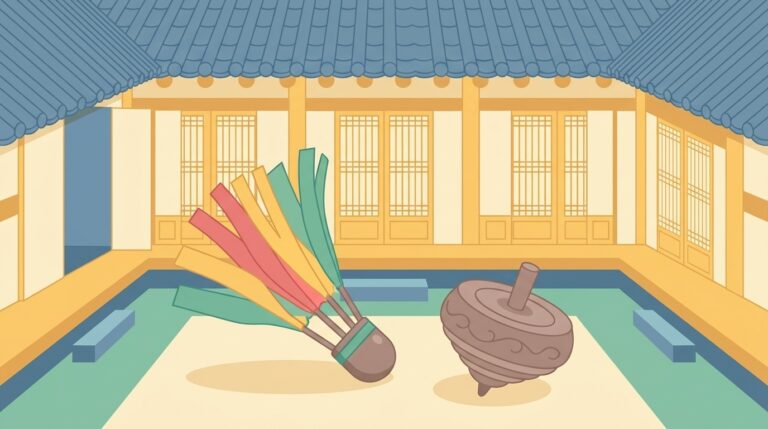
Beyond Squid Game: Master Korean Banter While Kicking Jegi and Whipping Tops
Phase 1: Empathy (Immersive Storyline Opening)
안녕하세요! 매일한글 에디터입니다. (Hello! I’m your Daily Hangul editor.)
Picture this: You are standing in the brisk winter air at Namsangol Hanok Village during the Lunar New Year holiday. Surrounded by laughter and steam rising from paper cups of roasted barley tea, you spot a circle of locals gathered around a cobblestone courtyard. In the center, someone is effortlessly volleying a metallic, foil-tasseled shuttlecock into the air with the inner rim of their shoe, counting aloud rhythmically. Just steps away, another group is furiously snapping cloth-tipped whip ropes against wooden conical tops, sending them skittering and humming across the frozen stones like miniature dancers.
Inspired by countless variety shows like Running Man and 2 Days & 1 Night, you step up to try jegichagi (제기차기). Your Korean friend shoots you a teasing grin: “Wanna bet on this?” You step in, kick blindly, completely whiff the tassel, and kick your own ankle bone while the shuttlecock rolls meekly into a puddle. Everyone chuckles good-naturedly, but you freeze. Do you laugh it off? What witty banter should you fire back? How do you say “Wait, give me a warm-up round!” or “My shoe slipped!” without sounding like a robotic, polite textbook from 1995?
For advanced (C1) Korean learners, the challenge isn’t just reciting game rules; it’s navigating the electric, lightning-fast cultural rhythm of Korean competitive camaraderie. Traditional folk games aren’t historical relics frozen in museums—they are dynamic social arenas where Koreans shed strict hierarchical boundaries, trade playful insults, and showcase kinetic nunchi (눈치). Based on hundreds of real feedback sessions from international professionals and Korean culture enthusiasts, this guide gives you the precise native vocabulary, playful slang, and strategic body language needed to rule the courtyard like a true local.
Phase 2: Core Expressions Deep Dive (핵심 표현 3선)
1. 한 판 붙다 (Han pan butda)
- Pronunciation: [Han pan but-da] (Think of a crisp, staccato ‘Hahn’ followed by ‘pahn’, then ‘boot-dah’ like snapping your boot onto the ground).
- Meaning: Literal: “To stick together for one board/round” | Real Nuance: “To square off head-to-head” or “To throw down a challenge in a high-stakes match.”
- K-Culture Moment: Every major holiday variety show special features this phrase right before two fierce rivals step up for a penalty-laden traditional game showdown.
- Editor’s Insight: The counter pan (판) originates from board games like baduk and wrestling rings (ssireum-pan). Using “붙다” (to stick/clash) injects pure adrenaline into what might otherwise be a friendly game. It conveys sporting swagger without malice.
- Situation Spectrum: Casual: ✅ | Semi-formal: ⚠️ | Formal: 🚫
- 🤔 Think About It: In English, we say “let’s have a match,” which focuses on the event. Why do you think Korean expresses rivalry through physical proximity and adhesive friction (붙다)?
2. 감 잡았어 (Gam jab-asseo)
- Pronunciation: [Gam jab-a-sseo] (Sounds like ‘Gahm jahb-ah-ssuh’—feel the satisfying click of catching something right in mid-air).
- Meaning: Literal: “I caught the sensation/persimmon” | Real Nuance: “I’ve unlocked the rhythm! / I’ve got the tactile hang of it!”
- K-Culture Moment: Seen when an idol fails their first four attempts at keeping a wooden top spinning, adjusts their wrist whip, and watches it spin seamlessly.
- Editor’s Insight: Gam (감) refers to intuitive, kinetic feel and instinctual muscle memory that words cannot quantify. In both jegichagi and paeng-ichigi, sheer strength is useless without gam. Declaring “감 잡았어!” signals to everyone around that your warm-up is officially over.
- Situation Spectrum: Casual: ✅ | Semi-formal: ✅ | Formal: ⚠️
- 🤔 Think About It: How does relying on intuitive gam contrast with analytical, step-by-step game tutorials in Western sporting culture?
3. 판을 뒤집다 (Pan-eul dwi-jip-da)
- Pronunciation: [Pan-eul dwi-jip-da] (Pronounced ‘Pahn-eul dwee-jeep-dah’ with vocal emphasis on ‘dwi’).
- Meaning: Literal: “To flip the board over” | Real Nuance: “To stage a miraculous comeback / turn the tables.”
- K-Culture Moment: The underdog player who scores only 2 jegi kicks in round one suddenly rattles off 25 consecutive kicks in round two to win the bet.
- Editor’s Insight: While Westerners might think of flipping a board as an act of angry frustration (rage-quitting), in Korean competitive vernacular, 판을 뒤집다 denotes masterclass tactical reversal. It’s the ultimate crowd-pleasing climax.
- Situation Spectrum: Casual: ✅ | Semi-formal: ✅ | Formal: ⚠️
- 🤔 Think About It: Reflect on how this idiom mirrors the dramatic plot swings celebrated in Korean storytelling, from Squid Game to historical Joseon dramas.
Phase 3: Textbook Korean vs. Real Native Korean (교과서 한국어 vs. 진짜 한국어)
Situation 1: Challenging a friend to play with coffee on the line
- 📖 교과서 한국어: “전통 민속놀이 체험을 해보시겠습니까? 지는 사람이 커피를 사야 합니다.”
(Jeontong minsoknori cheheomeul haebosigesseumnikka? Jineun sarami keopireul saya hamnida. / Would you like to experience traditional folk games? The loser must purchase coffee.) - 🗣️ 진짜 한국어: “야, 제기차기 딱 한 판만 내기 갈래? 꼴등이 커피 쏘기!”
(Ya, jegichagi ttak han panman naegi gallae? Kkolddeung-i keopi ssogi! / Hey, wanna do a single round bet on jegi? Dead last buys coffee!) - 💡 왜 다를까? (Why is it different?): Textbook phrasing relies heavily on Latinate, sterile concepts like “experience” (체험). Real natives bypass polite friction with high-tempo stakes-setting (내기, 쏘기) that instantly builds intimacy and playful tension.
Situation 2: Praising an impeccably spinning top
- 📖 교과서 한국어: “나무 팽이가 중심을 잡고 아주 오랫동안 잘 회전합니다.”
(Namu paeng-iga jungsim-eul japgo aju oraedong-an jal hoejeonhamnida. / The wooden top maintains its balance and rotates well for a very long duration.) - 🗣️ 진짜 한국어: “와, 팽이 줄 제대로 먹었다! 미동도 없이 쌩쌩 도네.”
(Wa, paeng-i jul jedaero meogeotda! Midongdo eopsi ssaengssaeng done. / Whoa, that whip caught the top cleanly! It’s humming with pure spin, not even wobbling.) - 💡 왜 다를까? (Why is it different?): Advanced street Korean employs sensory kinetic verbs like 줄을 먹다 (the cord “ate” the top cleanly) and vivid onomatopoeia like 쌩쌩 to praise the mechanical perfection of the spin.
Phase 4: K-Culture Deep Dive & Non-Verbal Manners
4-1. 눈치 (Nunchi) & Kinetic Etiquette in Folk Arenas
In Korean folk games, your physical demeanor is as expressive as your words:
* The Stance of Mock Focus: When kicking jegi, don’t stand rigid. Slightly bend your supporting knee, lean your torso inward, and hold both arms out like a crane’s wings. If you miss, clasp your head with both hands in dramatic, theatrical dismay—it keeps the mood buoyant!
* The Whip Flick Distance: In paeng-ichigi, never whip wildly when others are leaning in to adjust their tops. Respect the boundary (선) and make sharp eye contact before striking the cord. Shouting “들어간다!” (Deureoganda! / Coming in!) ensures safety while highlighting your veteran awareness.
* Humility in Domination: If you crush your opponent 30 to 5 in jegichagi, never gloat silently. Immediately offer an excuse for your opponent: “바람 때문에 그래, 바람!” (Baram ttaemune geurae, baram! / It was the wind’s fault, totally the wind!) This saves your friend’s face (체면) and invites an immediate rematch.
4-2. Culture Code: The Folk Game as the Ultimate Social Equalizer
In traditional Korean society, strict Confucian hierarchies ruled every interaction. Folk festivals like Chuseok and Seollal were the rare valve where village servants could beat landlords in wrestling or spinning tops without retribution. Today, that energy persists on variety shows: an intern can playfully smack their senior director with a foam bat after winning a round of jegichagi. Knowing how to adopt this playful persona allows you to step outside the rigid corporate or classroom hierarchy and forge genuine, lasting bonds (정, Jeong).
Phase 5: Real-Life Roleplay Scenario (실전 롤플레이)
Setting: A crisp autumn afternoon inside the courtyard of Insadong Folk Craft Center.
Characters: Alex (C1 foreign professional) and Minho (Alex’s razor-sharp, competitive Korean coworker).
- 민호: “알렉스 씨, 한국 생활 3년 차인데 설마 제기차기 한 번도 제대로 안 해봤어요?”
(Alex-ssi, hanguk saenghwal samnyeon chainde seolma jegichagi han beondo jedaero an haebwasseoyo?)
“Alex, you’ve lived in Korea for three years; don’t tell me you’ve never properly kicked a jegi?”
🎭 [눈썹을 찡긋하며 제기를 손바닥에 통통 튀긴다 - Bouncing the jegi on his palm with a cocky eyebrow raise] -
알렉스: “말씀을 섭섭하게 하시네요. 제가 겉보기엔 이래도 발목 스냅 하나는 타고났거든요?”
(Malsseum-eul seopseophage hasineyo. Jega geotbogien iraedo balmok seunaep hananeun tagonatgeodeunyo?)
“You wound my pride! I might look ordinary, but I was born with pristine ankle snap.”
🎭 [가슴을 펴고 헛기침을 하며 신발 밑창을 점검한다 - Straightening chest, coughing dryly, checking shoe sole] -
민호: “오호, 허세 좋습니다! 그럼 말 나온 김에 소원 들어주기 딱 한 판 붙을래요?”
(Oho, heose joseumnida! Geureom mal naon gime sowon deureojugi ttak han pan buteullaeyo?)
“Oho, love the swagger! Since you brought it up, shall we clash head-to-head for one wish?”
🎭 [제기를 검지손가락에 걸치고 승부욕을 불태운다 - Hooking the jegi tassel around his index finger, eyes gleaming] -
알렉스: “콜! 대신 제가 먼저 몸 좀 풀게 연습 게임 세 개만 인정해 주세요.”
(Kol! Daesin jega meonjeo mom jom pulge yeonseup geim se gaeman injeonghae juseyo.)
“Deal! On condition you grant me three practice kicks first to warm up my joints.”
🎭 [능청스럽게 발목을 빙글빙글 돌리며 씨익 웃는다 - Playfully rotating ankle in circles with a confident smirk] -
민호: “좋아요. 제가 먼저 본때를 보여드리죠. 하나, 둘, 셋… 열다섯 개! 자, 따라와 보시죠?”
(Joh-ayo. Jega meonjeo bontdaereul boyeodeurijyo. Hana, dul, set… yeoldaseot gae! Ja, ttarawa bosijyo?)
“Deal. Let me show you how it’s done. One, two, three… fifteen! Now, can you match that?”
🎭 [숨을 헐떡이면서도 턱을 치켜들며 도발한다 - Panting slightly but jutting chin out in open provocation] -
알렉스: “하, 딱 기다려요. 민호 씨 방금 무게중심 흔들린 거 다 봤습니다. 판을 뒤집어 드리죠.”
(Ha, ttak gidaryeoyo. Minho-ssi banggeum mugejungsim heundeullin geo da bwasseumnida. Paneul dwijibeo deurijyo.)
“Ha, watch this. I saw your center of gravity wobble on kick twelve. I’m turning the tables.”
🎭 [제기를 공중에 살짝 던지며 감각을 조율한다 - Lightly tossing jegi in the air to calibrate balance] -
민호: “말만 앞서지 말고 얼른 차기나 해요! 땅에 떨어지면 바로 끝입니다!”
(Malman apseoji malgo eolleun chagina haeyo! Ttange tteoreojimyeon baro kkeuchimnida!)
“Less talk, more kicks! Once it touches the cobblestone, you’re toast!”
🎭 [두 손을 모아 흥미진진하게 바라본다 - Clasping both hands together in giddy anticipation] -
알렉스: “갑니다! 찰나의 타이밍을 노려야 진짜 고수죠. 열여섯 개 가볍게 찍어드릴게요!”
(Gamnida! Chalna-ui taiming-eul noryeoya jinjja gosujo. Yeolyeoseot gae gabyeopge jjigeodeurilgeyo!)
“Here goes! A true master pounces on the split-second apex. Let me casually hit sixteen!”
🎭 [안쪽 발날을 완벽한 직각으로 들어 올리며 킥을 시작한다 - Lifting inside instep at a flawless 90-degree angle to kick]
🔀 Interactive Branching Decision
Imagine you missed your 10th kick, landing 5 kicks behind Minho. How do you respond?
- Option A (Best – Natural Street Savvy): “아, 오늘 바람이 왼쪽에서 불었네! 이건 인정 못 하니까 팽이치기로 연장전 갑시다!” (Oh, the wind caught it from the left! This doesn’t count; overtime with top spinning!)
- Feedback: Best! Playful self-defense mixed with an instant rematch proposition showcases maximum native sociability.
- Option B (Bad – Stiff Classroom Korean): “제가 졌습니다. 민호 씨가 저보다 전통 놀이 능력이 월등히 우수함을 인정합니다.” (I lost. I acknowledge that Minho-ssi’s folk game capability is exceedingly superior.)
- Feedback: Bad. Kills the festive banter instantly. It turns a casual game into a solemn evaluation.
- Option C (Risk – Overly Combative): “민호 씨가 옆에서 일부러 기침해서 집중 깨졌잖아요. 다시 해요!” (You deliberately coughed next to me to break my focus. Redo!)
- Feedback: Risk. Unless delivered with unmistakable comedic exaggeration, this can sound genuinely resentful.
Phase 6: 10-Second Emotional Shadowing Drill (감정 섀도잉)
Practice these lines out loud. Respect the pause marks (/) and embody the bracketed emotional states.
[🔥 승부욕에 불타오르며 - Fierce, playful competitive fire]
“말씀을 섭섭하게 하시네요! / 제가 겉보기엔 이래도 / 발목 스냅 하나는 / 타고났거든요?”
(Malsseum-eul seopseophage hasineyo! / Jega geotbogien iraedo / balmok seunaep hananeun / tagonatgeodeunyo?)-
[😎 능청스럽고 여유만만하게 - Cocky, breezy swagger]
“하, 딱 기다려요! / 민호 씨 흔들린 거 다 봤으니까 / 제가 깔끔하게 / 판을 뒤집어 드리죠.”
(Ha, ttak gidaryeoyo! / Minho-ssi heundeullin geo da bwasseunikka / jega kkalkkeumhage / paneul dwijibeo deurijyo.) -
[🤩 경이로움과 전율을 담아 - Awestruck & buzzing with adrenaline]
“와, 팽이 줄 제대로 먹었다! / 회전축 하나도 안 흔들리고 / 쌩쌩 도는 것 좀 봐!”
(Wa, paeng-i jul jedaero meogeotda! / Hoejeonchuk hanado an heundeulligo / ssaengssaeng doneun geot jom bwa!)
Phase 7: K-Culture Mini Dictionary (미니 사전)
- 텃세 (Teot-se) | Territorial Edge / Newcomer Hazing
- Historically used for local village resistance to outsiders, now humorously used when locals have home-court advantage in folk games: “동네 텃세 장난 아니네!” (This neighborhood home-turf advantage is wild!)
- 내기 (Naegi) | Casual Wager / Friendly Stake
- The lifeblood of Korean group hangouts. Whether it’s coffee, convenience store ice cream, or an arcade penalty, turning activities into a naegi cements immediate camaraderie.
- 쌩쌩이 (Ssaeng-ssaeng-i) | High-Speed Whir / Whip Top Mastery
- Refers to a top spinning so fast that its edges blur into a stationary hum, accompanied by a sharp whistling sound. Achieving 쌩쌩이 status is the ultimate mark of top-spinning finesse.
- 찰나 (Chal-na) | The Fleeting Instant / Split-Second Apex
- A Buddhist term integrated into vernacular Korean. In jegichagi, striking the tassel at the 찰나 (exact fractional moment of zero gravity) determines whether you kick 3 times or 30 times.
Phase 8: Traveler’s Survival Kit (여행자 생존 키트)
Top 3 Survival Phrases
- 1. “제기 하나만 빌려주실 수 있나요?” (Jegi hanaman billyeojusil su innayo?)
- Meaning: “Could I borrow one jegi for a moment?”
- Pro Tip: Use this at public folk stations in Hanok villages when all equipment bins seem empty.
- 2. “이거 팽이채 줄 어떻게 감아요?” (Igeo paeng-ichae jul eotteoke gam-ayo?)
- Meaning: “How do I wrap the cord around this top whip?”
- Pro Tip: Don’t struggle alone. Older gentlemen (eoreusin) hanging around love demonstrating their Joseon-level cord techniques!
- 3. “한 번만 다시 차 볼게요, 연습이었어요!” (Han beonman dasi cha bolgeyo, yeonseubieosseoyo!)
- Meaning: “Let me kick just once more; that was purely practice!”
- Pro Tip: Deliver this with a big, goofy smile to dodge penalty drinks or playful teasing.
Editor’s Travel Note
- Where to Play: Head straight to 국립민속박물관 체험마당 안내 확인하기 (National Folk Museum Experience Yard) right next to Gyeongbokgung Palace, or visit Namsangol Hanok Village during Seollal or Chuseok.
- Local Navigation: Don’t get stranded after dark when parks close. Check subway connections using 네이버 지도 앱 다운로드 및 길찾기 가이드 to travel smoothly between heritage parks and cozy makgeolli taverns.
Phase 9: “한 발 더 깊이” (Deep Cultural Reflection)
Folk games in Korea are rarely about isolated individual brilliance. In the West, sports often highlight solitary records and personal mastery; in Korea, traditional games were communal rituals (대동놀이, Daedong-nori) engineered to cultivate 신명 (Shinmyeong)—a collective ecstatic release of stress and social friction. When you kick a jegi or whip a wooden paengi on frozen ground, you are stepping into a centuries-old social valve designed to dissolve boundaries of age, class, and nationality through synchronized rhythm.
💬 Your Turn: Have you ever participated in a traditional street game in your home country or while traveling? What unspoken rules or banter did you observe? Share your story in the comments below!
Phase 10: FAQ & Avoiding Misunderstandings (FAQ 스키마)
Q: Can I use “한 판 붙자” with older superiors or professors?
A: Absolutely not! While it is affectionate among friends, peers, and coworkers in relaxed social contexts, issuing an uninvited challenge with “붙자” (let’s clash) to someone higher in age or rank can sound brash. Instead, soften it honorably: “팀장님, 저랑 제기차기 한 판 승부 어떠십니까?” (Team leader, how about a friendly match of jegi with me?)
Q: Why do Koreans count out loud so aggressively during jegichagi?
A: Counting out loud is psychological warfare and community validation wrapped into one! Shouting “하나! 둘! 셋!” maintains inner cadence, puts pressure on opponents, and ensures everyone agrees on the final score. Join the chorus when your friends kick!
Q: Is paeng-ichigi only played in winter?
A: Historically, yes! Traditional wooden tops were spun on frozen rivers and rice paddies because the slick ice minimizes friction. Today, however, you can play on smooth concrete courtyards, cobblestones, and museum grounds year-round.
🚨 Common Mistakes Alert (흔한 실수 TOP 3)
| Mistake | Why It Happens | Correct Action |
|---|---|---|
| Kicking with the toe tip (발끝) | Western soccer reflex | Turn hip outwards and kick strictly with the flat inner arch (발날 안쪽). |
| Using textbook phrase: “우리 승부합시다” | Literal translation of “Let’s compete” | Say “내기 한 판 가시죠!” for natural, organic peer banter. |
| Snapping top whip horizontally | Fear of hitting ground | Whip downward with a 45-degree snap at the bottom third of the wooden cone. |
Phase 11: Action Mission & Engagement
- 🥉 Bronze Mission (Solo Mastery): Practice saying the Phase 6 shadowing drill 3 times while miming the instep kick. Lock down the pronunciation of “판을 뒤집다!”
- 🥈 Silver Mission (Social Connection): Drop a comment below using the word 감 잡았어 to describe a Korean grammar skill or hobby you finally unlocked.
- 🥇 Gold Mission (Real-World Triumph): Visit a Hanok village or Korean cultural center, borrow a jegi, and initiate a playful one-round bet (딱 한 판 내기) with a native speaker!
🎮 K-Culture Media Mission: Watch Episode 214 of Running Man or any Chuseok idol special. Spot the moment a player shouts “한 판 붙자!” or claims the wind ruined their jegi shot!
Phase 12: Interactive Quiz Challenge
Test your real-world cultural instinct below! (Click the toggles to check your answers.)
Question 1: Situational Judgment
Your Korean friend just spun their top so perfectly that it looks completely motionless while spinning at high velocity. What is the most natural, native exclamation to shout?
* (A) “팽이의 회전수가 대단히 과학적입니다!”
* (B) “와, 팽이 줄 제대로 먹었다! 완전 쌩쌩이네!”
* (C) “팽이가 멈춰 있으니 제가 이겼습니다.”
🔍 Click here to reveal the answer & explanation!
Correct Answer: (B)
Explanation: Saying “줄 제대로 먹었다! 완전 쌩쌩이네!” shows you understand both the kinetic slang of the cord grip and the iconic state of high-speed top stability. (A) sounds like a physics paper, and (C) misunderstands the game’s core goal!
Question 2: Fill-in-the-Blank
Complete the sentence to mean: “I’m going to pull off a dramatic comeback and turn the tables in this game!”
“이번 라운드에서 제가 반드시 (____)을/를 뒤집어 보이겠습니다!”
🔍 Click here to reveal the answer & explanation!
Correct Answer: 판 (Pan)
Explanation: The complete idiom is 판을 뒤집다 (to flip the game board / stage a dramatic comeback).
Question 3: Cultural Fact Check (True / False)
Traditional jegichagi was historically played with gold coins wrapped in mulberry paper (hanji) or cloth. (True / False?)
🔍 Click here to reveal the answer & explanation!
Correct Answer: True!
Explanation: Before modern plastic tassels and metallic foil, Joseon-era children wrapped brass coins (yeopjeon, 엽전) in hanji or cloth, shredding the ends into tails to create aerodynamic drag. That weight is why real jegi drop with satisfying momentum!







