

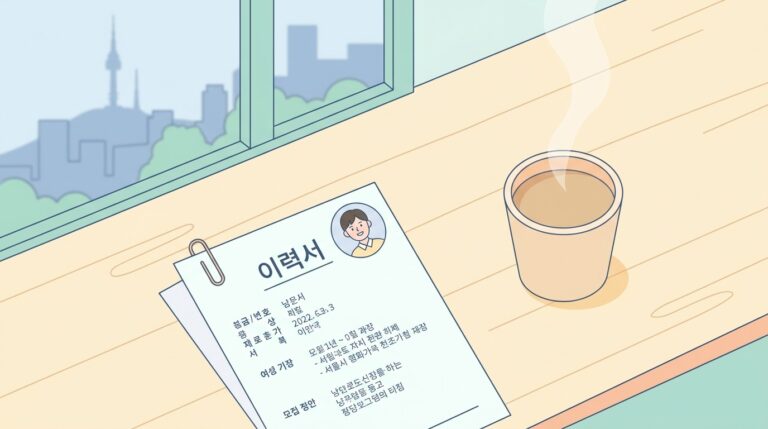
Phase 1: 공감 (Storytelling Opening)
안녕하세요! 매일한글 에디터입니다. (Hello! I’m your Daily Hangul editor.)
Picture this: You are watching your favorite K-Drama, like Start-Up or Misaeng. The main character sits nervously in a quiet hallway, holding a clean white folder labeled 이력서 (Iryeokseo – Resume). Their hands tremble slightly as they check their name and experience one last time. Now, bring that scene into your real life. Maybe you are applying for a cozy barista job in Hongdae, an internship in Gangnam, or just dreaming about working in Seoul someday. You open a standard Korean resume template, and suddenly your mind goes blank. Even though you know some Korean greetings, formal application words look like alien code!
Don’t panic. Many of our beginner learners tell us: “Editor, I can introduce myself in a cafe, but the moment I see official paperwork, I freeze!” That is totally natural. Today, we will decode the Korean resume step-by-step with zero headache. By the end of this guide, you will master the foundational vocabulary, know exactly what Korean employers look for, and feel ready to hand over your resume with genuine confidence. Let’s jump in together!
Phase 2: Core Expressions Deep Dive
1. 이력서 (Iryeokseo)
- Pronunciation: [I-ryeok-seo] (Sounds like “ee-ryuk-suh” — rhyme ryuk with the sound in truck!)
- Meaning: Literal: “Record of Background” vs Actual Nuance: Standard Curriculum Vitae (CV) or Resume
- K-Culture Moment: In youth workplace dramas, you will always see the protagonist tightly clutching an envelope marked 이력서 재중 (Iryeokseo Jaejung – Resume Enclosed) outside interview rooms.
- Editor’s Insight: Unlike Western multi-page resumes, a Korean Iryeokseo is traditionally a concise one- or two-page tabular form highlighting your personal details, education, and career facts without fluff.
- Situation Spectrum: Casual 🚫 | Semi-formal ⚠️ | Formal ✅
- 🤔 Think About It: In English, “resume” comes from the French word for “summary.” In Korean, I-ryeok literally means “履 (tread/walk) 歷 (pass through)” — literally the path you have walked. Isn’t that poetic?
2. 경력이 있습니다 (Gyeongryeogi itsseumnida)
- Pronunciation: [Gyeong-nyeog-i it-seum-ni-da] (Think “Gyung-nyug-ee eet-soom-nee-da”)
- Meaning: Literal: “Experience exists” vs Actual Nuance: “I have relevant work experience.”
- K-Culture Moment: When a fresh job seeker proudly answers the boss in a drama, demonstrating they are not a total rookie (신입 – Sinip).
- Editor’s Insight: If you do not have formal company experience, don’t worry! You can specify part-time work by saying 아르바이트 경력이 있습니다 (Areuba-iteu gyeongryeogi itsseumnida – I have part-time job experience).
- Situation Spectrum: Casual 🚫 | Semi-formal ⚠️ | Formal ✅
- 🤔 Think About It: Notice how Korean uses the existence verb 있다 (itda – to exist) rather than “I possess” or “I own.” It subtly focuses on the reality of the experience rather than individual boasting.
3. 잘 부탁드립니다 (Jal butakdeurimnida)
- Pronunciation: [Jal bu-tak-deu-rim-ni-da] (Sounds like “Jahl boo-tahk-doo-reem-nee-da”)
- Meaning: Literal: “I request your favor well” vs Actual Nuance: “Please look upon my application favorably / I look forward to working with you.”
- K-Culture Moment: Accompanied by a 45-degree bow whenever submitting a physical document or concluding a formal greeting.
- Editor’s Insight: This is Korea’s ultimate social lubricant. Leaving it off the end of your cover letter or submission email feels like leaving the front door wide open in winter!
- Situation Spectrum: Casual ⚠️ | Semi-formal ✅ | Formal ✅
- 🤔 Think About It: There is no 1-to-1 equivalent in English. It reflects Korea’s collective harmony—asking the other person to treat the upcoming relationship with warmth and care.
Phase 3: Textbook Korean vs Real Korean
Situation 1: Letting the employer know you sent your resume
- 📖 교과서 한국어: 저는 저의 이력서를 송부하였습니다. (Jeoneun jeoui iryeokseoreul songbuhayeotseumnida.) — “I have dispatched my curriculum vitae.”
- 🗣️ 진짜 한국어: 이력서 이메일로 보냈습니다! (Iryeokseo imeillo bonaesseumnida!) — “I sent my resume via email!” (Or in official submission: 이력서 제출했습니다. [Iryeokseo jechulhaesseumnida.])
- 💡 왜 다를까? 송부 (Songbu) is stiff legal/administrative jargon. Real modern speakers prefer 제출하다 (Jechulhada – to submit) or everyday polite 보내다 (Bonaeda – to send).
Situation 2: Checking if they received your documents
- 📖 교과서 한국어: 당신은 저의 이력서를 받았습니까? (Dangsineun jeoui iryeokseoreul badatseumnikka?) — “Did you receive my resume?”
- 🗣️ 진짜 한국어: 이력서 잘 도착했나요? (Iryeokseo jal dochakhaennayo?) or 확인 부탁드립니다. (Hwag-in butakdeurimnida.) — “Did the resume arrive safely? / Please kindly confirm.”
- 💡 왜 다를까? Using 당신 (Dangsin – You) sounds aggressive or accusatory in spoken Korean! Natural Korean simply drops the pronoun and focuses on the action.
Phase 4: K-Culture Deep Dive & Non-Verbal Manners
4-1. 눈치 (Nunchi) & Gestures: The Two-Hand Rule
In Korea, how you physically hand over your resume is just as important as what is typed on the page:
* The Two-Hand Handoff (두 손으로 건네기): Never push your printed resume with one hand like a restaurant flyer! Hold the document with both hands, lightly supporting the corners, with the text facing right-side up toward the receiver.
* Eye Contact & Polite Nod (목례): Make soft, respectful eye contact, then gently nod your head (about 15 to 30 degrees) as they take it.
* The ID Photo Culture (증명사진 – Jeungmyeongsajin): Unlike in the US or UK where photos on resumes are often discouraged, almost every Korean resume template has a dedicated photo slot. Dress neatly, keep neat posture, and offer a soft, confident smile.
4-2. Cultural Code: The Value of 성실함 (Seongsilham – Sincerity & Diligence)
In K-Dramas like Castaway Diva or Misaeng, you will see managers scrutinizing blank gaps in applicants’ resumes. In Korean workplace culture, having an impressive list of skills is great, but showing up as a dependable, sincere team player (성실한 사람) who fits the workplace harmony often carries even more weight for entry-level roles.
Phase 5: Real-Life Roleplay Scenario
Setting: You are visiting Cafe Yeontral, an aesthetic neighborhood cafe in Yeonnam-dong. You see a hiring flyer on the door and decide to hand in your resume to Manager Min-ho behind the counter.
- Turn 1 (You): 안녕하세요! 아르바이트 공고 보고 왔습니다. (Annyeonghaseyo! Areubaiteu gong-go bogo watseumnida.)
🎭 Politely bowing 15 degrees at the counter - Turn 2 (Min-ho): 아, 네! 안녕하세요. 이력서 가져오셨어요? (A, ne! Annyeonghaseyo. Iryeokseo gajyeo-osyeosseoyo?)
🎭 Smiling warmly and setting down a coffee tamper - Turn 3 (You): 네, 여기 이력서 있습니다. (Ne, yeogi iryeokseo itsseumnida.)
🎭 Holding the resume neatly with both hands and passing it over - Turn 4 (Min-ho): 감사합니다. 카페 일 해보신 적 있으세요? (Gamsahamnida. Kape il haebosin jeok isseuseyo?)
🎭 Taking the document with two hands and scanning the first section - Turn 5 (You): 네, 카페 경력이 1년 있습니다. (Ne, kape gyeongryeogi il-nyeon itsseumnida.)
🎭 Answering clearly with steady, friendly eye contact - Turn 6 (Min-ho): 오, 좋네요! 한국어도 아주 자연스러우시네요. (O, jonneyo! Hangugeodo aju jayeonseureousineyyo.)
🎭 Nodding with an impressed nod - Turn 7 (You): 감사합니다. 열심히 배우겠습니다! (Gamsahamnida. Yeolsimhi bae-ugetseumnida!)
🎭 Smiling with enthusiastic humility - Turn 8 (Min-ho): 확인해보고 내일까지 문자 드릴게요. (Hwag-inhaebogo nae-ilkkaji munja deurilgeyo.)
🎭 Carefully placing the resume into a folder
🔀 Interactive Decision Point: How do you wrap up your conversation?
- Choice A: 잘 부탁드립니다! 연락 기다리겠습니다. (Jal butakdeurimnida! Yeollak gidarigesseumnida. – Please look favorably upon my application! I will await your contact.)
- Choice B: 내일 꼭 연락하세요. (Naeil kkok yeollakhaseyo. – Make sure to call me tomorrow.)
- Choice C: 네, 안녕! (Ne, annyeong! – Yeah, bye!)
Feedback:
* Choice A (Best!): Perfect score! You used both formal respect (잘 부탁드립니다) and a friendly closing sentence. The manager will love your polite attitude.
* Choice B (Bad): Dangerous! This sounds like an authoritative order (Make sure you call me). It breaks Korean polite workplace etiquette.
* Choice C (Risk): Big faux pas! 안녕 is informal banmal (반말), only meant for close friends or younger kids. Using it with a hiring manager will instantly disqualify you.
Phase 6: 10-Second Emotional Shadowing Drill
Practice these lines out loud. Pay close attention to the pause markers (/) and emotional tone!
[😊 Confident & Polite]
안녕하세요! / 이력서 제출하러 왔습니다.
(Annyeonghaseyo! / Iryeokseo jechulhareo watseumnida.)
“Hello! / I came here to submit my resume.”-
[✨ Bright & Honest]
카페 경력이 / 1년 있습니다.
(Kape gyeongryeogi / il-nyeon itsseumnida.)
“I have / one year of cafe experience.” -
[🙏 Earnest & Warm]
열심히 하겠습니다! / 잘 부탁드립니다.
(Yeolsimhi hagetseumnida! / Jal butakdeurimnida.)
“I will do my very best! / Please look upon me kindly.”
Phase 7: K-Culture Mini Dictionary
- 이력서 (Iryeokseo) | Resume / CV: The foundational document outlining your name, contact details, educational history, and past jobs.
- 자기소개서 (Jagisogaeseo – often shortened to ‘자소서 Ja-So-Seo’) | Self-Introduction Essay: A mandatory essay section in Korea where you share your personal background, strengths, and goals.
- 지원동기 (Jiwondonggi) | Motivation for Applying: The specific field on a resume explaining why you want to join this particular store or company.
- 경력사항 (Gyeongryeoksahang) | Career History / Work Details: The section of your resume where you list previous positions, roles, and duration of employment.
Phase 8: Traveler & Expat Survival Kit
Top 3 Survival Phrases for Job Seekers:
- 혹시 직원 구하시나요? (Hoksi jigwon guhasinayo?) — “By any chance, are you looking for staff?”
- Pro Tip: Use 혹시 (Hoksi) to soften your question so you don’t sound abrupt when walking into a business.
- 여기 이력서 있습니다. (Yeogi iryeokseo itsseumnida.) — “Here is my resume.”
- Pro Tip: Keep it flat inside a neat clear folder before handing it over.
- 연락처는 여기에 적혀 있습니다. (Yeollakcheoneun yeogie jeokhyeo itsseumnida.) — “My contact number is written right here.”
- Pro Tip: Point gently with an open palm rather than a single pointing finger.
Editor’s Travel Note: Where to print your resume in Korea
Need to print your resume right now? Look for Kinko’s (킨코스) in major university neighborhoods or business districts. If you are near a university, search for 인쇄소 (Inswaeso – Print shop). Even better, convenience stores like CU and GS25 now offer document printing via automated kiosks! Find the closest printing kiosk easily through the Naver Map app store download.
Phase 9: “One Step Deeper” (Cultural Reflection)
In Western resume writing, candidates are often taught to highlight personal standout accomplishments with powerful action verbs like “orchestrated,” “spearheaded,” and “managed single-handedly.”
However, in traditional Korean work culture, aggressive self-promotion can sometimes be misinterpreted as individualistic or uncooperative. Instead, Korean resumes and self-introduction essays (자소서) place high value on 조화 (Johwa – Harmony), adaptability, and dedication to team goals. When you say “열심히 배우겠습니다” (I will learn earnestly), you are signaling to the Korean team that you are humble, coachable, and eager to grow together.
💬 Your Turn: In your home country, is it common to include a photo on your resume? How would you describe your work style in one word? Share your thoughts in the comments below!
Phase 10: FAQ & Avoiding Mistakes
Q: Can I use my English resume when applying for jobs in Korea?
A: For large multinational companies or language academies, an English resume is usually standard. However, for local startups, cozy cafes, or Korean-speaking offices, having an 이력서 (Iryeokseo) translated into clear Korean will increase your response rate tenfold!
Q: Do I really need to attach a photo to my Korean resume?
A: While some large conglomerates now use “blind recruitment” (블라인드 채용) without photos, small-to-medium businesses, cafes, and hospitality jobs still customarily expect a neat passport-style ID photo (증명사진).
Q: What should I write if I have zero formal work experience?
A: Don’t leave it completely blank! You can write 신입 (Sinip – Entry level / Newcomer) and highlight school projects, volunteer activities (봉사활동), or relevant personal hobbies that show your reliable personality.
🚨 Common Mistakes Alert:
- Mistake 1: Handing over the resume with one hand.
- Correct Action: Always present documents with both hands, lightly holding both edges.
- Mistake 2: Calling the employer ‘당신’ (Dangsin).
- Correct Action: Address them by their title + 님, like 사장님 (Sajangnim – Store Owner/Boss) or 매니저님 (Maenijeonim – Manager).
- Mistake 3: Forgetting to put your visa type.
- Correct Action: As an expat or traveler, always clearly state your current visa status (e.g., D-2 student, H-1 working holiday, F-series) right next to your nationality!
Phase 11: Action Missions
- 🥉 Bronze Mission (Solo Practice): Stand in front of your mirror with a sheet of paper. Practice offering it with both hands while smiling and saying: “안녕하세요, 이력서 제출합니다!” (Annyeonghaseyo, iryeokseo jechulhamnida!) three times.
- 🥈 Silver Mission (Community Share): Write down your primary skill or job interest in Korean in our comment section below (e.g., 바리스타 – Barista, 디자이너 – Designer, 영어 튜터 – English Tutor).
- 🥇 Gold Mission (Real Life Application): Download a blank Korean resume template, write your name in Hangul, fill out your birthdate, and paste your neat headshot photo in the corner!
🎮 K-Culture Mission: Watch Episode 1 of the drama Start-Up or Misaeng. Pause when a character holds an application folder and spot the word 이력서!
Phase 12: Interactive Quiz Challenge
Test your knowledge from today’s lesson! Can you get all three correct?
1. Situation Judgment: You walk into a bakery in Seoul to submit your printed resume to the manager. What is the most culturally respectful action?
* A) Toss the paper onto the glass counter and say “이거 봐요” (Look at this).
* B) Hold the resume with two hands, face it toward the manager, and say “이력서 제출합니다.”
* C) Email it on your phone silently while standing next to them.
2. Fill in the Blank: When you want to state that you have past work experience, you say:
“경력이 ______.”
* A) 없습니다 (eopseumnida – do not have)
* B) 모릅니다 (moreumnida – do not know)
* C) 있습니다 (itsseumnida – have/exists)
3. True or False: In Korea, the phrase “잘 부탁드립니다” can be politely omitted because your resume already contains your contact information.
* True
* False
👉 Click to reveal answers & explanations!
- Answer: B
Explanation: Presenting physical paperwork using both hands while stating 이력서 제출합니다 demonstrates both professional etiquette and cultural mindfulness. -
Answer: C (있습니다)
Explanation: 경력이 있습니다 (Gyeongryeogi itsseumnida) means “I have work experience.” Choice A means you have no experience, and Choice B means you don’t know! -
Answer: False
Explanation: 잘 부탁드립니다 (Jal butakdeurimnida) is essential! It communicates humility, goodwill, and desire for a positive working relationship. Never skip it!







