

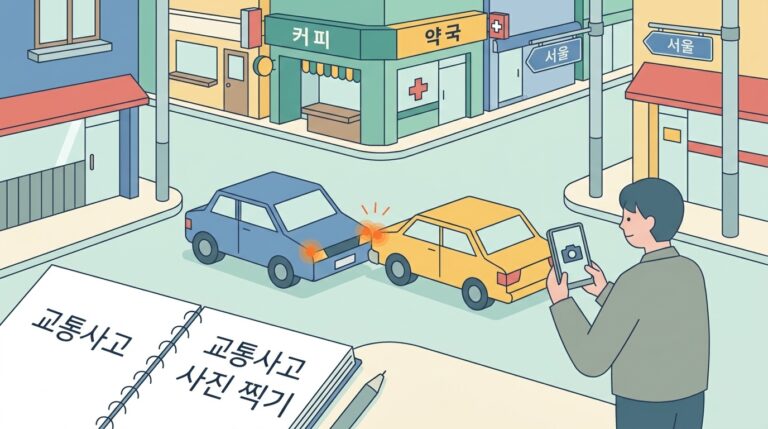
Phase 1: Empathy — When the Dashcam Beeps and Reality Hits
안녕하세요! 매일한글 에디터입니다. (Hello! This is your Daily Hangul editor.)
Imagine this scenario straight out of a sophisticated K-drama thriller: You are navigating a sleek sedan through the bustling, rain-slicked intersections of Teheran-ro in Gangnam. Neon lights reflect off the asphalt when suddenly—screeech, thud—a side-swipe jars your vehicle. Before you can even process the shock, the driver of the other car storms out, eyes wide, cellphone in hand, pacing aggressively around the fender.
Your instinct, conditioned by polite Korean textbooks, might be to step out, bow, and whisper, “죄송합니다 (I am sorry).” Stop right there. In the high-stakes reality of Korean civil law and auto insurance claims, that single instinctive apology can be weaponized as an unconditional admission of liability (과실 인정). Traffic disputes in South Korea are governed by a complex matrix of negligence ratios (과실 비율), dashcam forensics, and rapid insurance dispatch.
Many of our advanced C2 learners have mastered academic essays, yet freeze up when dealing with insurance adjusters or aggressive drivers on an Olympic-daero shoulder. Having navigated hundreds of real-life expat roadside emergencies over the last decade, I designed this guide to arm you with authentic, legally airtight C2 Korean. By mastering this blueprint, you will protect your legal standing, de-escalate tension with poise, and manage insurance protocols like a seasoned local.
Phase 2: Core Expressions — The C2 Strategic Arsenal
1. 현장 보존을 위해 사진부터 다각도로 촬영하겠습니다.
- Pronunciation: Hyeon-jang bo-jeon-eul wi-hae sa-jin-bu-teo da-gak-do-ro chwa-ryeong-ha-get-seum-ni-da. (Sounds like: Hyun-jahng boh-juhn-eul wee-hae sah-jeen-boo-tuh dah-gahk-doh-roh chwah-ryuhng-hah-get-soom-nee-dah)
- Meaning: “I will first take photographs from multiple angles to preserve the scene.”
- K-Culture Moment: Seen in legal dramas like Stranger (비밀의 숲), where an attorney maintains absolute emotional detachment to secure physical evidence before the opposing side alters the scene.
- Editor’s Insight: The phrase 현장 보존 (scene preservation) carries legal weight. It demonstrates that you understand standard accident investigation protocols, subtly warning the other party that arbitrary repositioning of vehicles will not be tolerated.
- Situation Spectrum: Casual: 🚫 | Semi-formal: ⚠️ | Formal: ✅
- 🤔 Think About It: In many Western jurisdictions, clearing the roadway immediately to avoid traffic obstruction takes precedence. Why does Korean practice emphasize keeping vehicles stationary until tire markings and distance shots are meticulously cataloged?
2. 과실 비율은 양측 보험사 간에 따져보도록 하고, 우선 접수 번호부터 교환하시죠.
- Pronunciation: Gwa-sil bi-yul-eun yang-cheuk bo-heom-sa gan-e tta-jyeo-bo-do-rok ha-go, u-seon jeop-su beon-ho-bu-teo gyo-hwan-ha-si-jyo. (Sounds like: Gwah-sheel bee-yool-eun yahng-chook boh-huhm-sah gahn-eh ttah-jyuh-boh-doh-rohk hah-goh, oo-suhn juhp-soo buhn-hoh-boo-tuh gyoh-hwahn-hah-shee-jyoh)
- Meaning: “Let the insurance companies determine the fault ratio; for now, let us exchange claim numbers.”
- K-Culture Moment: The quintessential response delivered by veteran corporate drivers in corporate melodramas when confronted by loud, blustering motorists trying to settle on the spot (합의).
- Editor’s Insight: 따져보다 here does not mean crude arguing; it refers to a forensic review of road traffic acts (도로교통법) and legal precedents. Saying 우선 접수 번호부터 교환하시죠 shuts down roadside shouting matches instantly by delegating liability discussions to professionals.
- Situation Spectrum: Casual: 🚫 | Semi-formal: ⚠️ | Formal: ✅
- 🤔 Think About It: Why is public verbal confrontation over liability considered counterproductive in modern Korea, given the pervasive reliance on automated insurance arbitration?
3. 제 블랙박스 영상 확보되어 있으니, 대인·대물 접수 진행해 주시기 바랍니다.
- Pronunciation: Je beul-laek-bak-seu yeong-sang hwak-bo-doe-eo it-seu-ni, dae-in·dae-mul jeop-su jin-haeng-hae ju-si-gi ba-ram-ni-da. (Sounds like: Jeh beul-laek-bahk-soo yuhng-sahng hwahk-boh-dweh-uh eet-soo-nee, deh-een deh-mool juhp-soo jeen-heng-heh joo-shee-gee bah-rahm-nee-dah)
- Meaning: “I have secured my dashcam footage, so please proceed with registering both bodily injury and property damage claims.”
- K-Culture Moment: The climactic turning point in YouTube shows like Han Moon-chul TV (한문철 TV), where indisputable dashcam footage overturns false witness claims.
- Editor’s Insight: 대인 (personal injury liability) and 대물 (property damage liability) are technical insurance terms. Demanding both indicates you will seek formal medical evaluation for latent injuries (염좌/whiplash) and repairs at an authorized shop.
- Situation Spectrum: Casual: 🚫 | Semi-formal: ⚠️ | Formal: ✅
- 🤔 Think About It: Contrast the Korean term 블랙박스 (black box, meaning dashcam) with Western aviation usage. How did continuous audiovisual recording become ubiquitous in Korean civil disputes?
Phase 3: Textbook Korean vs. Real Korean
Scenario 1: Preventing the Other Driver from Moving the Vehicle
- 📖 Textbook Korean: 차를 움직이지 마십시오. (Cha-reul um-jig-i-ji ma-sip-si-o. / Please do not move the car.)
- 🗣️ Real C2 Korean: 바퀴 꺾인 각도랑 노면 흔적 원거리 샷 남기기 전까진 차 일절 빼지 마세요. (Ba-kwi kkeok-kin gak-do-rang no-myeon heun-jeok won-geo-ri syat nam-gi-gi jeon-kka-jin cha il-jeol ppae-ji ma-se-yo. / Do not touch or move the car at all until we capture wide shots of the wheel angle and tire skid marks on the road surface.)
- 💡 Why the Difference? Basic textbooks teach generic imperatives. At a C2 level, you must specify evidentiary details (바퀴 각도, 원거리 샷, 노면 흔적) to block any attempt to tamper with the scene.
Scenario 2: Calling the Insurance Emergency Dispatch
- 📖 Textbook Korean: 보험 회사에 전화를 합시다. (Bo-heom hoe-sa-e jeon-hwa-reul hap-si-da. / Let us call the insurance company.)
- 🗣️ Real C2 Korean: 길거리에서 언성 높일 것 없이 각자 보험사 긴급출동 불러서 현장 출동 요원 입회하에 정리하시죠. (Gil-geo-ri-e-seo eon-seong no-pil geot eop-si gak-ja bo-heom-sa gin-geup-chul-dong bul-leo-seo hyeon-jang chul-dong yo-won ip-hoe-ha-e jeong-ni-ha-si-jyo. / There is no reason to raise our voices in the street; let us each summon our insurance emergency dispatch and settle this in the presence of the on-site claim agents.)
- 💡 Why the Difference? C2 Korean balances social civility with unyielding boundaries. The expression 언성 높일 것 없이 (without raising voices) establishes composure, while 현장 출동 요원 입회하에 invokes structured protocol.
Phase 4: K-Culture Deep Dive & Non-Verbal Etiquette
4-1. Nunchi & Posture: The Art of Composed De-escalation
In a Korean road accident, your physical posture speaks louder than words. Never exit your car shouting, but never exit bowing in deference either.
* Physical Distance & Eye Contact: Maintain an erect, neutral posture. Stand roughly 1.5 meters away from the other driver. Do not cross your arms (which signals hostile aggression) nor put your hands in your pockets (which suggests dismissive arrogance).
* The Verbal Reflex Trap: Eliminate “죄송합니다” (I am sorry) or “제 잘못이에요” (It is my fault) from your initial utterances. Under Korean insurance practices, unprompted apologies can be entered into field adjusters’ reports as preliminary concessions of liability. Instead, use neutral phrases like: “다치신 곳은 없으십니까?” (Are you injured anywhere? / Da-chi-sin gos-eun eop-seu-nim-ni-kkah?).
* Scene Safety Protocol: Immediately deploy the emergency hazard blinkers (비상등). If on an expressway, place your reflective warning triangle (삼각대) 100 meters behind the car (or activate an LED emergency baton) before stepping behind the guardrail to prevent catastrophic secondary collisions (2차 사고).
4-2. Cultural Code Analysis: The Dashcam & Han Moon-chul Phenomenon
South Korea boasts one of the world’s highest dashcam installation rates (over 90% of registered vehicles). This technological saturation gave birth to a distinct cultural phenomenon: 한문철 TV (Han Moon-chul TV), run by a preeminent traffic accident attorney whose YouTube channel analyzes thousands of user-submitted dashcam clips weekly.
Koreans no longer rely on loud vocal intimidation (목소리 큰 사람이 이긴다—”the one with the loudest voice wins,” an outdated 1990s adage). Contemporary road conflicts are won through pixel resolution, memory card integrity, and vehicle telematics. A calm motorist who quietly downloads footage to their smartphone via Wi-Fi commands far more legal leverage than someone shouting in the middle of an intersection.
Phase 5: Real-World Roleplay Scenario
Setting: A rainy evening at a multi-lane crossroads near Samseong Station. A commercial taxi clipped your rental vehicle’s rear quarter panel while making an aggressive lane merge.
Characters:
* Mr. Park (박 기사): A seasoned 60-year-old taxi driver accustomed to intimidating novice drivers.
* You: A poised, C2-level foreign professional driving a rental vehicle.
- Turn 1 (Mr. Park): [차 문을 거칠게 열고 나오며 삿대질을 한다] 아니, 깜빡이 켜고 들어가는데 그걸 못 보고 그냥 들이받으면 어떡해요! 운전 면허 어떻게 딴 거야, 참!
(Ani, kkam-ppag-i kyeo-go deul-eo-ga-neun-de geu-geol mot bo-go geu-nyang deul-i-bad-eu-myeon eo-tteok-hae-yo! Un-jeon myeon-heo eo-tteoh-ge ttan geo-ya, cham!)
(Bangs car door open, pointing aggressively) “Hey! I had my turn signal on while merging, how could you not see that and just rear-end me! How did you even get your driver’s license?!” -
Turn 2 (You): [🎭 차분하게 스마트폰 카메라를 켜고 차량 파손 부위와 차선 위치를 비추며] 기사님, 우선 진정하시고요. 차선 침범 사고라 과실 비율은 블랙박스 확인해 봐야 압니다.
(Gi-sa-nim, u-seon jin-jeong-ha-si-go-yo. Cha-seon chim-beom sa-go-ra gwa-sil bi-yul-eun beul-laek-bak-seu hwak-in-hae bwa-ya am-ni-da.)
“Sir, please calm down first. This is a lane-infringement collision, so liability will only be determined after inspecting dashcam footage.” -
Turn 3 (Mr. Park): [당황하며 언성을 더 높인다] 무슨 블랙박스 타령이야! 외국인이라 도로 사정도 모르는 것 같은데, 내가 바쁘니까 그냥 30만 원에 여기서 털고 끝냅시다!
(Mu-seun beul-laek-bak-seu ta-ryeong-i-ya! Oe-guk-in-i-ra do-ro sa-jeong-do mo-reu-neun geot gat-eun-de, nae-ga ba-ppeu-ni-kka geu-nyang sam-sip-man won-e yeo-gi-seo teol-go kkeut-naep-si-da!)
(Rattled, raising his voice) “What nonsense about dashcams! You seem unfamiliar with Korean roads because you are a foreigner; I am busy, so just give me 300,000 KRW cash right now and let’s call it a day!” -
Turn 4 (You): [🎭 단호한 눈빛으로 상대 차량 번호판과 운전석 전면을 촬영하며] 현금 합의할 생각 전혀 없습니다. 렌터카 규정상 정식 사고 접수해야 하니, 기사님 소속 공제조합에 접수 넣으세요.
(Hyeon-geum hap-ui-hal saeng-gak jeon-hyeo eop-seum-ni-da. Ren-teo-ka gyu-jeong-sang jeong-sik sa-go jeop-su-hae-ya ha-ni, gi-sa-nim so-sok gong-je-jo-hap-e jeop-su neo-eu-se-yo.)
“I have zero intention of settling for cash. Per rental car regulations, I must register an official accident claim, so please notify your taxi cooperative union immediately.” -
Turn 5 (Mr. Park): [한 발 물러서며 투덜거린다] 아니, 공제조합 부르면 둘 다 보험료 할증 붙고 손해라니까 그러네!
(A-ni, gong-je-jo-hap bu-leu-myeon dul da bo-heom-ryo hal-jeung but-go son-hae-ra-ni-kka geu-reo-ne!)
“Look, if we call the insurance union, both of our premiums will spike and we both lose out!” -
Turn 6 (You): [🎭 비상등 켜진 상태를 확인하고 안전지대로 이동하며] 할증 여부는 각자 감수할 문제고요. 전 제 보험사 현장 출동 불렀으니 출동 기사 올 때까지 현장 보존해 주십시오.
(Hal-jeung yeo-bu-neun gak-ja gam-su-hal mun-je-go-yo. Jeon je bo-heom-sa hyeon-jang chul-dong bul-leot-eu-ni chul-dong gi-sa ol ttae-kka-ji hyeon-jang bo-jon-hae ju-sip-si-o.)
“Premium surcharges are for each of us to bear independently. I have summoned my insurance emergency team, so please maintain the scene untouched until the agent arrives.” -
Turn 7 (Mr. Park): [담배를 물려다 말고 한숨을 푹 쉰다] 거 참, 빈틈이 없네… 알았어요, 접수 번호 찍어줄 테니까 내 번호도 받아 적어요.
(Geo cham, bin-teum-i eop-ne… Al-at-eo-yo, jeop-su beon-ho jjik-eo-jul te-ni-kka nae beon-ho-do bad-a jeok-eo-yo.)
(Sighs deeply) “Man, not an inch of give… Fine! I will provide my claim registration number, so take down my contact info too.” -
Turn 8 (You): [🎭 수첩을 꺼내 받아 적으며] 네, 대인·대물 일괄 접수 확인되면 제 접수 번호도 바로 문자 남겨드리겠습니다.
(Ne, dae-in·dae-mul il-gwal jeop-su hwak-in-doe-myeon je jeop-su beon-ho-do ba-ro mun-ja nam-gyeo-deu-ri-get-seum-ni-da.)
“Understood. Once I verify that both bodily injury and property damage are fully filed, I will text you my claim number immediately.”
🔀 Interactive Decision Branch
What would you do if Mr. Park suddenly jumps into his cab and attempts to drive away before insurance agents arrive?
- Option A: Stand in front of his taxi while filming him with your phone, shouting for him to stop.
- Option B: Memorize his license plate, verify your dashcam recording indicator is illuminated, record his departure trajectory, and dial 112 to report a hit-and-run (뺑소니/사고 후 미조치).
- Option C: Shrug it off, call your rental car firm, and tell them you will pay for the fender yourself.
[Evaluation Feedback]
- Option A (HIGH RISK): Extremely dangerous! Blocking a moving vehicle can result in severe physical injury or legal counter-charges of obstruction.
- Option B (BEST C2 DECISION): Textbook perfection! Leaving the scene of an unmanaged accident without exchanging information constitutes a hit-and-run under the Road Traffic Act. Police will track him within hours.
- Option C (WORST DECISION): Financial disaster. You forfeit rental CDW insurance rights and assume 100% liability for unverified damage.
Phase 6: 10-Second Emotion Shadowing Drill
Practice these high-stakes sentences using deliberate pausing (/) and strict adherence to emotional cues:
[🧊 침착하고 단호하게 / Cool & Unshakable]
“블랙박스 전원 확인했으니 / 억지 부리지 마시고 / 보험사 부르시죠.”
(Beul-laek-bak-seu jeon-won hwak-in-haet-eu-ni / eok-ji bu-ri-ji ma-si-go / bo-heom-sa bu-leu-si-jyo.)
“I have confirmed the dashcam power is on / so stop being unreasonable / and call your insurer.”-
[💼 전문적이고 빈틈없이 / Highly Professional & Incisive]
“원거리 샷과 바퀴 조향 각도 촬영 끝났으니 / 갓길로 이동하여 / 2차 사고를 방지하겠습니다.”
(Won-geo-ri syat-gwa ba-kwi jo-hyang gak-do chwa-ryeong kkeut-nat-eu-ni / gat-gil-ro i-dong-ha-yeo / i-cha sa-go-reul bang-ji-ha-get-seum-ni-da.)
“Wide shots and steering angle documentation are complete / so let us move to the shoulder / to prevent secondary collisions.” -
[🛡️ 타협 없는 법적 방어 / Uncompromising Legal Defense]
“현장 구두 합의는 사양하며 / 정식 대인·대물 접수 번호 / 문자 전송 부탁드립니다.”
(Hyeon-jang gu-du hap-ui-neun sa-yang-ha-myeo / jeong-sik dae-in·dae-mul jeop-su beon-ho / mun-ja jeon-song bu-tak-deu-rim-ni-da.)
“I decline verbal on-site settlements / so please forward / the official claim registration number via text message.”
Phase 7: K-Culture Mini Dictionary
-
과실 비율 (Gwasil Biyul)
Literal translation: Negligence/Fault Ratio.
Real-World Usage: Expressed in ratios like 8:2 or 7:3. It determines what percentage of the total vehicle repair costs and medical treatments each insurer covers. Achieving a 100:0 (zero liability) verdict is fiercely contested in South Korea. -
대인 / 대물 배상 (Dae-in / Dae-mul Baesang)
Literal translation: Bodily Injury / Property Damage Compensation.
Real-World Usage: 대인 접수 covers hospital admission, MRI scans, and physical therapy for individuals involved. 대물 접수 covers body shop mechanical repairs and rental vehicle costs while your car is serviced. -
현장 출동 (Hyeonjang Chuldong)
Literal translation: On-Site Emergency Dispatch.
Real-World Usage: Major insurers (Samsung Fire, Hyundai Marine, DB, KB) maintain rapid dispatch networks. Agents arrive on motorcycles or small patrol cars within 10 to 20 minutes to photograph tire marks, check dashcams, and administer documentation. -
마디모 프로그램 (Madimo Peurogeuraem)
Literal translation: MADYMO (Mathematical Dynamic Models) Simulation.
Real-World Usage: A Dutch computer simulation program operated by the National Forensic Service (국립과학수사연구원) in Korea to analyze whether a minor bump had sufficient kinetic impact to cause alleged bodily injury, frequently used to combat fraudulent personal injury claims.
Phase 8: Traveler’s Roadside Survival Kit
Top 3 Survival Phrases
- “보험사 긴급출동 바로 불러주세요.”
(Bo-heom-sa gin-geup-chul-dong ba-ro bul-leo-ju-se-yo.)
Pro Tip: Use this when speaking to rental car roadside support to ensure an authorized agent is immediately dispatched to your GPS coordinates. - “상대방 차량 번호와 연락처 먼저 메모하겠습니다.”
(Sang-dae-bang cha-ryang beon-ho-wa yeol-lak-cheo meon-jeo me-mo-ha-get-seum-ni-da.)
Pro Tip: Prevents the other driver from driving away unnoticed while you inspect vehicular scrape patterns. - “경찰에 사고 접수부터 하겠습니다.”
(Gyeong-chal-e sa-go jeop-su-bu-teo ha-get-seum-ni-da.)
Pro Tip: Invoking a formal police report (112) instantly neutralizes aggressive shouting or demands for illicit cash handoffs.
Editor’s Travel Note: Essential Infrastructure
Before driving anywhere in Korea—especially rental road trips across Jeju Island or Gangwon Province—download the Kakao Navi 앱 다운로드 or T-Map 네비게이션 앱 다운로드. Both apps provide real-time lane accident alerts and instant one-touch buttons to call local traffic accident roadside assistance.
Always locate the insurance contract paper in your rental glove compartment. It contains the dedicated rental accident hotline (사고 접수 전담 콜센터), which operates 24/7 with English translation services available through the Korea Tourism Organization (1330).
Phase 9: Think Deeper — Jeong vs. Modern Jurisprudence
Korean culture is globally renowned for Jeong (정)—a warm, empathetic communal bond that fosters collective generosity. However, the concrete expanse of multi-lane Korean highways reveals a fascinating socio-legal paradox: the coexistence of deep communal warmth and hyper-rationalized, procedural scrutiny.
When metal scrapes metal on an asphalt road, traditional Jeong yields instantaneously to technological vigilance and strict legal demarcation. The omnipresence of 4K dual-channel dashcams and rigorous insurance formulas reflects a high-density, hyper-digital society where objective truth (객관적 증거) replaces emotional appeals.
Understanding this duality is the hallmark of true C2 cultural fluency. Navigating an accident with icy legal precision does not make you rude or un-Korean; paradoxically, executing these procedures smoothly allows both parties to preserve emotional dignity while the institutional systems resolve the conflict.
💬 Your Turn: Have you ever noticed a situation where Korean society switches rapidly from warm communal intimacy to uncompromising procedural efficiency? Share your observations below!
Phase 10: FAQ & Common Pitfalls
Q: What should I photograph at the accident scene before moving the vehicles?
A: Take at least four distinct photographic angles: (1) A close-up showing paint transfer and damage depth, (2) A wide shot taken from 20 to 30 meters showing lane lines and traffic signals, (3) A clear shot of the front wheels showing steering angle (바퀴 조향 각도), and (4) The other car’s dashcam device showing that its operational LED light was turned on.
Q: Should I call the police (112) for every minor traffic accident in Korea?
A: For minor fender benders involving only vehicle damage where both parties possess valid auto insurance, contacting the insurers’ emergency dispatch (긴급출동) is standard practice. However, you must call 112 if: (1) Anyone is injured, (2) The other driver exhibits signs of intoxication or refuses to identify themselves, (3) An accident occurs involving the “12 Severe Traffic Violations” (12대 중과실, such as signal violations or centerline crossing), or (4) The other driver attempts to flee the scene.
Q: Can I settle an accident in cash (개인 합의) if the damage appears minimal?
A: As a foreign resident or tourist, settling in cash without written documentation is extremely risky. Unscrupulous motorists can accept your cash, depart, and later report you to police for hit-and-run (도주치상). Always insist on formal insurance claim registration (보험 접수) to guarantee a verified paper trail.
🚨 Common Mistakes Alert (외국인 학습자 흔한 실수 TOP 3)
- Saying “죄송합니다” out of politeness:
Correct Action: Ask about their safety neutral-mindedly: “몸은 괜찮으십니까?” (Are you unhurt?). Save apologies for your close friends. - Moving the car to the shoulder immediately without taking wide-angle contextual photos:
Correct Action: Turn on hazard lights, take 360-degree photos showing tire angles and lane dividers within 60 seconds, then relocate to safety. - Trusting verbal promises without securing an official insurance claim number (접수 번호):
Correct Action: Do not leave the location until you receive a verified claim number via text message from the opposing driver’s authorized insurance carrier.
Phase 11: Action Missions
- 🥉 Bronze Mission (Solo Practice): Stand in front of your mirror and practice the 3 Shadowing Drill sentences with a firm, professional facial expression until you deliver each sentence in under 4 seconds without hesitation.
- 🥈 Silver Mission (Social Exploration): Search for the Korean hashtag
#교통사고대처or#한문철레전드on Instagram or YouTube. Watch one analysis clip and write down two specialized terms used by the narrator. - 🥇 Gold Mission (Real-world Preparedness): Open your smartphone notes app right now. Create an Emergency Road Template including: your insurance carrier’s 24/7 hotline number, your rental vehicle policy number, and the phrase: “과실 비율은 양측 보험사 현장 출동 요원을 통해 산정하겠습니다.”
- 🎮 K-Culture Mission: Watch an episode of a Korean legal K-drama (such as Extraordinary Attorney Woo or Hyena). Spot the exact moment an attorney uses photographic evidence (증거 채증) to overturn an opponent’s argument.
Phase 12: Interactive C2 Road Quiz
Test your real-world readiness with this legal and cultural simulation:
1. Situational Judgment:
You are stopped at a red light on Dosan-daero when a car gently taps your rear bumper. The other driver gets out, smells faintly of alcohol, but aggressively hands you 500,000 KRW in crisp cash, insisting you bypass insurance. What is the correct C2 legal action?
* A) Accept the cash, bow respectfully, and drive away to avoid drama.
* B) Refuse the cash firmly, call 112 immediately to report suspected DUI (음주운전 의심 신고), and photograph both vehicles while waiting in a safe pedestrian zone.
* C) Exchange phone numbers and agree to visit a repair shop together the next day.
2. Fill-in-the-Blank:
“상대방 과실 100% 사고이므로, 병원 진료를 위해 상대측 보험사에 _______ 접수를 요구해야 합니다.”
(Since the other party is 100% at fault, you must demand _______ claim registration from their insurer for medical treatment.)
3. True or False:
Under Korean Road Traffic standards, dashcam footage from your vehicle can only be submitted if the other driver signs a privacy consent form at the scene. (True / False)
🔍 Click here to reveal the answers and detailed C2 explanations!
-
Correct Answer: B
Explanation: Under Korean law, driving under the influence is a severe criminal offense. Accepting cash from an intoxicated driver exposes you to potential legal entanglement or extortion allegations later. Immediate police notification (112) is the only legally sound action. -
Correct Answer: 대인 (Dae-in / Bodily Injury)
Explanation: Vehicle damage requires 대물 접수 (property damage claim), whereas hospital diagnostics, acupuncture, and physical therapy require 대인 접수 (personal bodily injury claim). -
Correct Answer: False
Explanation: Public roadway traffic accident footage captured on private vehicular dashcams can be submitted directly to insurance adjusters and national police stations (경찰서 교통사고조사계) as forensic evidence without requiring opposing party consent.







