

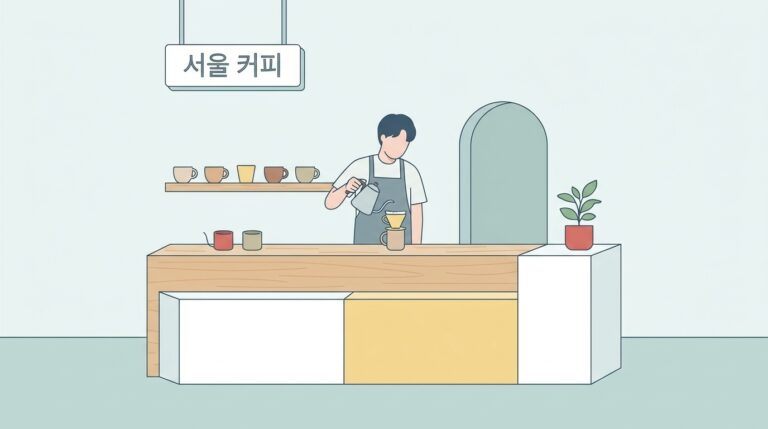
Mastering Korea’s Specialty Coffee Scene: Talk Like a True Connoisseur at the Brew Bar
Phase 1: Empathy (Story Immersion Opening)
안녕하세요! 매일한글 에디터입니다. (Hello! It’s your Daily Hangul editor.)
Picture this: You step off the bustling streets of Seongsu-dong or Yeonnam-dong and pull open the heavy wooden door of an understated, minimalist roastery. The intense hum of a Mahlkönig grinder fills the air, mingling with the exquisite, floral aroma of a light-roast Gesha being extracted on a V60. You take a seat at the low wooden brew bar. The barista, donned in a crisp canvas apron, places a sensory cupping tray before you and asks, “어떤 노트 좋아하세요? 산미 있는 편 좋아하시나요?” (What notes do you prefer? Do you lean towards bright acidity?)
Suddenly, your mind freezes. You’ve mastered conversational Korean—you can talk about K-dramas, discuss the economy, and effortlessly order an “아이스 아메리카노” (Iced Americano). But in the elevated world of third-wave Korean specialty coffee, standard textbook phrases feel clunky. You want to articulate the nuance of anaerobic fermentation, the balance of crisp acidity, or the silky mouthfeel without sounding like an automated translator.
Korea boasts one of the most sophisticated, competitive coffee cultures on earth, home to World Barista Champions and hyper-detailed extraction profiles. If you can converse fluently across the brew bar, you instantly unlock an authentic, deeply respected connection with the artisans shaping the local culture. Drawing from years of working alongside Seoul’s elite roasters and guiding advanced learners, I’ve put together this definitive C2 guide to navigating Korea’s specialty coffee scene with finesse and authentic local flair.
Phase 2: Core Expressions Deep Dive
Here are three advanced expressions used by discerning Korean coffee aficionados and coffee professionals.
1. 산미가 튀지 않고 밸런스가 잡혀 있어요 (Sanmiga twiji anko baelleonseuga japhyeo isseoyo)
- Pronunciation: [San-mi-ga twi-ji an-ko bael-leon-seu-ga ja-pyeo i-sseo-yo] (Think of twi like the quick “twee” in “tweet”, and japhyeo like “ja-pyo” with a crisp p-sound).
- Meaning: Literal: “The acidity doesn’t jump out, and the balance is caught.” / Nuance: “The acidity is subtle and not overbearing, yielding a harmoniously balanced cup.”
- K-Culture Moment: Seen in sophisticated café vlog channels like Ondo or specialty roastery documentaries, where guests evaluate a delicate Ethiopian washed pour-over without offending the roaster.
- Editor’s Insight: The verb 튀다 (twida, literally to bounce or splatter) is applied here to sensory sharpness. When acidity “bounces” (산미가 튄다), it denotes an unpleasant, jarring sourness. Saying 산미가 튀지 않다 demonstrates that you understand the fine line between vibrant acidity and underdeveloped roasting.
- Situation Spectrum: Casual ✅ | Semi-formal ✅ | Formal ✅
- 🤔 Think About It: In English, we often describe coffee as “smooth” or “bright.” Why do you think Korean coffee culture places such high philosophical value on 밸런스 (balance) rather than singular, explosive flavor profiles?
2. 내추럴 특유의 쿰쿰함보다는 클린컵이 돋보이네요 (Naechureol teug-yuui kumkumhambodaneun keullinkeobi dotboineyyo)
- Pronunciation: [Nae-chu-reol teu-gyu-ui kum-kum-ham-bo-da-neun keul-lin-keo-bi dot-bo-i-ne-yo] (The double-k kum-kum sounds like an earthy, nasal “koom-koom”).
- Meaning: Literal: “Rather than the musty funk unique to naturals, the clean cup stands out.” / Nuance: “Instead of any heavy, over-fermented funk typical of natural processing, this is exceptionally clean and transparent.”
- K-Culture Moment: Used by seasoned patrons leaning over the counter at independent roasters in Hannam-dong when discussing anaerobic natural lots.
- Editor’s Insight: 쿰쿰하다 (kumkumhada) usually refers to aged, pungent smells (like fermented soybean paste or a cellar). In specialty coffee, calling a natural coffee 쿰쿰하다 implies an unrefined funk. By contrasting it with 클린컵 (clean cup), you establish yourself as an expert cupper who appreciates clarity over raw fermentation.
- Situation Spectrum: Casual ✅ | Semi-formal ✅ | Formal ⚠️ (Slightly technical jargon)
- 🤔 Think About It: How does borrowing the English term “Clean Cup” alongside the native sensory adjective 쿰쿰하다 reflect the bilingual evolution of modern Korean subcultures?
3. 원두 본연의 캐릭터를 살린 추출이 인상적입니다 (Wondu bon-yeon-ui kaerikteoreul sallin chuchuri insangjeogimnida)
- Pronunciation: [Won-du bo-nyeo-nui kae-rik-teo-reul sal-lin chu-chu-ri in-sang-jeo-gim-ni-da] (Pronounce bon-yeon smoothly connected like “bo-nyun”).
- Meaning: Literal: “The extraction reviving the coffee bean’s innate character is impressive.” / Nuance: “The extraction exquisitely brings out the bean’s origin terroir.”
- K-Culture Moment: The polite, ultimate compliment delivered by coffee critics or respectful connoisseurs to the head barista after enjoying an Omakase-style filter flight.
- Editor’s Insight: 本然 (bon-yeon – innate/original essence) paired with 살리다 (sallida – to bring alive/revive) honors the barista’s technique as a transparent medium rather than an overpowering ego. It is the highest praise you can bestow upon a third-wave artisan.
- Situation Spectrum: Casual ⚠️ (Too literary) | Semi-formal ✅ | Formal ✅
- 🤔 Think About It: Does your native language distinguish between the bean’s “raw personality” and the barista’s “extraction technique” as distinct artistic layers?
Phase 3: Textbook Korean vs. Real Korean
Situation 1: Asking the barista for a pourover recommendation based on your taste
- 📖 교과서 한국어 (Textbook):
- 신맛이 없는 커피를 추천해 주시겠습니까? (Sinmasi eomneun keopireul chucheonhae jusigessseumnikka?)
- “Would you please recommend a coffee that does not have sourness?”
- 🗣️ 진짜 한국어 (Real-World C2):
- 산미 톤이 차분하고 바디감 좋은 싱글로 추천 부탁드려요. (Sanmi toni chabunhago badigam joeun singgeullo chucheon butakdeuryeoyo.)
- “Could you recommend a single-origin with a subdued acidity tone and a round body?”
- 💡 왜 다를까? (Why the shift?): Simply asking for “no sourness” (신맛 없음) sounds like you dislike specialty coffee altogether. Describing acidity as 차분한 톤 (subdued/calm tone) shows that you understand acid structure while steering the barista toward medium-dark profiles or pulped naturals without sounding dismissive.
Situation 2: Expressing appreciation for the pleasant lingering finish
- 📖 교과서 한국어 (Textbook):
- 커피를 마신 후에도 입안에 맛이 오래 남아서 좋습니다. (Keopireul masin huedo ibane masi orae namaseo joseumnida.)
- “It is good because after drinking the coffee, the taste stays in the mouth for a long time.”
- 🗣️ 진짜 한국어 (Real-World C2):
- 애프터에서 은은한 플로럴 뉘앙스가 길게 이어지네요. (Aepeuteoeseo euneunhan peulloreol nyuangseuga gilge ieojineyo.)
- “A subtle floral nuance lingers beautifully in the aftertaste.”
- 💡 왜 다를까? (Why the shift?): Using specialized vocabulary like 애프터 (aftertaste) alongside sensory adverbs like 은은한 (subtle/gentle) transforms a rudimentary observation into a refined tasting evaluation.
Phase 4: K-Culture Deep Dive & Non-Verbal Manners
4-1. 눈치 (Nunchi) & Counter Manners at the Pour-Over Bar
In Korean specialty roasteries, the brew bar is sacred. When the barista begins pouring hot water from their gooseneck kettle in concentric spirals, an unspoken rule of nunchi applies:
* Hold your questions during the bloom (뜸 들이기): The first 30–45 seconds require strict timing and scale monitoring. Interrupting during extraction breaks their concentration. Wait until the water finishes draining through the bed.
* The Two-Handed Cup Reception: When the barista presents the server or cup, receive it lightly supporting the base or side with your left hand while holding the handle with your right. This subtly honors the craft.
* Fragrance Sniffing Etiquette: If offered a sample tray of dry grounds (프래그런스), smell gently without exhaling directly into the tray, nod respectfully, and share a concise observation.
4-2. Cultural Code: The Rise of Seongsu-dong & “Gong-gan” (공간)
Korea’s specialty movement is deeply tied to architecture and gong-gan-gam (the aesthetic sensibility of physical space). Unlike American “grab-and-go” culture, Korean coffee consumers treat the specialty café as a sanctuary of curated sensory design. Roasters like Fritz Coffee Company, Center Coffee, and Lowkey design spaces where the furniture height, acoustic dampening, and porcelain cup shapes are calibrated to elevate the extraction. Appreciating both the cup and the space is the hallmark of the modern Korean urbanite.
Phase 5: Real-World Roleplay Scenario
Setting: Atelier d’Extraction, an intimate 6-seat specialty filter bar hidden down a quiet alley in Seongsu-dong. Rain patters against the floor-to-ceiling glass.
NPC Barista: Min-jun (민준), a national cup-taster finalist with a calm, meticulous demeanor.
- Barista Min-jun: 어서 오세요. 오늘 날씨가 꽤 쌀쌀하죠? 필터 커피 메뉴판 준비해 드렸습니다. (Eoseo oseyo. Oneul nalssiga kkwae ssalssalhajyo? Pilteo keopi menyupan junbihae deuryeotseumnida.)
🎭 Places a minimalist leather menu and a small glass of sparkling palate-cleansing water before you.
“Welcome. Quite chilly today, isn’t it? Here is our filter coffee menu.” -
You: 네, 비가 오니까 따뜻한 브루잉이 생각나더라고요. 혹시 오늘 브루잉 라인업 중에 캐릭터가 뚜렷한 원두가 있을까요? (Ne, biga onikka ttatteut-han beuru-ingi saenggangnadeoragoyo. Hoksi oneul beuru-ing raineop junge kaerikteoga tturyeotan wonduga isseulkkayo?)
🎭 Glancing over the single-origin origins with keen interest.
“Yes, with the rain, I really craved a warm pour-over. Among today’s lineup, do you have a bean with distinct character?” -
Barista Min-jun: 콜롬비아 게이샤 무산소 발효 원두가 새로 들어왔어요. 복숭아랑 자스민 톤이 아주 화사합니다. (Kollombia geisya musanso balhyo wonduga saero deureowasseoyo. Boksung-arang jaseumin toni aju hwasahamnida.)
🎭 Offers a ceramic vial containing freshly ground beans for you to evaluate the dry aroma.
“We just brought in an anaerobic fermented Colombian Gesha. The peach and jasmine notes are wonderfully vibrant.” -
You: 와, 프래그런스부터 핵과류의 달콤한 향이 확 올라오네요. 이 원두로 부탁드립니다. (Wa, peuraegeoreonseubuteo haekgwaryuui dalkomhan hyangi hwak ollaoneyo. I wonduro butakdeurimnida.)
🎭 Inhaling gently with eyes closed, recognizing stone-fruit complexity.
“Wow, right from the dry fragrance, sweet stone-fruit aromas rush up. I’ll take this one, please.” -
Barista Min-jun: 탁월한 선택이십니다. 추출 온도를 살짝 낮춰서 단맛 위주로 이끌어내 볼게요. (Tagwolhan seontaegisimnida. Chuchul ondoreul saljjak natchwoseo danmat wijuro ikkeureonae bolgeyo.)
🎭 Begins a precise multi-stage pour with steady hand control.
“Superb choice. I’ll lower the brew temperature slightly to coax out maximum sweetness.” -
You: 천천히 준비해 주세요. 지켜보는 것만으로도 힐링이 되네요. (Cheoncheonhi junbihae juseyo. Jikyeoboneun geonmaneurodo hilling-i doeneyo.)
🎭 Stepping back politely to allow the barista complete focus during extraction.
“Take your time. Just watching your process is therapeutic.” -
Barista Min-jun: 오래 기다리셨습니다. 처음에는 컵 노트의 산미를 즐기시고, 온도가 조금 내려가면 단맛이 어떻게 달라지는지 느껴보세요. (Orae gidarisyeotseumnida. Cheoeumeneun keop noteuui sanmireul jeulgisigo, ondoga jogeum naeryeogamyeon danmasi eotteoke dallajineunji neukkyeoboseyo.)
🎭 Gently sets down an artisan ceramic cup alongside a small tasting card detailing the farm elevation and variety.
“Thank you for waiting. First enjoy the acidity in the cup notes, then notice how the sweetness shifts as the temperature drops.” -
You: 첫 모금 넘겼을 때 산미가 튀지 않고 밸런스가 잡혀 있어요. 온도가 떨어질수록 애프터가 더 풍부해지네요. (Cheot mogeum neomgyeosseul ttae sanmiga twiji anko baelleonseuga japhyeo isseoyo. Ondoga tteoreojilsurok aepeuteoga deo pungbuhaejineyo.)
🎭 Taking a delicate sip, nodding appreciatively at the lingering finish.
“On the first sip, the acidity is well-balanced without being sharp. As it cools, the aftertaste blooms even richer.”
🔀 Interactive Choice Point
The barista smiles warmly, clearly pleased that you appreciate the nuanced extraction curve. He asks:
“혹시 평소에는 주로 어떤 가공 방식의 원두를 즐겨 드시나요?”
(By the way, what processing method do you usually prefer?)
- Choice A: “저는 원래 워시드 선호하는데, 이 무산소는 과발효취가 전혀 없어서 매력적이네요.” (Jeoneun wonrae wosideu seonhohaneunde, i musansoneun gwabalhyochwiga jeonhyeo eopseoseo maeryeokjeogineyo.)
- Choice B: “저는 그냥 쓴 커피가 싫고 달달한 바닐라 라떼가 제일 좋아요.” (Jeoneun geunyang sseun keopiga silko daldalhan banilla rattega jeil joayo.)
- Choice C: “커피는 그냥 다 똑같은 거 아닌가요? 아무거나 주세요.” (Keopineun geunyang da ttokgateun geo aningayo? Amugeona juseyo.)
[Feedback System]
* If you chose A [BEST]: Barista's eyes light up! Pointing out the absence of over-fermentation funk (과발효취) proves you possess an elite palate. He may even offer you an unlisted guest roast sample.
* If you chose B [RISK]: Honest, but completely derails the specialty filter dialogue you just built. It's fine in a commercial café, but slightly jarring here.
* If you chose C [BAD]: Dismisses the barista’s entire craft and invalidates your previous conversation. Instant awkward silence at the counter.
Phase 6: 10-Second Emotion Shadowing Drill
Practicing native rhythm and emotional cadence transforms your spoken Korean from robotic to evocative.
- Sentence 1 (Serious & Refined):
[🧐 진지하고 세심하게]
산미가 튀지 않고 / 전체적인 밸런스가 / 참 인상적이네요.
(Sanmiga twiji anko / jeonchejeogin baelleonseuga / cham insangjeogineyo.)
“The acidity doesn’t overpower, / and the overall balance / is truly remarkable.” -
Sentence 2 (Delighted & Tactile):
[✨ 감탄하며 섬세하게]
온도가 식을수록 / 베리류의 단맛이 / 선명하게 살아나요.
(Ondoga sigeulsurok / beriryuui danmasi / seonmyeonghage saranayo.)
“As it cools down, / the berry-like sweetness / springs vibrantly to life.” -
Sentence 3 (Deep Appreciation):
[☕ 여유롭고 깊이 있게]
원두 본연의 캐릭터를 / 아주 깔끔하게 / 잘 살려내셨네요.
(Wondu bon-yeon-ui kaerikteoreul / aju kkalkkeumhage / jal sallyeonaesyeonneyo.)
“You have captured / the bean’s intrinsic character / with such clarity.”
Phase 7: K-Culture Mini Dictionary
| Term | Korean + Romanization | Meaning & Real-World Usage |
|---|---|---|
| 1. | 필터 커피 (Pilteo Keopi) | Filter / Pour-Over Coffee. While “드립 커피” (Drip Coffee) was historically ubiquitous, modern third-wave spots strictly use 필터 커피 to signal specialty manual brewing on V60, Kalita, or Origami drippers. |
| 2. | 싱글 오리진 (Singgeul Orijin) | Single-Origin. Used when ordering beans from a single farm or region, contrasting with the house blend (하우스 블렌드). Expressed as: “오늘 싱글 라인업이 어떻게 되나요?” (What is today’s single-origin lineup?) |
| 3. | 떫은맛 (Tteolbeunmat) | Astringency / Dryness. The dry, puckering sensation caused by over-extraction or channeling. An essential cupping term: “후미에 떫은맛이 남지 않아 깔끔해요.” (It is clean with zero astringency lingering in the finish.) |
| 4. | 후미 / 애프터 (Humi / Aepeuteo) | Finish / Aftertaste. The classical Sino-Korean word 후미 (後味) and the loanword 애프터 are used interchangeably to evaluate length and flavor clarity after swallowing. |
Phase 8: Survival Kit for Travelers
Top 3 Survival Phrases for Roastery Hopping
- 따뜻하게 마셔야 향이 더 잘 느껴지나요?
(Ttatteuthage masyeoya hyangi deo jal neukkyeojinayo?)
Pro Tip: Asking whether the bean is better hot or iced indicates you care about aromatic release over mere temperature refreshment. - 혹시 원두 구매하면 필터 커피 한 잔 무료인가요?
(Hoksi wondu gumaemyeon pilteo keopi han jan muryoingayo?)
Pro Tip: Many boutique Seoul roasters offer a complimentary brew of the day when you purchase a 200g bag of beans. - 노트 카드 같이 챙겨주실 수 있나요?
(Noteu kadeu gachi chaenggyeojusil su 있nayo?)
Pro Tip: Collecting the aesthetic, beautifully typeset tasting cards provided with specialty cups is a staple of Korean café exploration.
Editor’s Travel Note
- Specialty Map Hunting: Skip Google Maps—it lags behind Seoul’s hyper-dynamic café turnover. Instead, use the Naver Map App Download and search keywords like
스페셜티 로스터리(Specialty Roastery) or핸드드립 전문(Hand-drip Specialist) in neighborhoods like Seongsu, Mangwon, Yeonhui-dong, and Huam-dong. - Counter Etiquette: Never take flash photography of the barista’s extraction without asking first. A quick “영상 조금 찍어도 될까요?” (May I take a short video?) shows exceptional poise.
Phase 9: “A Step Deeper” (Sociolinguistic Insight)
For decades, South Korea’s rapid economic miracle (한강의 기적) was fueled by instant yellow-stick coffee—Maxim Mocha Gold—swallowed in three hurried seconds to power 14-hour workdays. It was the quintessential symbol of ppali-ppali (hurry-hurry) culture.
Today, the explosion of the specialty coffee movement represents a fascinating cultural counterweight. Pouring a single-origin filter cup requires four minutes of absolute mindfulness: monitoring water temperature, observing the bloom, and waiting patiently. Engaging in sensory dialogue at a brew bar is an intentional, modern ritual where young Koreans reclaim autonomy over their time, savoring stillness and craftsmanship amidst the sensory overload of hyper-speed urban life.
💬 Your Turn: What does the coffee ritual signify in your country? Is it a functional fuel for productivity, or a deliberate aesthetic meditation like it is becoming in Seoul? Let me know in the comments below!
Phase 10: FAQ & Common Mistakes
Q: Why do Korean baristas always ask if I want my pour-over hot even during summer?
A: In specialty filter brewing, heat volatilizes aromatic compounds. Korean baristas believe high-end Geshas or washed florals unfold best warm. However, if you prefer cold, simply ask: “얼음 잔 따로 부탁드려도 될까요?” (Could I get a separate cup with ice?)—this lets you experience both hot aromatics and chilled refreshment!
Q: Can I ask for extra water if the filter coffee is too strong?
A: Yes, but phrase it courteously: “온수 조금만 더 부탁드려도 될까요?” (Could I trouble you for a little hot water?). This is known as 바이패스 (bypass) and is completely acceptable.
Q: Is it rude to drink the coffee quickly at a slow-brew bar?
A: While not strictly rude, specialty coffee changes profile as its temperature drops from 65°C to room temperature. Drinking it within three minutes means you miss out on the blooming sweetness and complex acid transformation.
🚨 Common Mistakes Alert!
- Calling all acidity “신맛” (Sin-mat):
- Wrong: “이 커피 너무 셔요!” (This coffee is so sour! – sounds harsh and childish).
- Correct Action: Use 산미 (San-mi) or specify fruit acidity: “시트러스 계열의 산미가 도드라지네요” (The citrus-driven acidity stands out).
- Confusing extraction strength with roast level:
- Wrong: “커피가 너무 진해요, 원두가 다크한가요?” (when it’s simply a high-ratio light roast).
- Correct Action: Ask about the roast degree: “배전도(로스팅 포인트)가 어떻게 되나요?” (What is the roast level?).
- Asking for sugar/syrup in a competition-grade single-origin cup:
- Wrong: “게이샤에 시럽 넣어주세요.” (Put vanilla syrup in my $15 Gesha cup).
- Correct Action: Savor it straight first! The natural sweetness often mimics brown sugar or stone fruit without artificial additives.
Phase 11: Action Missions
- 🥉 Bronze Level (Solo Practice): Stand before a mirror with your morning coffee. Say the Phase 6 Shadowing Drill sentences aloud three times, emphasizing the pauses at
/. - 🥈 Silver Level (Social Share): Snap your next coffee cup and post an Instagram story tagging your favorite roaster with the caption: “산미 톤이 차분하고 밸런스가 참 좋다 ☕”
- 🥇 Gold Level (Real-World Barista Dialogue): Visit a local specialty roaster in Korea (or a Korean-run café overseas). Sit at the bar and ask the barista: “오늘 원두 중에 가장 클린컵이 돋보이는 원두로 내려주세요!”
- 🎮 K-Culture Media Mission: Watch an episode of the Korean drama Would You Like a Cup of Coffee? (커피 한잔 할까요? starring Ong Seong-wu) and spot how customers interact at the wooden brew bar.
Phase 12: Interactive Quiz Challenge
Test your mastery of Korean specialty coffee discourse!
1. Situation Judgment
You are tasting a delicate anaerobic Ethiopian cup, and you notice an over-extracted, dry sensation in the back of your mouth. How do you describe this gracefully to the roaster?
* A) “커피에서 썩은 냄새가 나요.” (This smells rotten.)
* B) “후미에 떫은맛이 살짝 걸리는데, 추출 비율이 어떻게 되나요?” (There’s a slight astringency in the finish; what was the brew ratio?)
* C) “커피가 왜 이렇게 시큼해요?” (Why is this coffee so sour?)
2. Fill-in-the-Blank
“이 원두는 자극적인 산미가 ( ) 않고, 과일의 단맛과 밸런스가 잡혀 있어요.”
* Hints: Verb meaning “to bounce or sharply stick out”.
3. True / False Cultural Check
- True or False: In high-end Korean brew bars, saying “드립 커피 주세요” is universally preferred over “필터 커피 주세요” by specialty baristas.
🔍 Click to reveal answers & explanations!
-
Question 1 Answer: B
Explanation: Using 후미 (aftertaste) and 떫은맛 (astringency) allows you to offer technical, polite feedback. Choice A and C are blunt and unrefined. -
Question 2 Answer: 튀지
Explanation: The base verb is 튀다 (to jump out/splatter). In sensory Korean, 산미가 튀지 않다 means the acidity is well-integrated and never aggressive. -
Question 3 Answer: False
Explanation: While 드립 커피 (Drip Coffee) is historically understood, third-wave specialty roasters explicitly categorize manual pour-overs as 필터 커피 (Filter Coffee) on their menus to distinguish their method from automated machines.







