

Phase 1: Empathy (Storytelling Opening)
안녕하세요! 매일한글 에디터입니다. (Hello! I’m your Daily Hangul editor.)
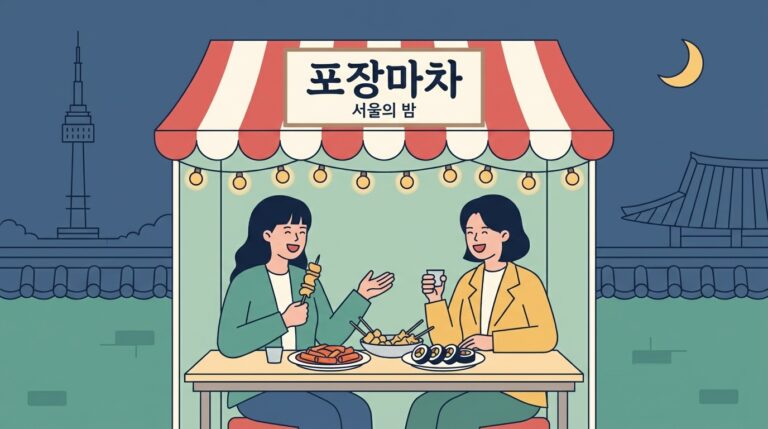
Picture this: You have just survived an agonizing 10-hour workday in Seoul. Your inbox was an avalanche of urgent requests, your subway commute felt like being packed into a tin of seasoned saury, and your mental battery is hovering at exactly one percent. All you want is to collapse onto a plastic stool under the glowing orange tarp of a Pojangmacha (street tent bar), order a piping-hot plate of fiery tteokbokki, and just vent with your best friend.
Yet, when you open your mouth to express that burning exhaustion in Korean, you freeze. If you rely on textbook phrases, you might end up saying something clinical like: “오늘 업무 때문에 스트레스가 많이 쌓였습니다. 대화로 풀고 싶습니다.” (I have accumulated a lot of stress due to work today. I would like to relieve it through conversation.) While grammatically flawless, it sounds like an excerpt from an HR survey, not a raw, soulful decompression session with your closest confidant!
In Korean culture, venting with friends isn’t just everyday small talk; it is an essential communal ritual known for melting away the pressures of a demanding society. Over the past ten years of coaching intermediate (B2) learners, I have seen so many brilliant speakers hit this exact wall: they know the grammar rules, but they lack the organic phrases, the somatic vocabulary, and the emotional pacing required to bond deeply. This guide is crafted from real student breakthroughs and daily Seoul life to help you master the authentic language of de-stressing. Let’s turn that bottled-up pressure into sweet relief together!
Phase 2: 3 Core Expressions In-Depth Analysis
1. 말도 마 (Maldo ma)
- Pronunciation: [Mal-do ma] (Pronounce mal like the start of “Maldon salt”, followed by an open, breathless do, and a sharp ma like “mom” without the final ‘m’.)
- Meaning: Literal: “Don’t even speak.” vs. Real Nuance: “Don’t even get me started!” or “You have no idea how crazy it was.”
- K-Culture Moment: In the hit comedy-drama Work Later, Drink Now (술꾼도시여자들), whenever the three protagonists reunite at their favorite pub after surviving nightmare clients, they slam down their spoons and sigh “말도 마” before launching into the hilarious gossip of the day.
- Editor’s Insight: This phrase is the ultimate storytelling launchpad. It doesn’t tell the listener to be quiet; instead, it dramatically flags that what happened is so absurd or exhausting that ordinary words barely suffice. It instantly pulls the listener into an empathetic conspiracy.
- Situation Spectrum: Casual: ✅ | Semi-formal: ⚠️ (Only with trusted senior colleagues using polite honorifics: 말도 마세요) | Formal: 🚫
- 🤔 Think About It: In English, we often dive directly into our complaints (“You won’t believe what happened…”). Why do you think Korean conversation creates an intentional suspenseful pause with “말도 마” first? What does this say about inviting the listener into shared emotional space?
2. 답답해 죽겠어 (Dapdaphae jukgesseo)
- Pronunciation: [Dap-dap-hae juk-get-seo] (Rhythmically hit the two ‘dap’ syllables like a double heartbeat, then glide through hae, snapping the final juk-get-seo with exasperation.)
- Meaning: Literal: “I am suffocating to death.” vs. Real Nuance: “I am losing my mind from frustration! / It’s driving me completely nuts!”
- K-Culture Moment: In workplace dramas like Misaeng (미생), exhausted office workers step out to the rooftop or coffee counter, pat their chest with a clenched fist, and groan, “진짜 답답해 죽겠다…”
- Editor’s Insight: 답답하다 is one of the most uniquely somatic emotional words in the Korean language. It describes a heavy, stagnant, blocked sensation in the chest or throat. Attaching ~죽겠다 (“to death”) does not carry a dark meaning here; it simply functions as a hyperbolic multiplier for emotional tension.
- Situation Spectrum: Casual: ✅ | Semi-formal: ⚠️ (Use ‘답답해 죽겠어요’ only with peers or close acquaintances) | Formal: 🚫
- 🤔 Think About It: While English speakers describe stress as a mental overwhelm (“I’m so stressed out”), Koreans frequently describe it as a physical obstruction in the chest (답답함). How does viewing emotional pain as physical pressure change how we offer comfort?
3. 속이 다 시원하다 (Sogi da siwonhada)
- Pronunciation: [So-gi da si-won-ha-da] (Say sogi, drop the quick da, and let si-won flow out smoothly like an exhalation of cool wind.)
- Meaning: Literal: “My inside is completely cool.” vs. Real Nuance: “What a cathartic relief! / That feels so incredibly satisfying!”
- K-Culture Moment: In revenge or legal dramas like Vincenzo or Marry My Husband, when a wicked boss or deceptive antagonist finally faces retribution, the main characters clink their beer mugs and cheer, “아, 이제야 속이 다 시원하다!” (Ah, now that’s a true cider moment!)
- Editor’s Insight: In Korean, the word 시원하다 (cool/refreshing) magically applies to ice water, boiling soup that clears your sinuses, and unburdened emotions. When you vent everything to a dear friend and empty your mental clutter, your internal fever cools down.
- Situation Spectrum: Casual: ✅ | Semi-formal: ✅ ( 속이 다 시원해요 ) | Formal: ⚠️ ( 속이 시원합니다 )
- 🤔 Think About It: Notice that the emotional epicenter in Korean is 속 (one’s insides/core/stomach). What metaphor does your native culture use when a burden is lifted? Is it a weight on the back, or a feeling in the gut?
Phase 3: Textbook Korean vs Real Korean
Situation 1: Describing Work Burnout
- 📖 교과서 한국어: “요즘 회사 업무가 많아서 스트레스를 심하게 받고 있습니다.” (Yojeum hoesa eommuga manhaseo seuteureseureul simhage batgo itsseumnida. – These days, I am severely receiving stress because there is much company work.)
- 🗣️ 진짜 한국어: “나 요즘 일 때문에 스트레스 받아서 미치겠어. 오늘 다 털어놓을래.” (Na yojeum il ttaemune seuteureseu badaseo michigesseo. Oneul da teoreonoeullae. – I’m going crazy from work stress lately. I really need to pour it all out today.)
- 💡 왜 다를까? Textbook Korean treats stress as an abstract item you formally “receive” (받고 있습니다). In daily spoken Korean, native speakers treat stress as an active destabilizer (미치겠어 – “it’s driving me crazy”) and use dynamic action verbs like 털어놓다 (to shake out / confide everything) to convey the urge to vent.
Situation 2: Suggesting an After-Work Venting Session
- 📖 교과서 한국어: “친구와 함께 식사하며 대화로 고민을 해결합시다.” (Chinguwa hamkke siksahamyeonseo daehwaro gomin-eul haegyeolhapsida. – Let us resolve our worries with conversation while dining together with a friend.)
- 🗣️ 진짜 한국어: “야, 오늘 매운 거 먹으면서 수다 한판 때리자!” (Ya, oneul maeun geo meogeumyeonseo suda hanpan ttaerija! – Hey, let’s smash some spicy food and hit an epic round of chatter tonight!)
- 💡 왜 다를까? Expressions like “한판 때리다” (literally to strike a round of something) infuse casual speech with punchy momentum. It elevates a casual chat into a passionate, revitalizing bonding mission.
Phase 4: K-Culture Deep Dive & Non-Verbal Manners
4-1. 눈치 (Nunchi) & Gestures: The Art of Attuned Venting
- The Sternum Tap (가슴 치기): When describing something infuriating, lightly pat your own upper chest with a loosely clenched fist while exhaling sharply. It non-verbally communicates that the injustice feels lodged right in your chest.
- The Seal Clap (물개박수) & Vocal Mirroring: If your friend is venting, do not remain silent or wait for your turn to speak. Lean forward across the table, nod continuously, and drop frequent verbal anchors: “맞아!” (Exactly!), “진짜?” (Seriously?!), or “어머, 웬일이야!” (Oh my goodness, what on earth!). If they say something bitterly funny, a rapid clap-and-laugh confirms your total solidarity.
- The Communal Cup Care: Keep an eye on your friend’s glass. In Korea, pouring your own drink while venting feels lonesome. Whenever their glass is empty, refill it with two hands as a silent gesture of saying: “I hear you, take your time, keep going.”
4-2. Cultural Code: Spicy Food Therapy (매운맛 테라피)
Ever notice how Korean venting sessions almost inevitably gravitate toward tteokbokki, buldak (fire chicken), spicy braised chicken (dakdoritang), or fiery chicken feet (dakbal)? This is not a coincidence. Koreans treat capsaicin as an edible catharsis. The sharp heat forces endorphin release, causes physical sweating that mimics a workout, and gives everyone an immediate biological excuse to sigh, laugh, and blow off steam in unison.
Phase 5: Real-Life Roleplay Scenario
- Setting: 8:45 PM on a rainy Thursday. Inside a retro Pojangmacha near Jongno 3-ga. Raindrums against the plastic tarpaulin. The smell of scallion pancakes and spicy stir-fried cartilage fills the warm tent.
- Characters:
- 지원 (Ji-won): Your candid, warm-hearted Korean coworker-turned-close-friend who looks completely drained after an unexpected department audit.
- 나 (You): An intermediate Korean learner ready to decompress after a chaotic week.
[Dialogue]
1. 지원 (Ji-won): “야, 오늘 진짜 영혼까지 털렸어… 너는 하루 어땠어?”
(Ya, oneul jinjja yeonghonkkaji teollyeosseo… Neoneun haru eottaesseo?
Hey, my soul was literally drained dry today… How was your day?
🎭 Collapses onto the orange plastic stool and unbuttons her heavy coat with a deep, weary sigh.)
- 나 (You): “말도 마. 나도 오늘 하루 종일 답답해 죽는 줄 알았어.”
(Maldo ma. Nado oneul haru jong-il dapdaphae jungneun jul arasseo.
Don’t even get me started. I felt like I was suffocating to death from frustration all day too.
🎭 Shakes head slowly, tapping upper chest once with a knowing grimace.) -
지원 (Ji-won): “진짜? 설마 부장님이 또 마감 직전에 트집 잡았어?”
(Jinjja? Seolma bujangnimi tto magam jikjeone teujip jabatseo?
Seriously? Don’t tell me the department manager nitpicked right before the deadline again?
🎭 Leans both elbows onto the stainless-steel table, eyes wide with genuine concern.) -
나 (You): “맞아! 퇴근 30분 전에 기획서를 완전히 다 뒤엎으라는 거야.”
(Maja! Toe-geun samsipbun jeone gihoekseoreul wanjeonhi da dwieopeuraneun geoya.
Exactly! Thirty minutes before clocking out, he told me to scrap the entire proposal and start over!
🎭 Throws both hands slightly upward in sheer disbelief.) -
지원 (Ji-won): “뭐라고? 와, 듣기만 해도 내가 다 열받는다! 일단 한 잔 마셔.”
(Mworago? Wa, deutgiman haedo naega da yeolbanneunda! Ildan han jan masyeo.
What?! Wow, just listening to this gets my own blood boiling! Drink a glass first.
🎭 Promptly pours a fresh cold drink into your glass with two hands.) -
나 (You): “고마워. 너한테 다 털어놓으니까 속이 다 시원하다.”
(Gomawo. Neohante da teoreonoeunikka sogi da siwonhada.
Thanks. Honestly, just pouring it all out to you makes me feel so relieved.
🎭 Clinks glasses together firmly with a relaxed, grateful smile.) -
지원 (Ji-won): “원래 친구끼리 수다 떨면서 푸는 거지! 자, 매운 닭발 나왔다.”
(Weollae chingukkiri suda tteolmyeonseo puneun geoji! Ja, maeun dakbal nawatta.
That’s what friends are for—blowing off steam together through endless talk! Look, the spicy chicken feet arrived.
🎭 Hands you a fresh set of chopsticks with an affectionate, triumphant grin.) -
나 (You): “좋아, 오늘 이 매운맛으로 스트레스 싹 다 날려버리자!”
(Joa, oneul i maeunmaseuro seuteureseu ssak da nallyeobeorija!
Awesome, let’s blow every single trace of stress away with this fiery spice tonight!
🎭 Picks up chopsticks and dives into the steaming red dish enthusiastically.)
🔀 Interactive Decision Branching
Ji-won picks up her drink, ready to share the audit disaster her manager caused. What is your best response to keep the supportive energy flowing?
- Option A: “무슨 일 있었는데? 하나도 빠짐없이 다 얘기해 봐! 내가 다 들어줄게.” (What on earth happened? Tell me everything without leaving out a single detail! I’m all ears.)
- Option B: “원래 직장 생활이 다 그런 거니까, 그냥 잊어버리고 먹자.” (Work life is always like that anyway, so let’s just forget about it and eat.)
- Option C: “그럼 내일 출근해서 감사팀에 정식으로 이의 제기서를 제출해 봐.” (Then go to work tomorrow and formally file an objection letter with the audit team.)
-
Feedback:
- Option A [Best]: Spot on! In Korean suda culture, offering unrestricted emotional sanctuary (“tell me everything, I’m on your side”) is the highest form of companionship.
- Option B [Bad]: Cold and dismissive. Telling a stressed friend to simply “get over it” invalidates their vulnerability.
- Option C [Risk]: Far too robotic. Unless your friend explicitly asks for tactical advice, jump into emotional alignment first before proposing corporate solutions!
Phase 6: 10-Second Emotion Shadowing Drill
Read these out loud, observing the rhythmic pause markers (/) and channeling the target emotion:
[😤 답답하고 억울하게 - Pent-up frustration and disbelief]
“말도 마… / 마감 직전에 / 기획서를 다 바꾸라잖아!”
(Mal-do ma… / magam jikjeone / gihoekseoreul da bakkurajanha!)
(Tip: Let out an audible breath right at the slash after ‘말도 마’.)-
[🥺 진심으로 공감하며 역정에 차서 - Fierce righteous empathy]
“와, 진짜? / 듣기만 해도 / 내가 다 화나네!”
(Wa, jinjja? / deutgiman haedo / naega da hwanane!)
(Tip: Elevate your pitch on ‘와, 진짜?’, and deliver ‘내가 다’ with strong percussive emphasis.) -
[🍻 후련하고 개운하게 - Complete cathartic release]
“크으! / 너한테 털어놓으니까 / 속이 다 시원하다!”
(Keu-eu! / neohante teoreonoeunikka / sogi da siwonhada!)
(Tip: Make the quintessential Korean “Keu-eu!” gut sound, then relax your jaw completely on ‘시원하다’.)
Phase 7: K-Culture Mini Dictionary
- 사이다 (Sa-i-da) | Noun | Literal: Lemon-lime soda. | Usage: Slang for an exhilarating situation, witty retort, or outcome that delivers immediate, refreshing justice and blows away frustration. (Opposite: 고구마 – goguma, sweet potato, meaning suffocatingly slow or frustrating).
- 털어놓다 (Teo-reo-no-ta) | Verb | Translation: To unbosom / to pour out one’s heart. | Usage: Used when sharing deep personal burdens, workplace gossip, or long-held secrets with someone you unconditionally trust.
- 뒷담화 (Dwit-dam-hwa) | Noun | Translation: Behind-the-scenes venting / gossip. | Usage: While malicious slander is frowned upon, mutual dwitdamhwa among peers functions as an acknowledged psychological safety valve in high-stress hierarchical institutions.
- 불금 (Bul-geum) | Noun | Literal: Fire Friday (TGIF). | Usage: The weekly cultural ritual of incinerating five days of workplace fatigue through savory food, cold drinks, and unrestrained conversation deep into the night.
Phase 8: Survival Kit for Travelers
Top 3 On-the-Ground De-stressing Expressions
- “여기 물 좀 더 주세요!” (Yeogi mul jom deo juseyo! – Could we please have some more water here?)
- Pro Tip: When conquering ultra-spicy street food to de-stress, don’t play tough. Hydrate proactively!
- “덜 맵게 해 주세요.” (Deol maepge hae juseyo. – Please make it less spicy.)
- Pro Tip: Authentic Korean spicy venting dishes can push serious culinary limits. If your tolerance is mild-to-medium, this sentence will save your stomach.
- “계산은 따로따로 할게요.” (Gyesaneun ttarottaro halgeyo. – We would like to pay separately.)
- Pro Tip: If splitting the bill (더치페이 – Dutch pay) after an epic multi-round food and drink crawl, announce this before handing over payment cards.
Editor’s Travel Note
- Local Navigation App: Skip Western map services, which often show outdated paths in Korea. Download the [Naver Map app on iOS & Android] to explore tucked-away alleyway pojangmacha spots in Euljiro or rooftop cafes in Seongsu-dong.
- Night Ride Mobility: Venting sessions often stretch past midnight when the Seoul subway shuts down. Set up the [Kakao T taxi booking app] ahead of time so you can hail certified, hassle-free cabs back to your hotel without any language anxiety.
Phase 9: “One Step Deeper” (Reflective Insight)
Korean society functions on a remarkably intricate social architecture: high-speed performance (Ppalli-ppalli culture) on the outside, and meticulous social hierarchy (Jondaetmal honorifics and seniority dynamics) on the inside. Because individuals must maintain high levels of composure and self-regulation in their public roles, the private sphere of friendship becomes a profound emotional sanctuary.
In this context, venting (suda) is never viewed as mere self-absorbed complaining. Rather, it is a treasured exchange of Jeong (정, warm relational affection). By sharing your messy, unpolished vulnerabilities and admitting that you feel “답답해 죽겠어”, you are offering your friend the ultimate compliment: I trust you enough to put down my social armor in front of you.
💬 Your Turn: How does your home culture de-stress with friends? Do people look for immediate analytical solutions, or do you prioritize sitting together in emotional solidarity over food like we do in Korea? Share your story in the comments below!
Phase 10: FAQ & Common Mistakes
Q: Can I use “말도 마” with an older coworker or boss if we are having casual drinks?
A: Definitely not! “말도 마” is strictly banmal (informal/casual language). Using bare banmal with someone of higher organizational or age hierarchy is considered rude, regardless of how relaxed the dinner table feels. If speaking with a friendly senior (sunbae), soften it into polite language: “말도 마세요, 정말 고생했어요” (Don’t even ask, it was such an ordeal).
Q: What is the exact difference between “스트레스 받다” and “스트레스 풀다”?
A: Think of it as inbound versus outbound energy. “스트레스(를) 받다” literally means to receive stress (the input of exhaustion). Conversely, “스트레스(를) 풀다” means to untie or dissolve stress (the output of relief, like loosening a tight knot).
Q: Why do people say “내가 다 열받네” when someone else is telling a story?
A: The phrase “내가 다 ~하다” literally translates to “I feel [emotion] on your behalf.” Saying “내가 다 열받네!” (I’m the one getting furious just hearing this!) proves you are emotionally co-living the experience with the storyteller. It is one of the warmest linguistic embraces in colloquial Korean.
🚨 Common Mistakes Board
- Mistake: Overusing the second-person pronoun “너 (neo)” while chatting casually with Korean peers.
- Correct Action: Native speakers rarely use “너” face-to-face; it can sound unnervingly confrontational. Instead, use their first name followed by the vocative particle (민지야 – Minji-ya) or omit the subject entirely.
- Mistake: Offering logical diagnostic solutions during the first 5 minutes of a friend’s venting.
- Correct Action: Hold your advice! First deliver pure validation: “진짜 힘들었겠다” (That must have been so exhausting) or “네 마음 완전 이해해” (I 100% get how you feel).
- Mistake: Confusing “시원하다” (refreshing/cathartic) with “차갑다” (physically cold to touch).
- Correct Action: When describing emotional liberation, a cooling breeze, or even a spicy piping-hot broth that cleanses your palate, always choose “시원하다”!
Phase 11: Action Missions & Engagement
- 🥉 Bronze Mission (Solo Practice): Stand in front of your mirror, give your chest a gentle pat, and practice delivering this line with authentic frustration: “말도 마, 오늘 답답해 죽는 줄 알았어!” (Say it 3 times until the rhythm feels second nature.)
- 🥈 Silver Mission (Community Challenge): The next time you order your favorite comfort food (especially something spicy!), snap a quick photo and share it with the caption: “오늘 스트레스 싹 다 날렸다! 속이 다 시원하다 🔥 #DailyHangul”.
- 🥇 Gold Mission (Real-Life Application): Next time a Korean acquaintance or language exchange partner asks “오늘 하루 어땠어요?”, steer away from the textbook “좋았어요” and reply: “말도 마세요, 오늘 정말 정신없었어요!” (Don’t even ask, it was so hectic today!).
- 🎮 K-Culture Mission: Tune into an episode of the slice-of-life drama Work Later, Drink Now or My Mister. Keep your ears peeled for the exact moment a character switches from formal corporate Korean into casual suda venting speech. Write down at least two emotional reaction words you recognize!
Phase 12: Interactive Quiz Challenge
Test your real-world instincts! Answer these three practical challenges below:
1. Situation Judgement
Your Korean friend Ji-won just spent ten straight minutes venting about how her team leader unfairly passed her project credit over to someone else. Which response creates the best emotional bonding?
* (A) “다음부터는 증거를 이메일로 미리 남겨 두는 게 훨씬 합리적이야.”
* (B) “와, 진짜 어이없다! 듣기만 해도 내가 다 속 터지네!”
* (C) “팀장님도 회사 사정이 있어서 어쩔 수 없었을 거야.”
2. Fill-in-the-Blank
Complete this classic Korean expression for untying life’s daily stress:
“우리 오늘 매운 떡볶이 먹으면서 스트레스 싹 다 (_______)자!”
(Hint: The verb root means ‘to untie’ or ‘to dissolve’.)
3. True or False Cultural Quiz
In Korean, the phrase “속이 다 시원하다” can only be uttered when you are drinking an ice-cold beverage on a scorching summer day. (True / False)
👉 Click here to reveal the Quiz Answers & Detailed Explanations!
-
Answer: (B)
Explanation: In Korean venting culture, immediate emotional alignment (“내가 다 속 터지네!” – My own chest is bursting with anger on your behalf!) is ten times more comforting than cold, hyper-logical advice (A) or playing devil’s advocate for the boss (C). -
Answer: 풀 (pul)
Explanation: The base verb is 풀다 (pulda – to untie, dissolve, or resolve). When attached to the casual cohortative suffix ‘~자’ (let’s), it becomes 풀자 (“Let’s dissolve our stress!”). -
Answer: False
Explanation: “속이 다 시원하다” is frequently used for psychological satisfaction, relieving pent-up emotional frustration, or even while sipping scalding hot soup (해장국) that makes you break into a restorative sweat!







