

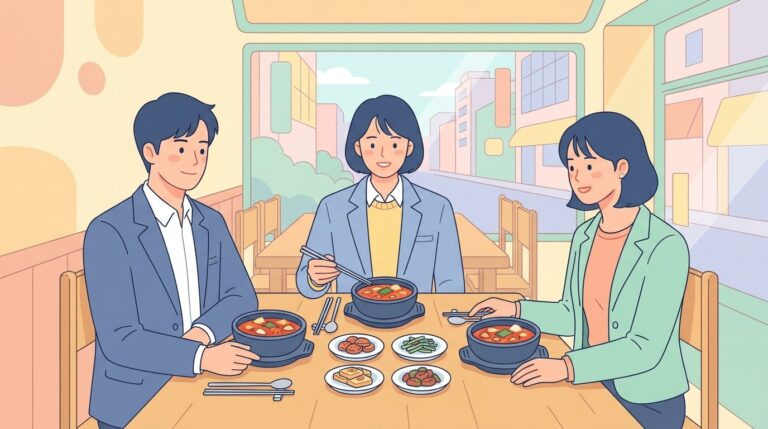
Surviving the Korean Office Lunch Dilemma: How to Order Without Losing Face
Phase 1: 공감 (스토리 몰입형 오프닝)
안녕하세요! 매일한글 에디터입니다.
It is exactly 11:58 AM on a regular Tuesday at an office in Teheran-ro, Gangnam. Suddenly, a heavy silence falls over the open-plan office. Keyboards stop clicking. Colleagues exchange quick, sideways glances. Then comes the dreaded question from your team leader: “So… what should we eat for lunch today?”
If you have watched K-Dramas like Misaeng (Incomplete Life), you know this is not a casual food inquiry—it is an intricate ritual of workplace diplomacy. In Korean corporate culture, picking lunch is rarely about personal culinary cravings; it is about Nunchi (눈치, social sensing), group cohesion, and hierarchy. As an expat or international professional, this moment can feel like walking through a conversational minefield. Do you suggest a burger? Do you shout “Anything!”? Or do you stay silent and stare at your monitor?
Over the past decade of coaching foreign professionals in Seoul, “Lunch Menu Paralysis” has consistently ranked as one of the most nerve-wracking daily micro-interactions. Learning the subtle art of the Korean lunch negotiation will immediately boost your rapport with coworkers, display high emotional intelligence, and save you from the awkward social blunder of ordering a 40-minute artisanal pasta when your boss just wants a 10-minute bowl of Kimchi-jjigae. Let’s master the exact phrases and cultural codes so you can step out for lunch with total confidence!
Phase 2: 핵심 표현 3선 심층 분석
1. 저는 다 좋아요. (Jeoneun da joayo.)
- Pronunciation: [Jeo-neun da jo-ah-yo] (Sounds like “John-un da joy-o”)
- Meaning: Literal: “I like everything.” / Nuance: “I am easy-going and completely happy to follow the team’s decision!”
- K-Culture Moment: Frequently used in office sitcoms when a junior employee wants to blend into the background and let the senior manager make the call without being accused of having no opinion.
- Editor’s Insight: While textbook Korean teaches “아무거나 괜찮아요” (Anything is fine), “저는 다 좋아요” sounds significantly warmer and more cooperative. “아무거나” can unintentionally sound dismissive or bored, like “Whatever.”
- Situation Spectrum: Casual: ✅ | Semi-formal: ✅ | Formal: ⚠️
- 🤔 Think About It: In Western business cultures, expressing distinct personal preferences shows individuality. Why does Korean culture value dietary flexibility as a sign of teamwork?
2. 칼칼한 거 어떠세요? (Kalkalhan geo eotteoseyo?)
- Pronunciation: [Kal-kal-han geo eo-tteo-se-yo] (Sounds like “Cull-cull-hahn go uh-tto-say-yo”)
- Meaning: Literal: “How about something spicy and throat-clearing?” / Nuance: “How about a savory, refreshing hot stew to recharge or cure our collective hangover?”
- K-Culture Moment: Seen in almost every contemporary K-Drama where coworkers gather after a late-night team dinner (Hoeshik) and crave comforting soup like Sundubu-jjigae or Yukgaejang.
- Editor’s Insight: “칼칼하다” is an untranslatable sensory adjective describing a sharp, clean chili spice that warms the back of your throat. Suggesting a category (like spicy soup) instead of a specific restaurant allows the team leader to retain decision-making power while nudging the team toward a popular group consensus.
- Situation Spectrum: Casual: ✅ | Semi-formal: ✅ | Formal: ✅
- 🤔 Think About It: Notice how this expression proposes a flavor sensation rather than an item. How does sensory language help avoid direct disagreement?
3. 팀장님 드시고 싶은 걸로 가요! (Timjangnim deusigo sipeun geollo gayo!)
- Pronunciation: [Tim-jang-nim deu-si-go si-peun geol-lo ga-yo] (Sounds like “Team-jang-nim dew-she-go she-poon girl-lo guy-yo”)
- Meaning: Literal: “Let’s go with whatever the team leader wants to eat!” / Nuance: “We trust your choice, boss; please lead the way!”
- K-Culture Moment: The classic line delivered by attentive junior associates with a respectful smile when the team is stuck in decision fatigue.
- Editor’s Insight: This phrase employs high-honorific vocabulary: “드시다” (to eat, honorific) instead of “먹다”. It actively grants authority to the senior member while relieving peers of the burden of choosing.
- Situation Spectrum: Casual: 🚫 | Semi-formal: ✅ | Formal: ✅
- 🤔 Think About It: How does verbally surrendering choice demonstrate respect and filial loyalty in corporate hierarchies?
Phase 3: 교과서 한국어 vs 진짜 한국어
Situation 1: Suggesting an item you crave without sounding selfish
- 📖 교과서 한국어: 저는 오늘 김치찌개를 먹고 싶습니다. (Jeoneun oneul gimchijjigaereul meokgo sipseumnida. / “I want to eat kimchi stew today.”)
- 🗣️ 진짜 한국어: 날도 쌀쌀한데 김치찌개 당기지 않으세요? (Naldo ssalssalhande gimchijjigae danggiji aneuseyo? / “It’s chilly today; aren’t you craving some kimchi stew?”)
- 💡 왜 다를까?: Directly stating your individual desire (“먹고 싶습니다”) sounds overly blunt and demanding in a Korean group context. Native speakers tie their suggestion to shared environmental factors (like the weather) and use “당기다” (to crave / to pull) framed as a communal question.
Situation 2: Narrowing down lunch options smoothly
- 📖 교과서 한국어: 아무 음식이나 상관없습니다. (Amu eumsigina sanggwaneopseumnida. / “Any food does not matter to me.”)
- 🗣️ 진짜 한국어: 저는 어제 면 먹어서 밥 종류면 다 좋아요! (Jeoneun eoje myeon meogeoseo bap jongnyumyeon da joayo! / “I had noodles yesterday, so anything with rice sounds great!”)
- 💡 왜 다를까?: Saying “I don’t care” forces others to carry 100% of the cognitive load. By setting a broad category boundary (rice vs. noodles), you help the group eliminate choices without appearing picky.
Phase 4: K-Culture 딥다이브 & 비언어적 매너
4-1. 눈치(Nunchi) & 제스처 (The Silent Restaurant Protocol)
When the team finally enters the restaurant, the lunch dynamics are only half done:
1. The Napkin & Utensil Setup: As the junior or newer member, grab the paper napkins, lay them down neatly in front of everyone, and place metal spoons and chopsticks on top. Do this instinctively before browsing the menu.
2. Water Duty: Pick up the stainless steel water jug, fill the senior colleague’s cup first, and then work clockwise. Never fill your own cup first.
3. Menu Reading: Notice the team leader’s eyes. If they gravitate toward the daily set meal, don’t order an expensive seasonal delicacy that takes twice as long to prepare.
4-2. 문화 코드 분석: 식구 (Sikgu) & “밥심 (Bap-shim)”
In Korean, an intimate term for “family” is Sikgu (식구), which translates literally to “mouths eating together.” Sharing a midday meal is not an administrative break; it is an emotional bonding ritual. Rejecting communal lunch to eat a protein bar at your desk without notice can be perceived as distancing yourself from the corporate tribe. Koreans believe in Bap-shim (밥심, stamina fueled by a proper cooked meal). Joining in, sharing side dishes (Banchan), and exchanging laughs over bubbling stews is the ultimate ticket to becoming an insider.
Phase 5: 실전 롤플레이 시나리오
Setting: It is 12:02 PM. Manager Park (팀장님), Assistant Manager Minji (대리님), and you (Alex) stand in the office elevator hallway.
- 박 팀장 (Manager Park): 🎭 Strokes his chin and gazes at the ceiling with indecision
“벌써 열두 시네. 오늘 점심 뭐 먹지?”
(Beolsseo yeoldu sine. Oneul jeomsim mwo meokji?)
“It’s twelve already. What should we eat for lunch today?” - 이민지 (Minji): 🎭 Glances quickly at Manager Park, then turns to you
“알렉스 씨, 혹시 오늘 특별히 생각나는 거 있어요?”
(Alex ssi, hoksi oneul teukbyeolhi saenggangnaneun geo isseoyo?)
“Alex, is there anything specific you are craving today?” - 알렉스 (Alex): 🎭 Smiles warmly and shakes head gently
“저는 다 좋아요! 어제 야근하셨는데 해장되는 국물 어떠세요?”
(Jeoneun da joayo! Eoje yageunhasyeonneunde haejangdoeneun gungmul eotteoseyo?)
“I like everything! You worked overtime yesterday, so how about some soup to recharge?” - 박 팀장 (Manager Park): 🎭 Nods vigorously with visible relief
“오, 알렉스 씨 눈치 빠른데? 속 풀리는 뜨끈한 게 딱 필요했어.”
(O, Alex ssi nunchi ppareunde? Sok pullineun tteukkeunhan ge ttak piryohaesseo.)
“Oh, Alex has great nunchi! I desperately needed something warm and soothing for my stomach.” - 이민지 (Minji): 🎭 Pulls out smartphone to check local wait times
“회사 앞 북어국집 갈까요, 아니면 뼈해장국집 갈까요?”
(Hoesa ap bugeogukjip galkkayo, animyeon ppyohaejanggukjip galkkayo?)
“Shall we go to the dried pollock soup place across the street, or the pork bone hang-over stew place?” - 알렉스 (Alex): 🎭 Turns politely toward Manager Park with open hands
“팀장님 드시고 싶은 걸로 가요! 둘 다 맛있어 보여요.”
(Timjangnim deusigo sipeun geollo gayo! Dul da masisseo boyeoyo.)
“Let’s go with whatever you prefer, Manager Park! Both look delicious.” - 박 팀장 (Manager Park): 🎭 Pats Alex on the shoulder cheerfully
“좋아, 오늘은 뼈해장국으로 든든하게 갑시다! 내가 쏠게!”
(Joa, oneureun ppyohaejanggugeuro deundeunhage gapsida! Naega ssolge!)
“Great, let’s go with pork bone stew for hearty energy today! My treat!” - 이민지 (Minji): 🎭 Chuckles and presses the lobby elevator button
“팀장님, 잘 먹겠습니다! 알렉스 씨, 메뉴 추천 나이스였어요.”
(Timjangnim, jal meokgetseumnida! Alex ssi, menyu chucheon naiseyeosseoyo.)
“Thank you for the lunch, Manager Park! Alex, nice menu nudge.”
🔀 인터랙티브 분기점 (Your Choice at Turn 3):
When Minji asks what you want to eat, how do you respond?
* Choice A: “저는 햄버거 먹고 싶어요. 각자 먹을까요?” (I want to eat hamburgers. Shall we eat individually?)
👉 Feedback (Bad): Proposing individual fast food breaks the group harmony and signals that you wish to separate yourself from the team.
* Choice B: “아무거나요. 상관없어요.” (Anything. Doesn’t matter.)
👉 Feedback (Risk): While common, flat indifference can make you seem unenthusiastic and unhelpful to a manager seeking consensus.
* Choice C: “저는 다 좋아요! 어제 야근하셨는데 해장되는 국물 어떠세요?” (I like everything! How about some soup to recharge?)
👉 Feedback (Best!): Perfect score! You display flexibility (Nunchi), show empathy for your boss’s overtime fatigue, and offer a practical direction without demanding a specific venue.
Phase 6: 10초 감정 섀도잉 드릴 (Shadowing Drill)
Practice matching the exact rhythm, micro-pauses (/), and emotional intent of native speakers!
[😊 밝고 배려심 넘치게 / Bright & Considerate]
“저는 / 다 좋아요! / 편하신 걸로 / 골라주세요.”
(Jeoneun / da joayo! / Pyeonhasin geollo / golrajuseyo.)
“I’m good with anything! Please pick whatever is comfortable for you.”-
[🤔 센스 있게 유도하며 / Tactful & Observant]
“오늘 날씨도 흐린데, / 칼칼한 김치찌개 / 어떠세요?”
(Oneul nalssido heurinde, / kalkalhan gimchijjigae / eotteoseyo?)
“The weather is overcast today; how about some spicy, savory kimchi stew?” -
[🫡 깍듯하고 흔쾌하게 / Respectful & Deferential]
“팀장님 / 드시고 싶은 메뉴로 / 바로 가시죠!”
(Timjangnim / deusigo sipeun menyuro / baro gasijyo!)
“Let’s head straight to whatever menu you’d like to eat, Team Leader!”
Phase 7: K-Culture 미니 사전 (핵심 키워드 4개)
- 눈치 (Nunchi): The intuitive art of gauging others’ thoughts, moods, and unspoken desires to maintain harmony. In the workplace, high nunchi ensures smooth teamwork and conflict prevention.
- 국룰 (Guk-rul): A compound of Guk (Nation) and Rule. Refers to an unwritten societal consensus or universal standard (e.g., ordering iced Americano right after lunch is Korea’s corporate Guk-rul).
- 당기다 (Danggida): Literally meaning “to pull,” this colloquial verb is used when your stomach or mood is pulled toward a specific food (e.g., “치킨 당긴다” = “I’m craving fried chicken”).
- 점메추 (Jeom-me-chu): Trendy acronym for 점심 메뉴 추천 (Lunch Menu Recommendation). Often texted in corporate team chat rooms around 11:30 AM.
Phase 8: 여행자를 위한 생존 키트
Top 3 Survival Phrases
- “여기 뭐가 제일 잘 나가요?” (Yeogi mwoga jeil jal nagayo?)
Literal: “What goes out the best here?”
👉 Pro Tip: Use this at bustling local restaurants when you can’t read the wall menu. It asks for their signature bestseller. - “덜 맵게 해주실 수 있나요?” (Deol maepge haejusil su innayo?)
Literal: “Can you make it less spicy?”
👉 Pro Tip: Essential for stews if your spice tolerance is low; cooks will gladly reduce the red chili powder (Gochugaru). - “따로 계산해도 될까요?” (Ttaro gyesanhaedo doelkkayo?)
Literal: “Can we pay separately?”
👉 Pro Tip: Useful when having Dutch-pay lunches with colleagues at counter checkouts.
Editor’s Travel Note
When coordinating lunch spots in Korea, Google Maps frequently lacks up-to-date business hours or interior photos. Instead, install the Naver Map application download to check real-time menus, crowd waiting trends, and authentic local reviews. Also, keep in mind that many traditional downtown eateries (Baekban spots) require a 2-person minimum order for main hotpot dishes during peak lunchtime (11:45 AM – 1:00 PM).
Phase 9: “한 발 더 깊이” (생각 질문)
In many Western cultures, a lunchtime conversation is built around personal autonomy: individuals state their boundaries, pick distinct dietary trays, and enjoy personal headspace. Korean corporate dining, however, is rooted in neo-Confucian collective interdependence where yielding your personal palate for the group’s smooth cohesion is regarded as a sign of maturity. Sharing a bubbling pot of stew from the same burner creates an emotional tether (Jeong, 정) that solitary lunches simply cannot foster.
💬 Your Turn: How does your home country handle group business lunches? Would people feel offended or relieved if a colleague suggested: “Let’s just eat whatever the boss wants”? Share your thoughts below!
Phase 10: FAQ & 오해 방지 (FAQ Schema)
Q: Can I bring my own packed lunch (Dosirak) to a Korean office?
A: Yes, it has become increasingly common among younger workers due to rising food prices (Lunchflation). However, during your first month, it is culturally advisable to join your team for lunch as much as possible to build foundational rapport before opting out.
Q: What should I do if I have severe dietary restrictions or allergies?
A: Communicate your restrictions early and clearly to your immediate mentor or teammate (e.g., “저는 돼지고기를 못 먹어요” – I cannot eat pork). Frame it as an allergy or health restriction rather than a personal whim, and offer 2–3 alternative cuisines where your team can still find diverse options.
Q: Is it considered rude to order a more expensive meal than your manager?
A: Generally, yes. If the team leader or senior colleague announces they are paying (“내가 쏠게”), it is an unwritten etiquette rule to choose a menu item in the same price tier or slightly cheaper than what they ordered.
🚨 흔한 실수 (Common Mistakes) 경고판
- ❌ Mistake 1: Saying “아무거나요!” (Whatever!) while looking completely disinterested on your phone.
✅ Correct Action: Provide broad categories: “저는 다 좋은데, 밥이나 따뜻한 국물이면 좋겠습니다!” (I like anything, but rice or warm soup would be great!) - ❌ Mistake 2: Starting to eat the second your bowl arrives at the table.
✅ Correct Action: Wait until the most senior person at the table picks up their spoon and takes the first bite. - ❌ Mistake 3: Rushing to pay for everyone as a junior intern to be polite.
✅ Correct Action: In Korea, seniority pays downwards. Offer sincere verbal gratitude (“잘 먹었습니다!”) or offer to buy coffees at a nearby kiosk afterwards.
Phase 11: 액션 미션 & 참여 유도
- 🥉 Bronze Mission (Solo Practice): Stand in front of your mirror and practice saying: “저는 다 좋아요. 칼칼한 거 어떠세요?” with a bright, welcoming smile in under 5 seconds.
- 🥈 Silver Mission (Social Connection): The next time you chat with a Korean friend, ask: “오늘 점심 메뉴 정하셨어요? 점메추 해드릴까요?” (Have you decided on lunch today? Want a lunch menu recommendation?).
- 🥇 Gold Mission (Real-World Application): At your next group meal with Korean colleagues or classmates, set out the paper napkins and utensils before anyone else touches the table.
- 🎮 K-Culture Mission: Watch Episode 1 of the K-Drama Misaeng or Hospital Playlist. Spot how the junior doctors or interns handle water glasses and menu discussions during their meal scenes!
Phase 12: 인터랙티브 퀴즈 챌린지
1. Situation Judgment:
Your Korean manager turns to you and asks: “알렉스 씨, 오늘 점심 뭐 먹고 싶어요?” You don’t want to make an assertive demand, but you really want warm soup. Which response displays the highest Nunchi?
* A) “저는 무조건 삼계탕이어야 합니다.” (It must unconditionally be ginseng chicken soup.)
* B) “아무거나 괜찮은데, 오늘 날씨가 쌀쌀해서 국물 요리 당기네요!” (Anything is fine, but since it’s chilly today, I’m craving a warm soup dish!)
* C) “저는 점심 생각 없으니 혼자 드세요.” (I don’t care for lunch, go eat alone.)
🔍 정답 및 해설 보기 (Click to view Answer & Explanation)
Correct Answer: B
Explanation: Option B balances flexibility with a gentle, helpful nudge. Connecting your craving to the cold weather gives a logical context that helps the group narrow down restaurant options without feeling forced.
2. Fill in the Blank:
Fill in the missing sensory adjective meaning “spicy, savory, and throat-clearing”:
“어제 술 한잔했는데, 오늘 점심에 [ ______ ] 찌개 어떠세요?”
🔍 정답 및 해설 보기 (Click to view Answer & Explanation)
Correct Answer: 칼칼한 (Kalkalhan)
Explanation: 칼칼한 perfectly describes the refreshing, spicy broth Koreans crave to soothe their stomach after a long evening or night out.
3. True or False Cultural Manners:
In Korean office etiquette, when eating lunch out, it is considered polite for the youngest or most junior member to let senior colleagues distribute the napkins, chopsticks, and pour the water.
* (True / False)
🔍 정답 및 해설 보기 (Click to view Answer & Explanation)
Correct Answer: False
Explanation: It is customary for the most junior members (Maknae, 막내) to lay out napkins, set the utensils, and pour water for their seniors. It showcases attentiveness and proactive team care.







