

Phase 1: 공감 (Story-Immersive Opening)
안녕하세요! 매일한글 에디터입니다.
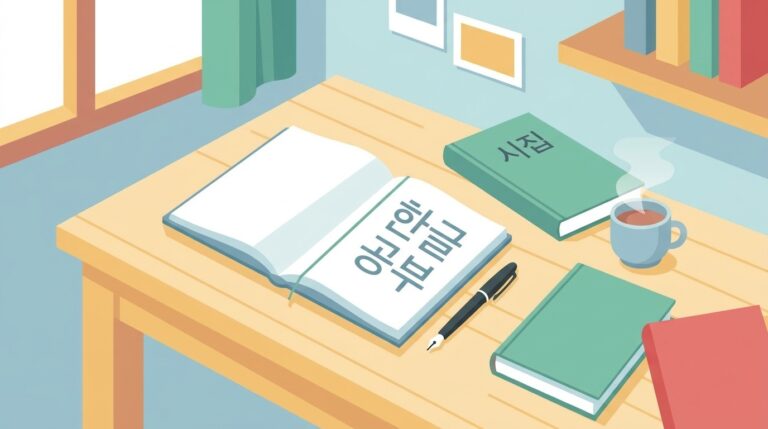
Picture this: You are sitting by a rainy window in a quiet cafe tucked behind the alleyways of Seochon, Seoul. Across from you, a young Korean university student opens a thick linen notebook, unclasps a fountain pen, and begins transcribing a passage from Han Kang’s latest novel with meditative care. There is no rush, no frantic typing—just the crisp, rhythmic whisper of ink meeting paper.
If you have reached the C1 level in Korean, you know this peculiar frustration all too well: your vocabulary is solid, you can breeze through TOPIK II reading passages, and you grasp topical news broadcasts. Yet, when you sit down to write an insightful book review (서평) or engage in an intellectual debate, you find yourself recycling the same basic expressions like “이 책은 정말 재미있었다” (This book was really fun) or “매우 감동적이었다” (It was very touching). Your active expression feels pale compared to your passive comprehension.
This is where the venerable Korean tradition of 필사 (Pilsa – handwritten text transcription) enters the picture. Across Korean reading circles and creative writing circles, copying curated masterworks by hand is not a mechanical chore; it is the ultimate cognitive bridge that elevates textbook proficiency into genuine authorial flair. Based on ten years of guiding advanced learners beyond the “intermediate plateau,” this guide introduces the core vocabulary, cultural nuance, and practical methodology of Pilsa—helping you digest complex syntax, discover your own Korean voice, and craft literary book reviews that resonate like a native speaker’s.
Phase 2: 핵심 표현 3선 심층 분석 (Core Expressions Deep Dive)
1. 문장을 곱씹다 (Munjang-eul gop-ssipda)
- Pronunciation: Munjang-eul gop-ssipda (sounds like “moon-jahng-eul gohp-sheep-dah”; the “gop” snaps lightly against the lips before the rhythmic “ssip”)
- Meaning: Literally “to chew a sentence repeatedly like a cow chewing the cud.” Nuance: To ruminate on, savor, and deeply contemplate the layered subtext of a piece of writing.
- K-Culture Moment: Frequently heard on literary broadcasts, YouTube essay channels, and book podcasts like Kim Young-ha’s Book Reading Club when a host lingers over a solitary, haunting sentence.
- Editor’s Insight: Intermediate speakers default to “생각하다” (to think) or “이해하다” (to understand). However, 곱씹다 conveys slow, deliberate intellectual digestion. It signifies that the sentence contains emotional depths that cannot be exhausted on the first read.
- Situation Spectrum: Casual ⚠️ | Semi-formal ✅ | Formal ✅
- 🤔 Think About It: English speaks of “digesting ideas,” but Korean specifically emphasizes the physical, repetitive action of chewing (곱씹다). What does this visceral imagery reveal about how Korean culture values slow reflection over immediate reaction?
2. 손끝으로 체화하다 (Son-kkeuteuro chehwahada)
- Pronunciation: Son-kkeuteuro chehwahada (sounds like “sohn-kkoo-teu-roh chae-hwa-hah-dah”)
- Meaning: Literally “to embody through the fingertips.” Nuance: To internalize literary rhythm, syntax, and voice by handwriting until it becomes instinctive muscle memory.
- K-Culture Moment: Commonly cited by contemporary Korean novelists (such as Kim Hoon or Shin Kyung-sook) describing how they transcribed literary classics in their youth to master the craft of storytelling.
- Editor’s Insight: 체화(體化) combines “body” (體) and “transform” (化). While “외우다” (to memorize) implies temporary rote learning stored in the brain, 체화하다 means the language has entered your nervous system. In the context of Pilsa, your fingertips (손끝) become the conduit of stylistic mastery.
- Situation Spectrum: Casual 🚫 | Semi-formal ✅ | Formal ✅
- 🤔 Think About It: Western language learning often prioritizes cognitive debate and mental retention (“learning by heart”). How does the Korean focus on physical embodiment (체화) shift your relationship with grammar and handwriting?
3. 여운이 깊게 남다 (Yeo-uni gipge namda)
- Pronunciation: Yeo-uni gipge namda (sounds like “yuh-oon-ee geep-gae nahm-dah”)
- Meaning: Literally “a lingering resonance remains deeply.” Nuance: To be left with a profound, evocative emotional aftertaste long after the final page is turned.
- K-Culture Moment: A staple phrase in prestigious book reviews, film critiques on Watcha Pedia, and reflective drama endings (like My Mister or Twenty-Five Twenty-One).
- Editor’s Insight: 여운 (餘韻) originally referred to the lingering hum of a temple bell after the strike. In literary discourse, concluding a book review with “여운이 깊게 남는다” elevates your commentary from a mere summary into sophisticated aesthetic appraisal.
- Situation Spectrum: Casual ✅ | Semi-formal ✅ | Formal ✅
- 🤔 Think About It: Silence and emotional aftermath are central to Korean aesthetics. Why is the “aftertaste” of art often valued more in Korea than a neat, conclusive plot resolution?
Phase 3: 교과서 한국어 vs 진짜 한국어 (Textbook vs. Real-World Korean)
Situation 1: Describing a sentence that struck you with profound emotional weight
- 📖 교과서 한국어:
이 책의 문장이 아주 감동적이고 기억에 남습니다.
(I chaek-ui munjang-i aju gamdongjeog-igo gieoge namsumnida.)
“The sentences in this book are very touching and memorable.” - 🗣️ 진짜 한국어:
문장 하나하나가 가슴에 콕콕 박히더라고요.
(Munjang hana-hanaga gaseume kok-kok bakhideoragoyo.)
“Every single sentence felt like it struck right into my heart.” - 💡 왜 다를까?
Textbooks rely on generic abstract descriptors like “감동적이다.” Advanced native speakers use the sensory ideophone 콕콕 (describing a sharp, prickling touch) combined with 박히다 (to be embedded) to create a visceral, physical metaphor for emotional impact.
Situation 2: Explaining why hand-copying is superior to mere passive reading
- 📖 교과서 한국어:
글쓰기 실력을 향상시키기 위해 좋은 글을 따라서 쓰세요.
(Geulsseugi sillyeog-eul hyangsangsikigi wihae joeun geureul ttaraseo sseuseyo.)
“In order to improve writing skills, copy good writing.” - 🗣️ 진짜 한국어:
작가의 숨결과 문체를 온전히 흡수하기엔 필사만 한 게 없어요.
(Jakga-ui sumgyeol-gwa munche-reul onjeonhi heupsuhagien pilsaman han ge eopseoyo.)
“When it comes to truly absorbing an author’s breath and literary voice, nothing beats Pilsa.” - 💡 왜 다를까?
Rather than using didactic imperatives (따라서 쓰세요), native book-club participants employ stylized literary terms like 문체 (authorial style) and 숨결 (breath), anchored by the persuasive comparative idiom ~만 한 게 없다 (“nothing surpasses…”).
Phase 4: K-Culture 딥다이브 & 비언어적 매너 (Deep Dive & Non-Verbal Manners)
4-1. 눈치 (Nunchi) & Reading Etiquette in Korean Book Spaces
When practicing Pilsa or attending a book club (독서 모임) in Seoul’s independent literary cafes (such as those in Yeonhui-dong or Euljiro):
* The Fountain Pen Cadence: Korean notebook culture places immense aesthetic value on paper grain and pen weight. In shared reading salons (북카페), avoid loud, metallic clicks. Maintain a quiet, steady rhythm. If someone pauses with their fountain pen suspended in mid-air, do not break their train of thought—they are 곱씹는 중 (in the middle of rumination).
* Contemplative Eye Contact: When discussing an excerpt in a book club, do not stare directly at your interlocutor while they recite. Cast your eyes gently toward their open notebook or slightly downward. This non-verbal cue signals reverence for the text and grants the speaker cognitive space to articulate subtle sentiments.
4-2. Cultural Code Analysis: The MZ Generation’s “Slow Reading” Craze
Why has 필사 suddenly exploded among Korean 20-somethings on Instagram (#필사스타그램)? In an ultra-connected society driven by 빨리빨리 (hurry-hurry) and dopamine-heavy short-form video, handwriting has transformed into an act of mindful rebellion.
Major publishers now produce dedicated 필사책 (transcription workbooks) where blank lines sit opposite poems by Yun Dong-ju or modern prose by Chung Bora. It is not merely language practice; it is a secular meditation ritual—a curated space to reclaim mental focus, quiet anxiety, and connect intimately with Korean linguistic artistry.
Phase 5: 실전 롤플레이 시나리오 (Real-World Roleplay Scenario)
Setting: “글과 쉼” (Geul-gwa Swim), an atmospheric silent reading atelier in Seochon. Soft lo-fi piano plays, and the scent of freshly brewed dark roast fills the cedar-lined room.
Character: Min-seo (민서), an insightful curator and indie book review columnist, notices you closing a handwritten leather notebook.
- Turn 1 (민서):
손으로 꽤 오랫동안 뭔가를 적고 계시던데, 혹시 필사하시는 중이었어요?
(Son-euro kkwae oraedong-an mwongareul jeokgo gyesideonde, hoksi pilsahasineun jung-ieosseoyo?)
“You’ve been writing something by hand for quite a while. Were you practicing Pilsa by any chance?”
🎭 따뜻한 미소를 지으며 핸드드립 커피잔을 내려놓는다. -
Turn 2 (Learner):
네, 맞아요. 한강 작가님의 소설을 한 문장씩 곱씹으면서 적어보고 있었어요.
(Ne, majayo. Han Gang jakganim-ui soseor-eul han munjang-ssik gop-ssib-eumyeonseo jeogeobogo isseosseoyo.)
“Yes, that’s right. I was transcribing author Han Kang’s novel while ruminating over each sentence.”
🎭 필사 노트를 살짝 어루만지며 잔잔하게 답한다. -
Turn 3 (민서):
아, 그 작품 문장들이 워낙 단단하고 서정적이잖아요. 눈으로만 읽을 때랑 느낌이 많이 다르죠?
(A, geu jakpum munjangdeur-i wonak dandanhago seojeongjeog-ijanhayo. Nun-euroman ilgeul ttaerang neukkimi mani dareujo?)
“Ah, her prose is exceptionally firm yet lyrical. It feels quite different compared to just reading with your eyes, doesn’t it?”
🎭 고개를 가볍게 끄덕이며 진지한 눈빛을 보낸다. -
Turn 4 (Learner):
정말 그래요. 눈으로 볼 땐 스쳐 지나갔던 단어의 질감이 손끝으로 체화되는 기분이 들더라고요.
(Jeongmal geuraeyo. Nun-euro bol ttaen seuchyeo jinagatteon daneo-ui jilgami son-kkeuteuro chehwadoeneun gibuni deuldeoragoyo.)
“Truly. The texture of words that I merely skimmed past with my eyes feels like it’s being internalized through my fingertips.”
🎭 펜을 노트 옆에 정갈하게 정돈하며 말한다. -
Turn 5 (민서):
‘단어의 질감’이라니, 표현이 참 깊으시네요! 필사하고 나면 서평 쓸 때도 문장 구성이 자연스러워지지 않나요?
(Daneo-ui jilgam-irani, pyohyeoni cham gipeusineyo! Pilsahago namyeon seopyeong sseul ttaedo munjang guseongi jayeonseoreowojiji annayo?)
“‘The texture of words’—what a profound expression! After transcribing, doesn’t sentence structuring become much more natural when writing reviews?”
🎭 눈을 반짝이며 깊은 공감을 표한다. -
Turn 6 (Learner):
확실히 그래요. 전에는 어휘가 늘 제자리걸음이었는데, 요즘은 문장의 호흡을 자연스럽게 타게 돼요.
(Hwaksilhi geuraeyo. Jeoneneun eohwiga neul jejari-georeum-ieonneunde, yojeumeun munjang-ui hoheub-eul jayeonseoreopge tage dwaeyo.)
“Definitely. In the past, my vocabulary was always walking in place, but these days I can naturally ride the rhythm of the sentences.”
🎭 편안한 호흡으로 미소를 짓는다. -
Turn 7 (민서):
그게 바로 필사의 묘미죠. 오늘 적으신 구절 중에서 가장 여운이 깊게 남는 문장은 뭐였나요?
(Geuge baro pilsa-ui myomijo. Oneul jeogeusin gujeol jung-eseo gajang yeo-uni gipge namneun munjang-eun mwoyeonnayo?)
“That is precisely the beauty of Pilsa. Among the passages you transcribed today, which sentence left the deepest lingering resonance?”
🎭 조심스레 노트를 가리키며 호기심 어린 표정을 짓는다. -
Turn 8 (Learner):
‘어둠 속에서도 빛을 찾는 침묵’에 관한 문장이었어요. 다 쓰고 나서도 한참 동안 멍하니 바라보게 되더라고요.
(Eodum sog-eseodo bicheul chatneun chimmuk-e gwanhan munjang-ieosseoyo. Da sseugo naseodo hancham dong-an meonghani barabogae doedeoragoyo.)
“It was a line about ‘silence seeking light even within darkness.’ Even after finishing, I found myself staring at it blankly for a long while.”
🎭 페이지 위 적힌 문장을 손끝으로 가만히 짚어 보인다.
🔀 인터랙티브 분기점 (Interactive Branching Point)
Imagine Min-seo asks you: “외국인 학습자 입장에서 한국어 소설을 필사하는 게 너무 버겁지는 않으세요?” (From a foreign learner’s perspective, isn’t transcribing Korean novels too overwhelming?) How do you respond?
- Option A:
“처음엔 버거웠는데, 모르는 단어를 사전으로 다 찾기보다 문맥 속에서 문장을 곱씹다 보니 한국어 특유의 정서가 와닿더라고요.”
(Cheo-eumen beogeowonneunde, moreuneun daneoreul sajeon-euro da chatgiboda munmaek sog-eseo munjang-eul gop-ssibda boni hanguk-eo teugyu-ui jeongseoga wadateoragoyo.)
👉 Feedback [Best]: Flawless C1 articulation! You contrast mechanical lookup with contextual appreciation (문맥 속에서 곱씹다) and reference cultural sentiment (특유의 정서). Min-seo will treat you as an equal literary connoisseur. -
Option B:
“글씨 쓰는 게 재미있어서 그냥 맞춤법 연습 삼아 아무 생각 없이 베껴 쓰고 있어요.”
(Geulssi sseuneun ge jaemi-isseoseo geunyang matchumbeop yeonseup sama amu saeng-gak eopsi baekkyeo sseugo isseoyo.)
👉 Feedback [Bad]: The phrase 아무 생각 없이 베껴 쓰다 (copying mindlessly) reduces this reflective art to an elementary penmanship exercise. It misses the philosophical dimension of Pilsa completely. -
Option C:
“문법적으로 분석하려고 모든 문장을 문장 성분별로 해체하면서 꼼꼼하게 쓰고 있습니다.”
(Munbeopjeog-euro bunseokharyeogo modeun munjang-eul munjang seongbunbyeollo haechehamyeonseo kkomkkomhage sseugo itseumnida.)
👉 Feedback [Risk]: While grammatically correct, this response sounds overly clinical and academic. Pilsa in Korean book culture is primarily about aesthetic resonance, not syntactic dissection.
Phase 6: 10초 감정 섀도잉 드릴 (10-Second Emotional Shadowing Drill)
Practice reading these out loud, observing the / pauses and matching the intended psychological state.
- [차분하고 몰입하듯이 – Calm and Introspective]
한 줄 한 줄 손으로 적어 내려갈 때, / 비로소 작가의 숨결이 / 제 손끝에 와닿아요.
(Han jul han jul son-euro jeog-eo naeryeogal ttae, / biroso jakga-ui sumgyeor-i / je son-kkeute wadata-yo.)
“As I write down line after line by hand, / only then does the author’s breath / truly reach my fingertips.” -
[깊은 감탄과 여운을 담아 – With Wonder and Poignant Resonance]
마지막 마침표를 찍고 났는데도, / 그 문장이 남긴 여운 때문에 / 쉽게 책장을 덮지 못했어요.
(Majimak machimpyo-reul jjikgo nanneundedo, / geu munjang-i namgin yeo-un ttaemune / swipge chaekjang-eul deopji mothaesseoyo.)
“Even after putting down the final period, / the lingering resonance left by that sentence / made it impossible to close the book easily.” -
[지적이면서도 확신에 차서 – Intellectual and Confident]
단순히 눈으로 훑는 독서와 / 문장을 곱씹으며 써 내려가는 필사는 / 차원이 전혀 다른 경험이죠.
(Dansunhi nun-euro hultneun dokseowa / munjang-eul gop-ssib-eumyeonseo sseo naeryeoganeun pilsaneun / chawoni jeonhyeo dareun gyeongheom-ijo.)
“Merely skimming reading with your eyes / and transcribing while chewing over every sentence / are experiences on an entirely different plane.”
Phase 7: K-Culture 미니 사전 (Mini Dictionary)
-
필사 (筆寫, Pilsa):
Literal translation: Writing with a brush. Practical usage: The mindful act of copying printed literature, poetry, or sacred scripture into personal notebooks by hand to internalize style, improve penmanship, or achieve emotional tranquility. -
서평 (書評, Seopyeong):
Literal translation: Book evaluation. Practical usage: Unlike a simple 독후감 (elementary school book report), a 서평 is an analytical, critical essay that contextualizes an author’s themes, dissects prose style, and evaluates cultural significance for an audience. -
문체 (文體, Munche):
Literal translation: Body of writing. Practical usage: An author’s distinct literary voice, stylistic cadence, and syntactic personality (e.g., 간결한 문체 – concise, punchy style; 유려한 문체 – flowing, elegant style). -
행간 (行間, Haeng-gan):
Literal translation: Between the lines. Practical usage: Crucial in advanced book critiques. Phrases like 행간을 읽다 (to read between the lines) or 행간에 숨겨진 정서 (emotions concealed in the margins) describe grasping unspoken emotional subtexts.
Phase 8: 여행자를 위한 생존 키트 (Traveler’s Survival Kit)
Top 3 Pilsa & Bookstore Survival Expressions
-
필사하기 좋은 줄 노트나 만년필용 노트가 따로 있을까요?
(Pilsahagi joeun jul noteuna man-nyeonpir-yong noteuga ttaro isseulkkayo?)
“Do you have lined notebooks suitable for Pilsa or notebooks specifically for fountain pens?”
💡 Pro Tip: Stationery boutiques like Kyobo Hottracks categorize paper by bleed-through resistance (번짐 방지). -
이 책에서 가장 문체적인 울림이 큰 구절을 추천해 주실 수 있나요?
(I chaek-eseo gajang munchejeogin ullimi keun gujeor-eul chucheonhae jusil su innayo?)
“Could you recommend a passage from this book that has the greatest stylistic resonance?”
💡 Pro Tip: Independent bookstore curators in Seoul pride themselves on book curation and will gladly highlight marked lines (밑줄 구절). -
혹시 이 공간에서 조용히 필사하며 머물다 가도 괜찮을까요?
(Hoksi i gonggan-eseo joyonghi pilsahamyeo meomulda gado gwaenchaneulkkayo?)
“Would it be alright if I stay here quietly while practicing Pilsa?”
💡 Pro Tip: Always ask this when visiting quiet neighborhood reading cafes with limited seating.
Editor’s Travel Note: Stationery & Literary Hubs
- Navigate seamlessly to independent literature shops using the 네이버 지도 앱 다운로드. Search for keywords like
독서실형 북카페(study-style book cafes) or동네 책방(neighborhood bookstores) in districts like Seochon, Yeonhui-dong, and Mangwon-dong. - For the ultimate Pilsa shopping pilgrimage, visit the basement of 교보문고 광화문점 안내. Explore their specialty stationery section for Japanese and Korean acid-free paper pads (미색 모조지), which offer the perfect drag for handwriting.
Phase 9: “한 발 더 깊이” (Philosophical Reflection)
In traditional Korean thought, calligraphy and handwriting were never seen as mere data storage, but as an unfiltered mirror of the mind, captured in the classic adage 서여기인 (書如其人 – one’s writing reflects one’s true person). When you copy a Korean author’s sentences stroke by stroke, you are temporarily borrowing their linguistic bloodstream—sharing their breath, their pauses, and their historical melancholy (한, Han) or affection (정, Jeong). Pilsa dismantles the barrier between reader and writer. It proves that learning a foreign language at an advanced level is not an algorithmic compilation of vocabulary, but an intimate, embodied dialogue between your soul and another’s culture.
💬 Your Turn: Have you ever hand-copied a line of Korean poetry, drama dialogue, or K-pop lyrics that gave you goosebumps? Share that line in the comments below, and let’s ruminate on it (곱씹어 봅시다) together!
Phase 10: FAQ & 흔한 실수 방지 (FAQ & Common Mistakes)
Q: Should I look up every single unfamiliar vocabulary word while transcribing?
A: Definitely not. Halting your pen every two lines to open a dictionary app ruptures the stylistic flow (문맥의 호흡). When doing Pilsa, write through the end of a complete paragraph or page first. Underline uncertain words softly in pencil, immerse yourself in the emotional arc, and check definitions only after the ink dries.
Q: What genre is best for a C1 learner beginning Pilsa?
A: Skip overly dense historical sagas (대하소설) and abstract modern poetry initially. Begin with short essay collections (산문집) by celebrated prose stylists like Lee Byung-ryul (이병률), Shin Hyung-cheol (신형철), or Kim Ae-ran (김애란). Their writing features clean, modern grammar married to rich emotional nuance.
Q: How much should I transcribe each day to see noticeable improvements in my writing?
A: Consistency beats volume every time. Transcribing just three to five sentences per day with intense presence and vocal shadowing (음독) produces far greater syntactic retention than hastily copying three pages once a month.
🚨 흔한 실수 (Common Mistakes) 경고판
- Mistake 1: Relying solely on “베껴 쓰다” (Baekkyeo sseuda) instead of “필사하다” (Pilsahada).
Why it’s wrong: 베끼다 often implies cheating or mindless copying without comprehension.
Correct Action: Use 필사하다 or 손으로 옮겨 적다 when discussing literary study. - Mistake 2: Writing book reviews using spoken slang forms.
Why it’s wrong: Writing “이 책 진짜 쩔어요/대박이에요” in a written book review sounds immature at C1.
Correct Action: Use elevated register terms: “문장의 밀도가 대단합니다” (The sentence density is formidable) or “깊은 통찰을 제공합니다” (It offers deep insight). - Mistake 3: Neglecting Korean spacing rules (띄어쓰기) during Pilsa.
Why it’s wrong: Advanced syntax relies on spacing for semantic precision. Ignoring spacing while copying cements faulty habits.
Correct Action: Pay close attention to dependent nouns (것, 줄, 수) and postposition particles (조사) during transcription.
Phase 11: 액션 미션 & 참여 유도 (Action Missions)
- 🥉 Bronze Level: Choose one memorable quote from your current Korean reading material. Transcribe it by hand in a notebook, taking care to pause at every punctuation mark.
- 🥈 Silver Level: Take a photo of your handwritten transcription notebook and share it on social media with the tags
#매일한글 #한국어필사 #문장곱씹기, adding a two-sentence reflection using the expression 여운이 깊게 남다. - 🥇 Gold Level: Write a 200-word mini-book review (서평) of a Korean short story or essay, incorporating all three core expressions: 문장을 곱씹다, 손끝으로 체화하다, and 여운이 깊다.
🎮 K-Culture Bonus Mission: In the acclaimed K-drama 쓸쓸하고 찬란하神 – 도깨비 (Goblin), the protagonist transcribes the poem “사랑의 물리학” (The Physics of Love) into a leather book. Find this scene, transcribe the poem’s concluding two lines into your own notebook, and read them aloud!
Phase 12: 인터랙티브 퀴즈 챌린지 (Interactive Quiz Challenge)
Test your mastery of advanced literary Korean!
Q1. Situational Judgment
Which sentence represents the most natural and elevated way to say: “I spent all evening deeply reflecting on the final passage of this novel” in a literary review setting?
* (A) 오늘 저녁 내내 이 소설의 마지막 구절을 그냥 외웠어요.
* (B) 오늘 저녁 내내 이 소설의 마지막 구절을 곱씹으며 여운에 잠겼어요.
* (C) 오늘 저녁 내내 이 소설의 마지막 구절을 베껴 쓰면서 생각했어요.
Q2. Fill-in-the-Blank
작가의 독특한 ( )를 단순히 머리가 아닌 손끝으로 온전히 ( )기 위해 매일 아침 필사를 합니다.
(To fully [ ] the author’s unique [ ] not merely with my head but with my fingertips, I practice Pilsa every morning.)
Q3. True or False Cultural Quiz
In Korean literary and book club culture, the term 서평 (Seopyeong) is completely interchangeable with an elementary school book report called 독후감 (Dokhugam), carrying no difference in tone or analytical expectation. (True / False)
👉 정답 및 해설 확인하기 (Click to Expand Answers & Explanations)
Q1 정답: (B)
해설: (B) uses 곱씹다 (to ruminate/chew over) paired with the poetic phrase 여운에 잠기다 (to be immersed in lingering resonance), representing natural C1-level literary discourse. (A) sounds like test cramming, and (C) uses the informal, slightly pejorative verb 베끼다.
Q2 정답: 문체 (Munche) / 체화하(체화하기)
해설: 문체 denotes the author’s distinctive literary voice or style, and 체화하다 describes internalizing that style through physical handwriting practice.
Q3 정답: False
해설: A 독후감 (reading reflection) focuses primarily on personal emotional impressions (often practiced by schoolchildren or casual readers), whereas a 서평 (book review/critique) is an objective, analytical critique evaluating structural, thematic, and stylistic merit for other readers.







