

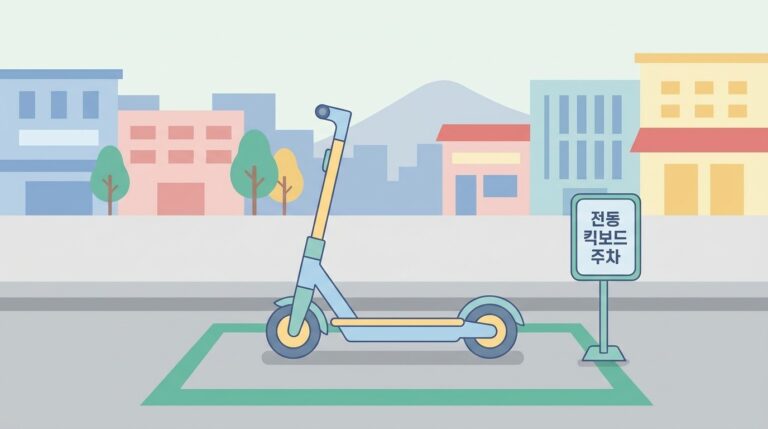
Phase 1: 공감 (Story Immersion Opening)
안녕하세요! 매일한글 에디터입니다.
Picture this: You’ve just finished a thrilling evening catching up with friends in the bustling backstreets of Seongsu-dong. Needing to catch the last subway train, you spot a sleek shared electric kickboard (공유 킥보드) parked on the sidewalk. You unlock it with a quick QR tap on your phone, breeze effortlessly through the cool Seoul night air, and pull up right outside the station entrance. In a rush, you leave the kickboard next to the subway stairs, snap a hasty confirmation photo, and head down.
Fast forward to 10:00 AM the following morning: your phone buzzes with an alarming notification from the mobility app. You have been hit with a 40,000 KRW towing fee (견인료), plus municipal storage surcharges (보관료), alongside a stern warning about parking violations. Frantic and baffled, you wonder: Wasn’t it just sitting on the sidewalk like everyone else’s? Who towed it so fast? How do I even dispute this when the system seems entirely automated and ruthless?
If you have ever felt blindsided by South Korea’s hyper-efficient urban management and the stringent regulatory crackdown on shared personal mobility devices, you are definitely not alone. For advanced (C2) learners navigating life, work, or extended stays in Korea, handling civic disputes, public grievances (민원), and administrative sanctions requires far more than casual conversational fluency. It demands precision, pragmatic socio-cultural competence, and a firm grasp of public sector protocol. Based on real-world experiences from our Daily Hangul global community, this masterclass equips you to articulate administrative disputes, de-escalate confrontations with municipal enforcement officers, and protect your consumer rights with utmost eloquence.
Phase 2: 핵심 표현 3선 심층 분석 (Top 3 Core Expressions)
1. 견인 조치될 수 있으니 주차 금지 구역을 확인해 주세요.
- Pronunciation: Gyeon-in jochi-doel su isseuni jucha geumji gu-yeog-eul hwag-in-hae juse-yo. (Sounds like: gyun-in jo-chee-dwel soo ee-ssuh-nee joo-cha geum-jee goo-yuhk-eul hwah-geen-hae joo-seh-yo)
- Meaning: Literal: “Because it may be towed, please check the no-parking zone.” / Real Nuance: “Make sure you double-check the designated no-parking areas, or municipal contractors will tow your ride without warning.”
- K-Culture Moment: Commonly heard in automated app safety announcements or voiced by vigilant security guards (경비 아저씨) outside major commercial complexes like COEX or residential apartment complexes (아파트 단지).
- Editor’s Insight: Notice the nominalized legal compound 조치(措置), meaning “institutional measure/action.” Koreans use 견인 조치 instead of simply saying 견인 when emphasizing municipal authority, administrative legality, and inevitability.
- Situation Spectrum: Casual: 🚫 | Semi-formal: ⚠️ | Formal: ✅
- 🤔 Think About It: In many Western countries, private operators bear the burden of misplaced micro-mobility units. Why do Korean municipalities hold individual riders directly accountable through immediate towing measures?
2. 점자블록 위에 방치되어 있어서 민원이 들어왔어요.
- Pronunciation: Jeom-ja-beul-lok wie bang-chi-doe-eo isseo-seo min-won-i deul-eo-wass-eo-yo. (Sounds like: juhm-jah-beul-lahk wee-eh bahng-chee-dweh-uh ee-ssuh-suh meen-wahn-ee deul-uh-wah-ssuh-yo)
- Meaning: Literal: “It was neglected on top of the tactile paving, so a civil complaint was received.” / Real Nuance: “Someone filed an official civic grievance because the kickboard was abandoned right over the yellow Braille blocks for the visually impaired.”
- K-Culture Moment: Featured prominently in local news investigative segments (MBC 실화탐사대 or SBS 모닝와이드) covering pedestrian safety conflicts in high-density school zones and transit hubs.
- Editor’s Insight: The keyword 방치(放置) implies irresponsible abandonment, while 민원(民願) refers to an official citizen petition or complaint lodged via platforms like the Safe People’s Portal (안전신문고). Using these terms signals an advanced comprehension of Korean civil law.
- Situation Spectrum: Casual: ⚠️ | Semi-formal: ✅ | Formal: ✅
- 🤔 Think About It: How does the Korean social contract prioritize collective disability access and uninhibited pedestrian walkways over tech-driven consumer convenience?
3. 계도 기간은 이미 끝났고 즉시 과태료 부과 대상입니다.
- Pronunciation: Gye-do gigan-eun imi kkeut-nass-go jeuk-si gwa-tae-ryo bu-gwa dae-sang-im-ni-da. (Sounds like: gyeh-doh gee-gahn-eun ee-mee kkeut-nahss-goh jeuk-shee gwah-teh-ryoh boo-gwah deh-sahng-eem-nee-dah)
- Meaning: Literal: “The guidance grace period has already ended and it is subject to an immediate administrative fine.” / Real Nuance: “The grace period is over; zero tolerance is in effect, and you will be fined on the spot.”
- K-Culture Moment: Uttered with absolute bureaucratic resolve by district office enforcement staff (구청 단속 공무원) when clearing congested sidewalks in front of Sinnonhyeon Station.
- Editor’s Insight: 계도(啓導) refers to a transitional, educative grace period before penalizing citizens. When an official declares that 계도 기간 has lapsed, arguing ignorance of the law will yield zero results. Pivot immediately to verifying factual grounds.
- Situation Spectrum: Casual: 🚫 | Semi-formal: ⚠️ | Formal: ✅
- 🤔 Think About It: Notice the balance between paternalistic administrative guidance (계도) and uncompromising legal penalties (과태료). How does this illustrate Korea’s rapid developmental governance?
Phase 3: 교과서 한국어 vs 진짜 한국어 (Textbook vs. Real-World Korean)
Situation 1: Calling the mobility operator to dispute an unjust towing fee
- 📖 교과서 한국어 (Textbook):
견인료가 왜 청구되었는지 저에게 설명해 주시겠습니까?
(Gyeon-in-ryo-ga wae cheong-gu-doeeot-neun-ji jeo-e-ge seol-myeong-hae ju-si-get-seum-ni-ka? / Could you explain to me why the towing fee was charged?) - 🗣️ 진짜 한국어 (Real-World C2):
앱 상에서는 주차 권장 구역으로 확인하고 반납했는데, 즉시 견인 조치된 소명 자료를 확인하고 싶습니다.
(Aep sang-e-seo-neun jucha gwon-jang gu-yeog-eu-ro hwag-in-ha-go ban-nab-haet-neun-de, jeuk-si gyeon-in jo-chi-doen so-myeong ja-ryo-reul hwag-in-ha-go sip-seum-ni-da. / I verified and returned the scooter in an app-recommended parking zone, so I would like to review the evidentiary documentation justifying immediate towing.) - 💡 왜 다를까?: The textbook version sounds timid and passive. In Korean administrative appeals, presenting formal legal terms like 소명 자료 (substantiating evidence) demonstrates high situational authority and forces customer service agents to process your claim through official dispute protocols rather than dismissing you with canned responses.
Situation 2: Asking an enforcement officer or contractor about an impounded scooter
- 📖 교과서 한국어 (Textbook):
이 킥보드를 지금 가져가지 말아 주세요.
(I kik-bo-deu-reul ji-geum ga-jyeo-ga-ji mar-a ju-se-yo. / Please do not take this kickboard away right now.) - 🗣️ 진짜 한국어 (Real-World C2):
제가 지금 막 반납 처리하고 사진 촬영 중이었는데, 견인 스티커 발부 전에 자진 이동 조치하면 안 될까요?
(Je-ga ji-geum mak ban-nab cheo-ri-ha-go sa-jin chwal-yeong jung-i-eot-neun-de, gyeon-in seu-ti-keo bal-bu jeon-e ja-jin i-dong jo-chi-ha-myeon an doel-kka-yo? / I was literally in the middle of processing the return and taking the verification photo; may I voluntarily relocate it before the towing citation is issued?) - 💡 왜 다를까?: Simply begging someone not to tow is ineffective. Mentioning 자진 이동 조치 (voluntary relocation) appeals to the officer’s discretion under administrative law, allowing them to record compliance without issuing a cumbersome towing invoice.
Phase 4: K-Culture 딥다이브 & 비언어적 매너 (Cultural Nuances & Etiquette)
4-1. 눈치 (Nunchi) & Non-Verbal Conduct in Public Disputes
- Show, Don’t Shout (사진 제시): In Korea, raising your voice during an administrative disagreement immediately labels you as an unreasonable person creating a scene (진상/난동). Instead, practice 눈치 (Nunchi): maintain steady, respectful eye contact, tilt your upper body forward slightly, and calmly show your smartphone screen displaying the timestamped parking photo (반납 인증 사진).
- Two-Handed Grievance Submission: When handing over your physical ID card or receiving the citation notice from a district officer or towing facility personnel, use both hands (두 손). This subtle non-verbal signal communicates that you respect public protocol, drastically reducing defensive hostility from civil servants.
4-2. Cultural Code Analysis: The War on “Kick-Rani” (킥라니)
- Social Context: In Korean media, reckless electric scooter riders are notoriously labeled 킥라니—a blend of “Kickboard” and 고라니 (water deer), known for abruptly darting into oncoming highway traffic. Because shared kickboards caused widespread sidewalk chaos and endangered seniors and children, Seoul Metropolitan Government instituted an aggressive 즉시 견인제 (Immediate Towing System).
- Under this regulatory framework, kickboards left on yellow tactile blocks (점자블록), bus stops (버스 정류장 10m 이내), crosswalk ramps, or subway station entrances can be photographed by any citizen via the Smart Seoul Complaint App and towed by contracted private wreckers within hours. The towing fee (typically 40,000 KRW plus 700 KRW per 30 minutes of storage) is forwarded straight to the mobility company, which automatically bills the last registered rider’s credit card.
Phase 5: 실전 롤플레이 시나리오 (Realistic Dispute Role-Play)
Setting: Outside Exit 3 of Gangnam Station. The user (Alex) has just parked an e-scooter to pick up a takeaway order and steps out to find a municipal towing contractor attaching a yellow towing harness to the device.
Characters:
* Alex (알렉스): Professional resident well-versed in legal terminology.
* Mr. Choi (최 반장): Veteran district towing contractor, tired but strict.
알렉스: 저기요, 기사님! 잠시만요. 제가 방금 1분 전에 포장 주문 찾으러 들어간 건데요.
(Jeo-gi-yo, gi-sa-nim! Jam-si-man-yo. Je-ga bang-geum il-bun jeon-e po-jang ju-mun chaj-eu-ro deul-eo-gan geon-de-yo.)
“Excuse me, officer! Just a moment, please. I literally stepped inside for one minute to pick up a takeout order.”
🎭 Gently stepping forward with palms open, smartphone unlocked in hand.
최 반장: 여기 보도블록 유도선 가로막고 있잖아요. 시민 신고 들어와서 즉시 견인 대상입니다.
(Yeo-gi bo-do-beul-lok yu-do-seon ga-ro-mak-go it-janh-a-yo. Si-min sin-go deul-eo-wa-seo jeuk-si gyeon-in dae-sang-im-ni-da.)
“Look here, you’re blocking the pedestrian guide tiles. A citizen report came in, so this is subject to immediate impoundment.”
🎭 Snapping a verification photo with his tablet and securing the towing hook.
알렉스: 아, 점자블록을 일부 침범한 점은 제 불찰입니다. 다만 아직 견인차에 결박 완료된 상태는 아니지 않습니까?
(A, jeom-ja-beul-lok-eul il-bu chim-beom-han jeom-eun je bul-chal-im-ni-da. Da-man a-jik gyeon-in-cha-e gyeol-bak wan-ryo-doen sang-tae-neun a-ni-ji anh-seum-ni-ka?)
“Ah, infringing slightly on the tactile paving was indeed my oversight. However, the device hasn’t been completely hoisted or strapped onto the tow truck yet, has it?”
🎭 Nodding respectfully while acknowledging the fault candidly.
최 반장: 결박 중이라도 이미 전산 시스템에 접수 처리되어서 취소 못 해요. 저도 원칙대로 해야 합니다.
(Gyeol-bak jung-i-ra-do i-mi jeon-san si-seu-tem-e jeop-su cheo-ri-doe-eo-seo chwi-so mot hae-yo. Jeo-do won-chik-dae-ro hae-ya ham-ni-da.)
“Even if we’re midway through securing it, it’s already logged into the electronic system, so I can’t cancel it. I have to go strictly by the book.”
🎭 Adjusting his safety vest with an unwavering, bureaucratic posture.
알렉스: 현장 지침상 차주나 이용자가 현장에서 자진 시정 의사를 밝히면 즉시 이동 조치가 가능한 것으로 알고 있습니다.
(Hyeon-jang ji-chim-sang cha-ju-na i-yong-ja-ga hyeon-jang-e-seo ja-jin si-jeong ui-sa-reul balk-hi-myeon jeuk-si i-dong jo-chi-ga ga-neung-han geos-eu-ro al-go it-seum-ni-da.)
“According to on-site enforcement guidelines, I understand that if the user expresses the intention for voluntary self-correction on the spot, immediate relocation is permitted.”
🎭 Speaking in a steady, measured, respectful tone without raising pitch.
최 반장: 흠… 규정을 잘 아시네. 바로 저쪽 전용 거치대로 옮기실 겁니까?
(Heum… Gyu-jeong-eul jal a-si-ne. Ba-ro jeo-jjok jeon-yong geo-chi-dae-ro olm-gi-sil geom-ni-ka?)
“Hmm… You certainly know the administrative rules well. Are you going to move it immediately to that designated rack over there?”
🎭 Pausing his tablet input, assessing Alex's cooperative demeanor.
알렉스: 네, 지하철 출구 옆 전용 주차 구역으로 지금 즉시 재배치하고 사진 제출하겠습니다.
(Ne, ji-ha-cheol chul-gu yeop jeon-yong ju-cha gu-yeog-eu-ro ji-geum jeuk-si jae-bae-chi-ha-go sa-jin je-chul-ha-get-seum-ni-da.)
“Yes, I will immediately reposition it to the designated parking rack by the subway exit and submit the verification photo right now.”
🎭 Taking hold of the handlebar, ready to move it expeditiously.
최 반장: 알겠습니다. 이번 건은 현장 계도로 처리할 테니, 앞으로는 절대 통행로 막지 마세요.
(Al-get-seum-ni-da. I-beon geon-eun hyeon-jang gye-do-ro cheo-ri-hal te-ni, ap-eu-ro-neun jeol-dae tong-haeng-ro mak-ji ma-se-yo.)
“Understood. I will log this case as on-site on-the-spot guidance, so please ensure you never block public thoroughfares in the future.”
🎭 Unhooking the harness and nodding in approval.
🔀 인터랙티브 분기점 (Interactive Choice)
If the officer had insisted on towing regardless, what would be your optimal next step?
- Option A: Block the tow truck physically and shout that you will post the video online to expose municipal tyranny.
Feedback: 🚫 Worst Action. This escalates the incident into obstruction of official duties (공무집행방해죄), leading to immediate police intervention and criminal charges. - Option B: Demand the officer’s administrative affiliation, record number, and photographic proof: “견인 단속 처분 고지서와 현장 단속 채증 사진 번호를 요청합니다. 정식 이의신청 절차를 밟겠습니다.”
Feedback: ✅ Best Action. Legally sound, professional, and protects your rights to appeal the fine through the district office’s formal dispute review board (이의신청 심의위원회). - Option C: Walk away silently and immediately cancel the linked credit card on your mobile app to prevent charges.
Feedback: ⚠️ High Risk. The mobility company will freeze your account, assign the debt to a collection agency, and report delinquency to credit rating bureaus.
Phase 6: 10초 감정 섀도잉 드릴 (10-Second Emotional Shadowing Drill)
Master the cadence of polite administrative assertion by practicing these exact pauses (/) and emotional inflections:
[🙏 정중하게 과실을 인정하며 / Respectfully acknowledging an oversight]
점자블록 침범은 / 제 불찰이나, / 현장에서 즉시 / 자진 시정하도록 하겠습니다.
(Jeom-ja-beul-lok chim-beom-eun / je bul-chal-i-na, / hyeon-jang-e-seo jeuk-si / ja-jin si-jeong-ha-do-rok ha-get-seum-ni-da.)-
[⚖️ 차분하고 단호한 법적 소명 / Calm and firm administrative appeal]
앱 상의 오작동으로 인한 반납 지연이었음을 증명하는 / 타임스탬프 로그를 제출하겠습니다.
(Aep sang-ui o-jak-dong-eu-ro in-han ban-nab ji-yeon-i-eoss-eum-eul jeung-myeong-ha-neun / ta-im-seu-taem-peu ro-geu-reul je-chul-ha-get-seum-ni-da.) -
[🤝 원만한 합의와 감사 표현 / Amicable resolution & courtesy]
현장 계도로 배려해 주셔서 감사합니다. / 다음부터는 주차 권장 구역을 철저히 확인하겠습니다.
(Hyeon-jang gye-do-ro bae-ryeo-hae ju-syeo-seo gam-sa-ham-ni-da. / Da-eum-bu-teo-neun ju-cha gwon-jang gu-yeog-eul cheol-jeo-hi hwag-in-ha-get-seum-ni-da.)
Phase 7: K-Culture 미니 사전 (Core Vocabulary)
-
소명 절차 (So-myeong jeol-cha) | Administrative Vindication / Substantiation Process
The formal procedural mechanism through which a citizen provides objective proof to overturn an unfair administrative penalty, such as an improper parking citation or towing invoice. -
채증 (Chae-jeung) | Collection of Incriminating Evidence
The formal act of taking photos, logging GPS coordinates, and capturing video footage by enforcement officers or citizens to legally substantiate a municipal infraction. -
보행권 (Bo-haeng-gwon) | Right to Walk / Pedestrian Rights
A cornerstone concept in South Korean urban planning and civic discourse defending the absolute primacy of pedestrian safety over vehicular or micro-mobility convenience. -
거치대 (Geo-chi-dae) | Designated Docking / Parking Rack
Physical curbside racks or painted street stalls officially sanctioned by city governments where shared scooters and bicycles must be deposited to qualify for return discounts and avoid fines.
Phase 8: 여행자를 위한 생존 키트 (Survival Kit for Expats & Travelers)
Top 3 Survival Phrases
- 여기 세워두면 단속 대상인가요?
(Yeo-gi se-wo-du-myeon dan-sok dae-sang-in-ga-yo?)
“Is it subject to enforcement fines if I park it right here?”
Pro Tip: Ask nearby shop owners or building attendants before leaving your scooter on commercial sidewalks. - 주차 확인 사진을 다시 첨부하여 이의신청하겠습니다.
(Ju-cha hwag-in sa-jin-eul da-si cheom-bu-ha-yeo i-ui-sin-cheong-ha-get-seum-ni-da.)
“I will re-attach the parking confirmation photo and submit a formal objection.” - 견인 보관소 위치와 납부 영수증 발부처를 알려주세요.
(Gyeon-in bo-gwan-so wi-chi-wa nap-bu yeong-su-jeung bal-bu-cheo-reul al-ryeo-ju-se-yo.)
“Please direct me to the vehicle impound yard and the receipt-issuing office.”
Editor’s Travel Note: Staying Fine-Free
- Navigate Smartly: Always check designated micro-mobility parking areas via Naver Map App Download. Seoul features hundreds of street-painted white-and-green scooter bays.
- Avoid the Big 5 Tow Zones: In Seoul, scooters left in any of these five locations are towed within minutes:
- Tactile paving (점자블록) & wheelchair ramps
- Within 10m of bus stops & subway entrances
- Directly in front of building emergency fire exits (소방시설)
- Pedestrian crosswalk entries
- Taxi stands
Phase 9: “한 발 더 깊이” (Reflective Cultural Essay)
South Korea’s public realm is founded upon high-density cohabitation, where personal convenience is meticulously calibrated against the collective harmony of millions moving in tight proximity. When micro-mobility operators first populated the streets of Seoul, the technology outpaced civil infrastructure, resulting in cluttered sidewalks that directly undermined the safety of elderly citizens, children, and people with visual impairments. The strict implementation of immediate towing and citizen reporting via smartphones isn’t merely bureaucratic overreach; it represents Korea’s distinctive civic contract: 공공선 (The Public Good).
Language reflects this communal ethos. Notice how disputes in Korea rarely hinge on individual “rights” alone, but rather on whether one acted with due social responsibility (배려) and diligence (주의 의무). To master C2 Korean is to understand that resolving friction with enforcement personnel is not an act of legal combat, but an exercise in demonstrating civic integrity through sophisticated vocabulary.
💬 Your Turn: Have you ever experienced an unexpected municipal fine or dispute while using shared mobility devices in Korea or your home country? Share your experience in the comments below!
Phase 10: FAQ & 오해 방지 (FAQ Schema)
Q: Who pays the towing fee if I park a shared scooter incorrectly in Seoul?
A: The district towing contractor invoices the mobility operating company (e.g., Swing, Beam, Kickgoing). The company then matches the timestamp of the violation to your account and automatically debits the towing fine (40,000 KRW) plus storage fees from your registered card.
Q: Can foreign tourists dispute a towing charge without an Alien Registration Card (ARC)?
A: Yes. You can submit a formal objection via the customer support portal inside the mobility application by providing your rental history, GPS timestamp, and the final return photograph showing proper clearance from restricted zones.
Q: Does voluntary relocation on the spot always dismiss the citation?
A: If the vehicle is already securely hoisted onto the wrecker and the electronic citation ticket has been finalized in the municipal system, the contractor cannot manually void the fee. However, if they are still inspecting or setting up the hitch, courteous self-relocation (자진 이동) often results in a verbal warning (현장 계도).
🚨 Common Mistakes Alert (외국인 학습자의 흔한 실수)
- Leaving the scooter on tactile pavement edges: Thinking “it’s only touching one wheel.” Even 5cm over the yellow block triggers instant citation. Correct Action: Park completely on the outer edge of sidewalks, parallel to the road, away from paths.
- Ignoring the final app photo: Snapping a blurry photo of the ground. Correct Action: Step back 2 meters and take a wide-angle photo displaying the scooter relative to the sidewalk, curbs, and nearby signage as legal proof.
- Using aggressive colloquial language: Demanding “돈 내기 싫어요” (I don’t want to pay). Correct Action: Frame your dispute professionally with terms like “과다 청구 소명” (clarification of excessive billing).
Phase 11: 액션 미션 & 참여 유도 (Action Missions)
- 🥉 Bronze Mission (Solo Practice): Read the dialogue in Phase 5 out loud three times. Focus on shifting your tone smoothly from deferential respect (제 불찰입니다) to firm procedural assertion (자진 이동 조치가 가능한 것으로 알고 있습니다).
- 🥈 Silver Mission (Community Sharing): Next time you walk down a major street in Korea, spot three designated scooter parking docks (전용 거치대). Snap a photo and post it on your social media or language study blog with the hashtag
#DailyHangul #보행권보호. - 🥇 Gold Mission (Real-Life Application): Download a local mobility app (like Kakao T or Ttareungyi). Locate the parking regulation guidelines section (이용 가이드 및 주차 가이드라인) and highlight every instance of the words 견인, 계도, and 과태료.
Phase 12: 인터랙티브 퀴즈 챌린지 (Interactive Quiz)
1. 상황 판단 (Situational Judgment)
An enforcement officer is about to write a citation for your parked kickboard, but you are standing right next to it. Which phrase is the most persuasive and linguistically sophisticated C2 choice?
* A) 아저씨, 진짜 너무하시네요. 그냥 좀 봐주세요.
* B) 지금 즉시 인근 전용 거치대로 자진 이동 조치할 테니 현장 계도로 참작해 주실 수 있습니까?
* C) 저 외국인이라서 법을 잘 몰랐으니 벌금 취소해 주세요.
🔍 정답 및 해설 보기 (Click to reveal)
정답: B
해설: Choice B combines accurate institutional terminology (자진 이동 조치, 현장 계도, 참작) delivered in polished formal polite register (하십시오체/해요체 blend). Choice A is whiny and disrespectful, while Choice C invokes an excuse of ignorance that is rarely accepted in Korean municipal enforcement.
2. 빈칸 채우기 (Fill in the Blank)
- “해당 구역은 시각장애인을 위한 (__________) 위이므로 주차 시 즉시 견인 대상이 됩니다.”
- (Hint: 4 letters, yellow raised pavers on the sidewalk)
🔍 정답 및 해설 보기 (Click to reveal)
정답: 점자블록 (Jeom-ja-beul-lok)
해설: Tactile paving blocks designed for visually impaired pedestrians are designated as absolute zero-tolerance towing zones across South Korea.
3. True or False 문화 퀴즈
- In Seoul, if you park an electric kickboard within 5 meters of a bus stop, private towing companies have legal authorization to tow it immediately without giving a grace period. (T/F)
🔍 정답 및 해설 보기 (Click to reveal)
정답: True (참)
해설: Under Seoul’s 2021 amended ordinance, five critical zones (including within 10m of bus stops, subway exits, and tactile blocks) are subject to immediate towing (즉시 견인) with no preliminary grace period provided.







