

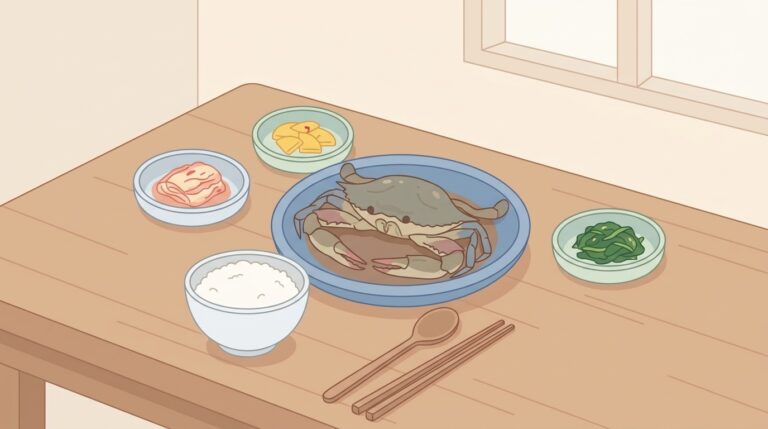
Why Koreans Accuse Delicious Food of Stealing: The Secret Behind Babdoduk
Phase 1: Empathy (Story Immersion Opening)
안녕하세요! 매일한글 에디터입니다.
Picture this: You are seated at a cozy, bustling restaurant in Mapo, Seoul. The table before you is groaning under the weight of fifteen small porcelain bowls filled with seasoned spinach, fermented kimchi, simmered lotus root, and, in the center, a glistening plate of ganjang gejang (soy sauce marinated raw crab). Your Korean friend snaps a photo, mixes a spoonful of steaming white rice directly into the crab carapace, takes a massive bite, and gasps: “와, 진짜 완전 밥도둑이다!” (Wa, jinjja wanjeon bapdoduk-ida!).
If you translate this literally, your friend just accused the chef’s prized specialty of being a petty criminal: “rice thief.” Did someone steal the rice? Did the restaurant overcharge you?
Not at all. In Korea, calling a side dish a “thief” is the highest culinary compliment you can possibly bestow. It means the dish is so intensely savory, umami-packed, and delicious that your bowl of rice disappears mysteriously fast without you even noticing.
Navigating Korean banchan (side dish) culture can feel like an overwhelming puzzle for intermediate learners. You might already know the textbook phrase “맛있어요” (It is delicious), but native speakers rarely stop there when confronted with legendary comfort food. By mastering the cultural and linguistic nuances of bapdoduk, you will unlock the heart of Korean culinary conversation, impress your dining companions, and finally understand why a bowl of carbs is considered sacred in Korea.
Phase 2: Core Expressions Deep Dive
1. 밥도둑 (Bapdoduk)
- Pronunciation: [Bap-do-duk] (Sounds like “Bop-doh-dook”, rhyming softly with “book” at the end)
- Meaning: Literally “Rice Thief” | Actual nuance: A dish so savory, salty-sweet, or delightfully spicy that it compels you to finish bowl after bowl of steamed rice effortlessly.
- K-Culture Moment: Seen in nearly every Korean mukbang or variety show like I Live Alone whenever someone breaks open a tin of seasoned seaweed, spam, or cuts into spicy braised mackerel.
- Editor’s Insight: The word carries an affectionate humor. It is never used for sweet desserts or bread; it exclusively belongs to hearty, seasoned dishes that require plain white rice to achieve balance.
- Situation Spectrum: Casual: ✅ | Semi-formal: ✅ | Formal/Business: ⚠️ (Use 밥을 부르는 맛 in ultra-formal culinary reviews)
- 🤔 Think About It: In your home culture, do you praise food based on what you pair it with, or solely by the ingredient itself? What does it say about Korean history that the highest compliment celebrates the consumption of rice?
2. 밥 한 공기 뚝딱했어 (Bap han gonggi ttukttakhaesseo)
- Pronunciation: [Bap han gong-gi ttuk-ttak-haess-eo] (The double-consonant ‘tt’ sounds like the tight “t” sound in “stop”)
- Meaning: Literally “I made a bowl of rice go clack/snap” | Actual nuance: “I devoured an entire bowl of rice in a flash!”
- K-Culture Moment: Used by characters in family K-Dramas like Reply 1988 when a child cleans their plate after a long day at school, making the parents beam with pride.
- Editor’s Insight: 뚝딱 (ttukttak) is an onomatopoeic/mimetic word evoking rapid, effortless completion—like snapping your fingers or finishing a task in one breath.
- Situation Spectrum: Casual: ✅ | Semi-formal: ✅ | Formal/Business: 🚫 (Sounds overly relaxed for a formal executive luncheon)
- 🤔 Think About It: Notice how Korean uses sensory adverbs like 뚝딱 to convey speed and satisfaction. How does your language express clearing a plate without saying “I ate quickly”?
3. 입맛이 싹 도네 (Ipmmasi ssak done)
- Pronunciation: [Im-ma-si ssak do-ne] (The ‘p’ in ‘ip’ shifts smoothly into an ‘m’ sound due to nasal assimilation)
- Meaning: Literally “Appetite turns completely” | Actual nuance: “This totally revived my appetite!” or “My mouth is watering immediately!”
- K-Culture Moment: Common in culinary travel shows when someone who felt sluggish or seasick tastes a sour, fermented kimchi stew or pickled garlic and immediately perks up.
- Editor’s Insight: 싹 (ssak) conveys a clean, sweeping motion. It implies that any lethargy or lack of hunger was cleanly wiped away by a burst of flavor.
- Situation Spectrum: Casual: ✅ | Semi-formal: ✅ | Formal: ⚠️
- 🤔 Think About It: How often do you talk about your “appetite” as an independent entity that arrives, disappears, or turns around?
Phase 3: Textbook Korean vs. Real Korean
Scenario 1: Praising a Flavorful Side Dish at Dinner
- 📖 Textbook Korean: 이 반찬은 매우 맛있어서 밥을 많이 먹게 됩니다. (I ban-chan-eun mae-u ma-sis-seo-seo bap-eul man-i meok-ge doem-ni-da. / This side dish is very delicious, so it causes me to eat a lot of rice.)
- 🗣️ Real Korean: 와, 이거 완전 밥도둑인데요? 두 공기 각이에요! (Wa, i-geo wan-jeon bap-do-dug-in-de-yo? Du gong-gi gag-i-e-yo! / Wow, this is a total rice thief! I’m definitely down for two bowls!)
- 💡 Why is it different? The slang term 각 (gak – an angle or clear signal) combined with 밥도둑 creates a lively, authentic reaction that shows natural enthusiasm rather than robotic grammatical description.
Scenario 2: Asking for a Banchan Refill
- 📖 Textbook Korean: 반찬을 더 주실 수 있습니까? (Ban-chan-eul deo ju-sil su it-seum-ni-kka? / Could you give me more side dishes?)
- 🗣️ Real Korean: 사장님, 죄송한데 이 반찬 리필 좀 부탁드려요! (Sa-jang-nim, joe-song-han-de i ban-chan ri-pil jom bu-tak-deu-ryeo-yo! / Boss, excuse me, could we please get a refill on this side dish?)
- 💡 Why is it different? In Korea, side dishes are typically refillable for free. Native speakers soften the request with a gentle 죄송한데 (excuse me / I’m sorry to bother) and use the Konglish loanword 리필 (refill) with warmth.
Phase 4: K-Culture Deep Dive & Non-Verbal Manners
4-1. Nunchi & Table Gestures: The Etiquette of Banchan
Sharing is at the core of Korean dining, but banchan etiquette requires subtle nunchi (social intuition):
1. Never Pick Up Your Rice Bowl: In contrast to Japan or China, lifting your rice bowl off the table to your mouth is considered uncouth or hasty (거지 밥 먹듯 – eating like a beggar). Leave the bowl firmly on the table and bring the spoon to your mouth.
2. The Chopstick vs. Spoon Division: Use your spoon exclusively for steamed rice and soups (guk / jjigae). Use your chopsticks for picking up banchan. Sticking a wet spoon into a communal banchan dish can cloud the flavors for others.
3. The Ganjang Gejang Ritual: If you are eating raw marinated crab, save the shell (게딱지, gettakji) for last. Scoop two spoonfuls of warm rice directly inside the shell, scrape the rich inner tomalley and crab butter from the crevices with your chopstick tip, and mix gently with your spoon before eating.
4-2. Cultural Code: Why Rice (Bap) Is King
In Western gastronomy, meat or fish usually constitutes the centerpiece, while carbs are side elements. Traditional Korean meal composition (Bapsang) inverts this hierarchy: Rice is the hero; banchan exists solely to accompany, balance, and facilitate the consumption of rice. Historically, agricultural Korea relied on high-calorie carbohydrates for manual labor. The phrase 밥심 (Bapsim – “the power derived from rice”) illustrates why a dish that accelerates rice consumption earns the ultimate crown.
Phase 5: Real-Life Roleplay Scenario
Setting: A legendary, 40-year-old raw marinated crab restaurant in Sinsa-dong, Seoul.
Characters: You (an enthusiastic diner) and Imo-nim (the warm, fast-moving restaurant auntie).
- Turn 1 (Imo-nim): 어서 와요! 우리 집은 간장게장이 전문이니까 2인분 바로 준비해 줄게요? (Eoseo wayo! Uri jibeun ganjanggejang-i jeonmun-inikka 2inbun baro junbihae julgeyo? / Welcome! Our specialty is soy-marinated crab, shall I prepare 2 servings right away?)
- Turn 2 (You): 네, 이모님! 공깃밥도 두 개 먼저 주세요. (Ne, imo-nim! Gonggitbap-do du gae meonjeo juseyo. / Yes, Imo-nim! Please give us two bowls of rice to start with as well.)
🎭 Rubbing hands together with anticipation - Turn 3 (Imo-nim): 게장 나왔어요. 게딱지에 밥 비벼 먹는 거 잊지 마요! (Gejang nawasseoyo. Gettakji-e bap bibyeo meongneun geo itji mayo! / Here is your crab. Don’t forget to mix your rice in the crab shell!)
🎭 Setting down the crab with a proud grin - Turn 4 (You): 우와, 알이 꽉 찼네요! 진짜 맛있겠다. (Uwa, ar-i kkwak chan-ne-yo! Jinjja mas-ik-get-da. / Wow, it’s packed with roe! It looks truly incredible.)
🎭 Eyes widening while taking a first bite - Turn 5 (You): 와… 짭조름한 게 입맛이 싹 도네요! 완전 밥도둑이에요. (Wa… jjap-jo-reum-han ge im-ma-si ssak do-ne-yo! Wan-jeon bap-do-dug-i-e-yo. / Wow… the savory-salty flavor totally woke up my appetite! It is a total rice thief.)
🎭 Nodding emphatically to your friend - Turn 6 (Imo-nim): 하하! 입에 맞아서 다행이네. 벌써 밥 한 공기 다 비웠어? (Haha! Ibe majaseo dahaeng-ine. Beolsse bap han gonggi da bi-wo-sseo? / Haha! Glad it suits your palate. Did you already empty a whole bowl of rice?)
🎭 Chuckling at your empty bowl - Turn 7 (You): 너무 맛있어서 밥 한 공기 뚝딱했어요. 이모님, 공깃밥 하나만 더 추가해 주세요! (Neomu mas-is-seo-seo bap han gong-gi ttuk-ttak-haess-eo-yo. Imo-nim, gong-git-bap ha-na-man deo chu-ga-hae ju-se-yo! / It was so good I finished the bowl in a flash. Imo-nim, could we please add one more bowl of rice?)
🎭 Holding up an empty bowl politely with both hands - Turn 8 (Imo-nim): 아이고, 잘 먹네! 금방 갖다줄게요! (Aigo, jal meongne! Geumbang gat-da-jul-geyo! / My goodness, you eat so well! I’ll bring it right out!)
🔀 Interactive Decision Branch
What should you do when you finish all the crab meat but still have sauce left on your plate?
* Choice A: Leave the plate alone and wipe your fingers on a napkin.
* Feedback (Bad): You missed the best part! Leaving behind rich marinade without mixing rice into it makes the restaurant auntie feel you didn’t fully enjoy the soul of the dish.
* Choice B: Ask for roasted seaweed (gim) and sesame oil to mix your extra rice into the remaining sauce.
* Feedback (Best): You will earn legendary respect from the restaurant staff. Mixing rice with seasoned nori into leftover gejang sauce is the ultimate local power move.
* Choice C: Drink the remaining crab soy sauce directly from the plate like a soup.
* Feedback (Risk): Be careful! The marinade is concentrated soy sauce packed with sodium. Drinking it straight will shock your palate and earn curious stares.
Phase 6: 10-Second Emotion Shadowing Drill
Read these out loud, pausing at the slashes (/) and matching the exact emotional tone:
[🤩 감탄하며 / In awe]
“와… / 이 게장 / 진짜 완전 / 밥도둑인데요?”
(Wa… / i gejang / jinjja wanjeon / bap-do-dug-in-de-yo? / Wow… this crab is a serious rice thief!)-
[😋 입맛을 다시며 / Savoring hungrily]
“매콤달콤해서 / 집 나간 입맛이 / 싹 돌아요!”
(Mae-kom-dal-kom-hae-seo / jip na-gan im-ma-si / ssak dor-a-yo! / Because it’s sweet and spicy, my vanished appetite has completely returned!) -
[ proud & satisfied / 뿌듯하고 당당하게]
“너무 맛있어서 / 벌써 / 밥 한 공기 / 뚝딱했어요!”
(Neomu mas-is-seo-seo / beolsse / bap han gong-gi / ttuk-ttak-haess-eo-yo! / It was so delicious, I polished off a bowl in a flash!)
Phase 7: K-Culture Mini Dictionary
- 밥심 (Bapsim) | Noun | “Rice energy / strength powered by a meal.” Koreans believe that true endurance and vitality stem from eating warm cooked rice rather than fast food or bread.
- 밑반찬 (Mitbanchan) | Noun | “Foundational side dishes.” Everyday staples kept in the fridge that do not spoil easily, such as seasoned anchovies (myeolchi bokkeum), pickled radish, or braised quail eggs (jangjorim).
- 무한리필 (Muhan-ripil) | Noun | “Unlimited refill / All-you-can-eat.” Often seen on restaurant signs for budget-friendly meat, banchan, or marinated crab establishments.
- 게딱지 (Gettakji) | Noun | “Crab carapace / shell.” The prized upper shell of the crab where seasoned diners mix plain rice with tomalley.
Phase 8: Survival Kit for Travelers
Top 3 Survival Phrases
- 이 반찬 리필 되나요? (I ban-chan ri-pil doe-na-yo?)
- Meaning: Can this side dish be refilled?
- Pro Tip: Most banchan is complimentary and refillable, but rare premium items (like whole fried fish or extra marinated raw crab) might incur a small charge. Asking with 되나요? keeps it polite and safe.
- 게딱지에 밥 비벼 먹어도 돼요? (Ge-ttak-ji-e bap bi-byeo meog-eo-do dwae-yo?)
- Meaning: May I mix rice in the crab shell?
- Pro Tip: This shows the owner that you know real Korean dining protocol, often prompting them to bring you complimentary roasted seaweed or sesame oil.
- 공깃밥 하나 추가해 주세요. (Gong-git-bap ha-na chu-ga-hae ju-se-yo.)
- Meaning: Please add one more bowl of rice.
- Pro Tip: Standard restaurant rice bowls are called 공깃밥 (air bowl rice – stainless steel bowls with lids). You will need this sentence frequently when encountering a true bapdoduk!
Editor’s Travel Note
When hunting for authentic ganjang gejang or jeonado hanjeongsik (South Jeolla feast tables famous for having 20+ side dishes), skip standard tourist blogs. Check verified local Korean foodie reviews through the Naver Map App Download and Guide. If a spot has hundreds of reviews from Korean office workers declaring “밥 세 공기 비웠습니다” (I emptied three bowls of rice), pin it immediately!
Phase 9: One Step Deeper
In many Western cultures, asking someone “Have you eaten?” is an inquiry about physical hunger or an invitation to step out for food. In Korea, “밥 먹었어요?” is an intimate greeting synonymous with “How are you doing?” and “Is life treating you well?”
This linguistic phenomenon is rooted in Korea’s post-war history, where food scarcity made regular meals the ultimate indicator of health and safety. The banchan table is inherently communal—individual plates of rice anchor each person, while the side dishes in the center unite the table. When you describe a dish as 밥도둑, you are not merely complimenting the seasoning; you are celebrating the communal rhythm of nourishing one another through the foundational staple of Korean life.
💬 Your Turn: What dish from your own home culture has the power to make you polish off carbs without realizing it? Share your comfort food in the comments below!
Phase 10: FAQ & Avoiding Misunderstandings
Q: Can any delicious food be called a 밥도둑 (Bapdoduk)?
A: No. You cannot use it for pizza, pasta, fried chicken, or cakes. A dish must be distinctly paired with steamed white rice to earn this title. Think intensely seasoned, salty, savory, or braised dishes like kimchi stew, raw marinated crab, fermented squid (ojingeo-jeotgal), or braised beef in soy sauce (jangjorim).
Q: Is asking for side dish refills considered rude in Korean restaurants?
A: Not at all! In traditional Korean dining culture (Jeong, 情), feeding guests generously is an honor. Asking for refills on banchan shows that you love the cooking. However, it is polite to finish the refilled portion rather than leaving it behind.
Q: What is the difference between 반찬 (Banchan) and 밑반찬 (Mitbanchan)?
A: Banchan is the general umbrella term for any side dish served at a meal, including freshly tossed salads or hot pancakes. Mitbanchan refers specifically to durable, cured, or braised side dishes prepared in advance and stored in the refrigerator for daily meals.
🚨 Common Mistakes Warning Board
- Mistake 1: Calling white rice Ssal (쌀) at the table.
- Correct Action: Ssal refers strictly to uncooked, raw rice grains. Once it is cooked and served in a bowl, it is always Bap (밥) or Gonggitbap (공깃밥).
- Mistake 2: Leaving your chopsticks stuck vertically into your rice bowl.
- Correct Action: This resembles incense sticks burned at Korean ancestral memorial services (Jesa) and is considered a bad omen. Always rest chopsticks across the edge of the bowl or on a chopstick rest.
- Mistake 3: Eating soup with chopsticks and banchan with a spoon.
- Correct Action: Keep your utensils separated: spoon for rice and soup broth, chopsticks for side dishes and meats.
Phase 11: Action Mission & Engagement
Take your learning beyond reading with our 3-tier practical challenge:
* 🥉 Bronze Level: Practice saying “완전 밥도둑인데요?” out loud 5 times using the shadowing audio cues from Phase 6 until your rhythm feels snappy.
* 🥈 Silver Level: The next time you cook or eat a savory meal, take a photo and post it on your Instagram Story with the sticker: #밥도둑 (Bapdoduk) and tag someone who eats rice every day.
* 🥇 Gold Level: Visit a local Korean eatery, finish your side dish, make gentle eye contact with the server, and say: “이모님, 이거 너무 맛있어서 밥 한 공기 뚝딱했어요! 리필 조금만 부탁드려요!”
🎮 K-Culture Mission: Watch an episode of a Korean food travel show (like Street Food Fighter or Baek Jong-won’s Alley Restaurant). Keep your ears open and count how many times someone refers to a dish causing them to finish their rice (밥 한 공기 비우다 or 밥도둑)!
Phase 12: Interactive Quiz Challenge
Test your real-world instincts with these three quick questions:
- Situational Judgment: You are dining with Korean colleagues. The table orders a large braised spicy short rib stew (Galbi-jjim). Which sentence is the most natural compliment to express how much you enjoy the savory gravy?
- (A) 이 갈비는 정말 빵도둑이에요!
- (B) 양념이 너무 맛있어서 밥도둑이 따로 없네요.
- (C) 쌀을 아주 많이 먹게 만듭니다.
- Fill-in-the-Blank: Complete the sentence to express devouring a bowl of rice in no time:
- “게장이 너무 맛있어서 밥 한 공기 ( ) 했어요!”
- True or False: In Korea, you can lift your rice bowl with your left hand while using chopsticks with your right hand, just like in Japan or Vietnam.
- (True / False)
👉 Click to reveal answers and explanations!
- Answer: (B)
- Explanation: 밥도둑이 따로 없네요 (Literally: “There is no other rice thief except this”) is an authentic intermediate idiom meaning “This is the absolute king of rice thieves!” Option (A) invents a fake term (빵도둑 is not a standard idiom here), and (C) sounds unnatural and stiff.
- Answer: 뚝딱
- Full Sentence: 게장이 너무 맛있어서 밥 한 공기 뚝딱했어요! (Ttukttak expresses quick, effortless completion).
- Answer: False
- Explanation: In Korean table etiquette, the rice bowl must remain rested on the table. Lifting your bowl to your mouth is considered impolite. Use your long-handled spoon to scoop the rice instead!
- Explanation: In Korean table etiquette, the rice bowl must remain rested on the table. Lifting your bowl to your mouth is considered impolite. Use your long-handled spoon to scoop the rice instead!







