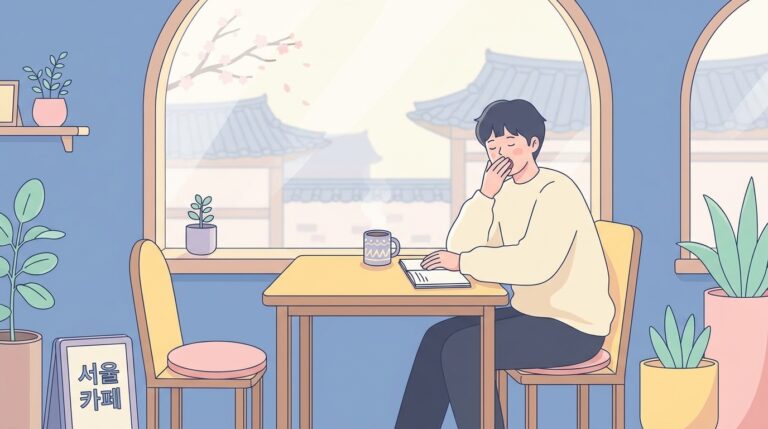
Phase 1: Empathy
안녕하세요! 매일한글 에디터입니다. (Hello! It’s your Daily Hangul editor.)
Have you ever found yourself sitting in a three-hour university lecture in Sinchon, or trapped in an endlessly dragging company dinner (hoesik) where your boss repeats the exact same story for the fourth time? Your eyelids turn into lead weights, your mind drifts off toward the Han River, and suddenly—gasp—a massive yawn creeps up your throat. You instinctively want to tell your Korean friend sitting beside you, “I am so bored I can’t stop yawning!”
Yet, what pops into your head? Probably the stiff textbook sentence: “저는 지금 지루합니다” (Jeoneun jigeum jiruhamnida). If you say that out loud, everyone at the table will freeze, staring at you like you just read aloud from a 1998 grammar workbook! In real life, native Koreans almost never express boredom that way. Instead, they playfully complain about “spiderwebs growing inside their mouths” or sigh that they are “bored to death.”
Expressing negative or vulnerable feelings like tiredness, boredom, and exhaustion naturally is the true hallmark of reaching an intermediate (B1) level. When you learn how to convey boredom with the right flavor, slang, and polite cultural etiquette (nunchi), you instantly bridge the gap between being a polite foreign visitor and an insider buddy. This guide combines real feedback from hundreds of intermediate learners who wanted to sound effortless without being accidentally rude. Let’s make sure your next yawn turns into a fun bonding moment instead of an awkward social blunder!
Phase 2: Core Expression Deep Dive
1. 지루해서 하품 나와요 (Jiruhaeseo hapum nawayo)
- Pronunciation: [Jiruhaeseo hapum nawayo] (Sounds like “Jee-roo-hae-suh hah-poom nah-wah-yo”)
- Meaning: Literal: “Because it is tedious, yawns are coming out.” / Real Nuance: “This is so dull that I can’t help yawning.”
- K-Culture Moment: Imagine watching an artsy, slow-burn movie in an indie cinema in Hongdae. Your friend turns to you at the intermission, rubbing their eyes, and softly whispers this line with a tired grin.
- Editor’s Insight: Notice the verb is 나오다 (naoda – to come out), not “I make a yawn.” In Korean, yawns, sneezes, and tears are viewed as physiological reactions that “emerge” involuntarily. Saying yawns “come out” subtly removes personal blame for being bored!
- Situation Spectrum: Casual ✅ | Semi-formal ⚠️ (Only with close colleagues) | Formal 🚫
- 🤔 Think About It: In English, we often say “You’re making me yawn!” which directly targets the other person or activity. Why do you think Korean expresses yawning as something that “comes out on its own”? Could it be a subconscious way to soften interpersonal friction?
2. 심심해 죽겠어요 (Simsimhae jukgesseoyo)
- Pronunciation: [Simsimhae jukgesseoyo] (Sounds like “Seem-seem-hae jook-get-ssuh-yo”)
- Meaning: Literal: “I am so bored I am going to die.” / Real Nuance: “I’m bored out of my mind / dying of boredom.”
- K-Culture Moment: A classic scene in every campus K-drama: the protagonist is stuck in a quiet study lounge during exam week, sliding their face flat onto the desk while groaning this exact phrase into their notebook.
- Editor’s Insight: B1 learners must grasp the difference between 지루하다 (juruhada) and 심심하다 (simsimhada). Juruhada means you are stuck doing something tedious or repetitive (like a boring speech). Simsimhada means you have nothing to do and lack stimulation. Adding ~죽겠다 (jukgetda – dying of ~) adds a dramatic, colloquial punch.
- Situation Spectrum: Casual ✅ | Semi-formal ✅ (with relatable colleagues/friends) | Formal 🚫
- 🤔 Think About It: Koreans frequently attach “~죽겠다” (jukgetda) to emotions—배고파 죽겠다 (starving to death), 좋아 죽겠다 (thrilled to death). How does hyperbole function differently when building camaraderie in your native culture?
3. 멍때리고 있어요 (Meongttearigo isseoyo)
- Pronunciation: [Meongttearigo isseoyo] (Sounds like “Mung-ttae-ree-go ee-ssuh-yo”)
- Meaning: Literal: “Hitting a blank state.” / Real Nuance: “I’m zoning out / spacing out.”
- K-Culture Moment: When an idol on a variety show suddenly gets caught on camera with totally blank, unfocused eyes while everyone else is debating games, the caption instantly flashes: “OO, 또 멍때리는 중” (Spacing out again).
- Editor’s Insight: “멍” (meong) represents an empty, vacant brain state. It’s not necessarily negative; in modern high-stress Korean society, zoning out has become an intentional self-care activity (like watching a bonfire or the river).
- Situation Spectrum: Casual ✅ | Semi-formal ✅ | Formal 🚫
- 🤔 Think About It: When does your mind naturally zone out? Is spacing out considered lazy in your home country, or is it accepted as a mental reset like it is in Korea?
Phase 3: Textbook Korean vs. Real Korean
Situation 1: Waiting for a friend who is 40 minutes late
- 📖 교과서 한국어 (Textbook Korean): 저는 기다리는 동안 매우 지루함을 느낍니다. (Jeoneun gidarineun dongan maeu jiruhameul neukkimnida. – “I feel extreme boredom while waiting.”)
- 🗣️ 진짜 한국어 (Real Korean): 아, 진짜 심심해 죽겠다. 입에서 거미줄 치겠어! (A, jinjja simsimhae jukgetda. Ib-eseo geomijul chigesseo! – “Ugh, I’m dying of boredom. Spiderwebs are gonna grow in my mouth!”)
- 💡 왜 다를까? (Why the difference?): Nobody articulates their emotional state in abstract noun clauses like “지루함을 느끼다” in daily life. Native speakers use evocative physical idioms like “spiderwebs in the mouth” to humorously emphasize how long they’ve sat in silence.
Situation 2: Commenting on a really slow, uninteresting movie
- 📖 교과서 한국어 (Textbook Korean): 이 영화는 흥미가 없고 재미가 없습니다. (I yeonghwaneun heungmiga eopgo jaemiga eopseumnida. – “This movie lacks interest and has no fun.”)
- 🗣️ 진짜 한국어 (Real Korean): 완전 노잼이라 보다가 잘 뻔했어. (Wanjeon nojaem-ira bodaga jal ppeonhaesseo. – “It’s a total no-jam (no fun); I almost fell asleep watching it.”)
- 💡 왜 다를까? (Why the difference?): Koreans love compound portmanteaus. 노잼 (No-jaem, English “No” + Korean Jaemi [fun]) is universal among Gen Z and Millennials to quickly label anything snooze-worthy.
Phase 4: K-Culture Deep Dive & Non-Verbal Manners
4-1. 눈치 (Nunchi) & Yawning Gestures
In Korean culture, yawning in the presence of others—especially someone older or higher in the social hierarchy—is considered a sign that you find their presence or conversation dull. Here is how you navigate this with high nunchi:
* The Two-Hand Shield: Never yawn with an open mouth. Always cover your mouth entirely with your hand. If an elder or supervisor is in the room, using both hands or turning your head 45 degrees away to muffle the yawn shows deep respect.
* The Sneeze Disguise: If an unavoidable yawn strikes during a business meeting or formal lecture, gently lower your head, press a tissue or knuckles against your mouth, and immediately take a sip of water or jot down a note to signal alertness.
4-2. Cultural Code: The Art of “Meong-taerigi” (멍때리기)
Did you know that Seoul holds an annual “Han River Space-Out Contest” (한강 멍때리기 대회)? Hundreds of people gather to sit on yoga mats for 90 minutes without checking phones, talking, laughing, or falling asleep. Judges even check participants’ heart rates to reward the most tranquil, empty-minded person!
In a relentless, fast-paced society driven by the ppalli-ppalli (hurry-hurry) mindset, prolonged boredom was once viewed as wasted time. Today, Koreans deliberately seek out therapeutic boredom:
* 불멍 (Bul-meong): Staring blankly at a campfire.
* 물멍 (Mul-meong): Gazing lazily at the ocean or river.
* 숲멍 (Sup-meong): Spacing out while looking into green trees.
Boredom has evolved from an irritating void into a cherished mental detox.
Phase 5: Real-World Roleplay Scenario
Setting: A quiet Sunday afternoon at a minimalist café in Yeonnam-dong. You and your Korean university friend, Minji (민지), have been studying for a midterm exam for three uninterrupted hours. The ambient lofi music is making you drowsy.
- 민지 (Minji): 저기… 우리 여기서 세 시간째 이러고 있는 거 알아? 🥱 (🎭 Stretches her arms and rests her chin on her desk)
(Jeogi… uri yeogiseo se siganjjae ireogo inneun geo ara?)
“Hey… do you realize we’ve been like this for three straight hours?” - You: 그러게요. 글자가 눈에 하나도 안 들어와요. 😵 (🎭 Rubbing your eyes with a tired sigh)
(Geureogeyo. Geuljaga nune hanado an deureowayo.)
“Tell me about it. Not a single word is entering my eyes.” - 민지 (Minji): 솔직히 이 챕터 너무 지루하지 않아? 하품 계속 나와. 💤 (🎭 Covers her mouth as her jaw drops into a big yawn)
(Soljiki i chaepteo neomu jiruhaji ana? Hapum gyesok nawa.)
“Honestly, isn’t this chapter so dry? I can’t stop yawning.” - You: 맞아요, 저도 지루해서 하품 나와 죽겠어요. 😴 (🎭 Chuckles and discreetly turns head to stifle a yawn)
(Majayo, jeodo jiruhaeseo hapum nawa jukgesseoyo.)
“Right, I’m so bored that yawns keep pouring out too.” - 민지 (Minji): 우리 딱 10분만 멍때리자. 머리가 굳은 것 같아. 🧠 (🎭 Pushes the textbook away and stares blankly at the wall)
(Uri ttak sip-bunman meongttaerija. Meoriga gudeun geot gata.)
“Let’s just space out for exactly 10 minutes. My brain feels frozen.” - You: 완전 찬성이에요. 창밖 보면서 물멍 때려요 우리. 🪟 (🎭 Pointing toward the small fountain outside the window)
(Wanjeon chanseong-ieyo. Changbak bomyeonseo mulmeong ttaeryeoyo uri.)
“Totally agreed. Let’s look out the window and do some water-zoning.” - 민지 (Minji): 푸하하, 너 이제 한국어 슬랭 진짜 잘 쓴다! 😆 (🎭 Bursts out laughing and claps her hands lightly)
(Puhaha, neo ije hangugeo seullaeng jinjja jal sseunda!)
“Hahaha, you use Korean slang so naturally now!” - You: 다 민지 씨 덕분이죠! 이제 커피 한 잔 더 마실까요? ☕ (🎭 Lifting your empty mug playfully)
(Da Minji ssi deokbun-ijyo! Ije keopi han jan deo masilkkayo?)
“All thanks to you, Minji! Shall we grab another round of coffee now?”
🔀 Interactive Choice Point
Minji sighs and drops her pen: “아, 진짜 너무 지루하다… 뭐 재미있는 거 없을까?” (Ah, I’m so bored… isn’t there anything fun?) How do you respond?
- Option A: “그럼 노래방 가서 스트레스 풀까요? 노잼 공부 그만해요!” (Geureom noraebang gaseo seuteureseu pulkkayo? Nojaem gongbu geumanhaeyo!)
👉 Feedback [BEST]: Natural, upbeat, and empathetic! Suggesting noraebang (karaoke) and casually slipping in “노잼” matches the friendly peer vibe perfectly. - Option B: “저는 매우 지루함을 느껴서 하품을 하였습니다.” (Jeoneun maeu jiruhameul neukkyeoseo hapumeul hayeotseumnida.)
👉 Feedback [BAD]: Way too robotic and overly formal. Minji will probably think you are quoting a Korean textbook from the 1990s. - Option C: “야! 너 때문에 나도 지루하잖아!” (Ya! Neo ttaemune nado jiruhajana!)
👉 Feedback [RISK]: Too blunt and accusatory (“Hey, it’s your fault I’m bored too!”). Unless you are childhood best friends, this sounds unnecessarily aggressive.
Phase 6: 10-Second Emotion Shadowing Drill
Speak these out loud using the rhythm marks (/) and feeling the emotional tags!
[🥱 Exhausted & yawning slowly]
아우… / 지루해서 / 하품이 계속 나와요.
(A-u… / jiruhaeseo / hapumi gyesok nawayo.)
“Ugh… / I’m so bored / yawns just keep coming out.”-
[😩 Exaggerated, whiny playfulness]
심심해 죽겠어! / 우리 뭐 / 신나는 거 없을까?
(Simsimhae jukgesseo! / uri mwo / sinnaneun geo eopseulkka?)
“I’m dying of boredom! / Isn’t there / something exciting we can do?” -
[🧘 Blank, zen-like whisper]
아무 생각도 안 할래… / 그냥 / 멍때리는 중이야.
(Amu saenggakdo an hallae… / geunyang / meongttaerineun jung-iya.)
“I don’t wanna think about anything… / I’m just / zoning out right now.”
Phase 7: K-Culture Mini Dictionary
-
하품 (Hapum)
Meaning: A yawn.
Usage: Used with the verb naoda (to come out: 하품이 나오다) or hada (to do: 하품하다). In daily life, saying “하품 나와” is the most natural way to signal drowsiness without sounding overly critical. -
노잼 (Nojaem)
Meaning: “No fun” / Boring / Unfunny.
Usage: A staple slang created by combining English “No” and Korean “Jaemi” (재미). Used to describe movies, jokes, lectures, or even friends acting unenthusiastic (“오늘 왜 이렇게 노잼이야?” – Why are you so un-fun today?). -
멍때리다 (Meongttearida)
Meaning: To zone out / to daydream into empty space.
Usage: Essential lifestyle slang in Korea. You’ll hear office workers stepping outside for a coffee break saying, “바람 쐬면서 멍 좀 때리자” (Let’s get some fresh air and zone out a bit). -
킬링타임 (Killing Time)
Meaning: Casual activity meant purely to pass idle hours.
Usage: Koreans use this English loanword frequently when browsing webtoons or watching YouTube shorts: “이 드라마는 킬링타임용으로 딱이야” (This drama is perfect for just killing time).
Phase 8: Traveler’s Survival Kit
Top 3 Survival Phrases for Slow Moments
- 조금 피곤해서 하품이 나오네요. (Jogeum pigonhaeseo hapumi naoneyo.)
Pro Tip: If you yawn accidentally in front of an elder or tour guide, say this immediately with a modest bow. It polite shifts the reason to simple physical fatigue rather than disinterest. - 시간 때울 만한 곳 있을까요? (Sigan ttae-ul manhan got isseulkkayo?)
Pro Tip: “Is there somewhere I can kill some time?” Great for asking hotel concierges when you have a 2-hour gap before check-in. - 너무 조용해서 잠 올 것 같아요. (Neomu joyonghaeseo jam ol geot gatayo.)
Pro Tip: “It’s so quiet I feel sleepy.” A charming way to break the ice in an awkwardly quiet café or waiting lounge.
🧳 Editor’s Travel Note
Stuck waiting in Seoul with nothing to do? Don’t wander aimlessly. Install the official Naver Map navigation application to instantly discover themed “book cafes” (buk-kape) or Han River picnic spots right around your current GPS coordinates. If you find yourself in a slow afternoon lull, renting a bicycle through the Ttareungi bike sharing system along Yeouido is the ultimate antidote to boredom!
Phase 9: “One Step Deeper” (Reflective Essay)
Korea is world-renowned for its hyper-efficient, adrenaline-fueled ppalli-ppalli (fast-fast) lifestyle. In a culture where productivity is celebrated, quiet periods of idleness have traditionally been accompanied by a slight sense of guilt. When Koreans say “심심해 죽겠다” (I’m dying of boredom), it isn’t just an observation—it is a subconscious plea for activity, connection, or a shared experience. Yet recently, the younger generation has reclaimed boredom not as a void to be filled, but as meong-taerigi—an essential sanctuary from burnout. In Korea, boredom is rarely an isolated solo state; it is either a collaborative joke with friends or a deliberate communal healing ritual.
💬 Your Turn: In your home country, how do people view doing “absolutely nothing”? Is spacing out viewed as a healthy mental break or seen as unproductive laziness? Tell me your thoughts in the comments below!
Phase 10: FAQ & Avoiding Misunderstandings
Q: Can I use “심심해요” and “지루해요” interchangeably?
A: Not quite! Use 심심해요 when you have free time and lack things to do (“I’m bored at home alone”). Use 지루해요 when the external situation or activity you are actively doing is tedious or dragging on (“This 3-hour speech is boring”). Saying “영화가 심심해요” sounds awkward; say “영화가 지루해요” or “영화가 노잼이에요”!
Q: Is yawning in public in Korea considered rude?
A: Yawning is a normal human bodily function, but letting out an audible, wide-open yawn without covering your mouth is viewed as bad manners (ye-ui eopda). Always cover your mouth with your hand, and never yawn directly facing a teacher, senior, or boss.
Q: What does “꿀잼” mean compared to “노잼”?
A: 꿀잼 (Kkul-jaem) combines “꿀” (honey) and “재미” (fun). It is the exact opposite of 노잼! If a Korean drama keeps you on the edge of your seat with zero boredom, you shout: “이 드라마 완전 꿀잼이야!” (This drama is super fun / sweet!).
🚨 Common Mistakes Warning Board
- Mistake: Telling your Korean date, “당신은 지루해요” (Dangsin-eun jiruhaeyo).
Consequence: This translates to “You are a boring, tedious person”—an instant relationship killer!
Correct Action: If you’re bored together, blame the activity: “우리 다른 거 하러 갈까요?” (Shall we go do something else?). - Mistake: Saying “하품을 만들어요” (Hapumeul mandeureoyo).
Consequence: Literally “I am manufacturing yawns.”
Correct Action: Always use 하품이 나와요 (Hapumi nawayo – yawns are coming out). - Mistake: Using “심심해 죽겠어” to your boss or company director.
Consequence: Extreme informality! The ending ~죽겠어 is purely casual peer talk.
Correct Action: In professional settings, maintain composure and say: “조금 환기가 필요한 것 같습니다” (I think we need a bit of fresh air/ventilation).
Phase 11: Action Missions
- 🥉 Bronze Mission (Solo Practice): Stand in front of your mirror, fake a tiny yawn while covering your mouth with your right hand, and say out loud with realistic tired intonation: “아, 지루해서 하품 나와요.” (Repeat 3 times).
- 🥈 Silver Mission (Social Media): Take a photo of an empty coffee cup or your study desk on Instagram Stories, add the sticker or text #멍때리는중 or #심심해죽겠음, and tag your Korean learning buddy!
- 🥇 Gold Mission (Real Life): Next time you are on a voice call with a Korean language exchange partner or tutor, use 멍때리다 or 노잼 naturally in conversation.
- 🎮 K-Culture Mission: Watch the next episode of any Korean variety show (like Running Man or Knowing Bros). Keep your eyes peeled for the caption whenever a guest looks blank. Spot the word 멍 on the screen!
Phase 12: Interactive Quiz Challenge
Test your knowledge below! Click the spoiler toggles to reveal the correct answers and explanations.
Question 1: Situation Judgment
You are sitting in a lecture room with your Korean professor. You accidentally let out a small yawn. Which of the following is the most culturally polite response if the professor looks over at you?
* A) “교수님, 강의가 너무 지루해서 하품 나와요!”
* B) “죄송합니다, 어제 잠을 못 자서 피곤해서 하품이 나왔습니다.”
* C) “완전 노잼이라 멍때리고 있었어요.”
🔍 Click to view Answer & Explanation
Correct Answer: B
Explanation: Never tell a professor or superior that their lecture is boring (A and C). Blaming lack of sleep or tiredness (“어제 잠을 못 자서 피곤해서…”) politely excuses the bodily reaction without disrespecting the speaker!
Question 2: Fill in the Blanks
Fill in the blank with the appropriate slang term:
“주말에 아무 약속도 없어서 집에서 하루 종일 _________ 죽겠어!”
* (Hint: You have nothing to do at home, not doing a tedious activity).
🔍 Click to view Answer & Explanation
Correct Answer: 심심해
Explanation: When you have no plans and lack stimulation, the word is 심심하다 (심심해 죽겠어). If you were forced to clean the entire house for 6 hours straight, you would say 지루해 죽겠어.
Question 3: Cultural True or False
True or False: In Korea, spacing out without any thoughts (멍때리기) is always considered irresponsible and lazy, and there is no public acceptance of it.
🔍 Click to view Answer & Explanation
Correct Answer: False
Explanation: Modern Korean culture actively embraces zoning out as a form of mental healing and mindfulness, to the point of holding the official annual Han River Space-Out Contest and popularizing trends like bul-meong (campfire zoning) and mul-meong (water zoning)!