

How to Ask for a Quick Checkout in Korea: Mastering Ppalli-Ppalli Culture Without Being Rude
Phase 1: 공감 (Story-Driven Opening)
안녕하세요! 매일한글 에디터입니다. (Hello! I’m your Daily Hangul editor.)
Picture this: You are sitting in a bustling, savory-smelling bibimbap spot near Seoul Station. It is 12:48 PM, and your KTX train to Busan leaves at 1:05 PM sharp. You waved your hand, finished your meal, and stood by the cashier counter. However, the owner is juggling three delivery receipts, bagging takeout containers, and packing side dishes. You feel your palms sweat as the digital clock clicks: 12:51 PM.
You want to scream: “Excuse me, hurry up, please!” But you freeze. Will saying “빨리 (Ppalli)” sound aggressive? In K-dramas, you hear impatient bosses yell “빨리빨리! (Ppalli-ppalli!)”, but using that with an elder restaurant owner (이모님 – Imonim) might earn you a sharp glare rather than fast service.
Here is the good news: South Korea is literally famous for its Ppalli-Ppalli (hurry-hurry) lifestyle. Locals value speed, efficiency, and respect for time above almost everything else. The secret is knowing how to communicate urgency wrapped in politeness. With the right A2-level phrases and physical cues, you will glide through the checkout in under ten seconds with a warm smile from the cashier.
Phase 2: 핵심 표현 3선 심층 분석 (Top 3 Core Expressions)
1. 계산 좀 빨리 부탁드려요 (Gyesan jom ppalli butakdeuryeoyo)
- Pronunciation: [Gye-san jom bbal-li bu-tak-deu-ryeo-yo] (Think: “Gye-san” sounds like ‘guess-on’, “jom” like ‘chom(p)’, and “ppalli” like a snappy ‘pah-lee’)
- Meaning: Literal: “Please request quick calculation.” vs. Actual Nuance: “Could you please check me out quickly?”
- K-Culture Moment: You will hear this frequently in office-district lunch spots around Yeouido or Gangnam when office workers rush to get back before their 1:00 PM meetings.
- Editor’s Insight: The tiny syllable 좀 (jom) translates to “a little bit,” but in Korean etiquette, it acts as a magical cushion word that softens commands into courteous requests.
- Situation Spectrum: Casual ⚠️ | Semi-formal ✅ | Formal ✅
- 🤔 Think About It: In English, asking someone to “hurry up” at a register often feels demanding. Why does adding softening words like 좀 (jom) make urgency acceptable in Korean service culture?
2. 저 지금 좀 급해서요 (Jeo jigeum jom geuphaeseoyo)
- Pronunciation: [Jeo ji-geum jom geup-hae-seo-yo] (Sounds like: ‘Chaw jee-geum chom goop-heh-saw-yo’)
- Meaning: Literal: “Because I am a bit urgent right now.” vs. Actual Nuance: “I’m in a bit of a rush right now, so…”
- K-Culture Moment: Seen constantly in K-dramas when the protagonist has to sprint out of a convenience store to catch the last bus before it drives away.
- Editor’s Insight: Notice that the sentence ends with -어서요 (-eoseoyo), leaving the consequence unsaid. In Korean communication, trailing off gently allows the listener to fill in the blank and naturally step up to help you.
- Situation Spectrum: Casual ⚠️ | Semi-formal ✅ | Formal ⚠️
- 🤔 Think About It: Why is explaining your reason (“I’m in a rush”) culturally preferred over simply ordering someone to do their task faster?
3. 카드 먼저 드릴게요 (Kadeu meonjeo deurilgeyo)
- Pronunciation: [Ka-deu meon-jeo deu-ril-ge-yo] (Sounds like: ‘Kah-dew mun-jaw dew-reel-geh-yo’)
- Meaning: Literal: “I will give you the card first.” vs. Actual Nuance: “Here is my card ready for payment!”
- K-Culture Moment: Watch any YouTube Seoul street-food vlog: locals always have their physical card or phone extended before the cashier even states the total.
- Editor’s Insight: Offering your card ahead of time signals that you are ready to complete the transaction instantaneously, cutting transaction time in half.
- Situation Spectrum: Casual ✅ | Semi-formal ✅ | Formal ✅
- 🤔 Think About It: How does preparing your payment method ahead of time demonstrate Nunchi (social situational awareness) toward both the worker and the people behind you?
Phase 3: 교과서 한국어 vs 진짜 한국어 (Textbook vs. Real Korean)
Situation 1: Asking to pay right away
- 📖 교과서 한국어 (Textbook Korean):
- 지금 즉시 결제를 진행해 주시겠습니까? (Jigeum jeuksi gyeoljereul jinhaenghae jusigesseumnikka? – “Would you proceed with the settlement immediately?”)
- 🗣️ 진짜 한국어 (Real Korean):
- 결제 먼저 해도 될까요? (Gyeolje meonjeo haedo doelkkayo? – “Could I pay first?”)
- 💡 왜 다를까? (Why is it different?): Textbook phrasing sounds like an automated bank terminal. Real Koreans ask for permission softly using 해도 될까요? while pulling out their payment card.
Situation 2: Explaining that your train or bus is leaving
- 📖 교과서 한국어 (Textbook Korean):
- 저는 현재 탑승 시간이 임박하였습니다. (Jeoneun hyeonjae tapseung sigani imbakayeotseumnida. – “My boarding time is imminent at present.”)
- 🗣️ 진짜 한국어 (Real Korean):
- 제가 기차 시간이 다 돼서요! (Jega gicha sigani da dwaeseoyo! – “My train time is almost up!”)
- 💡 왜 다를까? (Why is it different?): Native speakers use everyday colloquial terms like 다 돼서요 (it’s almost time) to express urgency vividly without sounding like an official announcement.
Phase 4: K-Culture 딥다이브 & 비언어적 매너 (Deep Dive & Non-Verbal Manners)
4-1. 눈치 (Nunchi) & Body Language: The 3-Second Card Ready Rule
In Korea, non-verbal communication speaks louder than words:
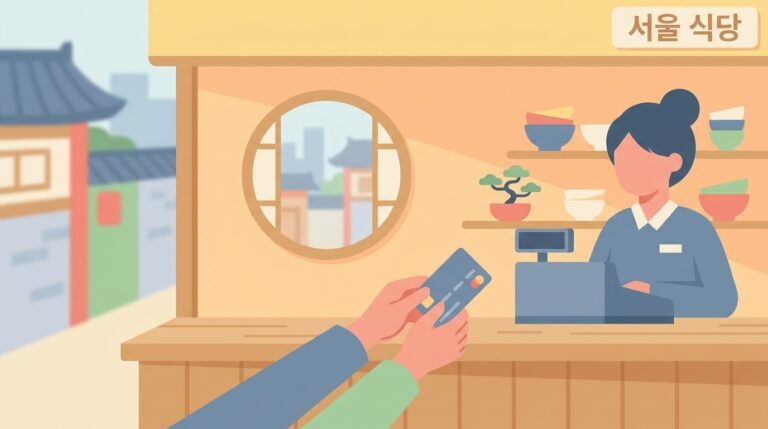
* The Two-Handed Card Hold: Hold your credit card or smartphone with both hands (or your right hand supported lightly at the wrist by your left hand). Extend it toward the terminal slightly at waist height.
* Eye Contact & Slight Bow: Catch the staff’s eye, nod your head at approximately 15 degrees, and maintain a polite, apologetic facial expression. A warm smile paired with an urgent posture communicates: “I don’t mean to bother you, I am just genuinely in a hurry!”
* Avoid Finger Tapping: Never tap your card or fingers on the glass counter. In Korea, tapping on tables signals irritation and impatience, which breaks relational harmony.
4-2. Cultural Code: The Engine of Ppalli-Ppalli
Where does Korea’s need for speed come from? Historically fueled by rapid post-war industrialization, speed became a national virtue. Today, it translates into the world’s fastest internet, subways arriving within 90-second intervals, and 20-minute food deliveries. When Koreans say 빨리빨리 (Ppalli-ppalli), it is rarely intended to be aggressive; it is an instinctual teamwork mentality where everyone tries to save each other’s precious minutes.
Phase 5: 실전 롤플레이 시나리오 (Real Role-Play Scenario)
Setting: It is 8:42 AM at a bustling Kimbap Cheonguk (Kimbap Heaven) near Seoul Station. You just finished breakfast, but your KTX boarding gate closes in 13 minutes.
NPC: Auntie Kim (김 이모님), an energetic restaurant owner wrapping tuna kimbap rolls behind the counter.
- Turn 1 (You):
- 저기요, 이모님! (Jeogiyo, imonim!)
- 🎭 Action: Raising one hand gently to shoulder height and stepping toward the register.
- “Excuse me, Auntie!”
- Turn 2 (Auntie Kim):
- 네, 김밥 두 줄만 말고 갈게요, 잠깐만요! (Ne, gimbap du julman malgo galgeyo, jamkkanmanyo!)
- 🎭 Action: Rolling seaweed swiftly without looking up.
- “Yes, I will just finish rolling these two kimbaps and come over, just a moment!”
- Turn 3 (You):
- 저 죄송한데, 지금 좀 급해서요. (Jeo joesonghande, jigeum jom geuphaeseoyo.)
- 🎭 Action: Taking out your card with both hands and speaking with an apologetic smile.
- “I’m really sorry, but I’m in a bit of a rush right now.”
- Turn 4 (Auntie Kim):
- 아이고, 그래요? 기차 타러 가요? (Aigo, geuraeyo? Gicha tareo gayo?)
- 🎭 Action: Quickly wiping hands on her apron and stepping toward the POS terminal.
- “Oh dear, really? Are you heading to catch a train?”
- Turn 5 (You):
- 네! 기차 시간이 다 돼서, 계산 좀 빨리 부탁드려요. (Ne! Gicha sigani da dwaeseo, gyesan jom ppalli butakdeuryeoyo.)
- 🎭 Action: Nodding repeatedly and extending your payment card.
- “Yes! My train time is almost up, so could you please check me out quickly?”
- Turn 6 (Auntie Kim):
- 카드 줘 봐요! 오천오백 원, 삑! 됐어요! (Kadeu jwo bwayo! Ocheon-obaek won, bbik! Dwaesseoyo!)
- 🎭 Action: Slapping the card into the reader and pressing receipt skip within two seconds.
- “Give me the card! 5,500 won, beep! Done!”
- Turn 7 (You):
- 감사합니다! 안녕히 계세요! (Gamsahamnida! Annyeonghi gyeseyo!)
- 🎭 Action: Bowing quickly while pocketing your card and grabbing your backpack.
- “Thank you so much! Goodbye!”
- Turn 8 (Auntie Kim):
- 뛰어가지 말고 조심해서 가요! (Ttwieogaji malgo josimhaeseo gayo!)
- 🎭 Action: Waving spatula encouragingly.
- “Don’t trip running, go safely!”
🔀 Interactive Decision Point
What do you do if there are two customers standing near the register chatting?
* Option A: Say “저기요, 빨리 비켜주세요!” (Jeogiyo, ppalli bikyeojuseyo! – “Excuse me, move aside quickly!”)
* Feedback: ❌ Bad. Yelling at other customers to get out of the way is extremely offensive and creates immediate conflict.
* Option B: Say “죄송합니다, 제가 기차 시간 때문에 그런데 먼저 계산해도 될까요?” (Joesonghamnida, jega gicha sigan ttaemune geureonde meonjeo gyesanhaedo doelkkayo?) while holding up your card.
* Feedback: 🏆 Best! Acknowledging them with 죄송합니다 and stating your train reason will prompt Koreans to cheerfully step aside for you.
* Option C: Stand quietly behind them and sigh loudly hoping they notice you are late.
* Feedback: ⚠️ Risk. Passive-aggressive sighing (한숨 쉬기) makes the atmosphere awkward, and they might think you are judging their meal!
Phase 6: 10초 감정 섀도잉 드릴 (10-Second Shadowing Drill)
Read these aloud, hitting the emotional mark and respecting the pause markers (/):
[🏃♂️ Urgently yet politely]
저기요! / 제가 지금 버스 시간이 다 돼서요! / 계산 좀 빨리 부탁드려요!
(Jeogiyo! / Jega jigeum beoseu sigani da dwaeseoyo! / Gyesan jom ppalli butakdeuryeoyo!)
“Excuse me! / My bus is almost here! / Could you please check me out quickly?”-
[🙏 Apologetic & humble]
죄송한데, / 카드 먼저 받아주시겠어요? / 좀 급해서요!
(Joesonghande, / kadeu meonjeo badajusigesseoyo? / Jom geuphaeseoyo!)
“I’m sorry, / could you take my card first? / I’m in a bit of a hurry!”
Phase 7: K-Culture 미니 사전 (Mini Dictionary)
- 빨리빨리 (Ppalli-ppalli) | Hurry-hurry / Fast-paced mindset
- Usage: The cultural rhythm of modern Korea that values rapid results, punctual service, and proactive speed.
- 계산 (Gyesan) | Bill / Checkout / Calculation
- Usage: Used everywhere from sit-down restaurants to grocery marts when asking to settle the tab (계산해 주세요).
- 급하다 (Geuphada) | To be urgent / In a rush
- Usage: An essential adjective for expressing personal emergencies, bathroom urgency, or approaching transit deadlines.
- 눈치 (Nunchi) | Situational tact / Social radar
- Usage: Reading the room and adapting your behavior appropriately so the group dynamic stays harmonious.
Phase 8: 여행자를 위한 생존 키트 (Traveler’s Survival Kit)
Survival Expressions TOP 3
- 영수증은 버려주세요 (Yeongsujeungeun beoryeojuseyo)
- Meaning: “Please throw away the receipt.”
- Pro Tip: Skip printing receipts to shave another 5 seconds off your checkout.
- 테이크아웃으로 바꿀 수 있나요? (Teikeu-a-useuro bakkul su innayo?)
- Meaning: “Can I change this to takeout?”
- Pro Tip: If your food arrives late, ask for it in a to-go container immediately.
- 포장해 주세요 (Pojanghae juseyo)
- Meaning: “Please pack this up to-go.”
- Pro Tip: Perfect when you cannot finish your meal in time for your transit departure.
Editor’s Travel Note
- Install the Naver Map navigation app to track real-time bus arrivals down to the second.
- Keep your international credit card, T-Money transport card, or WOWPASS card separated in an easily accessible front pocket so you don’t fumble through bags at the checkout counter.
Phase 9: “한 발 더 깊이” (Cultural Essay & Reflection)
In Western dining culture, waving down a waiter and asking to pay quickly while they attend to someone else might feel like a breach of dining etiquette. However, Korean dining spots are communal workspaces built on reciprocal consideration. When you say “제가 좀 급해서요” (I am in a bit of a rush), the worker does not take it as an insult to their pacing; rather, they instantly empathize with the stress of missing an appointment. In Korea, speed is not impatience—it is empathy in motion.
💬 Your Turn: Have you ever experienced Korea’s Ppalli-Ppalli culture in real life or in a K-drama? How do people handle quick checkouts in your home country? Share your stories in the comments below!
Phase 10: FAQ & 오해 방지 (FAQ Schema Ready)
Q: Is it considered rude to say “빨리 해 주세요” (Ppalli hae juseyo) directly?
A: Yes, saying just “빨리 해 주세요” without cushioning words can sound demanding and blunt, like “Do it fast!” Always pair it with “죄송한데” (I’m sorry, but) or “좀” (a little bit), such as “죄송한데 좀 빨리 부탁드려요.”
Q: Can I pay before my food even arrives if I know I have to leave quickly?
A: Absolutely! In small eateries (bunsikjip or cafes), you can step up to the counter and say: “저 먼저 계산해도 될까요?” (Could I pay first?) Korean restaurant owners are very accommodating to early payers.
Q: What if the cashier speaks very fast in Korean after I ask for quick payment?
A: They are almost always asking two standard questions: “영수증 드릴까요?” (Do you want a receipt?) or “포인트 적립 있으세요?” (Do you have a rewards number?). Simply say: “아니요, 괜찮아요!” (No, it’s okay!) and you are good to go.
🚨 흔한 실수 (Common Mistakes) 경고판
- ❌ Mistake 1: Tapping your card on the POS counter while waiting.
- 👉 Correct Action: Hold the card gently in both hands with arms lowered.
- ❌ Mistake 2: Shouting “빨리빨리!” across the restaurant floor.
- 👉 Correct Action: Walk up to the payment counter and speak at a conversational volume.
- ❌ Mistake 3: Waiting for the waiter to walk to your table with the bill in casual Korean diners.
- 👉 Correct Action: In most Korean casual restaurants, you must take the paper bill on your table and walk to the front exit register yourself!
Phase 11: 액션 미션 & 참여 유도 (Action Missions)
- 🥉 Bronze Mission (Solo Practice): Stand before a mirror with your payment card, hold it with two hands, and practice saying “저 지금 좀 급해서요, 계산 좀 빨리 부탁드려요!” three times with a polite smile.
- 🥈 Silver Mission (Social Connection): Write down your favorite Ppalli-Ppalli moment from a K-drama on Instagram or X and tag
@DailyHangulwith your practice audio clip! - 🥇 Gold Mission (Real-World Test): Next time you visit a Korean convenience store or restaurant, have your payment card extended before the cashier scans the final item!
- 🎮 K-Culture Mission: Watch an episode of an office K-drama like Misaeng or Business Proposal. Spot how many times characters use 빨리 in work situations versus food scenes!
Phase 12: 인터랙티브 퀴즈 챌린지 (Interactive Quiz)
1. Situational Judgment
You are grabbing a quick coffee before your subway train departs. The barista is steaming milk. What is the most polite and natural way to ask to settle payment now?
* A) 어이, 빨리 결제해! (Eoi, ppalli gyeoljehae!)
* B) 죄송한데, 제가 좀 급해서 결제 먼저 해도 될까요? (Joesonghande, jega jom geuphaeseo gyeolje meonjeo haedo doelkkayo?)
* C) 빨리빨리 커피 주세요. (Ppalli-ppalli keopi juseyo.)
🔍 Click to view Answer & Explanation
Answer: B
Explanation: Option B combines an apology (죄송한데), explains the urgent context (제가 좀 급해서), and asks for permission politely (결제 먼저 해도 될까요?). Option A is extremely rude informal language, and Option C sounds like an aggressive command.
2. Fill-in-the-Blank
Complete the polite softening sentence:
“기차 시간이 다 돼서, 계산 _____ 빨리 부탁드려요.”
🔍 Click to view Answer & Explanation
Answer: 좀 (jom)
Explanation: The magic cushion adverb 좀 softens the request and removes any demanding tone from your plea.
3. Cultural True or False
Statement: In casual Korean restaurants, the waiter always brings the credit card terminal to your dining table at the end of the meal.
🔍 Click to view Answer & Explanation
Answer: False
Explanation: Except in high-end Western dining or specialized barbecue restaurants, payment in Korea almost always takes place at the register counter located right next to the entrance door. Take your paper order slip to the counter to pay!







