

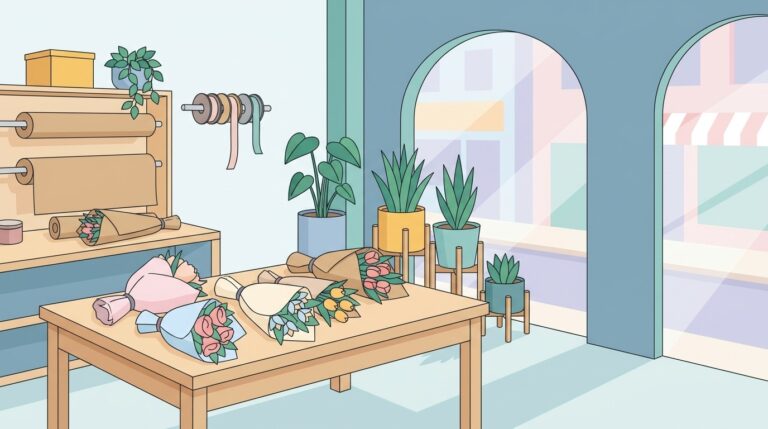
Master Korean Flower Gifting: From Flower Shop to Heartfelt Delivery
Phase 1: Empathy (Story-Driven Opening)
안녕하세요! 매일한글 에디터입니다. (Hello! I’m your Daily Hangul editor.)
Picture this: You are strolling down the charming, cobblestone backstreets of Yeonnam-dong on a cool autumn evening. You have a special occasion—maybe it’s a Korean friend’s birthday party, an end-of-term celebration, or a memorable first date. You spot a picturesque boutique florist with warm, amber lights spilling onto the pavement and rows of breathtaking dried eucalyptus and pastel tulips. You want to walk in, buy a stunning bouquet, and hand it over with that effortlessly smooth K-drama flair.
Then reality hits. You step inside, the little door chime rings, and the florist greets you with an expectant smile: “Eotteon geot chajeuseyo?” (What are you looking for?). Suddenly, your mind blanks. How do you say “bouquet”? How do you ask them to wrap it nicely without sounding like an archaic textbook? And when you finally hand it over, what do you say so it doesn’t feel awkward?
Don’t worry, you are not alone! Over the past decade tutoring hundreds of beginners, I have watched so many students freeze right at the shop counter. In this lesson, we will break down simple, beginner-friendly (A1) phrases that will transform you from an overwhelmed tourist into a thoughtful, confident gift-giver. Let’s make your flower gifting moment unforgettable!
Phase 2: Top 3 Core Expressions In-Depth Analysis
1. 꽃다발 하나 만들어 주세요 (Kkotdabal hana mandeureo juseyo)
- Pronunciation: Kkot-da-bal ha-na man-deu-reo ju-se-yo (Think of kkot like “coat” pronounced with a sharp, crisp ‘k’ sound as in ‘skate’, followed by da-bal, ha-na, and man-deu-reo joo-seh-yo).
- Meaning: Literal: “Please make one flower bouquet.” / Real Nuance: “Could you put together a bouquet for me, please?”
- K-Culture Moment: You will hear this in countless romantic K-dramas whenever the male lead nervously walks into a shop before a big milestone confession.
- Editor’s Insight: The word 꽃다발 combines 꽃 (flower) and 다발 (bundle/bunch). In Korea, ready-made bouquets sit on display, but asking them to “make” (만들어 주세요) one allows the florist to customize the colors and wrapping style to your budget.
- Situation Spectrum: Casual: ⚠️ (Only with close peers: 꽃다발 하나 만들어 줘) | Semi-formal: ✅ | Formal: ✅
- 🤔 Think About It: In English, we often say “I’d like to buy a bouquet.” Why do Koreans place the emphasis on the artisan’s action of making (만들다) rather than buying (사다)?
2. 이거 선물용이에요 (Igeo seonmulyong-ieyo)
- Pronunciation: Ee-geo seon-mool-yong-ee-eh-yo (Rhymes gently: ee-geo sounds like “eagle” without the ‘l’, seon-mul like “sun” + “mule”).
- Meaning: Literal: “This is for gift use.” / Real Nuance: “This is a gift for someone (so please wrap it beautifully).”
- K-Culture Moment: In slice-of-life K-dramas like Hospital Playlist, characters casually drop this line at counters so the staff knows to attach a message card and remove price tags.
- Editor’s Insight: The magic suffix -용 (用) means “for the purpose of.” Saying 선물용 instantly signals the florist to remove the price sticker, reinforce the water pouch around the stems, and add decorative ribbons.
- Situation Spectrum: Casual: ⚠️ (이거 선물용이야) | Semi-formal: ✅ | Formal: ✅
- 🤔 Think About It: How does your home culture communicate that an item is a present without explicitly asking for VIP wrapping?
3. 축하해요! 받아주세요 (Chukhahaeyo! Badajuseyo)
- Pronunciation: Choo-ka-hae-yo! Ba-da-joo-seh-yo (Chukha sounds like “chew” followed by an aspirated “car”).
- Meaning: Literal: “Congratulations! Please receive this.” / Real Nuance: “Congratulations! This is for you, please accept it!”
- K-Culture Moment: Seen at university graduation ceremonies and post-theater curtain calls in Seoul, accompanied by a polite, respectful bow.
- Editor’s Insight: In Korean etiquette, handing a gift is an invitation for the other person to receive your warmth. Saying 받아주세요 shows modesty and gentleness, ensuring the recipient feels honored.
- Situation Spectrum: Casual: ⚠️ (축하해! 받아!) | Semi-formal: ✅ | Formal: ✅
- 🤔 Think About It: Why is it customary in Korea to verbally ask someone to “receive” a gift rather than saying “Here, take this”?
Phase 3: Textbook Korean vs. Real Korean
Situation 1: Asking for Wrapping at the Counter
- 📖 Textbook Korean: 꽃을 포장해 주시겠습니까? (Kkoteul pojanghae jusigesseumnikka? – “Would you be willing to wrap the flowers?”)
- 🗣️ Real Korean: 예쁘게 포장해 주세요! (Yeoppeuge pojanghae juseyo! – “Please wrap it up prettily!”)
- 💡 Why is it different? While textbooks teach honorific conditionals, native Koreans prefer direct, enthusiastic, and cheerful requests. Adding 예쁘게 (prettily) is a natural, friendly compliment to the florist’s skill!
Situation 2: Handing Over the Flowers to a Friend
- 📖 Textbook Korean: 이것은 당신을 위해 준비한 꽃 선물입니다. (Igeoseun dangsineul wihae junbihan kkot seonmul-imnida. – “This is a flower gift prepared for you.”)
- 🗣️ Real Korean: 축하해, 네 생각나서 샀어! (Chukhahae, ne saenggaknaseo sasseo! – “Congrats, I bought this because it made me think of you!”)
- 💡 Why is it different? Pronouns like 당신 (you) feel stiff, distant, and overly theatrical. Real Koreans express warmth through emotional connection—mentioning that the gift reminded them of their friend.
Phase 4: K-Culture Deep Dive & Non-Verbal Manners
4-1. Nunchi (눈치) & Body Language
- The Two-Hand Rule (두 손): When handing or receiving a bouquet, always hold it with both hands. If one hand must steady your bag or coat, place your free hand lightly beneath your giving forearm or elbow. This subtle gesture instantly radiates respect and emotional sincerity.
- The Humble Bow: Accompany the presentation with a gentle, 15-degree nod of the head. Avoid prolonged, unbroken eye contact during the transfer—look down at the bouquet as you offer it, then look up with a warm smile once they take hold of it.
4-2. Cultural Code: The Language of Korean Flowers
In Korean culture, flowers are tied deeply to personal milestones:
* Graduations (졸업식): Yellow sunflowers and bright tulips symbolize shining futures.
* Parents’ Day & Teacher’s Day (어버이날 / 스승의 날): Red carnations express gratitude and filial duty. Giving white chrysanthemums (국화), however, is reserved strictly for funerals—never gift white chrysanthemums on a joyous occasion!
* 100-Day Anniversaries & Romance: Fresh pastel-toned roses or baby’s breath (안개꽃) remain classic symbols of pure, enduring affection.
Phase 5: Real-World Roleplay Scenario
Setting: “Haru Flower Studio”, a cozy, aromatic boutique near Mangwon Market. Soft indie-pop plays in the background. The counter is lined with pastel craft papers and satin ribbons.
Character: Florist Sora (friendly, perceptive, wearing a linen apron).
- Turn 1 (Florist Sora): 어서 오세요! 어떤 꽃 찾으세요?
(Eoseo oseyo! Eotteon kkot chajeuseyo?)
“Welcome! What kind of flowers are you looking for?”
🎭 Smiling brightly behind the counter -
Turn 2 (You): 안녕하세요! 꽃다발 하나 만들어 주세요.
(Annyeonghaseyo! Kkotdabal hana mandeureo juseyo.)
“Hello! Please make a flower bouquet for me.”
🎭 Looking around the flower displays with a friendly smile -
Turn 3 (Florist Sora): 네, 좋아요! 누구에게 선물하실 건가요?
(Ne, joayo! Nugu-ege seonmulhasil geongayo?)
“Sure thing! Who is this gift for?”
🎭 Picking up a pair of florist shears -
Turn 4 (You): 친구 생일이에요. 이거 선물용이에요.
(Chingu saeng-il-ieyo. Igeo seonmulyong-ieyo.)
“It is my friend’s birthday. This is for a gift.”
🎭 Pointing to soft pink and cream roses -
Turn 5 (Florist Sora): 축하해요! 생각하신 가격대가 있으세요?
(Chukhahaeyo! Saenggakhasin gagyeokdaega isseuseyo?)
“Congratulations! Do you have a price range in mind?”
🎭 Nodding thoughtfully -
Turn 6 (You): 삼만 원 정도로 예쁘게 포장해 주세요.
(Sam-man won jeongdoro yeoppeuge pojanghae juseyo.)
“Around 30,000 won, please wrap it up prettily.”
🎭 Showing appreciation with polite eye contact -
Turn 7 (Florist Sora): 네, 알겠습니다! 잠시만 기다려 주세요.
(Ne, algessumnida! Jamsiman gidaryeo juseyo.)
“Understood! Please wait just a moment.”
🎭 Skillfully arranging stems and wrapping with delicate paper -
Turn 8 (You): 감사합니다!
(Gamsahamnida!)
“Thank you!”
🎭 Bowing slightly as you prepare your payment card
🔀 Interactive Decision Branch
Now you meet your friend outside the cafe. What do you do?
- Option A: Thrust the flowers forward with one hand while checking your phone: “자, 받아.” (Ja, bada.)
- Option B: Hold the bouquet with both hands, bow slightly, and say with a smile: “생일 축하해! 받아줘.” (Saeng-il chukhahae! Badajwo.)
- Option C: Say nothing, put the bouquet on the outdoor table, and sit down.
Feedback:
* Option A (Bad): Handing gifts with one hand feels dismissive in Korea, and the tone sounds aloof!
* Option B (Best!): Perfect score! Two hands, a warm wish, and an affectionate, respectful delivery.
* Option C (Risk): Leaving flowers on the table without words can cause confusion or make the recipient wonder if they are for someone else!
Phase 6: 10-Second Emotion Shadowing Drill
Practice reading these out loud at native speed! Pause where you see /:
[😊 Cheerful & Confident]
꽃다발 하나 / 만들어 주세요!
(Kkotdabal hana / mandeureo juseyo!)-
[💐 Sweet & Helpful]
친구 생일 선물이에요, / 예쁘게 포장해 주세요!
(Chingu saeng-il seonmul-ieyo, / yeoppeuge pojanghae juseyo!) -
[🎉 Warm & Celebratory]
진심으로 축하해요, / 이거 받아주세요!
(Jinsimeuro chukhahaeyo, / igeo badajuseyo!)
Phase 7: K-Culture Mini Dictionary
- 꽃다발 (Kkot-da-bal) | Flower Bouquet
Usage: The standard noun for hand-tied bouquets. You will see signs outside floral cafes saying 미니 꽃다발 (mini bouquet), perfect for spontaneous budget gifting. - 선물포장 (Seon-mul-po-jang) | Gift Wrapping
Usage: Essential vocabulary at departmental shops, stationary outlets, and florists. Adding 포장해 주세요 asks the staff for professional wrapping. - 꽃말 (Kkot-mal) | Language of Flowers / Flower Meaning
Usage: Highly popular among younger Koreans. People often ask, “이 꽃 꽃말이 뭐예요?” (What is the flower meaning of this blossom?) to personalize their gift. - 축하 (Chuk-ha) | Celebration / Congratulations
Usage: Root word for all milestone wishes. Add -해요 for everyday politeness (축하해요), or use the formal noun form 축하드립니다 (Chukhadeurimnida) for teachers and elders.
Phase 8: Traveler’s Survival Kit
Top 3 Survival Expressions
- 얼마예요? (Eolmayeyo?) – How much is it?
Pro Tip: Point to any display bouquet and ask this directly if there is no visible price tag. - 카드 돼요? (Kadeu dwaeyo?) – Can I pay by card?
Pro Tip: Nearly all independent Korean flower studios accept international credit cards. - 메시지 카드 있어요? (Mesiji kadeu isseoyo?) – Do you have a small message card?
Pro Tip: Many florists will give you a tiny blank card and pen for free so you can write a handwritten note.
Editor’s Travel Note
- Navigation: Google Maps often lags with small back-alley shops in Seoul. Make sure you complete the Naver Map app download to find hidden boutique florists rated by locals.
- Language Backup: If you want a specific floral species, keep the Papago translation app guide handy to show flower photos and names.
- Subway Etiquette: When carrying fresh bouquets on crowded Seoul subway lines (Lines 2 and 9 during rush hours), hold the bouquet upright against your chest to protect the delicate petals from passing commuters!
Phase 9: “One Step Deeper” (Cultural Reflection)
In Korean society, gift-giving is less about the monetary cost of the object and much more about 정 (Jeong)—a unique Korean concept of unspoken affection, emotional bonding, and community care. When you hand someone flowers, Koreans often downplay their own effort with modest expressions because the true honor belongs to the recipient. Giving a gift is an act of acknowledging another person’s presence and joy in your life.
💬 Your Turn: In your home country, what is the most common occasion to give flowers? Have you ever felt nervous buying gifts abroad? Share your story in the comments below!
Phase 10: FAQ & Avoiding Misunderstandings
Q: Can I buy single flowers instead of a whole bouquet?
A: Yes! Ask for 한 송이 (Han song-i). Say: “장미 한 송이만 포장해 주세요” (Jangmi han song-iman pojanghae juseyo – “Please wrap just a single stem of rose”). It is a super common and affordable gesture for casual dates!
Q: Should I tip the florist for custom arrangements?
A: No. Tipping is not part of Korean culture. The final quoted price includes professional labor, floral tape, ribbon, and wrapping. Simply say “감사합니다!” with a smile.
Q: What if I don’t know any flower names in Korean?
A: You don’t need to know botanical terms! Just state your budget and occasion: “생일 선물용으로 3만 원에 맞춰 주세요” (Please match it to 30,000 won for a birthday gift). Florists in Korea are true styling pros and will handle the rest.
🚨 Common Mistakes TOP 3
- Gifting White Chrysanthemums for Birthdays:
Wrong Action: Buying white chrysanthemums because they look pure.
Correct Action: Avoid white chrysanthemums (국화); they belong exclusively to funerals and memorial rites. Choose colorful carnations, roses, or gerberas instead. - Handing Gifts With One Hand:
Wrong Action: Reaching out one-handed while your other hand is stuck in your pocket.
Correct Action: Use both hands to hold the bouquet stems, bowing your head slightly. - Using Excessively Stiff Pronouns:
Wrong Action: Saying “당신을 위한 꽃입니다” (This flower is for ‘you’).
Correct Action: Drop the pronoun entirely: “선물이에요, 받아주세요!”
Phase 11: Action Mission & Engagement
- 🥉 Bronze Mission (Solo Practice): Stand in front of your mirror with an imaginary bouquet. Practice holding it with both hands and saying aloud: “축하해요! 받아주세요!” three times with a bright smile.
- 🥈 Silver Mission (Social Media): Post a photo of your favorite flowers on Instagram or your study journal, tagging
#DailyHangulwith the caption: “꽃다발 하나 만들어 주세요! 💐” - 🥇 Gold Mission (Real Life): Visit a Korean florist or supermarket counter, order a single flower or small bunch, and use at least two phrases learned today!
- 🎮 K-Culture Mission: Watch the next episode of your favorite K-drama. Notice how characters give and receive items—can you spot them using two hands?
Phase 12: Interactive Quiz Challenge
Test your knowledge before you hit the flower shops!
1. Situational Judgment:
You are at a florist counter and want the florist to remove price tags and wrap it for your friend’s promotion. What do you say?
(A) 이거 환불해 주세요. (Refund this, please.)
(B) 이거 선물용이에요. (This is for a gift.)
(C) 이거 얼마예요? (How much is this?)
2. Fill-in-the-Blank:
“Please make one bouquet of flowers.”
꽃다발 하나 [ _____ ] 주세요.
(A) 먹어 (Eat)
(B) 만들어 (Make)
(C) 가르쳐 (Teach)
3. True or False:
In Korean culture, it is completely acceptable and polite to hand a celebratory flower bouquet using only your left hand while waving your right hand.
[ True / False ]
👉 Click to reveal answers & explanations!
- Answer: (B) 이거 선물용이에요.
Explanation: Stating that the purchase is 선물용 (for a gift) prompts the florist to wrap it attractively and take off price labels. - Answer: (B) 만들어
Explanation: The base verb is 만들다 (to make), which conjugates to 만들어 주세요 (please make it for me). - Answer: False
Explanation: Always present gifts with both hands (or one hand supporting the opposite forearm) to demonstrate respect and good manners in Korea!







