

안녕하세요! 매일한글 에디터입니다.
Imagine this: It’s a quiet Tuesday evening in your cozy Seoul officetel. You’re lounging on your sofa, steaming mug of barley tea in hand, binge-watching the latest K-drama on Netflix. Suddenly, the piercing, heart-stopping shriek of the national emergency alert blasts from your smartphone: 삐—! Before your brain can even process the blaring sound, your pendant lighting begins to sway, and the wooden floor beneath your feet trembles with a low, rumbling groan. For decades, Korea was perceived as relatively safe from significant seismic activity, but ever since the unprecedented 2016 Gyeongju and 2017 Pohang earthquakes, emergency preparedness has become an essential reality of daily life on the peninsula.
In those split seconds of raw adrenaline, panic sets in—especially if you aren’t familiar with local disaster vocabulary. Do you rush outside into narrow alleyways lined with tile roofs and neon signboards? Do you head straight to the subway station? What does that rapid-fire automated building broadcast actually command you to do? Many advanced Korean learners possess an enviable command of literary idioms or corporate business registers, yet find themselves completely paralyzed when confronted with urgent civil defense imperatives. This comprehensive guide—distilled from certified safety protocols, civil protection drills, and feedback from hundreds of long-term international residents—equips you with sophisticated, C2-level communicative reflexes to protect yourself and lead others with absolute composure.
Phase 2: Core Expressions Deep Dive
1. 머리를 보호하고 탁자 밑으로 들어가세요 (Meorireul bohohago takja miteuro deureogaseyo)
- Pronunciation: [Meo-ri-reul bo-ho-ha-go tak-ja mi-teu-ro deu-reo-ga-se-yo] (Think of boho sounding like the English word “boho-chic” spoken briskly, and miteuro rolling off the tongue like “meet-er-oh”)
- Meaning: Literally “Protect your head and enter beneath the table,” used as the imperative command: “Cover your head and take cover under a sturdy desk or table immediately.”
- K-Culture Moment: In modern K-dramas featuring disaster preparedness or local elementary school drill segments, you will hear teachers and emergency wardens shout this exact phrasing through mega-phones while demonstrating the protective fetal position.
- Editor’s Insight: Notice the use of the verb 보호하다 (to protect/shield) coupled with the sequential connector -고. In high-register emergency commands, Koreans prioritize safety sequence: protecting the cranial area comes before or simultaneously with taking shelter. At a C2 level, you should note that in frantic real-world evacuations, this formal instructional sentence is often compressed into curt commands like “머리 감싸고 엎드려요!” (Meori gamssago eopdeureoyo! / “Cover your head and drop down!”).
- Situation Spectrum: Casual ⚠️ | Semi-formal ✅ | Formal ✅
- 🤔 Think About It: Why does Korean protocol stress taking cover under wooden dining tables or sturdy desks rather than standing under door frames—a method often taught in older Western survival guides? (Hint: Modern Korean apartment construction relies on reinforced concrete and modular drywall partitions where door frames offer no structural load advantage).
2. 문을 열어 탈출구를 확보해 두세요 (Muneul yeoreo talchulgureul hwakbohae duseyo)
- Pronunciation: [Mu-neul yeo-reo tal-chul-gu-reul hwak-bo-hae du-se-yo] (Talchul sounds akin to “tahl-chul” with a sharp aspirated ‘ch’, and hwakbo sounds like “hwahk-boh”)
- Meaning: Literally “Open the door and secure the escape route in advance,” meaning: “Keep the exit doors propped open so you don’t get trapped if the building frame shifts.”
- K-Culture Moment: Seen frequently in urban survival vlogs and municipal disaster simulation centers (재난안전체험관), where instructors emphasize that heavy steel fire doors in Korean apartment complexes will jam permanently if distorted by seismic shear forces.
- Editor’s Insight: The compound grammatical construction -어 두다 (-eo duda) signifies performing an action beforehand to maintain a continuous, prepared state. By opening the front door (현관문) and unlatching the digital door lock immediately upon feeling the initial shock, you preempt the terrifying hazard of structural warping.
- Situation Spectrum: Casual ⚠️ | Semi-formal ✅ | Formal ✅
- 🤔 Think About It: How does the ubiquity of high-tech digital push-pull door locks in Korea change domestic disaster instincts compared to turn-key deadbolts common in Western homes?
3. 인근 옥외대피장소로 신속히 이동하십시오 (Ingeun ogwoedaepijangsoro sinsokhi idonghasipsio)
- Pronunciation: [In-geun ong-woe-dae-pi-jang-so-ro sin-sok-hi i-dong-ha-sip-si-o] (Note the nasalization: ogwoe shifts phonetically toward ong-woe, sounding like “ong-way”)
- Meaning: Formal civil broadcast register for: “Please evacuate expeditiously to an open-air outdoor assembly area nearby.”
- K-Culture Moment: This is the precise, authoritative phrasing broadcast across public address (PA) systems in apartment blocks, universities, and government districts when public authorities activate post-tremor community evacuation orders.
- Editor’s Insight: Pay close attention to the spatial taxonomy here: 옥외대피장소 (outdoor evacuation venue) is fundamentally different from a 민방위 대피소 (civil defense bomb shelter). Mistaking an underground bunker for an earthquake shelter during active structural collapses can be catastrophic. The formal imperative ending -(으)십시오 conveys institutional authority and public urgency.
- Situation Spectrum: Casual 🚫 | Semi-formal ⚠️ | Formal ✅
- 🤔 Think About It: How does the administrative distinction between indoor underground shelters and outdoor open-air shelters reflect Korea’s complex dual-threat defense posture (geopolitical/military conflict vs. natural seismic disasters)?
Phase 3: Textbook Korean vs. Real Korean
Situation 1: Reacting to Sudden Tremors Inside a Building
- 📖 교과서 한국어 (Textbook):
“지진이 발생하였으니 침착하게 대피하십시오.”
(Jijini balsaenghayeosseuni chimchakhage daepihasipsio.)
“An earthquake has occurred; please evacuate calmly.” - 🗣️ 진짜 한국어 (Real Korean):
“지금 흔들리니까 일단 테이블 밑으로 들어가요! 진동 멈추면 움직여요!”
(Jigeum heundeullinikka iltan teibeul miteuro deureogayo! Jindong meomchumyeon umjigyeoyo!)
“It’s shaking right now, so get under the table first! Don’t move until the shaking stops!” - 💡 왜 다를까? (Why the difference?):
Official textbooks print passive administrative notifications. Real native speakers on the ground use sharp sequential markers (일단… -면) and concrete physical action verbs (들어가다, 멈추다) to prevent panic and coordinate survival instincts in real time.
Situation 2: Stopping Someone from Taking the Elevator
- 📖 교과서 한국어 (Textbook):
“지진 발생 시 승강기 탑승을 금지합니다.”
(Jijin balseung si seungganggi tapseungeul geumjihamnida.)
“Boarding the elevator during an earthquake is prohibited.” - 🗣️ 진짜 한국어 (Real Korean):
“엘리베이터 타면 절대 안 돼요! 갇혀요! 비상계단으로 내려가요!”
(Ellibeiteo tamyeon jeoldae an dwaeyo! Gachyeoyo! Bisanggyedaneuro naeryeogayo!)
“You must never take the elevator! You’ll get trapped! Take the emergency stairs!” - 💡 왜 다를까? (Why the difference?):
Sino-Korean nouns like 승강기 (elevator) and 금지 (prohibition) belong to written regulatory signs. In live crisis situations, spoken Korean leans heavily on everyday loanwords (엘리베이터), explicit consequence warnings (갇히다 – to be trapped), and emphatic negative imperatives (절대 안 돼요).
Phase 4: K-Culture Deep Dive & Non-Verbal Manners
4-1. 눈치 (Nunchi) & Crisis Non-Verbal Decorum
In a communal society like South Korea, emotional contagion during emergencies is actively tempered through communal nunchi (situational awareness and social tact). When an alarm sounds in a shared office or crowded cafe, native Koreans will rarely scream or stampede toward the door. Doing so causes collective hysteria, which is heavily frowned upon. Instead, you will observe people exchanging wide-eyed, calibrated glances (눈치를 살피다), quickly crouching, and looking toward group leaders, building managers, or senior staff for behavioral cues.
- Protective Non-Verbal Posture: If you lack an immediate helmet or cushion, interlace your fingers behind your neck, tuck your elbows inward to shield your temples, and drop your center of gravity. Grabbing your laptop bag or backpack to hold firmly over your crown is the universally recognized visual signal that you are executing disciplined, text-book civil safety protocol.
- Elevator Etiquette Under Fire: If you are already inside an elevator when an earthquake strikes, do not press just the ground floor button. Swiftly press the buttons for every single floor above and below you. As soon as the doors crack open at the nearest floor, step out immediately without hesitation and exit via the stairwell.
4-2. Cultural Code: The Evolution of Korea’s Seismic Reality
Historically, the Korean peninsula was romanticized as a geologically benign haven. However, the catastrophic 2016 Gyeongju earthquake (magnitude 5.8) and the 2017 Pohang earthquake (magnitude 5.4) permanently shattered that complacency. The Pohang quake, in particular, exposed the vulnerabilities of Korea’s widespread 필로티 (piloti-style) residential architecture—buildings supported by open ground-floor pillars primarily designed to maximize parking space under multi-family villas.
Following these seismic wake-up calls, South Korea fundamentally overhauled its building codes (내진 설계 – earthquake-resistant design standards), mandatory nationwide safety drills, and emergency broadcast infrastructure. Today, the deafening scream of the 긴급재난문자 (Emergency Disaster Text) is a shared cultural touchstone: it unnerves locals and expats alike, but it guarantees instant dissemination of epicenter coordinates and magnitude data within seconds. Understanding this historical trajectory transforms confusing public drills from an annoyance into an impressive testament to collective societal resilience.
Phase 5: Real-Life Roleplay Scenario
Setting: 14th floor of a shared workspace lounge in Gangnam, Seoul. The light fixtures begin to violently rattle side-to-side. You and your project director, Manager Park, are sitting by a panoramic window.
- 과장 박민우 (Manager Park Min-woo):
어? 방금 바닥 흔들린 거 맞죠? 건물 전체가 울리는데요?
(Eo? Banggeum badak heundeullin geo matjyo? Geonmul jeonchega ullineundeyo?)
“Huh? Did the floor just shake? The entire building is vibrating, isn’t it?”
🎭 [눈이 휘둥그레지며 손에 든 커피잔을 급히 내려놓는다](Eyes wide, hastily setting down his coffee cup) -
You (Advanced Learner):
단순한 진동이 아니에요. 지진인 것 같습니다. 창가에서 즉시 떨어지세요!
(Dansunhan jindongi anieyo. Jijinin geot gateumnida. Changga-eseo jeuksi tteoreojiseyo!)
“This isn’t a mere vibration. It seems like an earthquake. Step away from the window right now!”
🎭 [단호하게 박 과장의 소매를 잡아당기며 창문 반대편으로 유도한다](Firmly tugs Manager Park’s sleeve, guiding him away from the glass) -
과장 박민우 (Manager Park Min-woo):
아, 머리 위 선반 흔들린다! 어디로 피해야 하지? 비상계단으로 뛸까요?
(A, meori wi seonban heundeullinda! Eodiro pihaeya haji? Bisanggyedaneuro ttwilkkayo?)
“Ah, the overhead shelf is shaking! Where should we hide? Should we dash for the emergency stairs?”
🎭 [떨어지는 서류철을 피하며 허둥지둥 발을 구른다](Dodging falling folders, stamping feet anxiously) -
You (Advanced Learner):
지금 움직이면 낙하물에 다쳐요. 일단 이 원목 테이블 밑으로 엎드려 머리부터 보호하세요!
(Jigeum umjigimyeon nakhamure dachyeoyo. Iltan i wonmok teibeul miteuro eopdeuryeo meoributeo bohohaseyo!)
“If we move now, we’ll get injured by falling debris. Drop under this solid wooden table and protect your head first!”
🎭 [의자를 밀어내고 가방을 머리 위에 얹은 채 테이블 다리를 단단히 움켜쥔다](Pushes chairs aside, holds bag over head, grips table legs firmly) -
과장 박민우 (Manager Park Min-woo):
알겠어요! …휴, 흔들림이 조금 잦아든 것 같네요. 이제 밖으로 나가야겠죠?
(Algesseoyo! …Hyu, heundeullimi jogeum jajadeun geot ganneyo. Ije bakkeuro nagayagetjyo?)
“Understood! …Phew, the tremors seem to have subsided a bit. We should head outside now, right?”
🎭 [조심스럽게 테이블 밑에서 고개를 내밀며 주위를 살핀다](Cautiously pokes head out from under the table, scanning the room) -
You (Advanced Learner):
잠시만요! 나가기 전에 출입문부터 열어둬서 탈출로를 확보해야 합니다. 문틀이 틀어지면 갇힐 수 있어요.
(Jamsimanyo! Nagagi jeone churimmunbuteo yeoreodwoseo talchulloreul hwakbohaeya hamnida. Munteuri teureojimyeon gathil su isseoyo.)
“Hold on a second! Before we exit, we must prop open the main door to secure our escape route. If the frame warps, we could be trapped.”
🎭 [신속히 출입구로 달려가 도어스토퍼를 받쳐 문을 열어젖힌다](Quickly dashes to the doorway, kicking a doorstop to lock the door wide open) -
과장 박민우 (Manager Park Min-woo):
맞다, 문이 안 열릴 수도 있었네! 자, 복도 비상벨 울리니까 어서 1층으로 내려갑시다. 엘리베이터 누를게요!
(Matda, muni an yeollil sudo isseonne! Ja, bokdo bisangbel ullinikka eoseo ilcheungeuro naeryeogapsida. Ellibeiteo nureulgeyo!)
“You’re right, the door could have jammed! Listen, the hallway alarm is ringing, let’s head down to the first floor. I’ll hit the elevator button!”
🎭 [엘리베이터 호출 버튼으로 손을 뻗는다](Reaches out toward the elevator call button) -
You (Advanced Learner):
과장님, 절대 안 됩니다! 지진 중 엘리베이터는 정전으로 멈춥니다. 비상계단으로 침착하게 대피해야 합니다!
(Gwajangnim, jeoldae an doemnida! Jijin jung ellibeiteoneun jeongjeoneuro meomchumnida. Bisanggyedaneuro chimchakhage daepihahaeya hamnida!)
“Manager Park, absolutely not! The elevator will halt during an earthquake due to power cuts. We must evacuate calmly down the fire stairs!”
🎭 [박 과장의 팔을 막아서며 비상계단 방화문 쪽을 단호하게 가리킨다](Blocks his arm and points firmly toward the fire escape door)
🔀 Interactive Decision Point
You have successfully reached the ground floor lobby with Manager Park. Outside, broken glass from storefront windows lines the street, and sirens are wailing. Where should you lead your team?
- Option A: Head straight into the underground Gangnam Subway Station concourse to seek shelter deep below ground.
- Option B: Run quickly across the street to an expansive public school sports field or local park designated as an outdoor earthquake shelter.
- Option C: Stay close beneath the wide concrete awning of the modern high-rise building until further official announcements appear on your phone.
[Feedback Analysis]
* Selection A (Risk): While Korean subway stations serve as exceptional '민방위 대피소' (air-raid and civil defense shelters), entering subterranean spaces during seismic events risks post-quake infrastructure failure, electrical fires, and entrapment from collapsed ground entrances.
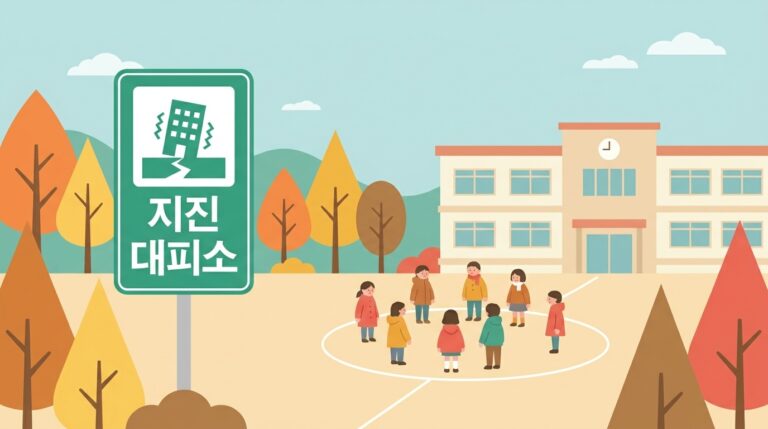
* Selection B (Best): Perfect situational judgment! In earthquakes, your immediate goal is an '옥외대피장소' (open outdoor space) free from shattering high-rise curtain-wall glass, falling billboards, and overhead power cables. School grounds (학교 운동장) are Korea’s primary designated seismic assembly points.
* Selection C (Bad): Fatal error. The perimeter zone directly underneath skyscrapers is known in urban disaster analysis as the "deadly glass shatter zone." Heavy architectural facades and exterior cladding frequently detach minutes after major shock waves.
Phase 6: 10-Second Emotion Shadowing Drill
Master the cadence, urgency, and authoritative calmness of these three lifelines. Practice pausing exactly where the / appears.
Sentence 1: Directing Immediate Action Inside
[🚨 다급하고 단호하게 - Urgent, commanding, and resolute]- “당황하지 말고 / 머리부터 감싸고 / 단단한 테이블 밑으로 / 피하세요!”
- (Danghwanghaji malgo / meoributeo gamssago / dandhan teibeul miteuro / pihaseyo!)
- “Don’t panic / cover your head first / and take shelter / under a solid table!”
Sentence 2: Preventing Dangerous Shortcuts
[⚠️ 다급하게 만류하며 - High-stakes prevention and warning]- “엘리베이터는 갇힐 위험이 크니까 / 무조건 / 비상계단으로 걸어가야 해요!”
- (Ellibeiteoneun gathil wiheomi keunikka / mujogeon / bisanggyedaneuro georeogaya haeyo!)
- “Because there’s a huge risk of getting trapped in the elevator / without exception / you must walk down the fire stairs!”
Sentence 3: Guiding Evacuees to True Safety Outdoors
[🤝 침착하고 신뢰감 있게 - Calm, steadying, and deeply reassuring]- “유리창과 건물 외벽에서 떨어져서 / 넓은 학교 운동장으로 / 신속하게 이동합시다!”
- (Yurichanggwa geonmul oebyeogeseo tteoreojyeoseo / neolbeun hakgyo undongjangeuro / sinsokhage idonghapsida!)
- “Keep away from glass windows and building facades / and let’s move swiftly / toward the open school sports field!”
Phase 7: K-Culture Mini Dictionary
- 긴급재난문자 (Gingeup Jaenan Munja) | Cell Broadcast Emergency Alert
Every Korean smartphone connected to domestic telecommunications networks receives these location-specific cellular alerts. Sent by the Ministry of the Interior and Safety (행정안전부), they are categorized into ‘안전안내’ (Safety Guidance), ‘긴급재난’ (Emergency Disaster), and ‘위급재난’ (Critical Disaster—which bypasses silent modes with a 40-decibel siren). -
지진 옥외대피장소 (Jijin Ogwoe Daepi Jangso) | Designated Outdoor Earthquake Assembly Site
Unlike standard civil defense bunkers (민방위 대피시설) tucked in basements, these are legally audited open spaces—predominantly public school athletic grounds (학교 운동장), public plazas, and neighborhood open-air parks—shielded from falling glass, brick veneer, and utility poles. -
내진 설계 (Naejin Seolgye) | Seismic / Earthquake-Resistant Structural Design
A standard feature in high-level real estate discussions. Korea expanded mandatory seismic design laws in 2017 to cover all new structures of two stories or higher (or exceeding 200 square meters). Spotting the phrase “내진 설계 인증 건축물” (Seismically Certified Building) on official municipal real estate documents provides peace of mind when signing rental leases. -
여진 (Yeojin) | Aftershock
Formed from the Chinese character 餘 (remaining) and 震 (quake). In the hours and days following an initial primary tremor (본진 – bonjin), weather broadcasts and municipal safety texts will repeatedly issue alerts warning citizens to brace for intermittent ‘여진’ (aftershocks).
Phase 8: Survival Kit for Travelers
Survival Expressions TOP 3
- 가장 가까운 지진 대피소가 어디예요? (Gajang gakkaun jijin daepisoga eodiyeyo?)
Pro Tip: Use this exact sentence when asking convenience store clerks, transit guards, or police officers on the street. It immediately clarifies you are looking for an open assembly area, not a bomb shelter. - 건물 밖으로 나갈 수 있게 문 좀 열어주세요! (Geonmul bakkeuro nagal su itge mun jom yeoreojuseyo!)
Pro Tip: If an automatic commercial sliding door or magnetic security door has locked up due to an electrical trip, shout this clearly to staff members nearby. - 부상자가 있으니 구급차를 불러주세요! (Busangjaga isseuni gugeupchareul bulleojuseyo!)
Pro Tip: Use this to initiate emergency medical rescue. Remember that in Korea, 119 covers both medical rescue and firefighting, whereas 112 is exclusively for police.
Editor’s Travel Note
- Essential Digital Infrastructure: If you live in or travel through South Korea, do not rely exclusively on foreign global map engines, which are legally restricted from hosting high-detail vector mapping data within Korea. Download the official 안전디딤돌 (Safety Stepping Stone) 앱 다운로드—the government’s multilingual disaster safety app that sends real-time earthquake alerts in English.
- Mapping Your Sanctuary: Open the 네이버 지도 (Naver Map) 앱 다운로드 or KakaoMap and search the query term “지진 옥외대피소”. The map will immediately populate your area with small green icons denoting verified public school fields and municipal parks. Bookmark the two closest sites to your hotel or residence right now.
Phase 9: “One Step Deeper” (Reflective Essay)
In contemporary sociolinguistic discourse, emergencies expose the foundational scaffolding of a nation’s collective psyche. In South Korea, crisis communication is profoundly defined by 공동체 의식 (Gongdongche Uisik – collective community consciousness) and deep civic reliance on central coordination. Where hyper-individualistic linguistic frameworks emphasize isolated personal survival, the Korean emergency grammar centers on coordinated mutual protection—using inclusive imperative endings like “-합시다” (let us do together) and deferential honorific cautions that safeguard public order without splintering into anarchy. In times of elemental shock, language is not merely a mechanism for personal safety; it is the civic glue that prevents panic and ensures that the vulnerable are carried along to open ground.
💬 Your Turn: How does your home culture communicate natural disasters compared to Korea’s centralized cellular broadcast network? Have you ever experienced an earthquake drill or tremor abroad? Share your reflections and questions in the comments below!
Phase 10: FAQ & Misconception Prevention
Q: Should I run down into a subway station during an earthquake in Korea?
A: No! While subways are designated as civil defense shelters (민방위 대피시설) for military defense scenarios, they are strictly hazardous during active earthquakes due to structural debris risks, subterranean smoke traps, and electrical failures. You must proceed to an open-air 지진 옥외대피장소 (outdoor earthquake shelter).
Q: Why does my phone scream with alerts even when the earthquake happened hundreds of kilometers away?
A: The Korean Meteorological Administration (KMA) automatically transmits 긴급재난문자 over national cell broadcast towers within 10 to 25 seconds of detecting high-energy P-waves. Even if the epicenter is located off the coast of Ulsan or deep in North Gyeongsang province, nationwide cellular warnings are triggered proactively so that high-rise residents throughout Gyeonggi-do and Seoul have crucial seconds to take cover before slower, destructive S-waves arrive.
Q: If I am in an older villa or officetel without seismic certification, what is the safest spot?
A: Avoid small bathroom stalls if they feature heavy ceramic tiles that can shear and fall. Drop beneath a thick wooden dining table, a heavy desk, or squat next to an interior load-bearing pillar away from windows. Keep your shoes on, as floors become littered with shattered glass and broken ceramics.
🚨 흔한 실수 (Common Mistakes) Warning Board
- Mistake: Rushing out into narrow exterior alleys during active shaking.
Correct Action: Stay inside beneath a table until shaking stops. Modern Korean streets are filled with heavy overhanging commercial neon signs (간판) and tiled parapets that collapse outward onto sidewalks during early tremors. - Mistake: Searching for “대피소” (Daepiso) blindly without distinguishing indoor bunkers from outdoor fields.
Correct Action: Specifically search for 지진 옥외대피장소 (Earthquake Outdoor Shelter) on local map applications. - Mistake: Turning off your digital door lock latch when fleeing.
Correct Action: Prop your apartment door wide open using a wedge, shoes, or a heavy item. Frame deformation can lock you into a burning or crumbling building.
Phase 11: Action Mission & Engagement
- 🥉 Bronze Level Mission: Shadow and memorize the 10-second shadowing drills in Phase 6 until you can speak Sentence 1 fluidly without stuttering.
- 🥈 Silver Level Mission: Open your Korean navigation app (Naver Map or KakaoMap), search for “지진 옥외대피소” around your accommodation, screenshot the route to the nearest school ground, and share it on your Instagram story with the tag
#DailyHangulEmergency. - 🥇 Gold Level Mission: Locate the physical emergency exit stairwell and the door latch mechanism in your current building, check the building’s seismic compliance signage near the entrance lobby, and explain the escape procedure in Korean to a friend.
- 🎮 K-Culture Mission: Next time you watch an urban K-drama or Korean news broadcast, look out for the green rectangular signage marked “지진 옥외 대피장소” on school walls or sports grounds!
Phase 12: Interactive Quiz Challenge
1. Scenario Judgment
You are on the 8th floor of an academy in Sinchon when a magnitude 5.2 earthquake strikes. Which of the following sequences represents the correct, culturally and procedurally accurate response?
* (A) Grab your belongings, run directly to the elevator lobby, and press the ground floor button immediately.
* (B) Crawl under a desk, cover your head, wait until the shaking stops, open the exit door to ensure it’s not jammed, then take the emergency stairs down to an open school playground.
* (C) Run out into the hallway, call 119 repeatedly on your phone, and head immediately to the deepest underground basement level.
2. Fill-in-the-Blank
Complete the standard emergency public announcement:
“지진 발생 시 승강기를 이용하지 마시고, 반드시 _______(으)로 신속히 대피하시기 바랍니다.”
* Hint: It means ‘emergency stairs’.
3. True / False Cultural Check
- Statement: In South Korea, any shelter labeled “민방위 대피소” (Civil Defense Shelter) is also officially safe and recommended for immediate refuge during an earthquake.
정답과 해설 확인하기 (Click to reveal answers)
Quiz Explanations
-
Scenario Judgment Answer: (B)
Explanation: Ducking under a sturdy desk protects you from falling lighting grids and tiles. Securing the door prevents entrapment, and using fire stairs to reach an open school playground (지진 옥외대피장소) complies perfectly with safety protocols. Elevators and underground basements carry lethal risks during seismic shaking. -
Fill-in-the-Blank Answer: 비상계단 (Bisanggyedan – Emergency Stairs)
Full Sentence: “지진 발생 시 승강기를 이용하지 마시고, 반드시 비상계단으로 신속히 대피하시기 바랍니다.” -
True / False Cultural Check Answer: False
Explanation: A critical distinction! “민방위 대피소” are predominantly subterranean bunkers, subway platforms, and underground parking garages designed for artillery, aerial, or biochemical warfare threats. Earthquakes require 지진 옥외대피장소—open outdoor grounds like parks and schoolyards where structural collapse is impossible.






