

안녕하세요! 매일한글 에디터입니다.
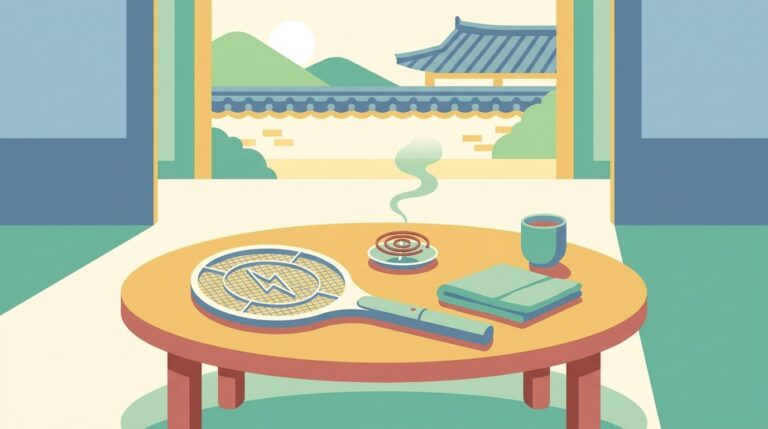
Imagine this familiar scene: It’s 2:30 AM in mid-July. The humid Seoul night wraps around your room, and the soft hum of your wall-mounted air conditioner has just lulled you into a peaceful slumber. Suddenly, right past your ear, comes the dreaded, sharp acoustic villain of the Korean summer: bzzz-wiiing (위이잉). You freeze. Your hand involuntarily shoots up to slap the air. The lights flick on, and you find yourself standing on your mattress wielding a tennis-racket-shaped electric flyswatter like an action hero in a K-drama climax.
Welcome to the annual rite of passage known across the peninsula as 모기와의 전쟁 (War on Mosquitoes).
If you have lived through or plan to experience a Korean summer, you will soon realize that dealing with mosquitoes isn’t just about pest control—it is a shared cultural bonding topic. Whether it’s coworkers bonding over their red ankle bites during morning coffee or K-pop idols passionately venting about mosquitoes during live fan streams, this experience unites everyone. In this guide, tailored specifically for intermediate (B1) learners, we’ll equip you with dynamic, natural Korean expressions, pharmacy survival hacks, and cultural insights so you can handle this summer battle like a true local.
Phase 2: Core Expressions Breakdown
1. 모기 물렸어요 (Mogi mul-lyeosseoyo)
- Pronunciation: [mo-gi mul-lyeo-sseo-yo] (Sounds like “mo-ghee mool-lyuh-ssuh-yo”)
- Meaning: Literal: “I got bitten by a mosquito” | Real Nuance: A casual statement of fact, usually accompanied by an exasperated roll of the eyes or an itchy scratch.
- K-Culture Moment: You will hear this constantly on outdoor reality shows like 2 Days & 1 Night or Camping Club whenever members wake up in tents and check their puffy cheeks and arms.
- Editor’s Insight: In Korean, the passive verb
물리다(to be bitten) comes from물다(to bite). Unlike in English where people sometimes say “mosquitoes got me,” in Korean it is almost exclusively framed as모기에게 물렸어요or simply모기 물렸어요. - Situation Spectrum:
- Casual (to friends): 모기 물렸어! (✅)
- Semi-formal (polite everyday): 모기 물렸어요. (✅)
- Formal (announcements/news): 모기에 물렸습니다. (✅)
- 🤔 Think About It: In English, you might say “I have a mosquito bite.” In Korean, the action focuses on the passive event of being bitten (
물렸어요). How does shifting the focus from the noun (“a bite”) to the verb (“got bitten”) change how you visualize the action?
2. 모기약 있어요? (Mogiyak isseoyo?)
- Pronunciation: [mo-gi-yak i-sseo-yo] (Sounds like “mo-ghee-yahk ee-ssuh-yo”)
- Meaning: Literal: “Is there mosquito medicine?” | Real Nuance: “Do you have mosquito repellent / anti-itch cream / bug spray?”
- K-Culture Moment: Stepping into a neighborhood convenience store or traditional pharmacy (yakguk) on a sticky July night after realizing your Airbnb has no bug defense.
- Editor’s Insight:
약(yak) means medicine, but Koreans use모기약(mosquito medicine) as a versatile umbrella term. It covers sprays (Homekeeper), plug-in diffusers, coils, and topical soothing gels like Bumeul-li. If you need something specific, you can specify바르는 모기약(ointment to apply) or뿌리는 모기약(spray). - Situation Spectrum:
- Casual: 모기약 있어? (✅)
- Semi-formal: 모기약 있어요? (✅)
- Formal: 모기약 있습니까? (⚠️ – sounds unnecessarily stiff for a shop)
- 🤔 Think About It: Why do you think Korean uses the single word
약(medicine) for both preventative chemical repellents and healing ointments?
3. 모기 때문에 잠을 못 잤어요 (Mogi ttaemune jameul mot jasseoyo)
- Pronunciation: [mo-gi ttae-mu-ne ja-meul mot ja-sseo-yo] (Sounds like “mo-ghee ttae-moo-neh jah-meul moht jah-ssuh-yo”)
- Meaning: Literal: “Because of mosquitoes, I could not sleep” | Real Nuance: The ultimate summer morning excuse for looking exhausted and clutching an extra-large Iced Americano.
- K-Culture Moment: Used by office workers or students slumping into their chairs at 9:00 AM, explaining their dark circles to colleagues.
- Editor’s Insight: At the B1 level, mastering the
Noun + 때문에(because of [noun]) structure alongside못 + Verb(cannot [verb]) elevates your conversational fluency. It sounds empathetic, relatable, and completely natural. - Situation Spectrum:
- Casual: 모기 때문에 잠 못 잤어. (✅)
- Semi-formal: 모기 때문에 잠을 못 잤어요. (✅)
- Formal: 모기 때문에 잠을 자지 못했습니다. (✅)
- 🤔 Think About It: In Korean, external causes of misfortune (
모기 때문에,비 때문에) are frequently cited to build instant rapport and mutual understanding among peers.
Phase 3: Textbook Korean vs. Real Native Korean
Situation 1: Describing an intense itch
- 📖 교과서 한국어 (Textbook): 모기에 물려서 피부가 가렵습니다. (Mogie mullyeoseo pibuga garyeopseumnida. / “I was bitten by a mosquito and my skin itches.”)
- 🗣️ 진짜 한국어 (Real Native): 모기 물려서 간지러워 미치겠어요! (Mogi mullyeoseo ganjireowo michigesseoyo! / “I got bitten by a mosquito and it’s driving me crazy itchy!”)
- 💡 왜 다를까?: Native speakers rarely say
피부가 가렵습니다in daily life. Instead, they use간지럽다(colloquial for itchy) combined with~아/어 미치겠다(“driving me crazy”), which instantly expresses physical agony and dramatic flair.
Situation 2: Asking for mosquito bug spray at a counter
- 📖 교과서 한국어 (Textbook): 살충제를 구매하고 싶습니다. (Salchungjereul gumaehago sipseumnida. / “I would like to purchase an insecticide.”)
- 🗣️ 진짜 한국어 (Real Native): 혹시 뿌리는 모기약 있어요? (Hoksi ppurineun mogiyak isseoyo? / “By any chance, do you have spray-type mosquito repellent?”)
- 💡 왜 다를까?:
살충제sounds clinical and agricultural. In consumer settings, using뿌리는 모기약(spray-type mosquito medicine) preceded by the polite cushion word혹시(by chance) sounds natural, gentle, and idiomatic.
Phase 4: K-Culture Deep Dive & Non-Verbal Manners
4-1. 눈치 (Nunchi) & Gestures: The Midnight Mosquito Clap
In Korea, there is a legendary, unspoken physical reflex known as the 모기 박수 (Mosquito Clap). When a mosquito flies into someone’s field of vision, they will instantly freeze, track it with narrowed eyes, and deliver a crisp, resonant two-handed clap in mid-air.
- The Etiquette Check: If you are in a quiet public space—such as a university library, a study cafe (스터디 카페), or an open-plan office—do not wildly flail or scream. Korean nunchi dictates that you eliminate the intruder with minimal body movement and a quiet, discreet clap, followed by a slight apologetic nod (
목례) to nearby people if your clap made a loud pop. - The “Cross-Fingernail Imprint” (십자 자국): You may witness Korean friends pressing a fingernail cross (
+) directly into fresh mosquito bites. While dermatologists strongly advise against it due to infection risks, it is a ubiquitous childhood habit to relieve itching through acute pressure pain!
4-2. Cultural Code: The Summer Arsenal in Korean Households
Korean summers feature two iconic gadgets found in almost every home:
1. 전기 모기채 (Electric Mosquito Swatter): Shaped like a bright tennis racket with a rechargeable USB port. Hearing that satisfying ZAP sound is practically a national summer sport.
2. 버물리 (Bumeul-li): A pocket-sized, roll-on topical liquid with a round foam head sold in every pharmacy (약국). Its cooling camphor sensation is the definitive scent of Korean July and August.
Phase 5: Real-Life Roleplay Scenario
- Setting: 11:30 PM. A small, bright neighborhood pharmacy (약국) near Hongdae.
- Characters:
- You: A weary traveler/student suffering from multiple mosquito bites.
- Pharmacist (약사님, Yaksa-nim): A warm, knowledgeable professional wearing a white coat and round glasses.
- Turn 1 (You):
안녕하세요, 약사님! 혹시 모기약 있어요?
(Annyeonghaseyo, yaksa-nim! Hoksi mogiyak isseoyo?)
“Hello, Pharmacist! Do you happen to have mosquito medicine?”
🎭 행동: Rubbing your forearm sheepishly with an exhausted smile. -
Turn 2 (Pharmacist):
네, 있어요! 뿌리는 거 찾으세요, 아니면 바르는 거 찾으세요?
(Ne, isseoyo! Ppurineun geo chajeuseyo, animyeon bareuneun geo chajeuseyo?)
“Yes, we do! Are you looking for a spray, or something to apply onto your skin?”
🎭 행동: Pointing to a shelf lined with blue bottles and roll-on boxes. -
Turn 3 (You):
어젯밤에 모기한테 너무 많이 물려서요. 바르는 약 주세요.
(Eojetbame mogihante neomu mani mullyeoseoyo. Bareuneun yak juseyo.)
“I got bitten so much by mosquitoes last night. Please give me an ointment to apply.”
🎭 행동: Showing two puffy red marks on your wrist. -
Turn 4 (Pharmacist):
아이고, 빨갛게 부었네요. 많이 가렵죠?
(Aigo, ppalgake bueotneyo. Mani garyeopjyo?)
“Oh dear, it’s swollen and red. It must be very itchy, right?”
🎭 행동: Nodding sympathetically with a gentle wince. -
Turn 5 (You):
네, 간지러워 미치겠어요. 긁으면 안 되는데 자꾸 손이 가요.
(Ne, ganjireowo michigesseoyo. Geulgeumyeon an doeneunde jakku soni gayo.)
“Yes, it’s driving me crazy itchy. I know I shouldn’t scratch, but my hands keep going there.”
🎭 행동: Sighing softly and shaking your head. -
Turn 6 (Pharmacist):
그럼 이 롤온 타입 버물리 써보세요. 시원해서 가려움이 금방 가라앉아요.
(Geureom i rol-on taip bumeulli sseoboseyo. Siwonhaeseo garyeoumi geumbang garaanjayo.)
“Then try this roll-on type Bumeul-li. It feels cool, so the itching will settle down quickly.”
🎭 행동: Placing a blue-and-white box on the counter. -
Turn 7 (You):
다행이네요! 그리고 혹시 방에 두는 모기향도 있나요?
(Dahaeng-ineyoyo! Geurigo hoksi bange duneun mogihyangdo innayo?)
“What a relief! And by any chance, do you have room mosquito coils or repellents too?”
🎭 행동: Bringing hands together in gratitude. -
Turn 8 (Pharmacist):
네, 콘센트에 꽂는 전자 모기향 여기 있습니다. 오늘 밤엔 푹 주무실 거예요!
(Ne, konsenteue kkotneun jeonja mogihyang yeogi itsseumnida. Oneul bamen puk jumusil geoyeyo!)
“Yes, here is an electric plug-in mosquito diffuser. You will sleep soundly tonight!”
🎭 행동: Ringing up the items with a warm, encouraging smile.
🔀 Interactive Decision Point
Suppose the pharmacist asks: “모기 물린 데 붙이는 패치도 드릴까요?” (Shall I also give you patches to stick on mosquito bites?). How do you reply?
- Option A: “아니요, 됐어요. 돈 없어요.” (No, forget it. I have no money.)
- Feedback [Bad 🚫]: While grammatically understandable, saying
돈 없어요sounds overly blunt and awkwardly personal for a retail exchange.
- Feedback [Bad 🚫]: While grammatically understandable, saying
- Option B: “네, 패치도 같이 주세요! 긁지 않게 붙이면 좋겠네요.” (Yes, please give me the patches too! It would be great to stick them on so I don’t scratch.)
- Feedback [Best ✅]: Excellent B1-level response! You express agreement using
~도 같이 주세요and give a natural reason using~지 않게(in order not to scratch).
- Feedback [Best ✅]: Excellent B1-level response! You express agreement using
- Option C: “패치는 필요 없으니까 저리 치워주세요.” (I don’t need patches, so put them away over there.)
- Feedback [Risk ⚠️]:
저리 치워주세요is aggressive and rude to service workers. It sounds like you are scolding them.
- Feedback [Risk ⚠️]:
Phase 6: 10-Second Emotion Shadowing Drill
Practice reading these sentences aloud, paying close attention to the pause markers (/) and matching the emotional cues!
[😫 극도로 피곤하고 짜증스럽게 / Exhausted & Annoyed]
어젯밤에 / 모기 소리 때문에 / 한숨도 못 잤어요!
(Eojetbame / mogi sori ttaemune / hansumdo mot jasseoyo!)
“Last night / because of the mosquito sound / I couldn’t sleep a single wink!”-
[🙏 간절하고 절박하게 / Desperately Seeking Relief]
약사님, / 너무 간지러운데 / 제일 잘 듣는 약으로 / 추천해 주세요!
(Yaksa-nim, / neomu ganjireounde / jeil jal deunneun yageuro / chucheonhae juseyo!)
“Pharmacist, / it’s so itchy / with the most effective medicine / please recommend one!” -
[😌 안도하며 시원하게 / Relieved & Refreshed]
와, / 이거 바르니까 / 화~하면서 / 가려움이 싹 사라졌어요!
(Wa, / igeo bareunikka / hwa~hamyeonseo / garyeoumi ssak sarajyeosseoyo!)
“Wow, / now that I applied this / it feels refreshingly cool / and the itchiness vanished completely!”
Phase 7: K-Culture Mini Dictionary
-
전기 모기채 (Jeongi mogichae)
- Meaning: Electric mosquito swatter / zapper racket.
- Usage: An essential appliance in Korean homes. You will see young roommates debate who gets to wield the
전기 모기채before turning the bedroom lights off.
- 버물리 (Bumeul-li)
- Meaning: Korea’s most iconic OTC mosquito bite roll-on liquid.
- Usage: In Korea, “버물리” has become a proprietary eponym (like Band-Aid or Kleenex). Asking for “버물리 있어요?” works in almost every pharmacy.
- 모기 패치 (Mogi paechi)
- Meaning: Hydrocolloid anti-itch mosquito sticker patches.
- Usage: Extremely popular among children and adults alike. Sticking a cute cartoon patch over a bite prevents scratching and secondary bacterial infections.
- 방충망 (Bangchungmang)
- Meaning: Window insect screen mesh.
- Usage: When renting a studio (원룸) in summer, tenants always inspect if the
방충망has tiny tears or if the drainage holes at the bottom of the sliding window frame need물구멍 방충망 스티커(drain-hole screen stickers).
Phase 8: Survival Kit for Travelers
Top 3 Emergency Phrases
- “모기 기피제 어디에 있어요?” (Mogi gipije eodie isseoyo? / Where is the mosquito repellent spray?)
- Pro Tip: Use
모기 기피제if you want outdoor spray to prevent mosquitoes from landing on you while hiking the Han River or walking in parks.
- Pro Tip: Use
- “가려움 완화 패치 있어요?” (Garyeoum wanhwa paechi isseoyo? / Do you have itch-relief patches?)
- Pro Tip: If you have sensitive skin and liquid roll-ons sting, ask for gentle patches.
- “모기 물려서 퉁퉁 부었어요.” (Mogi mullyeoseo tungtung bueosseoyo. / I got bitten by a mosquito and it swelled up puffy.)
- Pro Tip:
퉁퉁is an onomatopoeia describing visibly swollen skin. It helps the pharmacist assess whether you need mild antihistamines.
- Pro Tip:
Editor’s Travel Note
- Finding Nighttime Pharmacies: If you are attacked by mosquitoes at midnight, open the Naver Map app to search 24-hour pharmacies using the search term
야간약국(night pharmacy) or휴일지킴이약국. - Convenience Store Hack: If pharmacies are closed, head to CU, GS25, or 7-Eleven. In their seasonal summer aisle, you will find Homekeeper spray and plug-in liquid vaporizers right beside umbrellas and sunscreens.
Phase 9: “A Step Deeper” (Reflective Essay)
In Korean culture, the arrival of mosquitoes marks more than just an annoyance; it is a shared seasonal marker of vulnerability and community care. When summer temperatures spike, grandmothers in rural pavilions (정자) burn green spiral coils (모기향) at dusk, keeping neighborhood children safe as they eat chilled watermelon. In cramped urban apartments, asking a roommate or coworker “모기 때문에 잠 설쳤지?” (You tossed and turned because of mosquitoes, didn’t you?) is an act of everyday empathy. Shared discomfort breaks down formal barriers faster than pleasant weather ever could. When everyone is swatting at the same invisible foe, we are reminded of our shared human quirks.
💬 Your Turn: What is the most memorable summer insect battle you’ve experienced in your home country or while traveling? Share your story in the comments below using the phrase “~때문에 잠을 못 잤어요”!
Phase 10: FAQ & Avoiding Misunderstandings
Q: Can I buy effective mosquito bite medication at Korean convenience stores?
A: Convenience stores carry repellent sprays (기피제) and room sprays, but for medicated anti-itch solutions like Bumeul-li (버물리) or mild hydrocortisone creams, you must visit a pharmacy (약국). Look for the red “약” sign on neighborhood street corners.
Q: What is the difference between ‘가렵다’ (garyeopda) and ‘간지럽다’ (ganjireopda)?
A: Traditionally, 가렵다 referred strictly to an itch requiring scratching, while 간지럽다 meant ticklish. However, in modern native spoken Korean, 간지럽다 is universally used to mean “itchy” as well. Saying 너무 간지러워요! sounds very natural.
Q: Are mosquito coils (모기향) still used indoors in Korea?
A: Traditional burning green coils are now mostly reserved for outdoor camping, porch areas, or traditional markets due to smoke inhalation concerns. Indoors, modern apartments rely heavily on liquid plug-in diffusers (전자 모기향) or ultrasonic traps.
🚨 Common Mistakes (흔한 실수) Warning Board
- Mistake: Saying
모기를 물었어요instead of모기 물렸어요.- Why it’s wrong:
물었어요means you bit the mosquito! - Correct Action: Always use the passive form
물렸어요(I was bitten).
- Why it’s wrong:
- Mistake: Calling all sprays
에어컨 약or살충제at a boutique cafe.- Why it’s wrong: Overly clinical terms sound like an extermination crew is arriving.
- Correct Action: Ask politely for
모기약or뿌리는 기피제.
- Mistake: Forgetting honorifics with the pharmacist.
- Why it’s wrong: Shouting “모기약 줘!” (Give me mosquito medicine!) to an elder pharmacist sounds rude.
- Correct Action: Always address them respectfully: “약사님, 바르는 모기약 주세요.”
Phase 11: Action Missions & Community Engagement
- 🥉 Bronze Mission (Solo Practice): Look in the mirror, point to an imaginary red bump on your arm, and say out loud with genuine frustration: “모기 물려서 간지러워 미치겠어요!” three times.
- 🥈 Silver Mission (Social Share): Next time you see someone swatting the air or talking about summer heat on Instagram or Weverse, comment: “모기 조심하세요!” (Watch out for mosquitoes!).
- 🥇 Gold Mission (Real-World Execution): Walk into a local Korean supermarket, convenience store, or pharmacy and locate the insect section. Practice asking: “혹시 바르는 모기약 어디에 있어요?”
🎮 K-Culture Mission: Watch an episode of a summer reality show (like Three Meals a Day or BTS In the SOOP). Spot how many times the members use an electric mosquito swatter (전기 모기채) or apply blue roll-on ointment!
Phase 12: Interactive Quiz Challenge
1. Situational Judgment
You are sitting in a quiet cafe in Gangnam. A mosquito lands on your hand. What is the most culturally appropriate reaction?
* A) Scream loudly, jump onto the chair, and run outside.
* B) Calmly take aim, deliver a discreet two-handed clap, and check if you caught it without disrupting others.
* C) Demand that the cafe manager spray toxic insecticide all over the customer seating area immediately.
2. Fill-in-the-Blank
Complete the sentence using the B1 grammar structure for “because of”:
“어젯밤에 ______ (mosquitoes) 때문에 잠을 한숨도 못 잤어요.”
3. True or False Cultural Quiz
- Statement: In modern Korean pharmacies, asking for “버물리” (Bumeul-li) will only get you confused looks because it is an obsolete slang term.
- (True / False)
👉 Click here to reveal answers & explanations!
-
Answer: B
Explanation: In shared public spaces in Korea, maintaining nunchi and keeping noise levels reasonable is respected. A swift, quiet mosquito clap followed by discreet sanitizing is the local way! -
Answer: 모기
Explanation: The full sentence reads: 어젯밤에 모기 때문에 잠을 한숨도 못 잤어요. (Last night, because of mosquitoes, I couldn’t sleep a single wink). -
Answer: False
Explanation: Bumeul-li (버물리) is Korea’s most iconic, best-selling anti-itch roll-on brand! Every pharmacist instantly recognizes it, just like Tylenol or Band-Aid.







