

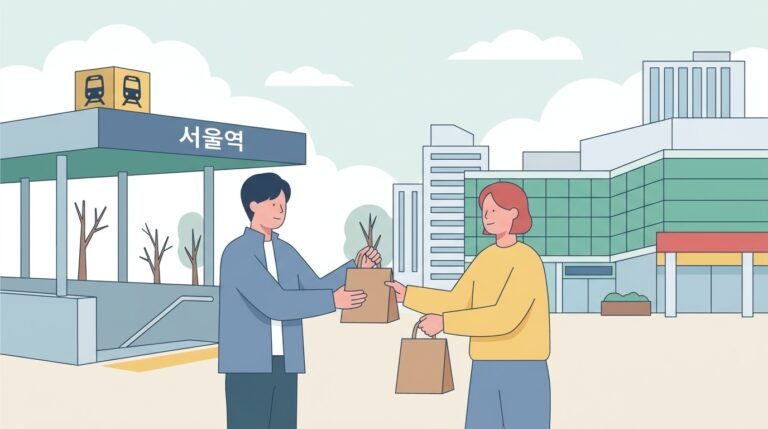
Phase 1: Empathy
안녕하세요! 매일한글 에디터입니다.
Imagine this: You have just moved to Seoul or are staying for an extended semester, and you have finally set up your account on Korea’s iconic secondhand platform, Karrot Market (당근마켓). You find the exact limited-edition K-pop vinyl or cozy interior lamp you have been searching for at half price. Your heart flutters with excitement! You send a friendly chat message, and the seller replies instantly: “직거래 가능하신가요? 편하신 장소랑 시간 말씀해 주세요!” (Are you available for a direct in-person trade? Please let me know a place and time that works for you!)
Suddenly, the screen blurs before your eyes. How do you propose a specific subway exit without sounding demanding? Is it rude to suggest meeting right at the station turnstile? What if they propose a time right in the middle of your dinner, and you need to negotiate politely without losing the deal?
Setting a time and location for an in-person exchange (직거래) is a major social hurdle for intermediate Korean learners. In Korea’s fast-paced, high-trust society, arranging a meetup is not just about logistics—it is a subtle dance of politeness, mutual consideration, and subtle social radar (nunchi). Based on feedback from dozens of our intermediate students who have navigated the streets of Hongdae and Gangnam for secondhand trades, this guide will arm you with the exact conversational tools, cultural context, and confidence you need to seal the deal smoothly like a true Seoulite.
Phase 2: Core Expressions Deep Dive
1. 혹시 몇 시쯤 편하세요? (Hoksi myeot sijjeum pyeonhaseyo?)
- Pronunciation: [Hok-shi myut shi-jjeum pyun-ha-se-yo?] (Think of Hok like “hockey” without the “ey”, shi like “she”, and pyeon like “pun” with a soft ‘y’ glide).
- Meaning: Literal: “By any chance, around what time are you comfortable?” | Real Nuance: “What time works best for your schedule? No pressure at all!”
- K-Culture Moment: In the slice-of-life drama Run On, characters often soften scheduling questions with hoksi (혹시) to lower the social pressure and show deference to the other person’s personal routine.
- Editor’s Insight: Adding 혹시 (hoksi – by any chance) at the beginning is the ultimate politeness hack in Korean. Without it, “몇 시에 만나요?” (What time are we meeting?) can sound demanding, almost like an interrogation. “편하세요” uses the honorific infix -(으)시- to prioritize the other person’s comfort.
- Situation Spectrum:
- Casual: 🚫 (Too formal for close friends)
- Semi-formal (Trading apps, acquaintances): ✅ (The gold standard)
- Formal: ⚠️ (Use “언제가 편하시겠습니까?” in formal business)
- 🤔 Think About It: In English, we often ask “When are you free?” In Korean, the question focuses on the other party’s comfort (편하다) rather than just availability. Why do you think Korean relational culture emphasizes “comfort” over mere free time?
2. [장소] 앞이나 개찰구 쪽에서 뵐 수 있을까요? ([Jangso] ap-ina gae-chal-gu jjok-eseo boel su isseulkkayo?)
- Pronunciation: [Jang-so ap-ee-na gae-chal-gu jjok-eh-seo boel su eess-eul-kka-yo?] (Sound analogy: gae-chal-gu sounds like “get-chall-goo”).
- Meaning: Literal: “Could I meet you in front of [Place] or by the ticket turnstiles?” | Real Nuance: “Would it be convenient for you to meet at [Place], or right by the subway turnstile so nobody has to pay an extra transit fare?”
- K-Culture Moment: If you watch real-life Seoul vloggers buying secondhand camera gear, this sentence appears on screen in almost every trade outside a subway station.
- Editor’s Insight: Notice the verb 뵙다 (boepda), which is the humble form of 만나다 (to meet). Using 뵐 수 있을까요? lowers your own social posture while elevating the counterparty, establishing that you are a reliable, respectful trading partner.
- Situation Spectrum:
- Casual: 🚫
- Semi-formal: ✅ (Polite, considerate, and precise)
- Formal: ✅
- 🤔 Think About It: Suggesting a subway turnstile (개찰구) implies you are thinking about whether the other person is traveling by train and wants to avoid tapping out. How does this spatial consideration reflect Korean urban community manners?
3. 중간 지점에서 뵙는 건 어떠세요? (Jung-gan ji-jeom-eseo boemneun geon eotteoseyo?)
- Pronunciation: [Joong-gahn jee-jum-eh-suh boem-neun gun ut-tuh-seh-yo?]
- Meaning: Literal: “How about meeting at an intermediate point?” | Real Nuance: “Let’s meet halfway so neither of us has to travel all the way across town.”
- K-Culture Moment: Used frequently in workplace comedies when colleagues from different branches want to pick a fair dinner spot midway along Subway Line 2.
- Editor’s Insight: Intermediate deals can reach a stalemate if both parties live on opposite sides of a neighborhood. Proposing a 중간 지점 (halfway point) using the gentle suggestion ending -는 건 어떠세요? shows high emotional intelligence (sensu) without appearing stubborn.
- Situation Spectrum:
- Casual: ⚠️ (Use “중간에서 보자!” instead)
- Semi-formal: ✅
- Formal: ✅
- 🤔 Think About It: When negotiating location in your native language, do you offer a 50/50 compromise immediately, or do you expect the buyer/seller to yield? How does this phrasing keep the interaction balanced?
Phase 3: Textbook Korean vs Real Korean
Situation 1: Suggesting a meetup location near a station exit
- 📖 교과서 한국어 (Textbook Korean):
우리 신촌역 앞에서 만납시다. (Uri Sinchon-yeok ap-eseo mannapsida.)
Translation: Let us meet in front of Sinchon Station. - 🗣️ 진짜 한국어 (Real Korean):
혹시 신촌역 4번 출구 쪽에서 뵐 수 있을까요? 제가 그쪽으로 갈게요! (Hoksi Sinchon-yeok sa-beon chul-gu jjok-eseo boel su isseulkkayo? Jega geu-jjog-euro gal-geyo!)
Translation: By any chance, could we meet near Exit 4 of Sinchon Station? I will head over to your side! - 💡 왜 다를까? (Why is it different?):
Textbook imperative suggestions ending in “-ㅂ시다” sound excessively rigid and authoritative in peer-to-peer trades. Real Koreans pinpoint the exact numbered exit (출구 번호) and proactively volunteer to walk toward the other person to convey warmth.
Situation 2: Asking the seller when they are free after work
- 📖 교과서 한국어 (Textbook Korean):
당신은 오늘 언제 시간이 있습니까? (Dangsin-eun oneul eonje sigan-i itseumnikka?)
Translation: When do you have time today? - 🗣️ 진짜 한국어 (Real Korean):
오늘 퇴근 시간 이후에 혹시 언제쯤 편하실까요? (Oneul toe-geun sigan i-hu-e hoksi eonje-jjeum pyeon-ha-sil-kkayo?)
Translation: Sometime after your work hours today, around when might be convenient for you? - 💡 왜 다를까? (Why is it different?):
Never use “당신” (you) with strangers—it can sound combative or confrontational! Native speakers omit the pronoun, anchor the timeframe around typical milestones like 퇴근 시간 (quitting time), and soften with “-실까요?”.
Phase 4: K-Culture Deep Dive & Non-verbal Manners
4-1. 눈치 (Nunchi) & Gestures
When meeting a stranger for a secondhand deal in Korea, actions speak louder than words:
* The Station Exit Scan: Stand near the designated exit sign holding your phone visible at waist level. When you spot someone looking around holding a distinct shopping bag or checking their app, make eye contact, offer a polite 15-degree bow, and ask: “혹시… 당근이세요?” (Hoksi… Danggeuni-seyo? / By any chance, are you from Karrot?).
* The Two-Handed Hand-off (양손 매너): When handing over either cash or the traded item, always hold it with both hands, or support your right forearm with your left hand. Doing this with one hand looks dismissive or curt.
* The Discreet Inspection: It is completely acceptable to inspect the item, but do it within 30 seconds. Nod appreciatively and say, “상태 정말 좋네요, 감사합니다!” (Sangtae jeongmal jonneyo, gamsahamnida! / It’s in really great condition, thank you!).
4-2. Culture Code: The “Manner Temperature” (매너온도)
On Korean apps like Karrot Market, every user starts with a baseline Manner Temperature of 36.5°C (human body temperature). Punctuality, prompt replies, and polite phrasing increase your score; canceling last-minute or haggling aggressively on-site (현장 네고) sends your score plunging into freezing territory.
Meeting at subway turnstiles (개찰구 직거래) has become a unique cultural fixture of Seoul life. Sellers frequently offer to pass items across the barrier so the buyer does not have to scan out of the transit system and pay extra. Being thoughtful about these minor details is how Seoulites maintain warm neighborhood solidarity in a megalopolis of 10 million people.
Phase 5: Real-World Roleplay Scenario
Setting: It is 6:30 PM on a brisk autumn evening outside Mangwon Station (망원역). Chris is buying a rare vintage camera lens from Min-ji through an in-app chat.
- Turn 1 (Chris):
안녕하세요! 판매글 보고 연락드렸어요. 혹시 직거래 가능할까요? 🎭 (Politely sending the initial chat with a warm emoji)
(Annyeonghaseyo! Panmae-geul bogo yeollak-deuryeosseoyo. Hoksi jikgeorae ganeung-halkkayo? / Hello! I am contacting you regarding your listing. By any chance, is direct trade possible?) - Turn 2 (Min-ji):
네, 안녕하세요! 직거래 가능합니다. 혹시 어디 사세요? 🎭 (Replying within 2 minutes)
(Ne, annyeonghaseyo! Jikgeorae ganeung-hamnida. Hoksi eodi saseyo? / Yes, hello! Direct trade is possible. By any chance, where do you live?) - Turn 3 (Chris):
저는 합정역 근처에 살고 있어요. 망원역 쪽으로 제가 갈 수 있습니다! 🎭 (Offering to travel to make it easier for the seller)
(Jeoneun Hapjeong-yeok geuncheo-e salgo isseoyo. Mangwon-yeok jjok-euro jega gal su isseumnida! / I live near Hapjeong Station. I can head over to Mangwon Station!) - Turn 4 (Min-ji):
와, 배려해 주셔서 감사합니다! 오늘 저녁에 혹시 몇 시쯤 편하세요? 🎭 (Genuinely appreciative of the buyer’s willingness to travel)
(Wa, baeryeo-hae jusyeoseo gamsahamnida! Oneul jeonyeok-e hoksi myeot sijjeum pyeonhaseyo? / Wow, thank you for being so considerate! Around what time are you comfortable with this evening?) - Turn 5 (Chris):
퇴근하고 가면 7시 반쯤 도착할 것 같은데, 그때 괜찮으실까요? 🎭 (Checking transit time and proposing a clear hour)
(Toe-geun-hago gamyeon ilgop-si ban-jjeum dochak-hal geot gateunde, geuttae gwaenchaneu-silkkayo? / I think I will arrive around 7:30 after getting off work, would that time be okay with you?) - Turn 6 (Min-ji):
네, 딱 좋아요! 망원역 2번 출구 앞 벤치에서 뵐까요? 개찰구 안 나오셔도 돼요. 🎭 (Proposing an efficient meetup micro-location)
(Ne, ttak joayo! Mangwon-yeok i-beon chul-gu ap benchi-eseo boelkkayo? Gae-chal-gu an na-o-syeodo dwaeyo. / Yes, that is perfect! Shall we meet in front of the bench at Mangwon Station Exit 2? You don’t have to exit the turnstile.) - Turn 7 (Chris):
감사합니다! 그럼 7시 30분에 2번 출구 개찰구 쪽에서 뵙겠습니다. 검은색 패딩 입고 갈게요! 🎭 (Confirming clothing color for easy recognition)
(Gamsahamnida! Geu-reom ilgop-si samsip-bune i-beon chul-gu gae-chal-gu jjok-eseo boep-getseumnida. Geomeun-saek paeding ipgo gal-geyo! / Thank you! Then I will see you at 7:30 by the Exit 2 turnstiles. I will be wearing a black puffer jacket!) - Turn 8 (Min-ji):
네, 조심히 오세요! 도착하시면 채팅 주세요~ 🎭 (Adding a friendly wave tilde)
(Ne, josimhi oseyeo! Dochak-hasimyeon chaeting juseyo~ / Yes, travel safely! Please drop a chat when you arrive~)
🔀 Interactive Decision Point
Suppose Min-ji suddenly messages: “죄송한데 제가 8시까지 야근하게 되었어요ㅠㅠ 어떡하죠?” (I’m so sorry, but I ended up having to work overtime until 8:00 PMㅠㅠ What should we do?)
How should you reply?
- Option A: “그럼 거래 취소할게요. 시간 약속은 지키셔야죠.” (Then I will cancel the deal. You should have kept your time promise.)
- Feedback [Bad]: Technically justified in strict Western terms, but this destroys your Manner Temperature and will result in an immediate negative review for lacking flexibility.
- Option B: “괜찮습니다! 고생 많으시네요. 그럼 망원역 근처 카페에 있을 테니 8시 10분쯤 편하실 때 연락 주세요!” (No problem at all! You must be having a tough workday. I will be at a cafe near Mangwon Station, so feel free to message me around 8:10 whenever you are comfortable!)
- Feedback [Best]: Demonstrates top-tier nunchi and warmth. The seller will likely discount the item or gift you a free treat for your patience!
- Option C: “아… 그럼 지금 회사 앞으로 갈게요. 회사 주소 주세요.” (Ah… then I will go to your office right now. Give me your office address.)
- Feedback [Risk]: Coming to someone’s workplace unexpectedly crosses personal boundaries in Korean culture and may cause anxiety or alarm.
Phase 6: 10-Second Emotion Shadowing Drill
Practice these lines out loud. The / represents a natural breath pause. Match the emotional tone tag!
[😊 Cheerful and accommodating]
혹시 / 신촌역 2번 출구 쪽에서 / 뵐 수 있을까요? / 제가 그쪽으로 갈게요!
(Hoksi / Sinchon-yeok i-beon chul-gu jjok-eseo / boel su isseulkkayo? / Jega geu-jjog-euro gal-geyo!)-
[🤔 Thoughtful and considerate]
퇴근 시간이라 많이 복잡하죠? / 천천히 오셔도 괜찮습니다!
(Toe-geun sigan-ira mani bokjap-hajyo? / Cheon-cheon-hi osyeodo gwaenchan-seumnida!) -
[🥺 Apologetic and polite]
지하철이 조금 연착되어서요, / 딱 5분만 늦을 것 같은데 / 정말 죄송합니다!
(Jihacheol-i jogeum yeonchak-doeeoseoyo, / ttak o-bun-man neujeul geot gateunde / jeongmal joesong-hamnida!)
Phase 7: K-Culture Mini Dictionary
- 직거래 (Jikgeorae): Direct, in-person trade. Buying and selling items face-to-face rather than shipping via parcel (택배거래). The foundation of local community commerce in Korea.
- 쿨거래 (Kulgeorae): “Cool trade.” An ultra-smooth transaction where both buyer and seller agree on price, place, and time immediately without haggling or delays. Native speakers love writing “쿨거래 환영” (Cool trades welcome!) in listings.
- 네고 (Nego): Short for “negotiation” (price discount). Proposing a nego before meeting is common, but asking for an unexpected nego face-to-face during a meetup is considered a serious breach of etiquette.
- 매너온도 (Maeneoon-do): “Manner Temperature.” The crowd-sourced behavioral rating on Karrot Market. Higher than 40°C indicates a reliable neighborhood saint; below 36.5°C warns of potential unreliability.
Phase 8: Survival Kit for Travelers & Expats
Top 3 Survival Phrases
- “지금 출발합니다! 15분 뒤에 도착해요.” (Jigeum chulbal-hamnida! Sib-o-bun dwi-e dochak-haeyo.)
- Pro Tip: Always send a departure alert. Korean direct trades value real-time tracking so neither person freezes outside in winter.
- “개찰구 카드 찍지 마시고 안쪽에서 건네주세요!” (Gae-chal-gu kadeu jjikji masigo an-jjog-eseo geonne-juseyo!)
- Pro Tip: Use this if the other person is using the subway and you are waiting outside the gates.
- “혹시 계좌이체로 보내드려도 괜찮을까요?” (Hoksi gye-jwa-i-che-ro bonae-deuryeodo gwaenchan-eulkkayo?)
- Pro Tip: Most Koreans prefer instant mobile bank transfers (Toss, KakaoPay) over bulky paper currency.
Editor’s Travel Note
- Mapping Your Meetup: Street numbers can be confusing in older Korean neighborhoods. Always download the Naver Map app on the iOS App Store or Google Play Store to search exact subway exit numbers and convenience store branch names (e.g., CU 망원희망점).
- Subway Etiquette: If meeting inside the station, stay clear of the primary commuter flow path. Step to the side near the ticket vending machines or locker facilities.
Phase 9: “한 발 더 깊이” (Deep Cultural Reflection)
In many Western cultures, a public meetup for an online purchase can feel like an encounter between two strictly self-interested parties, held under cautious vigilance. In Korea, however, secondhand trade often functions under the umbrella of 정 (jeong)—a collective, empathetic social affection that binds community members.
When a seller chooses a subway exit or turnstile, they are actively calculating how to save you a 1,400 won transit charge and shield you from wind or rain. When a buyer volunteers to travel to the seller’s station, they are acknowledging the seller’s effort in packing the item. Secondhand exchanges in Korea are not just economic transactions; they are small rituals of public harmony and mutual consideration.
💬 Your Turn: Have you ever bought or sold something secondhand in Korea or your home country? What is the unspoken “golden rule” for meeting strangers where you live? Share your story in the comments below!
Phase 10: FAQ & Common Mistakes
Q: Can I ask the seller to bring the item to my house?
A: In general, no. Asking a stranger to come directly to your residential doorstep is viewed as invasive and potentially unsafe in Korea, especially for solo female traders. Keep meetups in neutral public zones such as subway exits, building lobbies, or well-lit convenience store entrances.
Q: What should I do if I am running 5 to 10 minutes late?
A: As soon as you suspect a delay, message the seller immediately with the exact reason and estimated time: “죄송합니다, 지하철을 놓쳐서 10분 정도 늦을 것 같습니다!” Koreans are forgiving about honest transit delays if warned in advance, but going silent (잠수) will ruin your trade record.
Q: Is cash still preferred for secondhand trades in Korea?
A: Surprisingly, instant app-to-app bank transfers (계좌이체) via KakaoPay or banking apps on the spot are far more common than cash. If you only have cash, prepare the exact change beforehand—sellers rarely carry a float of coins or bills.
🚨 Common Mistakes Alert (흔한 실수)
- Mistake: Demanding a discount once you meet face-to-face (“Could you shave off 5,000 won since I came all this way?”).
- Correct Action: All price discussions must be finalized in the chat before confirming the meetup. On-site haggling is considered bad etiquette.
- Mistake: Using informal speech (banmal) because the other person looks younger.
- Correct Action: Even if the seller looks like a college freshman, always maintain polite language (jondaenmal). Public trades exist outside age-based hierarchies.
- Mistake: Vaguely saying “Let’s meet at Gangnam Station” without specifying an exit number.
- Correct Action: Major Seoul subway stations have up to 14 exits spanning hundreds of meters. Always specify the exit number: “강남역 11번 출구 앞”.
Phase 11: Action Missions
- 🥉 Bronze Mission (Solo Shadowing):
Record yourself saying: “혹시 퇴근 후에 신촌역 3번 출구 쪽에서 뵐 수 있을까요?” Listen back and check if your intonation sounds soft, friendly, and considerate. - 🥈 Silver Mission (SNS & Peer Share):
Post a screenshot of your practice script or write a mock Karrot chat message in Korean on Instagram or your study blog. Tag #DailyHangul #당근마켓한국어 to receive feedback from fellow learners! - 🥇 Gold Mission (Real-life Execution):
Download the Karrot app (당근), search for a small item under 5,000 won (like an unused notebook or cute keychain), and successfully arrange an in-person trade using the expressions learned today! - 🎮 K-Culture Mission:
Watch an episode of the Korean variety show Hangout with Yoo (놀면 뭐하니?) or search YouTube for “당근마켓 브이로그” (Karrot Market Vlog). Spot how many times people say “혹시 당근… 이세요?” when approaching someone!
Phase 12: Interactive Quiz Challenge
1. Situational Judgment
You are messaging a seller on Karrot Market. Which message is the most polite and natural way to ask what time they prefer to meet?
* A) 몇 시에 만날래? 시간 말해봐.
* B) 언제 시간이 있습니까? 빨리 결정합시다.
* C) 혹시 오늘 몇 시쯤 시간 편하세요?
* D) 당신의 스케줄을 저에게 알려주십시오.
2. Fill in the Blank
Fill in the blank to politely suggest meeting outside Exit 1:
* “홍대입구역 1번 _________ 쪽에서 뵐 수 있을까요?”
* (Choices: 개찰구 / 출구 / 환승역 / 버스정류장)
3. True / False Culture Check
- Question: Asking for a cash discount in person after you inspect the item is considered a clever, praiseworthy negotiation skill in Korean secondhand trading.
- (True / False)
👉 Click here to reveal Answers & Explanations!
- Answer: C
- Explanation: “혹시 오늘 몇 시쯤 시간 편하세요?” perfectly combines the softening adverb 혹시, the relational noun 편하다, and polite intermediate honorifics. (A is impolite banmal; B and D use unnatural textbook imperatives and the awkward pronoun 당신).
- Answer: 출구 (Exit)
- Explanation: The full sentence reads: “홍대입구역 1번 출구 쪽에서 뵐 수 있을까요?” (Could we meet near Exit 1 of Hongik University Station?).
- Answer: False
- Explanation: On-site haggling (현장 네고) is one of the most disliked behaviors on Korean trade platforms. Any negotiation should be completed and agreed upon in chat before meeting in person.
- Explanation: On-site haggling (현장 네고) is one of the most disliked behaviors on Korean trade platforms. Any negotiation should be completed and agreed upon in chat before meeting in person.







