

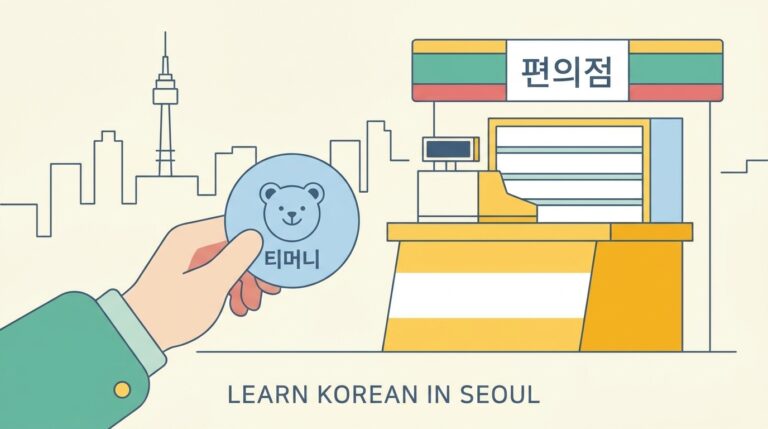
Never Get Stuck at Seoul Turnstiles: How to Recharge Your Korean Transit Card Like a Local
Phase 1: 공감 (Story-Immersive Opening)
안녕하세요! 매일한글 에디터입니다.
Picture this: It is 8:25 AM at Hongik University Station. The morning rush-hour commuter crowd moves like a relentless, synchronized river. You step briskly toward the subway turnstile, confidently tap your brand-new T-money card against the sensor, expecting that satisfying, high-pitched ding… but instead, a harsh “삐빅!” (bbee-beek!) pierces the air. A bright red ‘X’ flashes across the gate screen, and a calm automated robotic voice declares to everyone within a ten-meter radius: “잔액이 부족합니다” (Insufficient balance).
Behind you, a long line of office workers in tailored coats sigh softly in unison. You feel a sudden spike of nervous adrenaline as you step aside, clutching your card and staring helplessly at the glowing automated machines.
Don’t worry—every single traveler and expat in Korea has lived this exact rite of passage! While South Korea is celebrated as one of the most technologically advanced, nearly cashless societies on the planet, transit cards are the grand, charming exception: physical cash is still the undisputed king when it comes to topping them up. Today, drawing from over a decade of guiding global learners through real-life Seoul navigation, we will turn this stressful encounter into your proudest local moment. By the end of this guide, you will master the essential phrases to recharge your card effortlessly at any convenience store counter or station kiosk.
Phase 2: 핵심 표현 3선 심층 분석 (Top 3 Core Expressions)
1. 교통카드 충전해 주세요. (Gyotong-kadeu chungjeon-hae juseyo.)
- Pronunciation: Gyotong-kadeu chungjeon-hae juseyo (Sounds like: gyo-tong-kah-deu choong-jeon-heh joo-seh-yo. Think of “choong” like the punchy resonance of a bass drum).
- Meaning: Literal: “Please charge traffic card.” | Real Nuance: “Could you please recharge/top up my transit card?”
- K-Culture Moment: Seen in nearly every youth K-Drama—from Twenty-Five Twenty-One to Our Beloved Summer—where characters step into a neon-lit neighborhood convenience store on a quiet, rainy evening, sliding their transit card across the counter.
- Editor’s Insight: In Korean, the noun 충전 (chungjeon) refers to replenishing stored potential—used equally for recharging your smartphone battery and loading credit onto a prepaid transit card. The ending ~해 주세요 (-hae juseyo) strikes the sweet spot of everyday Korean politeness: warm, courteous, and completely natural.
- Situation Spectrum: Casual ⚠️ | Semi-formal ✅ | Formal ✅
- 🤔 Think About It: In English, we say “top up” or “reload” money, but Korean treats digital funds inside transit cards as “charging up energy” (충전). How does thinking of money as stored kinetic fuel change how you visualize smart transit cards?
2. 만 원 충전해 주세요. (Man won chungjeon-hae juseyo.)
- Pronunciation: Man won chungjeon-hae juseyo (Sounds like: mahn-won choong-jeon-heh joo-seh-yo. Note: “Man” rhymes with “yawn”, not the English word “man”!).
- Meaning: Literal: “Please charge ten thousand won.” | Real Nuance: “I would like to load 10,000 won, please.”
- K-Culture Moment: When college students in Seoul rush to catch the bus for an idol concert or weekend trip to Busan, you will hear them fire off this exact one-liner at the kiosk counter in less than two seconds.
- Editor’s Insight: 10,000 KRW (~$7.50 USD) is the universal “comfort amount” in Korea. It covers roughly 6 to 7 standard metro trips within metropolitan Seoul, making it the perfect default denomination to load without carrying excess balance.
- Situation Spectrum: Casual ⚠️ | Semi-formal ✅ | Formal ✅
- 🤔 Think About It: In Korean, large numbers jump by ten thousands (만, man), rather than thousands. Shifting your mental accounting from “10k” to a single unit of “만” is your first major leap into thinking like a native Korean speaker.
3. 현금만 돼요? (Hyeongeum-man dwaeyo?)
- Pronunciation: Hyeongeum-man dwaeyo? (Sounds like: hyun-geum-mahn dweh-yo? “Hyun” like in Hyundai, and “geum” like chewing gum).
- Meaning: Literal: “Only cash works?” | Real Nuance: “Is it cash only?”
- K-Culture Moment: You will often witness this scene in travel YouTube vlogs: an international traveler tries tapping an Apple Pay-enabled phone or overseas credit card on the recharge scanner, and the friendly store clerk gently waves their hands, sparking this exact clarification.
- Editor’s Insight: The particle ~만 (-man) means “only”. Adding 돼요? (dwaeyo? – does it work / is it allowed?) creates an ultra-useful, high-frequency A2 question pattern you can use anywhere across Korea.
- Situation Spectrum: Casual ⚠️ | Semi-formal ✅ | Formal ✅
- 🤔 Think About It: Why does Korea—where you can buy a 900-won pack of gum with a smartwatch—still enforce physical cash for transit card reloads? (Financial settlement regulations protect micro-mobility operators from credit card processing fees!).
Phase 3: 교과서 한국어 vs 진짜 한국어 (Textbook vs. Real Korean)
Situation 1: At the Convenience Store Counter
- 📖 교과서 한국어 (Textbook): 제 교통카드에 5,000원을 입금해 주시겠습니까? (Je gyotong-kadeu-e o-cheon-won-eul ipgeum-hae jusigesseumnikka? / Would you be so kind as to deposit 5,000 won into my transit card?)
- 🗣️ 진짜 한국어 (Real-Life): 티머니 5,000원 충전이요! (T-money o-cheon won chungjeon-iyo! / 5,000 won top-up on T-money, please!)
- 💡 왜 다를까? “입금” (ipgeum) is rigid institutional terminology reserved for bank tellers. Real locals replace long sentences with brand names (T-money) followed by the amount and “~충전이요!” to keep the checkout lightning fast during rush hour.
Situation 2: Asking If Credit Cards Work for Recharging
- 📖 교과서 한국어 (Textbook): 신용카드로 충전 대금을 결제하는 것이 가능합니까? (Sinyong-kadeu-ro chungjeon daegeum-eul gyeoljehaneun geosi ganeunghamnikka? / Is it possible to execute payment for the recharge using a credit card?)
- 🗣️ 진짜 한국어 (Real-Life): 카드로 충전 안 돼요? (Kadeu-ro chungjeon an dwaeyo? / Can’t I charge this with a credit card?)
- 💡 왜 다를까? Koreans favor snappy, negative-interrogative questions (“안 돼요?”) in service interactions. It sounds polite, natural, and gets straight to the point without cumbersome grammatical nominalization.
Phase 4: K-Culture 딥다이브 & 비언어적 매너 (Deep Dive & Non-Verbal Manners)
4-1. 눈치 (Nunchi) & Counter Etiquette
- The Two-Handed Pass (양손 매너): When presenting your transit card and cash bills to the store clerk, hand them over using both hands, or support your right wrist/forearm lightly with your left hand. This classic Korean gesture immediately conveys humility and deep respect.
- The Waiting Line Buffer: At automated subway recharge machines, keep a 1-meter courteous distance behind the person ahead of you. Stepping in too close violates personal space and makes commuters feel rushed.
- Flat on the Pad: Never flick or hover your card above the counter terminal. Look for the small, flat rectangular RFID pad next to the cashier’s monitor and place your card completely flat on top of it until the machine beeps.
4-2. Culture Code: The Magic Convenience Store Hub
In South Korea, convenience stores (GS25, CU, 7-Eleven, Emart24) are not just snack stops; they are community infrastructure hubs. While automated subway ticket kiosks can sometimes jam or refuse folded bank notes, convenience stores offer human warmth, instant change, and the ability to test your card on the spot. Furthermore, your recharged T-money card isn’t limited to subways and city buses—you can use its balance to pay for late-night taxis, purchase iced americano coffees, or pay for instant ramyeon at Han River parks!
Phase 5: 실전 롤플레이 시나리오 (Real-World Roleplay)
Setting: A brightly lit GS25 store right next to Exit 3 of Anguk Station, bustling with people heading toward Bukchon Hanok Village.
NPC: Min-ji (민지), a friendly, quick-witted college student working the morning shift in her blue convenience store vest.
- 민지: 어서 오세요! (Eoseo oseyo! / Welcome in!)
🎭 greeting with a warm nod while scanning a customer's water bottle - You: 저기요, 교통카드 충전할 수 있어요? (Jeogiyo, gyotong-kadeu chungjeonhal su isseoyo? / Excuse me, can I charge my transit card here?)
🎭 holding out your card politely with both hands - 민지: 네, 충전돼요! 얼마 충전해 드릴까요? (Ne, chungjeondeoyo! Eolma chungjeon-hae deurilkkayo? / Yes, you can! How much would you like me to load?)
🎭 sliding the RFID scanner pad toward you - You: 만 원 충전해 주세요. (Man won chungjeon-hae juseyo. / Please charge 10,000 won.)
🎭 taking out a fresh green 10,000 won bill - 민지: 네, 카드 여기에 올려주세요. (Ne, kadeu yeogie ollyeojuseyo. / Sure, please place your card right here.)
🎭 tapping her finger on the counter scanner - You: 아, 카드로 결제 안 돼요? 현금만 돼요? (A, kadeu-ro gyeolje an dwaeyo? Hyeongeum-man dwaeyo? / Ah, can’t I pay with a credit card? Is it cash only?)
🎭 tilting head inquisitively while showing a credit card - 민지: 네, 교통카드 충전은 현금만 가능해요! (Ne, gyotong-kadeu chungjeoneun hyeongeum-man ganeunghaeyo! / Yes, transit card recharges are cash only!)
🎭 smiling apologetically and pointing toward the bill slot - You: 알겠습니다. 여기 현금 만 원이요! (Algesseumnida. Yeogi hyeongeum man won-iyo! / Understood. Here is 10,000 won in cash!)
🎭 handing the banknote smoothly with both hands
🔀 인터랙티브 분기점 (Choose Your Move!)
- Choice A: “여기 카드요! 신용카드로 다 해주세요!” (Yeogi kadeu-yo! Sinyong-kadeu-ro da hae juseyo! / Here is my card! Do it all by credit card!)
👉 Feedback (Bad): The clerk cannot process credit card transactions for card recharges under Korean banking regulations. This causes delays and awkwardness. - Choice B: “만 원 충전해 주세요. 현금 여기 있습니다.” (Man won chungjeon-hae juseyo. Hyeongeum yeogi isseumnida. / Please charge 10,000 won. Here is cash.)
👉 Feedback (Best!): Professional, courteous, and fast. The clerk will finish the top-up in under 5 seconds flat! - Choice C: (Silently tapping your credit card on the terminal pad without speaking)
👉 Feedback (Risk): The cashier will assume you are trying to buy something from the shelf or purchase a blank new card, leading to mutual confusion.
Phase 6: 10초 감정 섀도잉 드릴 (10-Second Emotion Shadowing Drill)
Practice matching the native rhythm, breath breaks (/), and emotional tone:
[😊 Politely & Friendly]
저기요, / 교통카드 / 충전해 주세요.
(Jeogiyo, / gyotong-kadeu / chungjeon-hae juseyo.)
“Excuse me, / please recharge / my transit card.”-
[⚡ Confident & Quick]
만 원 / 충전해 주세요!
(Man won / chungjeon-hae juseyo!)
“10,000 won / top up, please!” -
[🤔 Curious & Gentle]
혹시 / 현금만 돼요?
(Hoksi / hyeongeum-man dwaeyo?)
“By any chance, / is it cash only?”
Phase 7: K-Culture 미니 사전 (Mini Dictionary)
- 잔액 (Janaek) | Remaining Balance
The monetary value remaining on your card. When tapping through turnstiles, the lower number displayed on the screen indicates your remaining 잔액. - 일회용 교통카드 (Il-hoe-yong gyotong-kadeu) | Single-Journey Transit Card
The temporary orange transit card dispensed by automated subway kiosks if you don’t possess a permanent T-money card. It includes a 500-won refundable deposit. - 보증금 환급기 (Bojeunggeum hwangeupgi) | Deposit Refund Machine
The dedicated machine located right outside subway turnstiles where you feed your used single-journey card to retrieve your 500-won coin refund. - 환승 (Hwanseung) | Transit Transfer Discount
Korea’s famous integrated transit algorithm. When you tap out of a bus and tap into a subway within 30 minutes, your journey continues seamlessly at almost no extra fee!
Phase 8: 여행자를 위한 생존 키트 (Traveler’s Survival Kit)
서바이벌 표현 TOP 3 (Top 3 Survival Expressions)
- 카드 올려놓으세요. (Kadeu ollyeoneoeuseyo.)
Meaning: “Please place your card on the pad.”
Pro Tip: When the clerk says this, lay your card flat on the terminal scanner and leave it undisturbed until the terminal chirps. - 영수증 필요하세요? (Yeongsujeung piryohaseyo?)
Meaning: “Do you need a receipt?”
Pro Tip: To decline politely, simply smile and reply: “아니요, 괜찮아요” (Aniyo, gwaenchanayo – “No, I’m okay”). - 잔액 확인해 주세요. (Janaek hwaginhae juseyo.)
Meaning: “Please check my balance.”
Pro Tip: If you aren’t sure how much money is left on your card, hand it over with this phrase, and the clerk will read out your remaining funds.
Editor’s Travel Note
- Keep Paper Bills Handy: Always tuck a 10,000-won or 5,000-won physical bill behind your phone case specifically for transit recharges.
- Navigation Essential: Standard Google Maps does not provide real-time walking and transit transfer updates in Korea. Make sure to download the Naver Map app download for transit navigation to track exact subway arrivals and turnstile exit numbers.
- T-Money vs. Climate Card (기후동행카드): If you plan on taking more than 5 subway or bus rides a day within Seoul, check convenience stores for the Climate Card, which offers unlimited rides for 1 to 5 days on a flat budget!
Phase 9: “한 발 더 깊이” (Cultural Reflection Essay)
Korea’s public transit system is widely ranked among the cleanest, safest, and most punctual in the world. But beneath the polished stainless steel and heated subway seats lies an unspoken cultural contract: collective consideration (배려, baeryeo). The rapid speed at which Koreans recharge their cards and tap through turnstiles is not merely about personal haste; it is an active effort to ensure that fellow citizens never miss their train or lose their rhythm. When you master these short recharge phrases and have your cash ready in hand, you are doing more than practicing basic Korean—you are harmonizing with the heartbeat of ten million people moving together in mutual respect.
💬 Your Turn: Have you ever experienced a funny or confusing moment trying to take public transportation in another country? Drop your story in the comments below!
Phase 10: FAQ & 오해 방지 (FAQ Schema & Mistakes)
Q: Can I recharge my Korean transit card with a foreign credit card or Apple Pay?
A: No. Automated station kiosks and convenience stores strictly accept physical Korean cash (KRW) for topping up transit cards. Overseas credit cards and contactless mobile payments will be rejected at the recharge terminal.
Q: Can one T-money card pay for two people traveling together?
A: On city buses, yes! Tell the bus driver “두 명이요” (Du-myeong-iyo – “Two people, please”) before tapping your card. However, in the subway system, every passenger must possess their own individual transit card to pass through the turnstiles.
Q: What should I do if my card gets an error at the turnstile and the gate won’t open?
A: Do not attempt to jump the turnstile. Look for the emergency gate or the nearby intercom pillar marked “도움” (Help). Press the bell button and say: “카드가 안 돼요” (Kadeuga an dwaeyo – “My card isn’t working”). The station attendant will unlock the barrier remotely.
🚨 흔한 실수 (Common Mistakes)
- Mistake 1: Removing the card too quickly from the counter scanner.
Correct Action: Keep the card completely still until the cashier tells you it’s done and hands you your receipt or cash change. - Mistake 2: Forgetting to tap the card when getting off the bus.
Correct Action: Always tap your card against the reader by the rear door before stepping off the bus. If you forget to tap out, you forfeit your transfer discount and get charged a maximum-distance penalty on your next trip! - Mistake 3: Feeding credit cards into the subway cash recharge slot.
Correct Action: Subway station recharge machines only have card readers for domestic Korean transit-debit cards. Always look for the green flashing paper note slot to insert cash.
Phase 11: 액션 미션 & 참여 유도 (Action Missions)
- 🥉 Bronze Mission (Solo Practice): Stand in front of your bathroom mirror and recite: “교통카드 만 원 충전해 주세요!” smoothly 3 times in under 10 seconds.
- 🥈 Silver Mission (Social Sharing): Snap a photo of your transit card or your favorite Korean transit station and post it with the phrase: “오늘 배운 한국어: 교통카드 충전해 주세요! #DailyHangul”.
- 🥇 Gold Mission (Real-World Execution): Walk into a GS25 or CU convenience store in Korea, hand over your card with 10,000 won in cash, and complete the top-up entirely in Korean!
- 🎮 K-Culture Mission: Next time you watch an episode of a modern Seoul K-Drama, spot the moment a character taps their card at a bus door. Listen closely for the distinct beep sound and notice where they keep their card!
Phase 12: 인터랙티브 퀴즈 챌린지 (Interactive Quiz Challenge)
Test your knowledge with these three quick scenarios!
1. [Situational Judgment] You are standing at a convenience store counter near Myeongdong with your T-money card and a 10,000 won banknote. What is the most natural sentence to say?
– A) 신용카드 결제해 주시겠어요?
– B) 교통카드 만 원 충전해 주세요.
– C) 지하철 표 하나 교환해 주세요.
2. [Fill in the Blank] Fill in the missing word:
“교통카드 충전은 [ _____ ]만 가능해요. 카드는 안 돼요!”
(Hint: The word for physical cash/paper bills)
3. [True or False]
In the Seoul subway system, two adults traveling together can share a single T-money card at the turnstile as long as they tap it twice in a row.
👉 Click here to reveal answers and explanations!
- Answer: B (교통카드 만 원 충전해 주세요.)
Explanation: This is the most authentic, natural way to request a 10,000-won reload. Option A asks for credit card payment (not allowed), and Option C asks to exchange a ticket. - Answer: 현금 (Hyeongeum – Cash)
Explanation: “교통카드 충전은 현금만 가능해요” (Transit card recharges are only possible with cash). - Answer: False (X)
Explanation: While buses allow multi-person taps if requested to the driver, subway turnstiles strictly require one card per individual rider.







