

Phase 1: Empathy (Story Opening)
안녕하세요! 매일한글 에디터입니다. (Hello! I’m your Daily Hangul editor.)
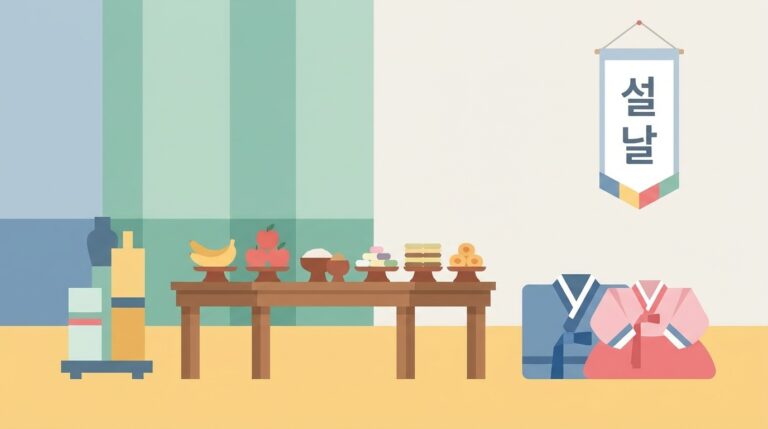
Picture this: It is the brisk, chilly morning of Seollal (Korean Lunar New Year). You are standing in your Korean friend’s or partner’s family living room. The scent of warm sesame oil, savory beef broth, and burning wood incense fills the room. In front of you stands an impressive wooden table called a Charyesang (차례상), stacked meticulously with peeled apples, dried persimmons, golden pancakes, and steamed rice cakes.
Suddenly, the eldest family member clears his throat. Everyone falls quiet, lining up in front of the table to greet the ancestors. Your heart begins to race. Which hand goes on top? Do I bow once or twice? Am I supposed to say something out loud to the spirits, or keep totally silent?
If you have ever panicked at the thought of Korean ancestral ceremonies, take a deep breath. Over the past decade coaching international learners, I have watched dozens of foreign guests stand frozen during ancestral rites, terrified of committing a cultural faux pas. But here is the secret: Korean families do not expect you to be a ritual master! What touches their hearts is simply seeing you offer your genuine respect (Jeongseong, 정성). Today, we will walk step-by-step through the core phrases and simple gestures for greeting ancestors during Seollal so you can stand before the table with poise, warmth, and complete peace of mind.
Phase 2: Core Expressions Deep Dive
1. 새해 복 많이 받으세요 (Saehae bok mani badeuseyo)
- Pronunciation: [Sae-hae bok mah-nee bah-deu-seh-yo] (Sounds like: Say-hey! Soak up ‘money’ and ‘body-say-yo’)
- Meaning: Literal: “Please receive lots of New Year’s good fortune” | Nuance: The warmest universal greeting for family, living elders, and ancestors alike during Seollal.
- K-Culture Moment: Seen in nearly every family K-drama holiday special (like Reply 1988), where generations gather in colorful Hanbok to exchange warm wishes and blessing money.
- Editor’s Insight: Even when honoring ancestors, this phrase reflects the core belief that blessings flow back and forth across generations. Saying this softly or keeping it in mind sets a gentle, respectful mood.
- Situation Spectrum: Casual ⚠️ | Semi-formal ✅ | Formal ✅
- 🤔 Think About It: In many Western traditions, New Year greetings look strictly forward. Why do you think Koreans include their departed ancestors in this wish for fortune and gratitude?
2. 절 올리겠습니다 (Jeol olligetseumnida)
- Pronunciation: [Jeol ol-li-get-seum-ni-da] (Sounds like: Jol all-lee-get-seum-nee-dah)
- Meaning: Literal: “I will offer a bow” | Nuance: An ultra-polite announcement made right before performing a formal deep bow to ancestors or grandparents.
- K-Culture Moment: In historical and modern family dramas, children or in-laws use this deferential sentence before stepping onto the traditional mat to bow to family patriarchs.
- Editor’s Insight: The verb ollida (올리다) literally means “to raise up” or “to offer upward.” You aren’t just “doing” a bow; you are dedicating the physical act of bowing as a humble gift.
- Situation Spectrum: Casual 🚫 | Semi-formal ⚠️ | Formal ✅
- 🤔 Think About It: How does your native language verbally express physical acts of reverence? Do you announce an action before doing it?
3. 조상님, 감사합니다 (Josangnim, gamsahamnida)
- Pronunciation: [Jo-sang-nim, gam-sa-ham-ni-da] (Sounds like: Joe-sang-neem, gahm-sah-hahm-nee-dah)
- Meaning: Literal: “Honored ancestors, thank you” | Nuance: A sincere expression of thanks acknowledging that the family’s health and happiness today exist thanks to their roots.
- K-Culture Moment: Often murmured during the final quiet contemplation of the ceremony, or spoken in variety shows when visiting hometown ancestral resting places.
- Editor’s Insight: The suffix -nim (님) adds genuine honorific warmth. As an A1 learner, this simple sentence delivers profound sincerity without stumbling over archaic ritual vocabulary.
- Situation Spectrum: Casual 🚫 | Semi-formal ✅ | Formal ✅
- 🤔 Think About It: How do families in your culture acknowledge previous generations during major holiday gatherings?
Phase 3: Textbook Korean vs Real Korean
Situation 1: Announcing your bow during the ritual
- 📖 교과서 한국어: 이제 제가 절을 하겠습니다. (Ije jega jeoreul hagetseumnida.) — “Now, I will perform a bow.”
- 🗣️ 진짜 한국어: 절 올리겠습니다. (Jeol olligetseumnida.) — “I shall offer a bow.”
- 💡 왜 다를까? Textbook Korean uses standard neutral verbs (hada / do), but Korean etiquette requires humble honorifics (ollida / offer upward) when paying homage to elders and ancestors.
Situation 2: Enjoying food together after the ritual (Eumbok)
- 📖 교과서 한국어: 제사 음식이 참 맛있습니다. (Jesa eumsigi cham mas-itseumnida.) — “The ancestral ritual food is indeed delicious.”
- 🗣️ 진짜 한국어: 감사히 잘 먹겠습니다! (Gamsahi jal meokgetseumnida!) — “I will eat gratefully!”
- 💡 왜 다를까? Speaking analytically about ritual food feels emotionally cold; saying you will eat it with deep gratitude demonstrates warm communal bonding and respect for the hosts.
Phase 4: K-Culture Deep Dive & Non-Verbal Manners
4-1. 눈치 (Nunchi) & Gestures: Hand Placement and Bow Count
Ancestral greeting is 90% body language! Here are the golden non-verbal rules:
1. Hand Clasping (공수 – Gongsu): Stand straight with feet together. For festive ancestral rites (Charye on Seollal):
* Men: Place your left hand on top of your right hand.
* Women: Place your right hand on top of your left hand.
(Note: This is the exact opposite of funeral etiquette!)
2. The Two-Bow Rule: When bowing to living elders (Sebae), you bow once. But when bowing to ancestors in front of the table (Charye), you perform two full floor bows plus one slight standing nod to conclude.
3. Gaze: Keep your eyes gently lowered toward your clasped hands or the mat. Avoid staring directly at family elders during the solemn moments.
4-2. Cultural Code: 차례 (Charye) vs. 음복 (Eumbok)
During Seollal morning, Korean families hold Charye (차례), a simplified ancestral memorial compared to nighttime death anniversaries (Jesa). The central food on the table is Tteokguk (떡국, sliced rice cake soup), symbolizing a clean, prosperous fresh start. Once the incense burns out and the ritual finishes, the best part begins: Eumbok (음복). This is the communal tradition where family members sit together and share the food offered to the ancestors, believing that consuming it passes down the ancestors’ blessings and protection for the year.
Phase 5: Real-Life Roleplay Scenario
Setting: Lunar New Year morning in Busan. You are at Minho’s family home. Minho’s warm grandfather (Harabeoji) welcomes you to the front of the Charyesang table.
- 할아버지 (Harabeoji): 이리 와요. 같이 인사드립시다. (Iri wayo. Gachi insadeuripsida.)
🎭 Gesturing gently toward the straw mat with a kind smile.
“Come over here. Let us greet them together.” - 나 (Me): 네, 할아버지! (Ne, harabeoji!)
🎭 Stepping forward quietly with both hands neatly clasped in front.
“Yes, Grandfather!” - 할아버지 (Harabeoji): 오른손이 위로 가야지, 기억하지요? (Oreunsoni wiro gayaji, gieokhajiyo?)
🎭 Checking your posture with an approving nod.
“Your right hand goes on top, you remember, right?” - 나 (Me): 네, 준비되었습니다. (Ne, junbidoeeotseumnida.)
🎭 Adjusting posture with serene confidence.
“Yes, I am ready.” - 나 (Me): 절 올리겠습니다. (Jeol olligetseumnida.)
🎭 Lowering knees gracefully onto the mat to start the deep bow.
“I shall offer my bow.” - 할아버지 (Harabeoji): 아이고, 아주 잘하네. (Aigo, aju jalhane.)
🎭 Watching proudly as you complete two deep bows smoothly.
“Oh my, you are doing so well.” - 나 (Me): 조상님, 새해 복 많이 받으세요. (Josangnim, saehae bok mani badeuseyo.)
🎭 Whispering respectfully as you rise back to your feet.
“Ancestors, please receive abundant New Year fortune.” - 할아버지 (Harabeoji): 허허, 조상님들도 아주 기뻐하시겠어. 떡국 먹으러 가자! (Heoheo, josangnimdeuldo aju gippeohasigesseo. Tteokguk meogeureo gaja!)
🎭 Patting your shoulder warmly with big laughter.
“Haha, the ancestors must be very happy too. Let us go eat Tteokguk!”
🔀 Interactive Decision Point
When Harabeoji invites you to step up to the ancestral table, how do you respond?
* Choice A: Say “절 올리겠습니다 (Jeol olligetseumnida)” and bow twice carefully.
👉 Feedback (Best): Perfect! Announcing your bow politely and executing two bows shows deep cultural awareness and warms everyone’s hearts.
* Choice B: Bow once quickly and say “안녕! (Annyeong!)” like greeting a close buddy.
👉 Feedback (Bad): High cringe factor! Bowing once is for the living, and casual language (banmal) is disrespectful at an ancestral altar.
* Choice C: Wave your hands in fear, say nothing, and hide behind the refrigerator.
👉 Feedback (Risk): Harmless, but you miss out on an unforgettable cultural bonding moment. Families love when you try!
Phase 6: 10-Second Emotion Shadowing Drill
Practice matching these rhythm breaks (/) and tones aloud:
[🌿 Calm and Reverent]
절 / 올리겠습니다.
(Jeol / ol-li-get-seum-ni-da.)-
[🙏 Sincere and Warm]
조상님, / 새해 복 많이 받으세요.
(Jo-sang-nim, / sae-hae bok mah-nee / bah-deu-seh-yo.) -
[😊 Bright and Grateful]
새해 복 많이 받으세요! / 감사히 잘 먹겠습니다!
(Sae-hae bok mani badeuseyo! / Gam-sa-hi jal meok-get-seum-ni-da!)
Phase 7: K-Culture Mini Dictionary
- 차례 (Charye): Traditional tea-and-food ceremony held on major holidays (Seollal and Chuseok) to greet and honor family ancestors.
- 세배 (Sebae): The ceremonial New Year’s deep bow performed specifically to living elder family members (grandparents, parents) to wish them longevity.
- 차례상 (Charyesang): The designated ceremonial ritual table set with prescribed fruits, fish, meat, and seasonal rice cakes.
- 음복 (Eumbok): The communal sharing and eating of the blessed ritual foods right after the ceremony concludes.
Phase 8: Traveler’s Survival Kit
Top 3 Survival Phrases
- 새해 복 많이 받으세요! (Saehae bok mani badeuseyo!)
Pro Tip: Use this anytime from late January through mid-February when greeting shop owners, taxi drivers, or hotel staff. - 사진 찍어도 될까요? (Sajin jjigeodo doelkkayo?) — “May I take a photo?”
Pro Tip: Always ask permission before photographing family ancestral tables or village ritual setups. - 감사합니다 (Gamsahamnida) — “Thank you.”
Pro Tip: A polite head nod accompanied by this phrase will dissolve any awkward beginner moment.
Editor’s Travel Note
Traveling across South Korea during Seollal is known as the great migration (Gwiseonggil). Trains and highway express buses sell out weeks in advance! If you plan to travel between Seoul and regional hubs like Busan or Gyeongju, check our KORAIL train ticket booking guide early. Furthermore, many independent neighborhood shops and restaurants close on the exact day of Seollal, so verify opening hours in advance using the Naver Map navigation application.
Phase 9: “One Step Deeper” (Thoughtful Reflection)
In Western individualist traditions, death often signifies an ultimate parting until an afterlife. In Korea’s Confucian-rooted culture, however, relationships do not end when breath leaves the body. Ancestors remain active, protective members of the extended family unit. Setting out freshly cooked food and bowing twice is a tangible way of saying, “We have not forgotten where our roots began; please continue watching over us.”
💬 Your Turn: Does your family or culture have a special tradition to remember ancestors or welcome the new year together? Drop your story in the comments below!
Phase 10: FAQ & Mistake Prevention
Q: Do foreigners have to participate in the Charye ritual?
A: No, it is never mandatory. Korean families will never pressure a guest or visitor. However, politely joining in or standing reverently nearby is considered a deeply thoughtful gesture of goodwill and friendship.
Q: Can I wear modern casual clothes like jeans during the ancestor bow?
A: Yes, neat modern clothing is completely acceptable if you don’t own a Hanbok! Just make sure your clothes are modest: avoid sweatpants, pajamas, or revealing tops.
Q: What should I do if my family practices a religion that does not bow to altars?
A: Simply communicate beforehand! Many modern Korean Christian families replace the traditional table bow with a silent prayer (Chudo Yebae). If you prefer not to bow for personal reasons, standing quietly with bowed head and clasped hands is fully respected.
🚨 Common Mistakes Alert (TOP 3)
- Mistake 1: Bowing only once to the ancestral table.
Correct Action: Bow two full times to ancestors. One bow is strictly reserved for living relatives. - Mistake 2: Mixing up festive hand positions with funeral customs.
Correct Action: For festive holiday Charye, men place the left hand on top, and women place the right hand on top. Placing the opposite hand on top is reserved for funerals. - Mistake 3: Nibbling food from the Charyesang table before the rite finishes.
Correct Action: Wait patiently until the incense burns out and elders announce Eumbok. Once invited, eat and enjoy wholeheartedly!
Phase 11: Action Missions & Engagement
- 🥉 Bronze Mission (Solo Practice): Stand in your room, practice placing your correct hand on top (Men: Left over Right; Women: Right over Left), and whisper: “절 올리겠습니다 (Jeol olligetseumnida).”
- 🥈 Silver Mission (Social Share): Share our practice phonetic drill with a friend or in your Korean study group with the hashtag
#DailyHangulSeollal. - 🥇 Gold Mission (Real Life): Send a holiday voice memo or text saying “새해 복 많이 받으세요!” to a Korean friend, teacher, or language partner.
- 🎮 K-Culture Mission: Watch the holiday family episode of any K-drama (such as Hospital Playlist or Reply 1988) and spot whether family members bow once or twice!
Phase 12: Interactive Quiz Challenge
Question 1 (Situational): You are standing in front of the Charyesang table on Seollal morning. How many times should you bow to the ancestors?
(A) 1 time
(B) 2 times
(C) 4 times
Question 2 (Fill-in-the-blank): Before lowering to the mat to bow, you announce politely: “절 ________ (Jeol ________).”
(A) 먹겠습니다 (meokgetseumnida)
(B) 올리겠습니다 (olligetseumnida)
(C) 가겠습니다 (gagetseumnida)
Question 3 (True/False): Eumbok is the tradition of sharing and eating the ritual food together after the ceremony finishes.
(A) True
(B) False
👉 Click to reveal answers & explanations!
- Question 1 Answer: (B) 2 times.
Explanation: In Korean tradition, two bows are offered to ancestors during memorial rites, while one bow is given to living elders. - Question 2 Answer: (B) 올리겠습니다 (olligetseumnida).
Explanation: Jeol olligetseumnida literally means “I shall offer a bow,” the most deferential way to announce your bow. - Question 3 Answer: (A) True.
Explanation: Eumbok (음복) means drinking and eating the blessings of the ancestors through the shared ritual meal.







