

안녕하세요! 매일한글 에디터입니다.
Imagine this: You finally find that limited-edition K-pop album, adorable stationery set, or trending K-beauty skincare product on a Korean website. Your shopping cart is full, your excitement is peaking, and you hit ‘Checkout.’ Then, suddenly, a maze of unfamiliar form fields pops up asking for 도로명주소 (road name address), 상세주소 (detailed address), and 공동현관 비밀번호 (building entrance code). Your heart sinks. Where does the room number go? What happens if you get it wrong and your parcel vanishes into the bustling streets of Seoul?
You are definitely not alone! As your local culture navigator with 10 years of experience helping Korean learners navigate daily life, I see this exact stumbling block trip up international students and travelers every single week. Online shopping in South Korea is world-renowned for its hyper-speed ‘Rocket Delivery’ (로켓배송), but unlocking that convenience requires knowing how Korean addresses tick. This guide was built directly from real learner struggles and tested solutions. By the end of this lesson, you will confidently fill out any checkout screen, write delivery requests like a local, and ensure your precious packages land safely at your doorstep.
Phase 2: Core Expressions Deep Dive
1. 배송지 입력해 주세요 (Baesongji ipryeokhae juseyo)
- Pronunciation: [Bae-song-ji ip-ryeok-hae ju-se-yo] (Sounds like: Bay-song-jee eep-ryuk-hae joo-say-yo)
- Meaning: “Please enter your shipping address.” (Literal: Shipping destination / input / please do)
- K-Culture Moment: You will see this on system prompts, popup windows, and customer service chats on apps like Coupang, Weverse Shop, or Olive Young.
- Editor’s Insight: ‘배송지’ (Baesongji) refers specifically to the destination where goods are delivered. Notice the polite ending ‘-해 주세요’ (-hae juseyo), which forms standard, courteous A2-level Korean requests.
- Situation Spectrum: Casual: 🚫 | Semi-formal: ✅ | Formal: ✅
- 🤔 Think About It: In your home country, do forms use commands or polite honorific requests? Why does Korean software speak so politely to users?
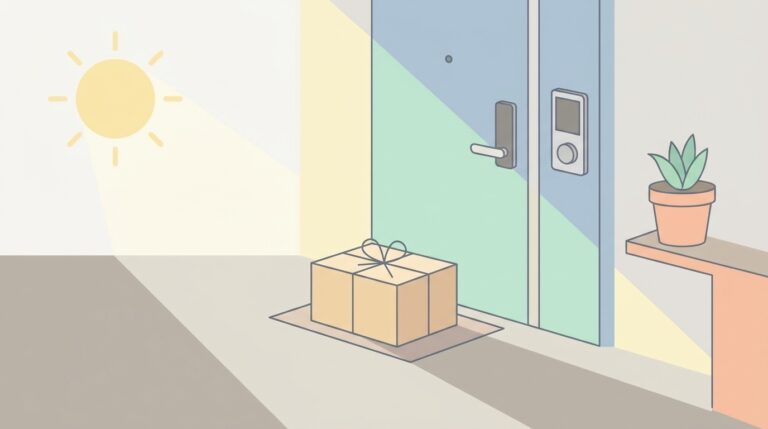
2. 문 앞에 놓아주세요 (Mun ape noajuseyo)
- Pronunciation: [Mun a-pe no-a-ju-se-yo] (Sounds like: Moon ah-peh noh-ah-joo-say-yo)
- Meaning: “Please leave it in front of the door.” (Literal: Door / front / at / leave / please do)
- K-Culture Moment: In almost every modern K-drama featuring an apartment, characters receive text photos of packages stacked right beside their front door without anyone ever ringing the bell.
- Editor’s Insight: Korea has a virtually zero-theft package culture. Leaving items outside the door (‘문 앞’) is the default, most loved option for busy locals.
- Situation Spectrum: Casual: ⚠️ | Semi-formal: ✅ | Formal: ✅
- 🤔 Think About It: Would you dare leave packages outside your door for hours where you live? What societal trust makes this possible in Korea?
3. 공동현관 비밀번호 (Gongdong hyeongwan bimilbeonho)
- Pronunciation: [Gong-dong hyeon-gwan bi-mil-beon-ho] (Sounds like: Gong-dong hyun-gwan bee-meel-bun-ho)
- Meaning: “Common building entrance passcode.”
- K-Culture Moment: In shows like Crash Landing on You or everyday vlogs, visitors and delivery couriers punch keypads at the glass entrance of ‘Villas’ or high-rise apartments.
- Editor’s Insight: If couriers cannot enter the main outer building door at dawn, your delivery gets delayed! Always look for this field when checking out.
- Situation Spectrum: Casual: ✅ | Semi-formal: ✅ | Formal: ✅
- 🤔 Think About It: How do delivery workers access multi-family apartment complexes in your culture?
Phase 3: Textbook Korean vs. Real Korean
Scenario 1: Providing Your Delivery Location
- 📖 Textbook Korean: 제 물품을 이 주소로 배송해 주십시오. (Je mulpumeul i jusoro baesonghae jusipsio.) – “Please dispatch my merchandise to this address.”
- 🗣️ Real Korean: 여기로 보내주세요. (Yeogiro bonaejuseyo.) – “Please send it here.”
- 💡 Why is it different? Textbook phrases often rely on overly stiff Sino-Korean words (물품, 배송, -하십시오). Everyday spoken Korean uses conversational native roots (보내다) with natural polite endings (-주세요).
Scenario 2: Requesting Package Drop-off When Away
- 📖 Textbook Korean: 부재 시 경비실에 보관을 부탁드립니다. (Bujae si gyeongbisire bogwaneul butakdeurimnida.) – “In the event of absence, I request storage in the security office.”
- 🗣️ Real Korean: 부재 시 문 앞에 놔주세요. (Bujae si mun ape nwajuseyo.) – “If I’m not home, please leave it by the door.”
- 💡 Why is it different? Most modern Korean studios or multi-unit buildings do not have on-site security guards (경비실) handling daily parcel deliveries. The doorstep is the go-to standard.
Phase 4: K-Culture Deep Dive & Non-verbal Manners
4-1. Nunchi & Gestures: Privacy at the Keypad
When living in or visiting a Korean apartment complex, you will notice people practicing subtle ‘Nunchi’ (social intuition) around the 공동현관 (main entrance). When typing your building passcode or entering notes for delivery workers, locals shield keypads with one hand or tilt their phones away. Furthermore, always write down your address in strict hierarchical order: from macro to micro (City -> District -> Road -> Building -> Unit). Mixing up the order confuses local post carriers!
4-2. Culture Code: Coupang, ‘Palli-Palli’, & Trust
Korea’s famous ‘Palli-Palli’ (빨리빨리, hurry-hurry) culture reached its modern climax through e-commerce. Services like 새벽배송 (Dawn Delivery) guarantee that orders placed at 11 PM arrive at your doorstep before 7 AM. Because CCTV coverage is widespread and communal trust runs high, couriers snap a quick photo of the box at your door, text it to you, and move to the next floor. No signatures, no face-to-face small talk—pure efficiency!
Phase 5: Real-world Roleplay Scenario
Setting: Maya is messaging a friendly local seller on an online marketplace who is confirming her delivery details.
- Turn 1 (Seller): 주문 확인되었습니다! 배송지 입력해 주세요. (Jumun hwagindoeeossseumnida! Baesongji ipryeokhae juseyo.) – [Order confirmed! Please provide your delivery address.] 🎭 Typing quickly in customer chat window.
- Turn 2 (Maya): 서울시 마포구 독막로 10길 5, 302호예요. (Seoul-si Mapo-gu Dongmak-ro sip-gil o, sam-baek-i-hoyeyo.) – [It is 5, Dongmak-ro 10-gil, Mapo-gu, Seoul, Unit 302.] 🎭 Checking notes carefully.
- Turn 3 (Seller): 네, 확인했습니다. 배송 요청 사항 있으신가요? (Ne, hwaginhaessseumnida. Baesong yocheong sahang isseusingayo?) – [Yes, confirmed. Do you have any delivery requests?] 🎭 Friendly and prompt.
- Turn 4 (Maya): 문 앞에 놓아주세요. (Mun ape noajuseyo.) – [Please leave it in front of the door.] 🎭 Smiling with confidence.
- Turn 5 (Seller): 혹시 공동현관 비밀번호가 필요한가요? (Hoksi gongdonghyeongwan bimilbeonhoga piryohangayo?) – [By any chance, is a building entrance passcode required?] 🎭 Checking building requirements.
- Turn 6 (Maya): 네! #1234* 누르시면 돼요. (Ne! Syap il-i-sam-sa byeol nureusimyeon dwaeyo.) – [Yes! You can press #1234.] 🎭 *Providing key codes accurately.
- Turn 7 (Seller): 감사합니다. 오늘 발송해 드릴게요! (Gamsahamnida. Oneul balsonghae deurilgeyo!) – [Thank you. I will ship it out today!] 🎭 Sending a bowing sticker.
- Turn 8 (Maya): 빠른 배송 감사합니다! 좋은 하루 보내세요. (Ppaareun baesong gamsahamnida! Joeun haru bonaeseyo.) – [Thank you for the fast shipping! Have a great day.] 🎭 Relieved and happy.
🔀 Interactive Branching Choice
The seller asks: “혹시 낮에 집에 계신가요?” (Are you home during the day?)
* Choice A: 집에 없어요. 문 앞에 놓아주세요. (Jibe eopseoyo. Mun ape noajuseyo.)
* Choice B: 저기요, 아무 데나 던져요. (Jeogiyo, amu dena deonjyeoyo.)
* Choice C: 비밀이에요. 직접 오세요. (Bimirieyo. Jikjeop oseyo.)
Outcome Feedback:
* Choice A (Best): Polite, clear, and perfectly natural! The courier knows immediately to leave your box safe at the door.
* Choice B (Bad): “Throw it anywhere” sounds rude and dismissive, violating standard customer courtesy.
* Choice C (Risk): Saying “It’s a secret, come directly” creates confusion and will likely lead to a canceled delivery.
Phase 6: 10-Second Emotion Shadowing Drill
Practice reading these lines aloud with the emotional cues and pauses indicated by /.
[😊 안도하며 정중하게](Relieved & Courteous)
배송지는 / 서울시 마포구예요. / 문 앞에 / 놓아주세요.
(Baesongjineun / Seoul-si Mapo-guyeyo. / Mun ape / noajuseyo.)
“The delivery address is / Mapo-gu, Seoul. / In front of the door / please leave it.”-
[📦 명확하고 또박또박](Clear & Precise)
공동현관 / 비밀번호는 / 샵 일이삼사 / 별이에요.
(Gongdonghyeongwan / bimilbeonhoneun / syap il-i-sam-sa / byeorieyo.)
“The entrance / passcode is / pound one-two-three-four / star.” -
[🥺 조심스럽고 부탁하듯이](Gentle & Requesting)
배송 전에 / 미리 / 전화 주세요.
(Baesong jeone / miri / jeonhwa juseyo.)
“Before delivery / in advance / please give me a call.”
Phase 7: K-Culture Mini Dictionary
- 택배 (Taekbae) | Parcel / Courier service | The ubiquitous word for parcel delivery in Korea. Used everyday: “택배 왔어요!” (The package is here!).
- 송장번호 (Songjang beonho) | Tracking number | The unique package number you copy and paste into tracking search engines or logistics portals.
- 상세주소 (Sangse juso) | Detailed address (Unit/Floor) | The second address line on checkout forms where apartment names, building numbers (동 – dong), and unit numbers (호 – ho) belong.
- 새벽배송 (Saebyeok baesong) | Dawn delivery | Korea’s signature e-commerce service that drops orders outside your apartment door between 1 AM and 7 AM.
Phase 8: Traveler’s Survival Kit
Top 3 Survival Phrases
- 택배 보관함에 넣어주세요. (Taekbae bogwanhame neoeojuseyo.)
- Pronunciation: [Taek-bae bo-gwan-ha-me neo-eo-ju-se-yo]
- Pro Tip: Useful if staying in modern officetels equipped with automated delivery locker stations.
- 배송 메모 확인해 주세요. (Baesong memo hwaginhae juseyo.)
- Pronunciation: [Bae-song me-mo hwa-gin-hae ju-se-yo]
- Pro Tip: Use this if you left special gate entry codes or drop instructions on the app.
- 송장번호 조회해 주세요. (Songjangbeonho jo-hoe-hae juseyo.)
- Pronunciation: [Song-jang-beon-ho jo-hoe-hae ju-se-yo]
- Pro Tip: Say this to store staff or customer support if your delivery is delayed.
Editor’s Travel Note
Before ordering in Korea, install the 네이버 지도 앱 다운로드. By searching your building name in English or Korean, Naver Map gives you the official formatted 도로명주소 (Road Name Address) and 5-digit postal code (우편번호). If staying in an Airbnb or hotel, always ask the host first: “택배 받아도 돼요?” (Can I receive parcels here?).
Phase 9: One Step Deeper
Have you ever noticed how a Korean address is written? In the West, you start with the most individual detail: Room 302, 15 Main Street, New York, USA. In Korea, it starts from the macro universe down to the individual: 대한민국 (Country) -> 서울특별시 (Metropolis) -> 마포구 (District) -> 와우산로 (Road) -> 123 (Building) -> 405호 (Unit).
This linguistic order mirrors traditional Korean collectivism, where the broad community framework contextualizes the individual. When filling out delivery forms, understanding this macro-to-micro logic keeps you from putting your apartment number into the city box!
💬 Your Turn: How are addresses arranged in your native country? Big-to-small or small-to-big? Share your thoughts in the comments below!
Phase 10: FAQ & Common Mistakes
Q: What is the difference between 지번주소 (Jibeon juso) and 도로명주소 (Doromyeong juso)?
A: 지번주소 is the older land-lot parcel system, while 도로명주소 is the standardized road-name system introduced in 2014. Modern online shopping forms almost always require the 도로명주소 (Road Name Address).
Q: Why do delivery apps ask for my ARC or Korean phone number?
A: Major Korean e-commerce platforms link user identity and domestic payment gateways to Korean mobile carriers for safety. For travelers without an ARC, specialized tourist-friendly platforms (like Trazy or global shopping sites) offer simpler foreign card checkouts.
Q: How do I write keypad symbols like ‘#’ or ‘*’ in notes?
A: In Korean, ‘#’ is called 샵 (syap) or 우물 정 (umul jeong), and ‘‘ is called 별 (byeol). You can simply write “#1234” in the notes field.
🚨 Common Mistakes Warning Board
- Writing the room number before the street: Putting ‘201호’ in the first address line scrambles auto-fill postal engines. Correct Action: Search your road name first, then type room numbers into ‘상세주소’.
- Forgetting the entrance gate code: Forgetting the 공동현관 비밀번호 often forces couriers to leave packages at the roadside entrance. Correct Action: Always note the keypad numbers in the delivery note field.
- Translating street names phonetically yourself: Translating words like ‘Hill’ or ‘Street’ manually leads to delivery failures. Correct Action: Copy the official romanized street name directly from map apps.
Phase 11: Action Missions
- 🥉 Bronze Mission (Solo Drill): Open your notes app and write out your current hotel or home address using Korean macro-to-micro format (City -> District -> Road -> Room).
- 🥈 Silver Mission (Community Drill): Comment below with the phrase “문 앞에 놓아주세요!” and practice recording your voice on our study channel.
- 🥇 Gold Mission (Real-world Drill): Place an online order on a Korean app or local convenience store pickup service and successfully track your parcel with your 송장번호!
🎮 K-Culture Mission: Watch a contemporary K-drama or Korean room-tour vlog. Spot the moment a delivery box sits outside an apartment door and identify what delivery request note is printed on the shipping label!
Phase 12: Interactive Quiz Challenge
Test your skills before placing your next order!
Question 1: Situational Judgment
You want your parcel left safely at your apartment door without meeting the driver. What do you select?
* (A) 직접 받을게요 (Jikjeop badeulgeyo)
* (B) 문 앞에 놓아주세요 (Mun ape noajuseyo)
* (C) 반품해 주세요 (Banpumhae juseyo)
Question 2: Fill in the Blank
빌딩 1층 입구 문을 열기 위해 필요한 번호는 [ ____________ ]입니다.
(The number needed to open the building ground entrance is the [ ____________ ].)
* (A) 송장번호 (Songjang beonho)
* (B) 전화번호 (Jeonhwabeonho)
* (C) 공동현관 비밀번호 (Gongdong hyeongwan bimilbeonho)
Question 3: True or False (Culture)
In Korea, leaving a parcel outside an apartment front door is generally considered dangerous due to rampant package theft.
* (True / False)
👉 Click here to reveal answers and explanations!
- Question 1 Answer: (B) 문 앞에 놓아주세요.
- Explanation: (A) means ‘I will receive it in person,’ and (C) means ‘Please process a return.’ (B) is the standard doorstep request.
- Question 2 Answer: (C) 공동현관 비밀번호.
- Explanation: (A) is a tracking number, and (B) is a phone number. The communal door code is 공동현관 비밀번호.
- Question 3 Answer: False.
- Explanation: South Korea has an exceptionally low parcel theft rate backed by CCTV networks and social norms; packages frequently sit outside doors for hours completely untouched!
- Explanation: South Korea has an exceptionally low parcel theft rate backed by CCTV networks and social norms; packages frequently sit outside doors for hours completely untouched!







