

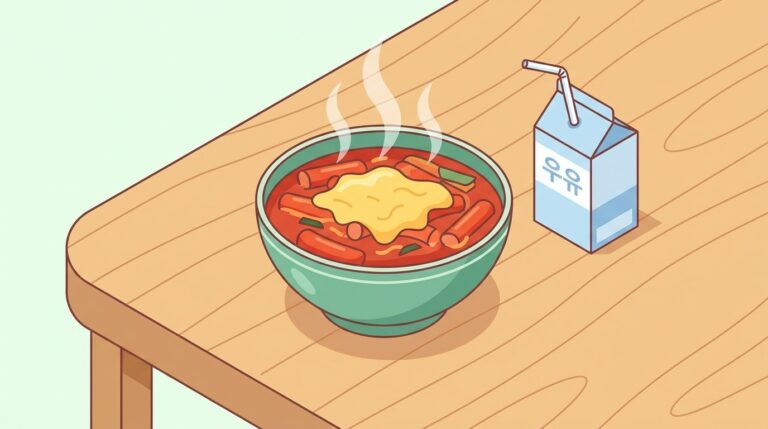
Phase 1: Empathy (Story Immersion Opening)
안녕하세요! 매일한글 에디터입니다. (Annyeonghaseyo! It’s your Daily Hangul editor here!)
Picture this: You are walking down the neon-drenched alleyways of Hongdae with friends on a brisk evening. Your senses are overwhelmed by the sizzling sound of hot pans and the sweet-savory perfume of red chili paste lingering in the air. You step into a bustling tteokbokki (spicy rice cake) or maeun galbijjim (spicy braised short ribs) spot. The walls are covered in colorful customer doodles, and halfway across the room, people are wiping sweat from their foreheads, gasping for cold water while smiling through the tears.
The energetic server (imo, auntie) approaches your table with a pen poised over an order sheet. She looks at you, squints slightly with concern, and asks: “많이 매운데, 괜찮으시겠어요?” (Mani maeunde, gwaenchanheusigesseoyo? / It’s very spicy, will you be okay?)
Your heart races. You want to embrace the authentic Korean food experience, but you definitely don’t want your stomach paying the price for the next 48 hours. In classroom textbooks, you probably only learned “안 맵게 해주세요” (An maepge haejuseyo / Please make it not spicy). But real Korean food isn’t just a binary switch between zero and a volcanic eruption. There’s a subtle, unspoken spectrum—a calibrated scale of heat and hospitality.
Over the past few years, dozens of intermediate learners have told us that food stalls and spicy challenge restaurants are where their confidence breaks down. Today, we’re unlocking the secret codes native speakers use to gauge, negotiate, and conquer Korea’s fiery cuisine with swagger. Let’s make sure you survive the spice with your tastebuds—and your pride—intact!
Phase 2: Core Expressions (3 In-Depth Breakdowns)
1. 맵기 조절 되나요? (Maepgi jojeol doenayo?)
- Pronunciation: [Maep-kki jo-jeol doe-na-yo?] (Sounds like: “Map-key jo-jull dway-nah-yo”)
- Meaning: Literal: “Is spiciness regulation possible?” | Actual Nuance: “Can the spice level be adjusted here?”
- K-Culture Moment: Seen constantly in Korean variety shows like Sixth Sense or mukbang YouTube streams when the cast checks how flexible the chef is before ordering legendary ghost pepper dishes.
- Editor’s Insight: This is the ultimate intermediate magic wand. Instead of demanding a bland dish, asking if they can “regulate” (jojeol) shows respect for their cooking style while protecting your stomach lining. If they say “네, 단계별로 있어요” (Yes, we have levels), you’re golden.
- Situation Spectrum: Casual: ✅ | Semi-formal: ✅ | Formal: ⚠️
- 🤔 Think About It: In many Western restaurants, dishes come with fixed heat profiles unless modified. Why do you think modern Korean eateries build entire numerical ranking systems for spice into their printed menus?
2. 신라면 맵기 정도로 해주세요. (Sinramyeon maepgi jeongdoro haejuseyo.)
- Pronunciation: [Shin-ram-yeon maep-kki jeong-do-ro hae-ju-se-yo] (Sound analogy: Shin-lahm-yuhn map-key jung-doe-row ha-joo-seh-yo)
- Meaning: Literal: “Please do it to the degree of Shin Ramyun’s spiciness.” | Actual Nuance: “Could you make it about as spicy as Shin Ramyun?”
- K-Culture Moment: Featured in K-dramas whenever a character is ordering late-night stew at a pojangmacha (tented street cart) and wants comfort food without crying in public.
- Editor’s Insight: Shin Ramyun is Korea’s unofficial national baseline for measuring Scoville units. If you ask for “a little spicy,” everyone’s definition is different. An ajumma’s “slightly spicy” might melt your tongue! Citing Shin Ramyun gives both you and the cook an unmistakable universal reference point.
- Situation Spectrum: Casual: ✅ | Semi-formal: ✅ | Formal: 🚫
- 🤔 Think About It: How does your home country measure everyday spice without using formal numbers? Why is a specific commercial food brand so universally accepted here?
3. 제가 맵찔이라서 덜 맵게 해주세요. (Jega maepjjiliraseo deol maepge haejuseyo.)
- Pronunciation: [Je-ga maep-jji-ri-ra-seo deol maep-kke hae-ju-se-yo] (Sound analogy: Jay-gah map-jee-ree-rah-suh dull map-kay hae-joo-seh-yo)
- Meaning: Literal: “Because I am a spice-wimp, please make it less spicy.” | Actual Nuance: “I’m a total lightweight when it comes to spice, so please take it easy on me!”
- K-Culture Moment: Young idols on live broadcasts frequently use this self-deprecating slang when doing eating shows, instantly winning playful sympathy from fans.
- Editor’s Insight: The slang word 맵찔이 (Maepjjili) combines maepda (spicy) + jjijiri (loser/wimp). Admitting this candidly is disarming. Restaurant owners soften immediately, smile, and make sure your food doesn’t scorch your throat.
- Situation Spectrum: Casual: ✅ | Semi-formal: ✅ (with friendly servers) | Formal: 🚫
- 🤔 Think About It: In English, calling yourself a “wimp” can feel genuinely self-deprecating. In Korean, why do terms like maepjjili build camaraderie rather than embarrassment?
Phase 3: Textbook Korean vs. Real Korean
Situation 1: Asking how spicy a signature stew is
- 📖 교과서 한국어 (Textbook):
- “이 찌개는 얼마나 맵습니까?” (I jjigaeneun eolmana maepseumnikka? / How spicy is this stew?)
- 🗣️ 진짜 한국어 (Real-Life):
- “이거 신라면보다 많이 매워요?” (Igeo Sinramyeonboda mani maewoyo? / Is this much spicier than Shin Ramyun?)
- 💡 Why it differs: Textbook phrases sound like an investigative survey. Native speakers anchor the question to tangible, shared cultural culinary benchmarks.
Situation 2: Asking for milk or a sweet drink to soothe the burn
- 📖 교과서 한국어 (Textbook):
- “매운맛을 완화할 수 있는 음료가 있습니까?” (Maeunmaseul wanhwahal su inneun eumryoga itsseumnikka? / Do you have a drink that alleviates the spicy taste?)
- 🗣️ 진짜 한국어 (Real-Life):
- “사장님, 여기 쿨피스 하나만 얼른 주세요!” (Sajangnim, yeogi Kulpiseu hanaman eolleun juseyo! / Boss, could we quickly get a Koolpis here, please!)
- 💡 Why it differs: Nobody asks to “alleviate spice.” You yell out for the iconic sweet peach lactic drink (쿨피스 – Koolpis) that lives in every spicy eatery fridge.
Phase 4: K-Culture Deep Dive & Non-Verbal Etiquette
4-1. Nunchi & Gestures: Surviving the Heat
When tackling a spicy challenge in Korea, your body language speaks volumes:
* The Inhale Hiss (Sseu-ha): When Korean food strikes, you don’t stick your tongue out and pant like a dog. Koreans draw air in through their teeth with a sharp “쓰읍-하 (Sseu-ha)” sound. Doing this signals to everyone around that you are engaged in the collective fight against capsicum.
* The Community Pour: If you see your tablemate starting to sweat, never drink water alone. Pick up the stainless steel water pitcher, pour a cup for them first, then pour for yourself. It is the peak of dining Nunchi (social tact).
* The Paper Towel Dab: Keep a small mountain of napkins (hyuji) at the side of your bowl. Dab your brow politely, never blow your nose aggressively right over the shared pot.
4-2. Culture Code: 맵부심 (Maepbusim) & Emotional Catharsis
Korea has a unique cultural concept called 맵부심 (Maepbusim)—a blend of maepda (spicy) and jasimshim/jabushim (pride). Taking on absurdly spicy foods isn’t just about showing off; it is deeply tied to 스트레스 해소 (stress relief). In Korean work and student life, high-pressure environments create intense mental tension (han or collective stress). Sweating profusely while eating flaming red dakbal (spicy chicken feet) or volcano-level tteokbokki releases real endorphins, creating a fresh emotional slate.
Phase 5: Real-Life Roleplay Scenario
Setting: A legendary, fire-red braised galbi restaurant near Sinchon station. Steam is billowing from brass pots. You are sitting with Min-kyung, a notoriously fiery-tongued yet motherly shop auntie (Imo).
- Turn 1 (Imo):
어서 오세요! 우리 집 매운 갈비찜은 기본도 땀 뻘뻘 흘려요. 몇 단계로 줄까?
(Eoseo oseyo! Uri jip maeun galbijjimeun gibondo ttam ppeol-ppeol heullyeoyo. Myeot danggyero julkka?)
“Welcome! Even our standard spicy ribs make you sweat buckets. What level should I give you?”
🎭 Wiping down the table briskly with an apron on, raising an eyebrow with an amused grin. -
Turn 2 (You):
저희가 매운 걸 잘 못 먹어서요. 맵기 조절 되나요?
(Jeohuiga maeun geol jal mot meogeoseoyo. Maepgi jojeol doenayo?)
“We don’t eat spicy food very well. Can the heat level be adjusted?”
🎭 Clasping hands together politely with an earnest smile. -
Turn 3 (Imo):
당연하지! 1단계 순한 맛부터 5단계 지옥 맛까지 있어. 보통 2단계가 신라면 정도야.
(Dangyeonhaji! Il-danggye sunhan matbuteo o-danggye jiok matkkaji isseo. Botong i-danggyega Sinramyeon jeongdoya.)
“Of course! We have Level 1 mild all the way to Level 5 hell. Usually, Level 2 is about Shin Ramyun level.”
🎭 Tapping the printed laminated board with her ballpoint pen. -
Turn 4 (You):
제가 완전 맵찔이라서 그런데, 1단계에 치즈 추가해 주실 수 있나요?
(Jega wanjeon maepjjiliraseo geureonde, il-danggye-e chijeu chugahae jusil su innayo?)
“I’m a total spice-wimp, so could we do Level 1 and add melted cheese toppings?”
🎭 Pointing sheepishly at the cheese topping section on the menu. -
Turn 5 (Imo):
아이고, 그래? 그럼 1단계로 해주고 양념 살짝 덜 맵게 볶아줄게! 쿨피스도 하나 서비스 줄게.
(Aigo, geurae? Geureom il-danggyero hae-jugo yangnyeom saljjak deol maepge bokk-ajulge! Kulpiseudo hana seobiseu julge.)
“Aww, really? Then I’ll make Level 1 and fry it with a bit less spice sauce! I’ll toss in a Koolpis drink on the house too.”
🎭 Patting your shoulder warmly with genuine maternal care. -
Turn 6 (You):
우와, 이모님 정말 감사합니다! 음료수는 시원한 걸로 부탁드려요.
(Uwa, imonim jeongmal gamsahamnida! Eumryosuneun siwonhan geollo butakdeuryeoyo.)
“Wow, auntie, thank you so much! Could we get a really cold drink, please?”
🎭 Bowing head slightly in gratitude with both hands gesturing thanks. -
Turn 7 (Imo):
(10분 후 음식이 나오고) 자, 먹어봐! 콧물 나면 저기 휴지 뽑아 쓰고!
(Sip-bun hu eumsigi naogo. Ja, meogeobwa! Konmul namyeon jeogi hyuji ppoba sseugo!)
“(10 minutes later, food arrives) Here, dig in! If your nose runs, grab the tissues right over there!”
🎭 Placing a bubbling crimson cauldron on the gas burner safely. -
Turn 8 (You):
잘 먹겠습니다! 쓰읍-하, 냄새부터 장난 아니네요!
(Jal meokgetseumnida! Sseu-ha, naemsebuteo jangnan anineyo!)
“Thank you for the meal! Whew, even the aroma is no joke!”
🎭 Snapping chopsticks apart and fanning the fragrant steam toward yourself.
🔀 Interactive Decision Branch
What do you do when your friend suddenly gets cocky and says: “Let’s switch to Level 4 (Fire Bomb)!”?
- Option A: “난 절대 안 돼. 내 위장 살려줘! 신라면 맵기로 통일하자.” (Nan jeoldae an dwae. Nae wijang sallyeojwo! Sinramyeon maepgiro tongilhaja.)
- Outcome (BEST): You stand your ground humorously. The whole table laughs, the server respects the boundary, and everyone enjoys delicious food without spending the night at a pharmacy.
- Option B: “그래, 까짓것 한번 죽어보자! 5단계로 주세요!” (Geurae, kkasitgeot hanbeon jugeoboja! O-danggyero juseyo!)
- Outcome (RISK): You look brave for 45 seconds. By bite three, your ears ring, tears stream uncontrollably, you can’t taste the premium meat, and your vacation itinerary for tomorrow is ruined.
- Option C: (Say nothing and nervously drink cold water in silence while looking distressed)
- Outcome (BAD): Passive silence leaves your order ambiguous. The server will likely bring a scorching pot by default, leaving you trapped with rice and side pickles all night.
Phase 6: 10-Second Emotion Shadowing Drill
Practicing with rhythm and breathing markers (/ = brief pause):
- [🔥 비장하고 솔직하게 – Resolute & Frank]
저 / 진짜 맵찔이라서 그런데 / 조금만 덜 맵게 해주세요.
(Jeo / jinjja maepjjiliraseo geureonde / jogeumman deol maepge haejuseyo.)
“I… / am a serious spice wimp, so / please make it just a little less spicy.” -
[🥵 땀 뻘뻘 흘리며 다급하게 – Sweating & Urgent]
이모님! / 여기 물 좀 더 주시고요 / 쿨피스 복숭아 맛 하나만 얼른 주세요!
(Imonim! / Yeogi mul jom deo jusigoyo / Kulpiseu boksunga mat hanaman eolleun juseyo!)
“Auntie! / A little more water here please / and peach Koolpis right away!” -
[😋 감탄하며 기분 좋게 – Impressed & Satisfied]
맛있게 매워서 / 자꾸 손이 가요 / 중독성 대박이에요!
(Masitge maewoseo / jakku soni gayo / jungdokseong daebagieyo!)
“It’s deliciously spicy / so my hands keep reaching for it / the addiction is insane!”
Phase 7: K-Culture Mini Dictionary
- 맵부심 (Maepbusim)
- Meaning: Spicy pride (Spicy + Pride).
- Usage: Used playfully when a friend brags that they put spicy peppers on top of their Buldak noodles without breaking a sweat.
- 맵찔이 (Maepjjili)
- Meaning: A spice lightweight.
- Usage: A friendly, self-deprecating badge worn by anyone who struggles with everyday kimchi or standard ramen.
- 쓰읍-하 (Sseu-ha)
- Meaning: The onomatopoeia for sharp inhalation through clenched teeth.
- Usage: Essential dining sound effect indicating you are actively battling spice like a pro.
- 치즈 추가 (Cheese Chuga)
- Meaning: Cheese topping addition.
- Usage: The holy grail secret weapon. Dairy fat encapsulates capsaicin, instantly taming the sting in dakgalbi, stew, or tteokbokki.
Phase 8: Survival Kit for Travelers
Top 3 Survival Expressions
- 양념 따로 주실 수 있나요? (Yangnyeom ttaro jusil su innayo?)
- Meaning: Could you serve the spicy sauce on the side?
- Pro Tip: Fantastic for fried chicken (yangnyeom chicken), pork cutlets (donkatsu), or bibimbap so you can test droplets before plunging in.
- 제일 순한 맛으로 주세요. (Jeil sunhan maseuro juseyo.)
- Meaning: Please give me the mildest flavor level you have.
- Pro Tip: When menus show 1 through 5, never assume 1 is zero spice. Always clarify with “제일 순한 맛” (mildest).
- 위장약 어디서 살 수 있나요? (Wijangyak eodiseo sal su innayo?)
- Meaning: Where can I buy stomach medicine?
- Pro Tip: In an emergency, any convenience store (CU, GS25) carries milk drinks and basic antacids, or look for an Ul-yak-guk (pharmacy).
Editor’s Travel Note
- Navigation: Skip foreign map apps that struggle in Korea. Use the 네이버 지도 앱 다운로드 to search terms like “순한맛 갈비찜” (mild braised ribs) or read authentic reviews tagged with “맵기 조절 가능” (spice adjustable).
- Emergency Prep: If you plan to visit the famous Sinyeoidon Tonkatsu or Yeopgi Tteokbokki, drink a small bottle of drinking yogurt (Bulgaris) 20 minutes beforehand to protect your stomach lining.
Phase 9: A Step Deeper (Reflection Question)
In Korean food culture, sharing a boiling, spicy red pot isn’t merely consumption; it is an intimate act of solidarity. By sharing the same physical reaction—flushed cheeks, watery eyes, and mutual “sseu-ha” gasps—social barriers and formal hierarchies dissolve across the table. It is where bosses and junior staff, or long-time friends, meet as equals against the challenge of the broth.
💬 Your Turn: In your home culture, do you bond over intense food challenges, or is dining strictly focused on calm comfort? Have you ever had a hilarious spice fail abroad? Drop your story in the comments below!
Phase 10: FAQ & Common Mistakes
Q: What if a menu has no spice levels listed at all?
A: Simply ask: “이거 기본 맛이 많이 매운가요?” (Is the default flavor very spicy?). If the server says yes, follow up immediately with: “덜 맵게 해드릴 수 있나요?” (Could you make it less spicy for us?). Most Korean kitchens cook stews and stir-fries fresh on the spot and are happy to withhold extra chili powder.
Q: Is “안 맵게 해주세요” (Make it not spicy) rude?
A: It is not rude, but in specialty spicy restaurants, it might be impossible because the base broth already contains chili mash fermented for days. That is why asking “맵기 조절 되나요?” (Can the heat level be adjusted?) sounds much more natural and culturally attuned.
Q: Does drinking ice water actually stop the burning sensation?
A: Temporarily yes, but water spreads capsicum oil across your mouth. Reach for dairy (milk or cheese) or sweetened drinks like Koolpis (쿨피스) or sweet sikhye (식혜), which dissolve capsaicin bonds much faster.
🚨 Common Mistakes Alert
- Assuming ‘White’ Means Non-Spicy: White broths like Kalguksu or clear clam soup (Jogae-tang) often hide diced green cheongyang peppers (cheongyang gochu). It won’t look red, but it will pack a fiery punch! Always ask: “청양고추 들어가나요?” (Are there cheongyang chili peppers inside?).
- Relying on English “Mild”: In Korea, an ajumma’s version of “mild” means “mild for an adult Korean who eats kimchi daily.” Always benchmark using Shin Ramyun as your ruler.
- Blowing Your Nose at the Table: While sweating is expected, blowing your nose loudly into a tissue at the dining table is considered unhygienic in Korean dining etiquette. Excuse yourself to the restroom or dab discreetly.
Phase 11: Action Mission & Engagement
- 🥉 Bronze Level: Stand in front of your mirror and practice the phrase: “신라면 맵기 정도로 해주세요!” five times with steady confidence.
- 🥈 Silver Level: Next time you cook noodles or order Korean takeout, snap a picture and post it on your Instagram Story tagging your spice level with the hashtag
#맵찔이탈출(Escaping the spice-wimp club) or#맵부심! - 🥇 Gold Level: Visit a local Korean restaurant or food cart. Order entirely in Korean, ask “맵기 조절 되나요?”, and request cheese or Koolpis like an insider!
🎮 K-Culture Mission: Watch an episode of a Korean variety show (like Running Man or Amazing Saturday). Listen closely for the exact moment someone says “쓰읍” or identifies themselves as a “맵찔이”. Write down what dish caused their meltdown!
Phase 12: Interactive Quiz Challenge
Test your real-world readiness with these three quick scenarios:
- Situational Judgment: You enter an authentic dakgalbi restaurant and want the dish mild without offending the chef. Which phrase is best?
- (A) 맛없게 해주세요.
- (B) 제가 맵찔이라서 덜 맵게 부탁드려요.
- (C) 고추장 절대 넣지 마세요.
- Fill-in-the-Blank: Complete the universal spice benchmark phrase:
- “이거 _________ 맵기 정도로 해주실 수 있나요?”
- True or False Cultural Quiz: In Korea, admitting you are a “맵찔이” will make people look down on you in a business dinner.
- (True / False)
👉 Click here to reveal answers & explanations!
- Answer: (B)
- Explanation: Calling yourself a 맵찔이 is polite, self-effacing, and perfectly communicative. Option (A) means “make it tasteless,” and Option (C) sounds aggressively demanding.
- Answer: 신라면 (Shin Ramyun)
- Explanation: Shinramyeon maepgi jeongdo is the gold-standard Korean culinary yardstick!
- Answer: False
- Explanation: It’s viewed as an endearing, honest confession. In fact, coworkers will often rally to help you order cheese toppings, fried rice, or steamed egg (gyeranjjim) to rescue you!
- Explanation: It’s viewed as an endearing, honest confession. In fact, coworkers will often rally to help you order cheese toppings, fried rice, or steamed egg (gyeranjjim) to rescue you!







