

The Art of Bulmeong and Outdoor Feasts: Mastering Korean Camping Culture
Phase 1: Empathy (Story Immersion Opening)
안녕하세요! 매일한글 에디터입니다. (Hello! I’m your Daily Hangul editor.)
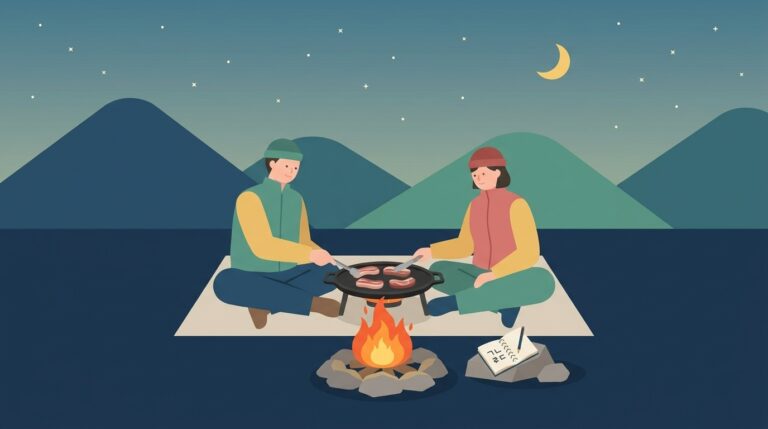
Picture this: the sun has just dipped behind the mist-shrouded peaks of Gangwon-do. The cool mountain air carries the mouthwatering scent of caramelized pork belly sizzling against a seasoned cast-iron griddle (그리들). You are gathered around the fire pit with Korean friends or colleagues. Someone passes you a metal cup of ice-cold barley tea or soju, and as the firewood crackles, a sudden, peaceful stillness settles over the entire circle. No one is talking. Everyone is simply watching the glowing embers with a soft, distant gaze.
At this moment, an anxious voice in your head whispers: “Wait, did the conversation die? Should I say something? Are they bored?” If you’ve ever studied Korean through formal textbooks, you might feel compelled to break the silence with an overly polite, textbook question like, “모닥불이 참 따뜻하지요?” (Is the campfire very warm?). But doing so instantly shatters the collective reverie. In Korean camping culture, this sacred silence is not an awkward lull; it is the ultimate destination: 불멍 (bulmeong)—the meditative art of spacing out while gazing into a campfire.
Over the past ten years coaching advanced Korean learners, I have found that outdoor gatherings are where classroom Korean falls flat. Camping is Korea’s favorite modern escape from the hyper-paced “Ppalli-Ppalli” (빨리빨리, hurry-hurry) lifestyle. To blend in seamlessly at a Korean campsite, you do not just need survival vocabulary; you need the exact idioms, culinary shorthand, and unspoken social rhythms that native speakers use when they disconnect from the city and connect around the flame. Let’s turn you into the smoothest camping companion at the campsite.
Phase 2: Core Expressions Deep Dive
Here are three advanced, quintessential expressions you will hear and use at every Korean campsite.
1. 불멍 때리다 (Bulmeong ttaerida)
- Pronunciation: [bul-meong ttae-ri-da] (Analog sound: Imagine saying “bull” without curling the tongue too sharply, “meong” rhyming with “song”, and “ttae-ri-da” as “teh-ree-dah” with a snappy, tense ‘t’)
- Meaning: Literally “to hit a fire daydream” | Actual Nuance: To zone out peacefully while gazing into a campfire; intentional mental idling.
- K-Culture Moment: In healing reality shows like Camping Club (캠핑클럽) or Three Meals a Day (삼시세끼), you will always see cast members collapsing into folding chairs after an elaborate dinner, staring silently at the hearth, murmuring: “아, 이제 불멍 때리자.” (Ah, time for some fire-zoning).
- Editor’s Insight: The word combines 불 (fire) and 멍 (from 멍때리다, to zone out / stare blankly). Adding the verb 때리다 (literally ‘to hit’) is colloquial Korean used to emphasize indulging in an activity decisively (e.g., 커피 한잔 때리다 = to knock back a coffee).
- Situation Spectrum: Casual: ✅ | Semi-formal: ⚠️ (acceptable among warm colleagues on a retreat) | Formal: 🚫 (Use ‘모닥불을 보며 휴식을 취하다’ in formal speeches)
- 🤔 Think About It: In many Western individualistic contexts, zoning out around others might be read as disinterest or lethargy. Why has contemporary Korean society elevated communal blankness into a celebrated wellness ritual?
2. 그리들에 구워 먹다 (Geurideure guwo meokda)
- Pronunciation: [geu-ri-deu-re gu-wo meok-da] (Analog sound: “Goo-ree-deul-eh goo-waw meok-dah”)
- Meaning: Literally “To grill and eat on a griddle” | Actual Nuance: The definitive ritual of Korean outdoor cooking, frying thick-cut meats so that the lard pools in the center to fry kimchi, potatoes, and eventually fried rice.
- K-Culture Moment: On YouTube camping vlogs (such as Rirang OnAir), the climax is never just roasting meat on a wire grill; it is laying thick samgyeopsal on a round cast-iron concave plate called a griddle and frying aged kimchi in the rendered fat.
- Editor’s Insight: Korean campers rarely use standard wire racks because dripping pork fat flares up and burns the meat. The concave griddle collects the fat, turning the meal into an orchestrated multi-course spectacle concluding with the mandatory bokkeumbap (fried rice).
- Situation Spectrum: Casual: ✅ | Semi-formal: ✅ | Formal: ✅ (Standard culinary terminology)
- 🤔 Think About It: Notice how the Korean verb structure pairs cooking (구워) with eating (먹다). How does combining process and consumption into one phrase reflect Korean food culture’s communal immediacy?
3. 운치 있다 (Unchi itda)
- Pronunciation: [un-chi it-da] (Analog sound: “Oon-chee eet-dah”)
- Meaning: Literally “To possess poetic mood/grace” | Actual Nuance: Having an atmospheric, elegant, and evocative ambiance—especially regarding nature, weather, or rustic outdoor settings.
- K-Culture Moment: When rain suddenly starts pattering against the camping tarp (a phenomenon called u-jung camping / 우중캠핑), characters in K-dramas look up with sentimental smiles and say: “비 오니까 진짜 운치 있다.” (It feels so atmospheric with the rain falling).
- Editor’s Insight: While beginners often overwork adjectives like 좋다 (good) or 예쁘다 (pretty), C1 speakers pull out 운치 있다 to praise subtle natural aesthetic value, like twilight over a river or embers glowing in a misty forest.
- Situation Spectrum: Casual: ✅ | Semi-formal: ✅ | Formal: ✅ (Sophisticated, poetic Sino-Korean word)
- 🤔 Think About It: English uses words like “picturesque” or “atmospheric,” but 운치 (韻致) contains roots related to lyrical rhyme and elegance. How does framing nature through “poetic rhythm” shape our outdoor appreciation?
Phase 3: Textbook Korean vs Real Korean
Level C1 mastery is all about understanding the stylistic gap between grammatically pristine school phrases and the evocative idioms natives drop around the campfire.
Situation 1: Suggesting that everyone stop working and unwind by the fire
- 📖 교과서 한국어 (Textbook Korean):
모닥불이 피워졌으니 우리 모두 조용히 휴식을 취합시다.
(Since the bonfire is lit, let us all rest quietly.) - 🗣️ 진짜 한국어 (Real Native Korean):
자, 세팅 끝났으니까 이제 제대로 불멍 한번 때려볼까요?
(Alright, everything’s set up, shall we properly zone out to the fire?) - 💡 Why the difference?
Native campers mark the transition from setup labor (텐트 피칭, 장작 패기) to leisure with colloquial energy. Phrases like 제대로 ~ 때리다 (do something properly/intensely) establish an inviting, relaxed camaraderie that stiff textbook honorifics inadvertently freeze.
Situation 2: Praising the extraordinary taste of food cooked outside
- 📖 교과서 한국어 (Textbook Korean):
야외에서 식사를 하니 실내에서 먹는 것보다 훨씬 맛있습니다.
(Eating outdoors is much more delicious than eating indoors.) - 🗣️ 진짜 한국어 (Real Native Korean):
확실히 밖에서 숯불에 구우니까 맛이 차원이 다르네요. 분위기가 다 했다!
(Grilling it over charcoal outside really puts it on a whole different level. The atmosphere did all the work!) - 💡 Why the difference?
Native speakers use expressive idioms like 차원이 다르다 (on another dimension) and 분위기가 다 했다 (the atmosphere did everything/carried the experience). It reflects the Korean aesthetic value where environment and flavor are inseparable.
Phase 4: K-Culture Deep Dive & Non-Verbal Manners
4-1. 눈치 (Nunchi) & Camping Manners
- The Sacred Custody of the Tongs (집게의 권한): In Korean outdoor cooking, whoever holds the tongs (jipge) and scissors (gawi) is the captain of the griddle. Never reach across and flip meat with your own chopsticks without asking. Flipping pork belly repeatedly ruins the crust. If you want to help, display proactive nunchi by cutting mushrooms, placing cooked pieces onto others’ plates, or refilling side sauces.
- The Decorum of 불멍 (Bulmeong): When someone steps up to poke the logs with fire tongs or add kindling, allow them to manage it. Do not blast music or make loud phone calls during campfire time. If someone is staring blankly at the flames, do not tap their shoulder to ask mundane work questions. Shared silence is a form of deep emotional bonding in Korea.
4-2. Cultural Code Analysis: The “Healing” Antidote
South Korea ranks among the OECD nations with the longest working hours and highest urban density. Why has gamseong camping (감성 캠핑, aesthetic camping) and chabak (차박, car camping) exploded across the peninsula over the last five years?
It serves as a counterweight to the panoptic social gaze of Seoul. In the city, your social radar (nunchi) is perpetually active—navigating crowded subways, corporate hierarchies, and digital connectivity. Camping provides an artificial vacuum. Staring at an unpredictable, primal flame activates what psychologists call “soft fascination,” letting the prefrontal cortex rest. For Koreans, camping is not about conquering untamed wilderness; it is about curating a cozy, portable miniature home where social expectations can safely melt away.
Phase 5: Real-World Roleplay Scenario
Setting: A secluded riverside campground in Yeongwol, Gangwon-do. Night has settled. The river is murmuring softly. Minho, a seasoned camper who brought high-end titanium gear, is scraping the griddle with a spatula.
- 민호: 알렉스 씨, 고기 거의 다 먹어 가는데 슬슬 판 갈까요, 아니면 밥 볶을까요?
(Alex, we’re almost through with the meat. Should we clear the pan, or shall we fry some rice?)
🎭 min-ho points his spatula toward the remaining golden pork fat and grilled kimchi. - 알렉스: 와, 남은 기름에 볶음밥 비비는 건 완전 국룰 아니에요? 무조건 가야죠!
(Woah, isn’t frying rice in the remaining fat practically an unwritten law? We absolutely have to!)
🎭 alex eagerly hands Minho a pouch of instant cooked rice and chopped seaweed. - 민호: 역시 알렉스 씨, 배운 사람이네! 김가루랑 참기름 딱 둘러서 겉바속촉으로 눌어붙게 만들어 볼게요.
(As expected, Alex, you’re a person of culture! I’ll drizzle seaweed flakes and sesame oil and scorch it so it’s crispy outside and tender inside.)
🎭 min-ho skillfully chops kimchi on the hot iron surface with kitchen shears. - 알렉스: 냄새 장난 아니네요. 야외에서 먹으니까 진짜 분위기가 다 한 것 같아요.
(The aroma is no joke. Eating out here in the open, the atmosphere really did all the work.)
🎭 alex inhales the savory steam, pouring warm roasted corn tea into two camp cups. - 민호: 맞아요. 서울에선 늘 쫓기듯 살다가 이렇게 나오면 숨통이 좀 트여요. 알렉스 씨도 잔 들어요.
(Totally. In Seoul, I always live like I’m being chased, but coming out here lets me breathe a bit. Grab your cup, Alex.)
🎭 min-ho clinks his enamel cup against Alex's cup with a contented grin. - 알렉스: 건배해요! 고생 많으셨어요, 민호 씨.
(Cheers! You worked so hard cooking, Minho.)
🎭 both take a sip and enjoy the crunchy fried rice. - 민호: 이제 배도 부르고, 장작도 바짝 말랐겠다… 제대로 불멍이나 때려 볼까요?
(Now that our bellies are full and the firewood is bone-dry… shall we properly zone out to the fire?)
🎭 min-ho dims the LED lanterns, letting the campfire dominate the darkness. - 알렉스: 너무 좋아요. 타닥타닥 장작 타는 소리가 정말 운치 있네요. 아무 생각 없이 푹 쉬어요 우리.
(I’d love that. The crackling sound of firewood is so poetic. Let’s rest deeply without a single thought.)
🎭 alex leans back deep into the low folding chair, gazing into the amber flames.
🔀 Interactive Branching Moment
Right after Minho suggests starting the campfire session, how should you respond to prove your C1 cultural sensitivity?
- Option A: “장작 타는 냄새가 옷에 밸 것 같은데, 텐트 안에 들어가서 넷플릭스 볼까요?” (The woodsmoke might soak into our clothes; should we go inside the tent and watch Netflix?)
- Option B: “좋아요! 제가 랜턴 불빛 좀 낮추고 따뜻한 차 한 잔씩 더 따라드릴게요.” (Awesome! Let me dim the lanterns and pour us another warm cup of tea.)
- Option C: “민호 씨, 그런데 다음 주 프로젝트 기획안 검토는 언제쯤 가능하신가요?” (By the way Minho, around when will you be able to review next week’s project proposal?)
Feedback & Analysis:
* Option A (Risk): While pragmatic, suggesting moving inside right when a Korean camp host prepares the campfire dampens their hospitality and misses the core ritual of outdoor camaraderie.
* Option B (Best): Flawless! You understand that bulmeong requires dim ambient lighting, and proactively offering tea shows exquisite campsite manners (센스).
* Option C (Bad): Bringing up workplace deliverables during sacred bulmeong is an unforgivable cultural violation. Campfires exist precisely to forget the office!
Phase 6: 10-Second Emotion Shadowing Drill
Practice reading these lines aloud with the emotional inflection and rhythmic pacing indicated by the slashes (/).
- [🤤 군침을 삼키며 감탄하듯 – Salivating with genuine admiration]
남은 돼지기름에 / 김치랑 밥 비비는 건… / 이건 진짜 반칙이죠!
(Nameun dwaejigireume / gimchirang bap bibineun geon… / igeon jinjja banchigijyo!)
“Frying kimchi and rice in leftover pork fat… this is seriously cheating!” -
[🔥 감성에 젖어 나지막하게 – Soft-spoken, immersed in deep evening sentiment]
장작 타는 소리 들으면서 / 가만히 앉아 있으니까… / 머릿속이 싹 비워지네요.
(Jangjak taneun sori deureumyeonseo / gamanhi anja isseunikka… / meoritsogi ssak biwojineyo.)
“Listening to the logs crackle while sitting still… my head completely clears out.” -
[😌 지친 일상을 털어내며 후련하게 – Relieved, letting go of daily exhaustion]
주중에 받았던 스트레스가 / 이 불꽃 속으로 / 다 타서 사라지는 기분이에요.
(Jujunge badatdeon seuteureseuga / i bulkot sogeuro / da taseo sarajineun gibunieyo.)
“I feel like all the stress I accumulated during the weekdays is burning away into these flames.”
Phase 7: K-Culture Mini Dictionary
- 불멍 (Bulmeong) | Noun
- The contemplative trance induced by watching campfire flames. Extended into modern urban slangs like 물멍 (mulmeong: staring at aquariums or rivers), 숲멍 (supmeong: staring blankly at forests), and 별멍 (byeolmeong: stargazing).
- 차박 (Chabak) | Noun
- Portmanteau of 차 (car) and 숙박 (lodging). Converting SUVs into mobile bedrooms. Popularized as an accessible alternative to pitching heavy canvas tents, heavily featured in Korean lifestyle programming.
- 그리들 (Geurideul) | Noun
- A heavy iron disc platter with a shallow dip in the middle. The quintessential cooking apparatus of modern Korean camping, engineered to prevent flare-ups and orchestrate multi-stage pork and fried-rice banquets.
- 겉바속촉 (Geot-ba-sok-chok) | Adjective phrase
- Abbreviation of 겉은 바삭하고 속은 촉촉한 (crispy on the outside, moist and juicy on the inside). The holy grail metric for grilled meats, toasted marshmallows, and campfire-baked sweet potatoes (gun-goguma).
Phase 8: Traveler’s Survival Kit
Top 3 Survival Phrases for Campsite Guests
-
혹시 장작 한 묶음만 더 살 수 있을까요?
(Hoksi jangjak han mukkeumman deo sal su isseulkkayo?)
“Could I possibly buy just one more bundle of firewood?”
Pro Tip: Campsite convenience stores (maejum) usually close early around 9:00 PM. Secure your extra firewood bundles before sunset. -
종량제 봉투랑 분리수거장은 어디에 있어요?
(Jongnyangje bongturang bunrisugeojangeun eodie isseoyo?)
“Where are the designated trash bags and the recycling station?”
Pro Tip: Korean campsites take waste separation very seriously. Ashes (jae) must be disposed of in designated iron drums, never in standard trash bins. -
날씨가 쌀쌀한데, 난로 등유 좀 보충할게요.
(Nalssiga ssalssalhande, nanro deung-yu jom bochunghalkkeyo.)
“It’s chilly, so I’m going to refill kerosene for the heater.”
Editor’s Travel Note: Campsite Logistics in Korea
Booking public campsites in Korea often feels like trying to secure front-row seats to a BTS concert. Most scenic spots in national parks (like Jirisan or Seoraksan) open reservations on specific weekdays at 10:00 AM via official government booking platforms. For private glamping and auto-campsites, browse spots using the Naver Map navigation app by searching 오토캠핑장 (auto campsite) or 글램핑 (glamping). You can also reserve domestic sites easily through the CampLink reservation service. When packing, always carry a small 5,000 KRW cash bill for firewood deposits or communal shower meters in rural campgrounds.
Phase 9: “A Step Deeper” (Sociolinguistic Essay)
In modern linguistics, silence is often analyzed as a void that conversation participants struggle to fill. Yet in Korean interpersonal dynamics, silence can represent the peak of shared intimacy. In everyday city life, Koreans operate under relentless nunchi—reading unspoken hierarchies between juniors (hubae) and seniors (seonbae), monitors at the desk, and expectations on KakaoTalk.
Sitting shoulder-to-shoulder around a campfire reverses this communicative burden. Bulmeong creates a socially sanctioned state of “parallel presence.” You do not have to perform, entertain, or conform to speech levels. The fire acts as a shared conversational buffer: you look at the embers together rather than looking directly at each other’s eyes. It is communion without performance. Understanding bulmeong means recognizing that in Korean relationships, being comfortable enough with someone to share twenty minutes of unbroken silence is a far deeper sign of closeness than any polite compliment.
💬 Your Turn: Have you ever experienced a “comfortable silence” with close friends or partners in your home culture? What kind of setting unlocks that feeling for you? Share your stories in the comments below!
Phase 10: FAQ & Common Misconceptions
Q: Can I use the phrase “불멍 때리다” in front of my Korean boss or university professor?
A: Only if they have personally invited you on an informal outdoor trip and explicitly created a casual mood by initiating casual banter. While “불멍” is widely recognized across Korean television news and lifestyle media, the attached verb “때리다” remains informal slang. If speaking formally to an elder or superior, soften it to: “모닥불 보면서 힐링하고 있습니다” (I am healing while watching the campfire).
Q: Is it true that cooking fried rice on the griddle at the end is mandatory?
A: Culturally speaking, yes! In Korean culinary culture, finishing any pan-fried meat or stew meal with rice mixed into the residual sauce and fat is affectionately called K-디저트 (the Korean dessert) or 국룰 (ungoverned national rule). Skipping the bokkeumbap on a campsite griddle leaves native companions feeling like a symphony ended without the final chord.
Q: What should I do if a Korean camper at the next site brings us food?
A: This is the time-honored tradition of jeong (정, warm relational affection) known as eumsik nanum (음식 나눔, sharing food). Never return an empty plate! If your neighbors send over five grilled prawns or a bowl of kimchi stew, wait until you make your fried rice or toast sweet potatoes, and send a portion back to their tent with a bright “맛있게 잘 먹었습니다!” (We enjoyed it so much!).
🚨 Common Mistakes Alert (흔한 실수)
- Mistake: Extinguishing charcoal/logs with a splash of water directly on the iron griddle.
Correct Action: Thermal shock will crack cast iron and ruin the seasoning. Move the griddle aside first, and let the coals burn out or extinguish them carefully using dedicated fire-tongs inside the pit. - Mistake: Constantly flipping the pork belly every 10 seconds.
Correct Action: Let the griddle achieve high heat. Cook one side until deep golden brown, flip once, cut with shears, then let the sides cook in the pooling oil. - Mistake: Treating bulmeong as a photo session where you take flash photos of people’s faces.
Correct Action: The magic of fire gazing relies on night-adapted eyes and low contrast. If you snap photos, turn off your flash and capture the silhouettes and flames naturally.
Phase 11: Action Missions & Engagement
Level up your practical competence from study desk to campsite gravel with this three-tiered challenge:
- 🥉 Bronze Mission (Solo Vocal Drill): Practice the phrase “자, 이제 제대로 불멍 한번 때려볼까요?” five times aloud until the liaison between 불멍 and 때려볼까요 rolls off your tongue smoothly without hesitation.
- 🥈 Silver Mission (Social Media Engagement): Next time you watch a K-drama camping scene or light a scented candle at home, snap a cozy photo and post it with the caption: “오늘 밤은 가볍게 캔들멍 때리는 중 🕯️” (Doing a little candle-gazing tonight).
- 🥇 Gold Mission (Real-life Execution): When you go to a Korean BBQ restaurant or camping site with native speakers or friends, take charge during the end of the meal and confidently say: “남은 기름에 볶음밥 비비는 건 국룰인 거 아시죠?”
🎮 K-Culture Media Mission: Watch Episode 1 of the tvN variety show House on Wheels (바퀴 달린 집). Identify the exact moment the cast members light their portable stove, settle into their chairs, and slip into silence. Note down three expressive adjectives they whisper into the night air!
Phase 12: Interactive Quiz Challenge
Test your grasp of Korean outdoor nuance! Pick your answers, then click the spoiler dropdown to see how you scored.
1. Situational Judgment: You are sitting around a campfire with Korean colleagues after a long day of outdoor hiking. The fire crackles, and everyone has gone quiet for nearly seven minutes. What is the most culturally adept move?
* (A) Turn on your portable Bluetooth speaker to play lively K-Pop hits.
* (B) Lean back quietly, occasionally sip your warm tea, and let the comfortable silence continue.
* (C) Loudly say, “왜 아무도 말씀이 없으세요? 제가 재미있는 이야기 해드릴까요?” (Why is nobody talking? Shall I tell a funny story?)
2. Fill in the Blank: After grilling pork belly, finishing the meal by mixing rice into the remaining pork lard on the griddle is universally known among campers as:
* 남은 기름에 밥 볶는 건 완전 [ ______ ]이지!
(Hint: An unwritten national standard rule)
3. True or False: The word 불멍 is a formal, classical Hanja term that has been written in historical Korean poetry for hundreds of years.
* (True / False)
👉 Click here to reveal the answers and explanations!
Answers:
1. (B) In Korean camping culture, shared silence during bulmeong is an intentional form of communal relaxation. Interrupting it with music or forced conversation breaks the therapeutic mood.
2. 국룰 (gung-nul) — Short for 국민 룰 (National Rule), representing universally agreed-upon food combinations or customs.
3. False — While it feels poetic, 불멍 is a 21st-century modern neologism born on internet forums, blending 불 (fire) with the slang 멍때리다 (to zone out). The classical, formal phrase for enjoying a scenic ambiance is 운치 (韻致)를 즐기다.







