

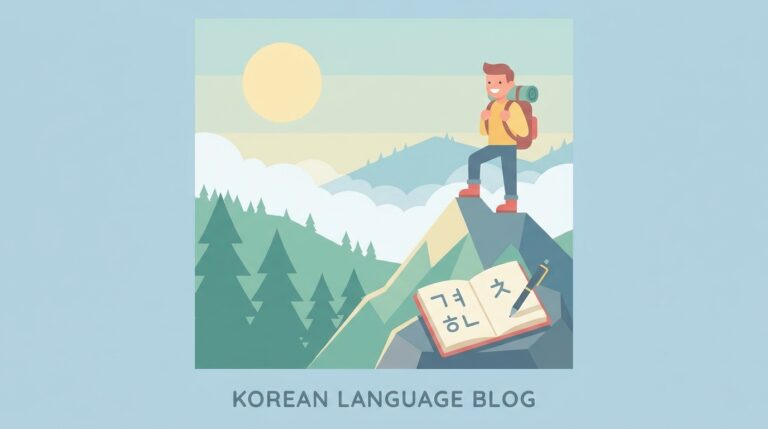
Phase 1: Empathy (Welcome to the Peak!)
안녕하세요! (Annyeonghaseyo!) I am your Daily Hangul editor.
Picture this: After sweating for two hours climbing the rocky stone steps of Mount Bukhansan or Inwangsan in Seoul, your legs are shaking like jelly. Beside you, energetic Korean grandfathers in bright neon hiking jackets breeze past you like mountain goats. Finally, you take the last step onto the summit granite rock. The entire Seoul skyline opens up below you—the Han River glittering in the afternoon sun.
Every K-drama and variety show you have ever watched flashes through your mind. Characters cup their hands around their mouths and shout into the mountain breeze: “Ya-ho!” You inhale deeply, get ready to unleash your inner movie star, and then freeze. Wait—do Koreans actually shout that in real life? Will people laugh at you? What are you actually supposed to say when you reach the top of a Korean mountain?
If you have ever felt nervous about making a cultural blunder on the hiking trail, do not worry at all. Korean hiking culture is one of the friendliest, most vibrant subcultures in the country. This beginner-friendly guide is built on real experiences from our foreign learners so you can sound natural, respect local trail etiquette, and celebrate your summit victory with total confidence!
Phase 2: Core 3 Expressions In-Depth
Here are the three golden phrases you need when you reach the top of any mountain in Korea.
1. 야호! (Yaho!)
- Pronunciation: [Ya-ho!] (Sounds just like saying “Yahoo!” in English, but cut off the final sound crisply: Ya like “yarn”, Ho like “home”).
- Meaning: “Woohoo!” or “Yaho!” (A traditional mountain summit cheer expressing pure joy).
- K-Culture Moment: You will see this in classic K-dramas, animated shows, and retro variety clips whenever characters conquer a mountain peak or need to release heavy emotional stress.
- Editor’s Insight: While shouting Yaho! is iconic, modern hikers use it more playfully or quietly today because loud echoes can startle wildlife. Whisper-shouting or saying it cheerfully with friends is the coolest way to do it!
- Situation Spectrum: Casual ✅ | Semi-formal ⚠️ | Formal 🚫
- 🤔 Think About It: Does your native language have a specific word reserved exclusively for outdoor peaks, or do you use general celebration words?
2. 경치 좋다! (Gyeongchi jota!)
- Pronunciation: [Gyeong-chi jo-ta!] (Gyeong rhymes with “young”, chi sounds like “cheese”, and jota sounds like “Joe” + “tah”).
- Meaning: Literal: “The scenery is good!” / Real nuance: “What a breathtaking view!”
- K-Culture Moment: The moment Koreans step onto the observation deck, wipe their brow with a towel, sip cold water, and gaze at the horizon, this phrase leaves their lips automatically.
- Editor’s Insight: This is an exclamation (반말 / Banmal style used to express self-talk or admiration). You can say it out loud to yourself or directly to hiking buddies without sounding rude.
- Situation Spectrum: Casual ✅ | Semi-formal ⚠️ | Formal 🚫
- 🤔 Think About It: In English, we often say “Look at that!” but Korean focuses on the emotional evaluation: “The view is truly good!”
3. 수고하셨습니다! (Sugohasyeotseumnida!)
- Pronunciation: [Soo-go-ha-syeot-seum-ni-da] (Soo like “soup”, go like “gold”, ha like “ha-ha”, syeot like “shot”, seum-ni-da).
- Meaning: “Thank you for your hard work!” or “Great effort today!”
- K-Culture Moment: Hikers exchange this warm phrase when passing each other on narrow ridge paths or when packing up gear at the summit stone.
- Editor’s Insight: Koreans deeply value acknowledging shared physical toil. Saying this instantly connects you with locals because you both conquered the same steep slope.
- Situation Spectrum: Casual ⚠️ | Semi-formal ✅ | Formal ✅
- 🤔 Think About It: Why does Korean have a dedicated honorific phrase solely meant to validate another person’s physical or mental effort?
Phase 3: Textbook Korean vs. Real Korean
Let’s swap robotic classroom phrases for what Koreans actually say on the trail.
Situation 1: Greeting another hiker passing you on the ridge
- 📖 Textbook Korean: 안녕하십니까, 반갑습니다. (Annyeonghasimnikka, bangapsubnida. – “How do you do, nice to meet you.”)
- 🗣️ Real Korean: 안녕하세요~ 힘내세요! (Annyeonghaseyo~ Himnaeseyo! – “Hello~ Hang in there!”)
- 💡 Why the difference? On a steep mountain, nobody has breath for formal introductions! A melodic “Hello” followed by a punchy cheer (힘내세요!) gives fellow climbers energy.
Situation 2: Finally reaching the summit
- 📖 Textbook Korean: 우리는 산 정상에 도착하였습니다. (Urineun san jeongsange dochakhayeotseumnida. – “We have arrived at the mountain summit.”)
- 🗣️ Real Korean: 와, 드디어 도착! (Wa, deudieo dochak! – “Wow, finally arrived!”)
- 💡 Why the difference? Casual exclamations highlight genuine relief and joy rather than stiff factual reports.
Phase 4: K-Culture Deep Dive & Non-Verbal Manners
4-1. Nunchi (눈치) & Summit Gestures
- The Photo Line Etiquette: At almost every Korean peak, there is a stone marker called a 정상석 (Jeongsangseok) showing the mountain’s name and elevation. Never rush or cut in! Form a neat single-file queue. When it is your turn, take two or three photos swiftly so the next person can shoot.
- The “Yaho” Volume Check: Before shouting 야호!, glance around using your Nunchi (social radar). If groups are quietly meditating, resting, or having lunch, keep your cheer playful and moderate rather than a window-shattering roar.
- Offering a Photo: If you see someone struggling to take a solo selfie, offering to take their photo with both hands holding their phone is an instant friendship builder.
4-2. Mountain Code: The Post-Hike Ritual
In Korea, hiking is only half the journey. The real climax happens at the base of the mountain (하산길), where rows of traditional restaurants serve sizzling seafood scallion pancakes (해물파전 – Haemulpajeon) and chilled rice wine (막걸리 – Makgeolli). Even if you climb alone, stopping for a quick snack at the bottom completes the authentic Korean hiking lifestyle.
Phase 5: Real Role-play Scenario
Setting: You just reached the summit ridge of Mount Inwangsan on a clear Saturday morning. An energetic Korean hiking veteran, Uncle Min-soo (50s, wearing colorful neon gear and trekking poles), turns to you with a warm smile.
- Uncle Min-soo: 오, 외국인 친구네요! 힘들었죠? (O, oegukin chinguneyo! Himdeureotjyo?)
- 🎭 Action: Wiping sweat with a neck towel and offering a friendly nod.
- “Oh, a foreign friend! Was it tough?”
- You: 네, 조금 힘들었지만 괜찮아요! (Ne, jogeum himdeureotjiman gwaenchannayo!)
- 🎭 Action: Catching your breath with two hands on your knees, smiling back.
- “Yes, a little tough, but I’m okay!”
- Uncle Min-soo: 대단해요! 여기 뷰가 참 좋죠? (Daedanhaeyo! Yeogi byuga cham jotjyo?)
- 🎭 Action: Pointing his trekking pole across the city skyline below.
- “Impressive! The view here is really nice, right?”
- You: 와, 경치 진짜 좋다! (Wa, gyeongchi jinjja jota!)
- 🎭 Action: Taking off your cap and admiring the sprawling mountain ridges.
- “Wow, the scenery is really amazing!”
- Uncle Min-soo: 정상 왔으니까 우리 같이 외쳐볼까요? 하나, 둘, 셋! (Jeongsang wasseunikka uri gachi oechyeobolkkayo? Hana, dul, set!)
- 🎭 Action: Cupping both hands around his mouth excitedly.
- “Since we reached the summit, shall we shout together? One, two, three!”
- You: 야호! (Yaho!)
- 🎭 Action: Raising both arms high in a triumphant V-shape cheer.
- “Yaho!”
- Uncle Min-soo: 하하하! 속이 다 시원하네! 오늘 수고했어요! (Hahaha! Sogi da siwonhane! Oneul sugohaesseoyo!)
- 🎭 Action: Chuckling warmly and giving a gentle thumbs up.
- “Hahaha! That clears out all the stress! Great effort today!”
- You: 감사합니다! 아저씨도 수고하셨습니다! (Gamsahamnida! Ajeossido sugohasyeotseumnida!)
- 🎭 Action: Bowing respectfully with both hands clasped neatly in front.
- “Thank you! You worked hard as well, mister!”
🔀 Interactive Choice Point
Uncle Min-soo steps aside near the summit stone and says: “사진 찍어 줄까요?” (Sajin jjigeo julkkayo? – Shall I take your photo?) How do you respond?
- Option A: 네! 한 장만 부탁드립니다! 감사합니다! (Ne! Han jangman butakdeurimnida! Gamsahamnida! – “Yes! Just one photo please! Thank you!”)
- Feedback (Best Choice): Perfect! Polite, enthusiastic, and shows clear gratitude.
- Option B: 아니요, 혼자 찍을게요. 저리 가세요. (Aniyo, honja jjigeulgeyo. Jeori gaseyo. – “No, I will shoot alone. Go away over there.”)
- Feedback (Bad Choice): Ouch! Telling someone 저리 가세요 sounds hostile and offensive to a kind stranger.
- Option C: 야! 사진 찍어! (Ya! Sajin jjigeo! – “Hey! Take a picture!”)
- Feedback (Risky Choice): Severe blunder! Ya is rude slang to someone older than you. Never say this to an elder.
Phase 6: 10-Second Emotion Shadowing Drill
Practice these natural rhythm pauses marked by /. Match the emotion in the brackets!
[😊 Proud & Breathless]- 와, / 드디어 / 정상 도착! (Wa, / deudieo / jeongsang dochak!)
- “Wow, / finally / summit arrival!”
[🤩 Awed & Delighted]- 서울 경치 / 진짜 / 좋다! (Seoul gyeongchi / jinjja / jota!)
- “Seoul scenery / really / is good!”
[📣 Cheerful & Energized]- 하나, 둘, 셋, / 야호~! (Hana, dul, set, / Ya-ho~!)
- “One, two, three, / Yaho~!”
[🙏 Warm & Respectful]- 오늘 / 등산 / 수고하셨습니다! (Oneul / deungsan / sugohasyeotseumnida!)
- “Today’s / hike / you worked so hard!”
Phase 7: K-Culture Mini Dictionary
- 야호 (Yaho)
- Translation: Traditional mountain summit shout (Yahoo / Hooray).
- Usage: Used exclusively at high elevations or scenic vantage points to celebrate climbing to the top.
- 정상석 (Jeongsangseok)
- Translation: Summit stone marker.
- Usage: A carved stone marking the peak name and height in meters. The definitive photo spot for hikers.
- 등산화 (Deungsanhwa)
- Translation: Hiking boots / trail shoes.
- Usage: Essential gear in Korea. Granite rocks make trails slippery, so Koreans always emphasize wearing proper 등산화.
- 하산 (Hasan)
- Translation: Descending a mountain.
- Usage: Going down requires caution. Hikers say: “안전하게 하산하세요” (Safe descent!) to people starting their downward trek.
Phase 8: Traveler’s Survival Kit
Top 3 Survival Phrases
- 물 있어요? (Mul isseoyo?)
- Pronunciation: [Mool ee-sseo-yo?]
- Pro Tip: Use this at small mountain shelter kiosks or when you urgently need to ask a fellow hiker for extra water.
- 얼마나 남았어요? (Eolmana namasseoyo?)
- Pronunciation: [Eol-ma-na na-ma-sseo-yo?]
- Pro Tip: Meaning “How much further is left?” When you ask older hikers, they almost always reply with a comforting lie: “Just 10 minutes!” (10분 남았어요!).
- 사진 찍어 드릴까요? (Sajin jjigeo deurilkkayo?)
- Pronunciation: [Sa-jin jji-geo deu-ril-kka-yo?]
- Pro Tip: “Shall I take a photo for you?” The ultimate icebreaker when waiting in line at the summit stone.
Editor’s Travel Note
- Trail Navigation: Google Maps does not provide detailed trail paths in Korea. Be sure to check the Naver Map app download guide or KakaoMap before heading out to track elevation and trail forks.
- Public Transit Access: Most peaks in Seoul (Bukhansan, Gwanaksan, Achasan) connect straight to subway exits! Keep your T-money transit card loaded.
Phase 9: A Step Deeper (Reflection)
In South Korea, hiking is rarely a solitary, isolating endeavor. Despite the bustling pace of daily city life where strangers rarely make eye contact on crowded subway cars, the hiking trail operates under completely different social rules. On the mountain path, titles, corporate ranks, and age barriers soften. Total strangers will readily offer you a freshly washed chilled cucumber (오이), a slice of sweet apple, or a handful of cherry tomatoes just because you share the same climb.
Shouting 야호! or exchanging 수고하셨습니다! is a verbal handshake—a collective reminder that everyone on that trail tackled the same steep slope together.
💬 Your Turn: In your home country, do strangers greet each other while hiking, or do people prefer quiet privacy? Share your thoughts with us in the comments!
Phase 10: FAQ & Common Mistakes
Q: Can I shout “Yaho!” as loudly as I want anywhere on the mountain?
A: It is best to look around first. Shouting Yaho is a beloved cultural trope, but Korea’s National Park Service encourages moderate noise levels to avoid disturbing wild birds and other hikers who are resting quietly.
Q: Is it rude if I don’t greet every single hiker I pass?
A: Not at all! On crowded weekend trails, saying hello every three seconds would exhaust your lungs. A soft nod, a small smile, or greeting hikers on quieter, narrower stretches is plenty.
Q: What should I reply if someone says “수고하셨습니다” to me?
A: Simply say “감사합니다! 수고하셨습니다!” (Gamsahamnida! Sugohasyeotseumnida!) with a friendly nod. You are returning both the thanks and the shared recognition of hard work.
🚨 Common Mistakes Warning Board
- Mistake: Screaming 야호! right next to someone taking a video or meditating.
- Correct Action: Step slightly away to an open scenic overlook and check your surroundings before cheering.
- Mistake: Standing in front of the peak stone (정상석) for 10 minutes checking your phone.
- Correct Action: Take your summit pictures promptly and step aside so waiting hikers can snap theirs.
- Mistake: Calling older hikers 너 (Neo – You) or 야 (Ya – Hey).
- Correct Action: Always use polite forms like 선생님 (Seonsaengnim), 등산객님 (Deungsangaengnim), or simply add -yo to your greetings.
Phase 11: Action Mission & Engagement
Put your learning to work with this 3-tier mission challenge!
- 🥉 Bronze Mission (Solo Practice): Stand up straight in your room, look out the window, and practice shouting a crisp “하나, 둘, 셋, 야호!” three times with authentic excitement.
- 🥈 Silver Mission (Social Share): Write down 경치 좋다! (Gyeongchi jota!) on a sticky note, take a scenic snapshot from your balcony or local park, and post it with the caption: #DailyHangul #HikingKorean.
- 🥇 Gold Mission (Real Summit Action): On your next visit to a Korean peak or park overlook, greet a passerby with “안녕하세요, 힘내세요!” and offer to take a picture at the summit!
🎮 K-Culture Bonus Quest: Watch an episode of a Korean travel or variety show (like 2 Days & 1 Night or I Live Alone). Spot the exact moment someone climbs an overlook and listen for whether they say 야호! or 경치 좋다!
Phase 12: Interactive Quiz Challenge
Test your mountain smarts with these three quick questions!
Question 1: Situational Judgment
You finally conquer Mount Inwangsan and see an elderly couple resting near the peak. You want to praise the incredible scenery in natural Korean. What should you say?
* A) 물 주세요! (Mul juseyo!)
* B) 경치 좋다! (Gyeongchi jota!)
* C) 저리 가세요! (Jeori gaseyo!)
Question 2: Fill-in-the-Blank
Complete the iconic summit exclamation:
하나, 둘, 셋, [ _______ ]!
Question 3: True or False Cultural Etiquette
True or False: At popular Korean mountain peaks, it is considered polite to monopolize the summit stone (정상석) for as long as you want because you worked hard to climb there.
Click here to reveal the answers and explanations!
Answers & Explanations:
1. Answer: B) 경치 좋다! (Gyeongchi jota!)
* Explanation: 경치 좋다! means “The scenery is great!” Option A means “Give me water,” and Option C means “Go away.”
2. Answer: 야호 (Yaho)
* Explanation: 하나, 둘, 셋, 야호! (“One, two, three, Yaho!”) is the classic countdown cheer shouted at the peak.
3. Answer: False
* Explanation: Always be mindful of others waiting in line behind you. Take your commemorative photos quickly and make room for fellow climbers!







