

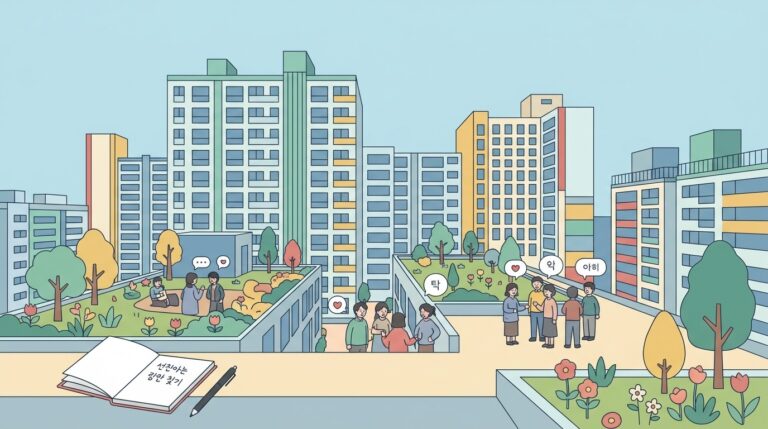
Beyond the Apartment Caste: Discussing Public Housing Equity in South Korea
Phase 1: 공감 (Story-Immersive Opening)
안녕하세요! 매일한글 에디터입니다.
Imagine walking through a brand-new residential complex in Mapo-gu with your Korean colleagues. You admire the landscaped gardens, the sleek glass facades, and the futuristic architecture. Suddenly, your colleague gestures toward a barricaded pathway separating the taller high-rise buildings from a smaller, isolated structure near the back gate. In a quiet, hushed whisper, they murmur, “저기는 임대동이라서 이쪽 커뮤니티 센터를 같이 못 쓰게 막아뒀더라고요 (That section is the public rental block, so they blocked them from using this community center).” A heavy silence falls over the group.
If you have lived in Korea long enough or achieved advanced Korean proficiency, you know that real estate is not merely an investment topic—it is Korea’s ultimate social barometer. Terms like “소셜믹스 (Social Mix)” were intended to integrate diverse socioeconomic backgrounds within the same apartment complex. Yet in reality, subtle and overt forms of discrimination persist, from children coining derogatory schoolyard slang for public housing residents to condo boards constructing physical fences between owned and rental units. At a C2 level, you are no longer just ordering food or navigating transit; you need to participate in profound, sensitive societal discourses with nuance, empathy, and sociolinguistic precision. Today, we delve into how to articulate housing justice, dismantle biases, and hold intellectually rigorous conversations about public rental housing in contemporary Korea.
Phase 2: 핵심 표현 3선 심층 분석 (Deep Dive into 3 Core Expressions)
1. 소셜믹스를 정착시키다 (Social mikseu-reul jeongchaksikida)
- Pronunciation: [So-syeol-mik-seu-reul jeong-chak-si-ki-da] (Think of social pronounced with a crisp Korean vowel so-syeol, followed by mix-eul, and jeongchak sounding like the ‘jung’ in ‘jungle’ with a sharp ‘chak’).
- Meaning: Literally “to settle/establish social mix”; practically, “to successfully implement socioeconomic integration within urban housing.”
- K-Culture Moment: Frequently heard in civic town halls, urban planning documentaries, and investigative reports on KBS or JTBC discussing apartment zoning disputes.
- Editor’s Insight: While “소셜믹스” is a loanword, combining it with “정착시키다” (to take root / establish firmly) elevates your speech into high-level policy analysis. It moves the discourse from a superficial ideal to institutional reality.
- Situation Spectrum: Casual ⚠️ | Semi-formal ✅ | Formal ✅
- 🤔 Think About It: In your home country, is socioeconomic housing integration pursued through policy, and does language reflect physical or social boundaries between renters and homeowners?
2. 주거권을 기본권으로 바라보다 (Jugeogwon-eul gibongwon-euro baraboda)
- Pronunciation: [Ju-geo-gwon-eul gi-bon-gwon-eu-ro ba-ra-bo-da] (Pronounce jugeo like ‘zoo-guh’, gwon with an open ‘gw-on’ vowel, and gibongwon akin to ‘gi-bon-gwon’).
- Meaning: Literally “to view the right to housing as a fundamental human right.”
- K-Culture Moment: Often articulated in civic forums, editorial columns in major dailies (Hankyoreh, Kyunghyang Shinmun), and high-tension legal/political K-dramas dealing with redevelopment scandals.
- Editor’s Insight: Framing shelter not as a speculative asset (자산/투자 대상) but as an inalienable fundamental right (기본권) completely reframes the narrative in Korea’s hyper-capitalist real estate climate.
- Situation Spectrum: Casual ⚠️ | Semi-formal ✅ | Formal ✅
- 🤔 Think About It: How does your native language distinguish housing as an asset versus housing as human dignity?
3. 편견의 벽을 허물다 (Pyeon-gyeon-ui byeog-eul heomulda)
- Pronunciation: [Pyeon-gyeo-nui byeo-geul heo-mul-da] (Pyeon-gyeon rhymes with ‘p-yawn gy-awn’, and heo-mul-da feels like a soft ‘huh-mool-da’).
- Meaning: Literally “to tear down the wall of prejudice”; figuratively, “to eliminate institutional and psychological stigmas against social housing.”
- K-Culture Moment: Resonates powerfully with the visual metaphor in the thriller drama Happiness (해피니스) and the film Concrete Utopia (콘크리트 유토피아), where physical gates and walls embody structural classism.
- Editor’s Insight: While “편견을 없애다” is standard, using the visceral verb “허물다” (to demolish a physical barrier) evokes the tangible fences built in mixed housing complexes.
- Situation Spectrum: Casual ✅ | Semi-formal ✅ | Formal ✅
- 🤔 Think About It: Why do cultures consistently map spatial and physical architectural barriers to cognitive prejudice?
Phase 3: 교과서 한국어 vs 진짜 한국어 (Textbook vs. Real Native Korean)
Situation 1: Calling out subtle classism in neighborhood attitudes
- 📖 교과서 한국어: “공공 임대 주택 주민들을 향한 차별적 태도는 바람직하지 않다고 생각합니다.” (Gonggong imdae jutaek jumin-deul-eul hyanghan chabyeoljeok taedoneun baramjikhaji antago saenggakhapnida. / I think discriminatory attitudes toward public rental housing residents are not desirable.)
- 🗣️ 진짜 한국어: “아파트 브랜드나 평수로 사람을 재단하는 풍조부터 걷어내야 하지 않을까요?” (Apateu beuraendeuna pyeongsu-ro saram-eul jaedanhaneun pungjobuteo geodeonaeya haji aneulkkayo? / Shouldn’t we first dismantle the social tendency to judge people’s worth based on apartment brands or square footage?)
- 💡 왜 다를까?: Textbook Korean relies on dry evaluative terms like “바람직하지 않다” (undesirable). Native C2 speakers utilize pointed socio-cultural idioms such as “사람을 재단하다” (to size up/measure someone) and “풍조를 걷어내다” (to peel back/eliminate a prevalent trend).
Situation 2: Debating physical segregation within mixed-tenure complexes
- 📖 교과서 한국어: “임대 주택 주민과 일반 분양 주민을 분리하는 것은 법적으로 금지되어야 합니다.” (Imdae jutaek jumin-gwa ilban bunyang jumin-eul bunlihaneun geoseun beopjeogeuro geumjidoeeoya hamnida. / Separating rental residents from regular sales residents must be legally prohibited.)
- 🗣️ 진짜 한국어: “같은 단지 안에서 출입구를 따로 내거나 시설 이용을 제한하는 건 명백한 공간적 배제예요.” (Gateun danji an-eseo chul-ipgu-reul ttaro naegeona siseol iyong-eul jehanhaneun geon myeongbaekhan gongganjeok baeje-yeyo. / Creating separate entrances or barring amenities within the same complex is an unequivocal act of spatial exclusion.)
- 💡 왜 다를까?: Advanced native discourse employs sharp sociological phrasing like “공간적 배제” (spatial exclusion) rather than basic legal prohibitions, lending gravitas and academic depth to the argument.
Phase 4: K-Culture 딥다이브 & 비언어적 매너 (K-Culture Deep Dive & Non-Verbal Manners)
4-1. 눈치 (Nunchi) & Gestural Etiquette in Sensitive Housing Debates
Discussions around apartment ownership in Korea are minefields of personal net worth, family status, and social mobility. When participating in a debate regarding public rental housing (공공임대주택):
* Controlled Gaze: Avoid casting your eyes downward or pointing directly toward adjacent complexes. Maintain relaxed yet steady eye contact to signal civic earnestness rather than personal confrontation.
* Softened Assertions (Hedges): Cushion critical sociopolitical critiques using introspective phrasing such as “우리 사회가 함께 짚어봐야 할 대목인 것 같아요” (I believe this is an aspect our society needs to reflect upon together) rather than bluntly declaring an opposing resident’s view wrong.
* Posture: Sit squarely without crossing your arms defensively. When challenging exclusionary neighborhood practices, a gentle open-palm gesture directed upward signals that you are inviting dialogue rather than passing moral condemnation.
4-2. Cultural Code: The Apartment Hierarchy in Media
The psychological fault lines of Korean real estate are vividly portrayed in contemporary popular culture. In the apocalyptic urban drama Happiness (2021), an apartment complex is locked down due to an infectious disease outbreak, immediately bringing the latent hostility between high-floor condo owners (일반 분양) and lower-floor public renters (공공 임대) to a violent boil. Renters are denied access to upper fitness amenities and treated with visceral suspicion. Similarly, in the acclaimed 2023 film Concrete Utopia, an apartment building becomes a micro-state where outsiders and non-owners are stripped of basic human survival rights. By examining these allegories, an advanced learner understands that fighting rental housing stigma is not just an administrative challenge; it is a battle against modern Korea’s profound anxiety over middle-class identity and downward social mobility.
Phase 5: 실전 롤플레이 시나리오 (Interactive Roleplay Scenario)
Setting: An urban planning forum and local neighborhood committee meeting in an arts center near Sangam-dong. Modern, sunlit amphitheater with acoustic wood paneling.
NPC: Min-seok (민석), a passionate 38-year-old urban policy researcher and civic activist who is advocating against physical fencing between rental and private units.
- Turn 1 (민석): “최근 신축 단지들에서 임대동 주민들의 주차장 출입을 제한하거나 놀이터 이용을 막는 사례가 잇따르고 있습니다. 이건 단순한 자산 가치 보전 차원을 넘어서는 문제입니다.” (Choe-geun sinchuk danji-deul-eseo imdaedong jumin-deul-ui juchajang chul-ib-eul jehanhageona noriteo iyong-eul makneun saryega itttareugo issseumnida. Igeon dansunhan jasan gachi bojeon chawon-eul neomeoseoneun munje-imnida.)
English: Recently, in newly built complexes, there has been a string of cases restricting rental unit residents from parking garages or playgrounds. This goes far beyond protecting property values.
🎭 두 손으로 발표 자료를 가리키며 씁쓸한 표정으로 청중을 응시한다. -
Turn 2 (You): “맞습니다. 자산 가치라는 미명 아래 일상적인 공간에서 위화감을 조성하는 것은 명백한 폭력입니다.” (Matseumnida. Jasan gachiraneun mimyeong arae ilsangjeogin gonggan-eseo wihwagam-eul joseonghaneun geoseun myeongbaekhan pongnyeogimnida.)
English: Exactly. Creating a sense of alienation in everyday spaces under the pretext of asset value is a clear form of violence.
🎭 고개를 단호하게 끄덕이며 진지한 어조로 공감을 표한다. -
Turn 3 (민석): “공공 임대 주택은 청년과 신혼부부, 취약계층의 주거 사다리가 되어주어야 하는데, 낙인효과가 너무 큽니다.” (Gonggong imdae jutaek-eun cheongnyeon-gwa sinhonbubu, chwiyak-gyecheung-ui jugeo sadariga doeeojueoya haneunde, naginhyo-gwaga neomu keumnida.)
English: Public rental housing ought to serve as a housing ladder for young people, newlyweds, and vulnerable groups, yet the stigma attached to it is overwhelming.
🎭 턱을 괴고 한숨을 푹 내쉬며 안타까움을 드러낸다. -
Turn 4 (You): “특히 언론이나 일부 입주민들이 만든 차별적 은어가 아이들에게까지 번지는 현실이 가장 뼈아픕니다.” (Teukhi eollon-ina ilbu ipjumin-deuri mandeun chabyeoljeok eoneoga aideul-egekkaji beonjineun hyeonsiri gajang ppyeo-apeumnida.)
English: What hurts the most is the reality that discriminatory slang coined by media or certain residents spreads even to children.
🎭 가슴에 손을 얹고 목소리에 차분한 분노와 안타까움을 싣는다. -
Turn 5 (민석): “외형상 분양동과 임대동을 전혀 구별할 수 없도록 설계하는 완전 소셜믹스 제도를 법제화하자는 의견에 대해선 어떻게 보십니까?” (Oehyeong-sang bunyangdong-gwa imdaedong-eul jeonhyeo gubyeolhal su eopdorok seolgyehaneun wanjeon sosyeolmikseu jedoreul beopjehwohajaneun uigyeon-e daehaeseon eotteoke bosimnikka?)
English: How do you view the proposal to mandate full social mix policies by law, designing complexes so rental and private units are externally indistinguishable?
🎭 눈을 반짝이며 당신의 통찰력 있는 분석을 기대하듯 마이크를 넘긴다. -
Turn 6 (You): “물리적 혼합 설계도 필수적이지만, 입주민 간의 자율적 소통 기구를 지원하는 정책적 완충 지대도 병행되어야 합니다.” (Mullijeok honhap seolgyedo pilsujeogijiman, ipjumin gan-ui jayuljeok sotong gigureul jiwonhaneun jeongchaekjeok wanchung jidaedo byeonghaengdoeeoya hamnida.)
English: Physical mixed design is essential, but it must be paired with policy buffer zones that support autonomous communication channels among residents.
🎭 양손을 모아 균형 잡힌 시각을 정중히 설명한다. -
Turn 7 (민석): “결국 주택을 ‘사는(buy) 것’이 아니라 ‘사는(live) 곳’으로 바라보는 인식의 대전환이 뒷받침되어야 한다는 뜻이군요.” (Gyeolguk jutaek-eul ‘saneun geot’-i anira ‘saneun got’-euro baraboneun insik-ui daejeonhwan-i dwitbatchimdoeeoya handaneun tteus-igunyo.)
English: So in the end, it requires a paradigm shift that views housing not as something to ‘buy’ (financial commodity), but as somewhere to ‘live’ (dwelling space).
🎭 깊이 공감하며 수첩에 메모를 적어 내려간다. -
Turn 8 (You): “그렇습니다. 법적 제도 개선과 성숙한 시민 의식이 맞물릴 때 비로소 편견의 벽을 허물 수 있습니다.” (Geureoseumnida. Beopjeok jedo gaeseon-gwa seongsughan simin uisik-i matmullil ttae biroso pyeon-gyeon-ui byeog-eul heomul su issseumnida.)
English: Exactly. Only when legal reforms intersect with mature civic consciousness can we finally tear down the walls of prejudice.
🎭 밝고 신뢰감 있는 미소를 지으며 발언을 맺는다.
🔀 인터랙티브 분기점 (Interactive Branching)
Min-seok turns to you and asks: “If a homeowners’ association claims that admitting rental tenants into the private community fitness center violates their property rights, how do you respond?”
- Option A: “재산권 행사도 헌법상 기본권이지만, 그것이 이웃을 향한 사회적 배제와 차별의 면죄부가 될 수는 없습니다.” (Exercising property rights is a constitutional right, but it cannot serve as an indulgence for social exclusion and discrimination against neighbors.)
- Outcome: Best! Flawlessly balanced. It respects constitutional legal theory while asserting moral and civic limits on discriminatory property practices.
- Option B: “아파트 값 떨어진다고 이기적으로 구는 집단이기주의니까 무조건 법적으로 처벌해야 합니다.” (It’s selfish NIMBYism fearing falling home values, so they must unconditionally face legal punishment.)
- Outcome: Bad. Overly combative and reductive. It dismisses socioeconomic complexity and alienates the counterpart in a professional policy debate.
- Option C: “집주인들이 돈을 더 냈으니 차별이 생기는 건 자본주의 사회에서 어쩔 수 없는 일 아닐까요?” (Since the homeowners paid more money, isn’t inequality inevitable in a capitalist society?)
- Outcome: Risk. Concedes entirely to neoliberal cynicism and abandons the progressive human-rights framework essential to resolving urban equity.
Phase 6: 10초 감정 섀도잉 드릴 (10-Second Emotional Shadowing Drill)
Practice matching these micro-pauses (/) and exact emotional states to master C2-level oral rhetoric.
- [🧐 냉철하고 단호하게 – Analytical & Resolute]
“주거 형태를 이유로 / 이웃을 서열화하는 것은 / 성숙한 민주시민 사회에서 / 결코 용납될 수 없습니다.”
(Jugeo hyeongtae-reul iyuro / iut-eul seoyeolhwahaneun geoseun / seongsughan minjusimin sahoe-eseo / gyeolko yongnapdoel su eopseumnida.)
“Ranking neighbors / based on housing tenure / can never be tolerated / in a mature democratic civil society.” -
[🤝 포용적이고 설득력 있게 – Inclusive & Persuasive]
“공공 임대는 / 누구나 머물며 미래를 설계할 수 있는 / 우리 사회의 든든한 / 주거 안전망이어야 합니다.”
(Gonggong imdaeneun / nuguna meomulmyeo mirae-reul seolgyehal su inneun / uri sahoe-ui deundeunhan / jugeo anjeonmang-ieoya hamnida.)
“Public rental housing / must serve as a robust housing safety net / for our society / where anyone can reside and plan their future.” -
[💡 영감을 주며 당당하게 – Inspiring & Visionary]
“우리가 허물어야 할 것은 / 아파트 단지 사이의 담장이 아니라 / 우리 마음속에 견고하게 자리 잡은 / 편견의 벽입니다.”
(Uriga heomureoya hal geoseun / apateu danji sai-ui damjang-i anira / uri ma-eumsoge gyeongohage jari jabeun / pyeon-gyeon-ui byeogimnida.)
“What we must tear down / is not merely the fences between apartment blocks, / but the walls of prejudice / rigidly entrenched within our minds.”
Phase 7: K-Culture 미니 사전 (Core Lexicon)
- 소셜믹스 (Sosyeol-mikseu) | Social Mix Policy
Urban planning mandate requiring private developers to integrate public rental units within the same residential complex to prevent economic ghettoization. - 주거 사다리 (Jugeo Sadari) | Housing Ladder
The developmental progression from rental housing to partial ownership and permanent property acquisition; crucial for class mobility discussions in Korea. - 임대동 차별 (Imdaedong Chabyeol) | Rental Block Segregation
The systemic or cultural marginalization of buildings designated for public renters within mixed apartment complexes (e.g., differentiated exterior paint, restricted gate access). - 입주자 대표회의 (Ipjuja Daepyohoeui) | Homeowners’/Residents’ Council
The governing council of an apartment complex that makes binding decisions regarding property management, community bylaws, and security policies.
Phase 8: 여행자를 위한 생존 키트 (Traveler’s Survival Kit)
Whether you are renting an Airbnb or conducting field research on urban design in Seoul, understand the nuances of the built environment:
- Top 3 Survival Expressions:
- “여기 단지 내에 주민 개방형 보행로가 있나요?” (Yeogi danji nae-e jumin gaebanghyeong bohaengroga innayo? / Is there a public pedestrian walkway open to the community through this complex?) — Pro Tip: Many luxurious Seoul complexes receive public subsidies in exchange for keeping their internal walkways open to all citizens.
- “이곳은 공공 기여를 통해 조성된 개방 공간입니다.” (Igos-eun gonggong giyeo-reul tonghae joseongdoen gaebang gonggan-imnida. / This area is an open public space established through public community contributions.) — Pro Tip: Security cannot legally ban outside pedestrians from designated open paths.
- “단지 배치가 임대와 분양의 구분을 두지 않고 조화롭네요.” (Danji baechiga imdaewa bunyang-ui gubun-eul duji anko johwaromneyo. / The layout of this complex is harmonious without distinguishing rental and private sales blocks.) — Pro Tip: An eloquent compliment to an urban design guide or Korean architect.
- Editor’s Travel Note:
When studying Seoul’s urban evolution, consult the Seoul Real Estate Information Plaza website to examine zoning data, historical redevelopment plans, and socioeconomic distributions. Use the Naver Map app download to cross-reference apartment construction dates and examine how modern super-blocks integrate with surrounding traditional multi-family villas (빌라촌).
Phase 9: “한 발 더 깊이” (Deep Reflection: The Philosophy of Space)
In South Korea, an apartment is rarely just bricks, concrete, and mortar. It functions as a financial instrument, an educational zip code, and a certificate of social standing. When the apartment became the dominant national housing typology during Korea’s rapid compressed modern growth (압축성장), ownership was inextricably bound to respectable civic status. Consequently, subsidized public housing has frequently borne the brunt of middle-class anxiety over property devaluation. To discuss public housing in Korea with authentic cultural empathy is to acknowledge this collective historical trauma: the dread of falling behind in the unrelenting race of asset accumulation.
💬 Your Turn: How does the dominant housing typology in your country influence social standing and community integration? Share your reflections in the comments below!
Phase 10: FAQ & 오해 방지 (FAQ Schema)
Q: Isn’t public rental housing in Korea exclusively for extremely low-income households?
A: No. While National Rental Housing (국민임대) serves low-income families, modern programs like Happy Housing (행복주택) and Youth Integrated Public Rental (청년·신혼부부 통합공공임대) are designed for young workers, university students, and newlyweds earning competitive middle-class wages to help them stabilize financially.
Q: Why do private owners sometimes resist mixed housing complexes so fiercely?
A: The tension is largely tied to asset valuation (“집값 방어”). Korean homeowners fear that an overt presence of rental units or shared access to exclusive facilities will depress market perception during sales or lower apartment rankings on real estate platforms.
Q: Is using terms like ‘휴거’ (LH 거지) punishable by law?
A: While casual schoolyard slang may not directly incur criminal charges, using such terms in corporate or civic documentation, institutional memos, or public school bullying disputes is increasingly classified as severe harassment, defamation, and human rights violations by administrative bodies.
🚨 Common Mistakes (흔한 실수 TOP 3)
- Confusing ‘임대’ (Imdae – Rental) with ‘전세’ (Jeonse – Lump-sum lease):
- Incorrect: “공공임대주택은 보증금만 내는 전세와 똑같아요.”
- Correct Action: Differentiate clearly between private rental contracts and government-subsidized public housing schemes (공공임대주택).
- Assuming Social Mix only means physical co-location:
- Incorrect: “같은 건물에 살면 소셜믹스가 성공한 거예요.”
- Correct Action: Highlight that without equal access to amenities and community leadership roles, physical proximity creates “물리적 혼합에 불과한 불완전한 소셜믹스” (incomplete social mix that is merely physical mixing).
- Using overly blunt confrontational terms in community meetings:
- Incorrect: “당신들은 차별주의자입니다!” (You are discriminators!)
- Correct Action: Critique systemic norms by saying: “우리 단지가 배타적인 공동체로 비추어지지 않도록 성숙한 해결책을 모색해야 합니다” (We should seek mature solutions so our complex is not perceived as an exclusionary community).
Phase 11: 액션 미션 & 참여 유도 (Action Mission)
- Bronze Mission (혼자 연습): Read the 10-second shadowing drill from Phase 6 out loud three times, matching the cadence and emotional annotations.
- Silver Mission (SNS 공유): Write a brief post on your social channel or Korean learning forum discussing your perspective on “소셜믹스” using the phrase “주거권을 기본권으로 바라보다.”
- Gold Mission (실전 사용): The next time you watch a K-drama featuring housing disputes or chat with a Korean friend about real estate, introduce the idiom “편견의 벽을 허물다” to shift the conversation toward housing justice.
- 🎮 K-Culture Mission: Watch Episode 1 and 2 of the drama Happiness (해피니스) and identify three visual scenes where the physical architecture establishes social hierarchy between rental and owned residents.
Phase 12: 인터랙티브 퀴즈 챌린지 (Interactive Quiz Challenge)
1. Situation Judgment: In an editorial discussing apartment complex fences, which phrase most naturally reflects high-level journalistic prose?
– (A) 집주인들이 기분 나빠서 담을 쌓았어요.
– (B) 자산 가치 보전을 앞세운 공간적 배제와 집단이기주의의 발로입니다.
– (C) 임대 주택 사람들을 싫어하는 것은 당연한 심리입니다.
2. Fill-in-the-Blank:
“단순히 건물을 섞어 짓는 데 그치지 않고, 진정한 ( )를 정착시키기 위한 제도적 지원이 시급합니다.”
3. True or False: Modern public rental housing (공공임대주택) in Korea is structurally inferior by law and must use different exterior building materials.
Click to view answers and detailed explanations
1. Answer: (B)
Explanation: “공간적 배제와 집단이기주의의 발로” (An outgrowth of spatial exclusion and collective NIMBYism) represents sophisticated C2 sociopolitical discourse, while (A) is colloquial and simplistic, and (C) is culturally insensitive.
2. Answer: 소셜믹스 (Social Mix)
Explanation: “소셜믹스를 정착시키다” is the core policy expression used to denote sustainable social integration in urban housing.
3. Answer: False
Explanation: Under current metropolitan guidelines (such as Seoul Metropolitan Government’s social mix upgrade guidelines), public rental units are required to be built with identical high-grade materials and indistinguishable architectural layouts to prevent visual stigmatization.







