

Phase 1: 공감 (Story-Driven Opening)
안녕하세요! 매일한글 에디터입니다.
Picture this: You are on day five of your dream trip to Seoul. You spent yesterday walking along the rainy alleys of Ikseon-dong, and your suitcase is overflowing with damp socks and oversized hoodies. You walk into a brightly lit 24-hour coin laundromat (코인빨래방) in Hongdae, humming with the soothing sound of spinning drums. But suddenly, panic sets in. You see flashing Korean buttons: 고온 (High Heat), 표준 (Standard), 추가 (Add Time). How many minutes do you need so your favorite K-fashion knit doesn’t shrink to baby size? How do you ask the friendly local next to you if 30 minutes is enough?
Setting the dryer time shouldn’t feel like diffusing a time bomb. Our Daily Hangul community frequently asks: “I knew how to say ‘laundry’, but I froze when figuring out the dryer settings!” This guide is built directly from those real student hurdles. By the end of this lesson, you will confidently stride up to any Korean dryer, set the perfect cycle, and even exchange warm small talk with nearby locals without breaking a sweat.
Phase 2: Core Expressions Deep Dive
1. 30분만 돌리면 다 말라요? (Samsip-bun-man dollimyeon da mallayo?)
- Pronunciation: Sahm-ship-boon-mahn dol-li-myeon dah mahl-lah-yo? (Think of dollimyeon like rolling a “dolly” down the street).
- Meaning: Literal: “If I turn it for just 30 minutes, does it all dry?” | Nuance: “Is 30 minutes enough for this load to dry completely?”
- K-Culture Moment: A classic laundromat scene in the K-drama Crash Landing on You or Weightlifting Fairy Kim Bok-joo where two people bond over waiting for laundry.
- Editor’s Insight: In Korean, you don’t “run” a machine; you “spin/turn” (돌리다) it! When asking about duration, pairing
~만(only) with돌리면 돼요?sounds exceptionally natural.- Situation Spectrum: Casual (⚠️) | Semi-formal (✅) | Formal (✅)
- 🤔 Think About It: In English, we say “dry my clothes,” but Koreans often say “spin the dryer.” How does the visual image of spinning reflect the mechanics of Korean daily verbs?
2. 10분 더 추가할게요. (Sip-bun deo chugahalgeyo.)
- Pronunciation: Sheep-boon duh choo-gah-hahl-geh-yo. (Chuga sounds like “choo-choo” train with a soft “gah”).
- Meaning: Literal: “I will add 10 more minutes.” | Nuance: “It’s still damp, so I’m popping in another 10 minutes.”
- K-Culture Moment: Used at coin wash kiosks or screen-touch dryers when tapping your T-money card or dropping 500-won coins.
- Editor’s Insight:
추가(chuga) means “addition.” You will use this exact word at barbecue restaurants when ordering extra meat (고기 추가), making it a high-yield power word.- Situation Spectrum: Casual (⚠️) | Semi-formal (✅) | Formal (✅)
- 🤔 Think About It: Korean verbs ending in
~(으)ㄹ게요express a polite, personal intention toward the listener. Can you feel how this softens the statement compared to a plain statement?3. 고온으로 하면 옷 줄어들어요? (Goon-euro hamyeon ot jureodeureoyo?)
- Pronunciation: Go-ohn-eu-ro hah-myeon oht joo-ruh-deul-uh-yo?
- Meaning: Literal: “If done with high heat, will clothes shrink?” | Nuance: “Will this high temperature shrink my clothes?”
- K-Culture Moment: Travelers drying their thrifted vintage sweaters bought in Dongdaemun asking the laundromat owner for advice.
- Editor’s Insight: Korean dryers generally have three heat levels:
고온(High),중온(Medium), and저온(Low). Remembering줄어들다(to shrink) will save your wardrobe!- Situation Spectrum: Casual (⚠️) | Semi-formal (✅) | Formal (✅)
- 🤔 Think About It: Notice how
고(高) means high and온(溫) means temperature. Korean words rooted in Hanja (Chinese characters) make guessing compound meanings like a puzzle.
Phase 3: 교과서 한국어 vs 진짜 한국어 (Textbook vs. Real Korean)
Situation 1: Setting the dryer time
- 📖 교과서 한국어: 건조 시간을 30분으로 설정하십시오. (Geonjo siganeul samsip buneuro seoljeonghasipsio. / “Please configure the drying time to 30 minutes.”)
- 🗣️ 진짜 한국어: 30분만 돌리면 돼요. (Samsip-bun-man dollimyeon dwaeyo. / “Just running it for 30 minutes will do.”)
- 💡 왜 다를까?: Native speakers rarely use technical words like
설정하다(to configure/set) in daily chores. Instead, the dynamic and conversational verb돌리다(to spin/run) takes over completely.
Situation 2: Checking if the laundry is finished
- 📖 교과서 한국어: 세탁물이 완전히 건조되었습니까? (Setangmuri wanjeonhi geonjodoeeosseumnikka? / “Has the laundry been completely desiccated?”)
- 🗣️ 진짜 한국어: 빨래 다 말랐어요? (Ppalrae da mallasseoyo? / “Is the laundry dry yet?”)
- 💡 왜 다를까?:
세탁물and건조sound like a legal manual or an automated voice. Everyday Korean favors pure native words like빨래(laundry) and마르다(to dry).
Phase 4: K-Culture Deep Dive & Non-verbal Manners
4-1. 눈치 (Nunchi) & Laundromat Etiquette
- The Laundry Basket Signal: If all dryers are running, do not stand right behind someone staring at the timer. Place your empty laundry basket (빨래 바구니) near an almost-finished machine. That silently claims your spot with impeccable nunchi.
- The 5-Minute Grace Window: Koreans value speed (Palli-Palli). If your dryer ends, try to empty it within 3 to 5 minutes. If someone else’s load has ended and they aren’t there, gently place their clothes into the clean basket on top of the machine without snooping.
4-2. The Cozy Oasis of Modern K-Laundromats
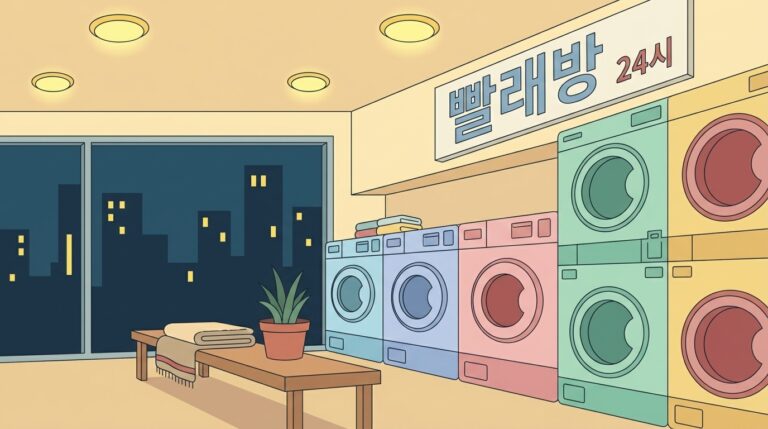
In Korean university districts and residential neighborhoods, 24-hour laundromats have evolved far past dingy basements. They are aesthetic, hybrid community spaces! Many feature self-service capsule coffee bars, retro arcade machines, or massage chairs. It is common to see students studying on laptops or people watching YouTube on free high-speed Wi-Fi while their down jackets fluff up in the dryer.
Phase 5: 실전 롤플레이 시나리오 (Real-World Roleplay)
Setting: 11:30 PM, a warm laundromat in Yeonnam-dong. Rain is pattering outside. You are holding damp jeans. A friendly local college student, Minjun, is folding his fresh hoodies at the center folding table.
- You: 저기요, 실례지만 건조기 몇 분 돌려야 돼요? (Jeogiyo, sillyejiman geonjogi myeot bun dollyeoya dwaeyo?)
🎭 행동 지문: Holding up jeans with a hesitant look.
Translation: Excuse me, how many minutes should I run the dryer for? - Minjun: 아, 청바지 있으시네요! 청바지는 한 40분은 돌려야 다 말라요. (A, cheongbaji isseusineyo! Cheongbajineun han sasip-buneun dollyeoya da mallayo.)
🎭 행동 지문: Smiling and glancing at your laundry basket.
Translation: Ah, you have jeans! For jeans, you need to run it for about 40 minutes to dry completely. - You: 40분이요? 고온으로 해도 괜찮을까요? (Sasip-bun-iyo? Goon-euro haedo gwaenchaneulkkayo?)
🎭 행동 지문: Pointing at the temperature knob on the machine.
Translation: 40 minutes? Is it okay to use high heat? - Minjun: 면 옷은 줄어들 수 있어서 중온이 안전해요! (Myeon oseun jureodeul su isseoseo jung-oni anjeonhaeyo!)
🎭 행동 지문: Making a shrinking motion with both hands.
Translation: Cotton clothes can shrink, so medium heat is safer! - You: 아, 그렇군요! 그럼 500원짜리 동전 8개 넣으면 되나요? (A, geureokgunyo! Geureom obaek-won-jjari dongjeon yeodeol-gae neoeumyeon doenayo?)
🎭 행동 지문: Checking the coins in your palm.
Translation: Ah, I see! Then do I insert eight 500-won coins? - Minjun: 네, 맞아요! 500원에 5분씩 늘어나거든요. (Ne, majayo! Obaek-wone o-bun-ssik neureonageodeunyo.)
🎭 행동 지문: Nods and points at the coin slot coin guide.
Translation: Yes, exactly! Each 500 won adds 5 minutes. - You: 친절하게 알려주셔서 정말 감사해요! (Chinjeolhage allyeojusyeoseo jeongmal gamsahaeyo!)
🎭 행동 지문: Bowing slightly with a grateful smile.
Translation: Thank you so much for explaining so kindly! - Minjun: 별말씀을요! 저기 커피 머신도 있으니까 한잔 드시면서 기다리세요. (Byeolmalsseumeullyo! Jeogi keopi meosindo isseunikka hanjan deusimyeonseo gidariseyo.)
🎭 행동 지문: Waving his hand modesty and pointing toward the coffee corner.
Translation: Don’t mention it! There’s a coffee machine over there, so grab a cup while you wait.
🔀 Interactive Choice Point
The dryer stops after 40 minutes, but your thick jeans waistband is still slightly wet. What do you say to Minjun before adding more coins?
- Choice A: 아직 덜 말라서 10분 더 추가할게요! (Ajik deol mallaseo sip-bun deo chugahalgeyo!)
Feedback (Best!): Natural, friendly, and crystal clear A2 Korean! Minjun will nod with empathy. - Choice B: 기계가 나쁩니다. 옷이 젖었습니다. (Gigyega nappeumnida. Osi jeojeotseumnida.)
Feedback (Bad): “The machine is bad. Clothes are wet.” This sounds overly aggressive and robotic! - Choice C: 야, 돈 더 줘. (Ya, don deo jwo.)
Feedback (Risk!): “Hey, give me more money.” Extremely rude informal speech! You might start a drama scene.
Phase 6: 10초 감정 섀도잉 드릴 (Shadowing Drill)
Practice saying these aloud, pausing at the / marks and adopting the emotion tags!
[🤔 고민하며 신중하게]
청바지라서 / 30분만 돌리면 / 다 안 마를 것 같아요. (Cheongbajiraseo / samsip-bun-man dollimyeon / da an mareul geot gatayo.)
“Since they are jeans / if I only run 30 minutes / I think they won’t dry completely.”-
[💡 깨달음을 얻고 명쾌하게]
아하! / 500원 넣을 때마다 / 5분씩 늘어나는군요! (Aha! / obaek-won neoeul ttaemada / o-bun-ssik neureonaneungunyo!)
“Aha! / Every time I put in 500 won / it increases by 5 minutes!” -
[😊 개운하고 만족스럽게]
바운스 넣었더니 / 뽀송뽀송하고 / 냄새 너무 좋아요! (Baunseu neoeotdeoni / pposongpposonghago / naemsae neomu joayo!)
“Because I put in a dryer sheet / it’s so fluffy and soft / and smells amazing!”
Phase 7: K-Culture Mini Dictionary
- 코인빨래방 (Koin-ppallaebang): Coin Laundromat. Often branded as “WashEnd”, “Coin Wash 24”, or “CleanUp 24”. Available 24/7 across every urban pocket in Korea.
- 건조기 (Geonjogi): Clothes dryer. In typical Korean apartments, open-air drying racks are traditional, making industrial dryers at laundromats a lifesaver during winter and monsoon season.
- 바운스 (Baunseu): Dryer sheet (fabric softener sheet). Derived from the popular brand name Bounce, Koreans use this as a generic noun for all dryer aroma sheets sold in vending machines inside laundromats.
- 덜 마르다 (Deol mareuda): To be incompletely dry / still damp.
덜means “less than fully.” You will use this often when deciding whether to add extra minutes.
Phase 8: Survival Kit for Travelers
Top 3 Survival Phrases
- 동전 교환기 어디 있어요? (Dongjeon gyohwangi eodi isseoyo?)
- Where is the coin changer?
- Pro Tip: Most standalone dryers take only 500-won coins unless the shop has a centralized digital kiosk card system.
- 건조기 문이 안 열려요. (Geonjogi muni an yeollyeoyo.)
- The dryer door won’t open.
- Pro Tip: For safety, dryers remain locked for 10-20 seconds after the cycle stops while the drum cools down.
- 다 끝나면 바구니에 담아둘게요. (Da kkeutnamyeon bagunie damadulgeyo.)
- When it finishes, I’ll place it in the basket for you.
- Pro Tip: Use this polite phrase if another person’s load has stopped and you need to use the dryer.
Editor’s Travel Note
Before wandering with heavy laundry bags, open your map and search “빨래방” or “코인세탁” via the 네이버 지도 앱 다운로드 (Naver Map app download). Make sure to prepare 1,000-won and 5,000-won paper bills; coin exchange machines rarely take 50,000-won bills!
Phase 9: 한 발 더 깊이 (Cultural Reflection)
Korean laundromats are miniature mirrors of Korean civic mindfulness (배려 – baeryeo). Because space in Korean metropolitan cities like Seoul and Busan is compact, these communal facilities thrive entirely on mutual respect and silent punctuality. People treat machines gently, clean out lint screens when prompted, and never leave clothes abandoned for hours. By learning these simple laundry phrases, you aren’t just doing chores; you are seamlessly participating in the rhythmic, respectful flow of everyday Korean society.
💬 Your Turn: What is the laundromat culture like in your home country? Have you ever had a funny or embarrassing laundry mix-up while traveling? Share your story in the comments below!
Phase 10: FAQ & Common Mistakes
Q: Can I pay with an international credit card instead of coins?
A: Many modernized laundromats now feature a touchscreen kiosk (키오스크) where you can select dryer numbers and pay with foreign credit cards. However, older mom-and-pop laundromats strictly run on 500-won coins. Always bring a few 1,000-won cash notes just in case!
Q: What does ‘표준’ mean on the dryer settings?
A: 표준 (Pyo-jun) means “Standard” or “Normal.” It sets the temperature to Medium-High (usually around 65°C-70°C), which is suitable for standard everyday cotton T-shirts, underwear, and towels.
Q: How do I know how many minutes 500 won buys?
A: Most commercial Korean dryers operate on a base rate (e.g., 4,000 won for 30 minutes) and then allow incremental top-ups where each additional 500-won coin grants 4 to 5 minutes.
🚨 Common Mistakes Warning Board
- Mistake: Pouring liquid detergent into the dryer.
- Correct Action: Dryers only take dry scented sheets (
바운스). Liquid detergent belongs exclusively in the washing machine (세탁기)!
- Correct Action: Dryers only take dry scented sheets (
- Mistake: Opening the dryer door mid-cycle without pressing pause.
- Correct Action: Check for an
일시정지(Pause) button. Opening it directly can trigger an error alarm on older machines.
- Correct Action: Check for an
- Mistake: Leaving delicate woolen knitwear on
고온(High Heat).- Correct Action: Always switch to
저온(Low Heat) or take knit items home to air dry to avoid drastic shrinkage.
- Correct Action: Always switch to
Phase 11: Action Mission & Engagement
- 🥉 Bronze Mission: Say “30분만 돌리면 돼요?” 3 times out loud in front of a mirror with natural intonation.
- 🥈 Silver Mission: Find a laundromat scene in any K-drama (like Hometown Cha-Cha-Cha or Crash Landing on You) and comment the timestamp below!
- 🥇 Gold Mission: Next time you visit Korea, visit a local coin wash, successfully insert coins to set your dryer time, and post a cozy story tagging
@DailyHangul!
🎮 K-Culture Mission: Next time you listen to K-pop, check if you hear words like 돌려 (spin/turn) or 말라 (dry) in upbeat choreographies or lyrics!
Phase 12: Interactive Quiz Challenge
1. Situational Judgment: Your clothes are still a bit damp after the dryer stops. What should you say?
* A) 물 주세요! (Mul juseyo!)
* B) 10분 더 추가할게요. (Sip-bun deo chugahalgeyo.)
* C) 세탁기 돌릴게요. (Setakgi dollilgeyo.)
👉 Click to view answer & explanation
Answer: B
Explanation: “10분 더 추가할게요” means “I’ll add 10 more minutes.” Option A asks for water, and Option C says you will run the washing machine!
2. Fill-in-the-Blank: Fill in the word for “shrink”:
* 고온으로 하면 옷이 ________? (Will the clothes shrink on high heat?)
👉 Click to view answer & explanation
Answer: 줄어들어요 (jureodeureoyo)
Explanation: 줄어들다 is the verb meaning “to shrink or decrease.”
3. True or False: In Korean, the dryer sheet is commonly called ‘바운스’ (Baunseu).
👉 Click to view answer & explanation
Answer: True
Explanation: Brand eponyms are common in Korea; fabric softener dryer sheets are almost universally labeled and referred to as 바운스 in coin laundromats!







