

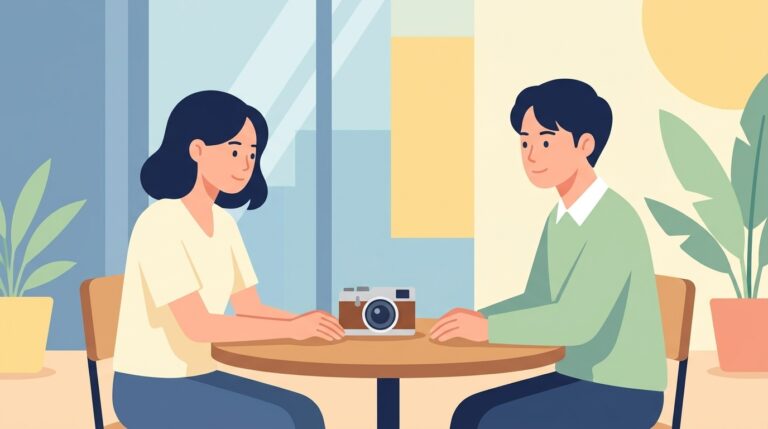
Phase 1: Empathy
안녕하세요! 매일한글 에디터입니다. (Hello! This is your Daily Hangul editor.)
Imagine this absolute nightmare scenario: You are sitting at a trendy, sunlit café in Yeonnam-dong with Minji, your close Korean study buddy. You politely borrowed her beloved pastel-pink portable power bank because your phone had dipped to a critical 2%. While reaching across the small wooden table to grab your iced Americano, your sleeve catches the USB cord. In slow motion, the charger crashes onto the hard terrazzo floor with a sharp crack. The LED power lights flicker once and extinguish completely. Your stomach drops instantly into your shoes.
In English, you might instinctively exclaim, “Oh no, I am so sorry! I’ll buy you a new one!” But in Korean, just stammering “죄송합니다 (Joesonghamnida)” can sound overly robotic and emotionally distant, like an airline announcement. On the flip side, simply tossing out a casual “미안해 (Mianhae)” feels shockingly dismissive when someone’s actual property is lying broken on the floor. How do you take authentic responsibility, handle the fragile social atmosphere, and actually strengthen your friendship instead of ruining it?
Based on feedback from hundreds of intermediate Korean language learners, dealing with accidental property damage is one of the most stressful social hurdles foreigners face in Korea. In this comprehensive guide, we will unpack the exact B1-level expressions, non-verbal cues, and relational etiquette you need to handle this awkward situation like a considerate local.
Phase 2: Core Expressions Deep Dive
1. 어쩌지, 내가 고장 낸 것 같아… (한글)
- Pronunciation: [Eojjeoji, naega gojang naen geot gata…] (Sounds like: Ud-jju-jee, neh-ga go-jahng nen gut gah-tah)
- Meaning: Literal: “What to do, it seems I made a breakdown…” | Actual Nuance: “Oh no, what should I do? I think I might have broken it…”
- K-Culture Moment: This is the quintessential line spoken in K-dramas right after a well-meaning protagonist accidentally shatters an expensive office tablet or drops their best friend’s vintage turntable.
- Editor’s Insight: Notice the ending -것 같아 (-geot gata / seems like). In Korean interpersonal psychology, declaring an outright fact like “내가 고장 냈어! (I broke it!)” can sound jarringly blunt. Cushioning your statement with “-것 같아” expresses vulnerability and distress rather than cold detachment.
- Situation Spectrum: Casual: ✅ | Semi-formal: ⚠️ (Use: 어쩌죠, 제가 고장 낸 것 같아요) | Formal: 🚫
- 🤔 Think About It: Why does Korean prioritize softening an obvious reality with “it seems like” during an emergency, while English speakers often value immediate, blunt admissions?
2. 내가 꼭 똑같은 걸로 다시 사줄게. (한글)
- Pronunciation: [Naega kkok ttokgateun geollo dasi sajulge.] (Sounds like: Neh-ga kok tok-gah-tun gul-lo dah-shee sah-jool-geh)
- Meaning: Literal: “I will surely buy you again with the exact same thing.” | Actual Nuance: “I promise I will replace it with the exact same model.”
- K-Culture Moment: Picture two college roommates living in a tiny Seoul studio (one-room). One roommate drops the other’s limited-edition K-pop mug. This sentence is the ultimate olive branch that saves the friendship.
- Editor’s Insight: The magic keyword is 똑같은 걸로 (ttokgateun geollo / the exact same thing). Promising to replace the specific item proves you honor the owner’s taste and attachment, rather than reducing their possession to mere monetary compensation.
- Situation Spectrum: Casual: ✅ | Semi-formal: ⚠️ (Use: 제가 꼭 똑같은 걸로 다시 사드릴게요) | Formal: 🚫
- 🤔 Think About It: How does offering an identical physical replacement preserve interpersonal harmony better than simply asking, “How much did it cost?”
3. 내가 수리비 전부 물어낼게! (한글)
- Pronunciation: [Naega suribi jeonbu mureonaelge!] (Sounds like: Neh-ga soo-ree-bee jun-boo moo-ruh-nel-geh)
- Meaning: Literal: “I will bite out all repair expenses!” | Actual Nuance: “I will cover 100% of the repair costs, no matter what!”
- K-Culture Moment: You are taking aesthetic photos under the cherry blossoms along the Han River, and your friend’s digital mirrorless camera slips from your grip. You immediately shout this to reassure them.
- Editor’s Insight: The expressive verb 물어내다 (mureonaeda) carries intense emotional weight. Unlike the standard word for paying money (돈을 내다), 물어내다 specifically signifies reimbursing or compensating for damages you caused. It broadcasts total accountability.
- Situation Spectrum: Casual: ✅ | Semi-formal: ⚠️ (Use: 제가 수리비 전부 물어드릴게요) | Formal: 🚫
- 🤔 Think About It: Korean separates paying for a purchase (지불하다/내다) from paying for damage caused (물어내다). What does this reveal about social accountability in Korea?
Phase 3: Textbook Korean vs. Real Korean
Scenario 1: Admitting that a borrowed tech gadget stopped working
- 📖 교과서 한국어: 제가 당신의 물건을 파손시켰습니다. (Jega dangsin-ui mulgeoneul pasonsikyeosseumnida. / “I have inflicted damage upon your property.”)
- 🗣️ 진짜 한국어: 어떡해, 이거 갑자기 작동이 안 돼… 내가 잘못 만졌나 봐. (Eotteokhae, igeo gapjagi jakdong-i an dwae… Naega jalmot manjyeonna bwa. / “Oh no, this suddenly won’t work… I must have pressed something wrong.”)
- 💡 왜 다를까?: In real Korean conversations, addressing someone as “당신 (dangsin)” sounds combative or bizarre, and “파손 (pason)” belongs in an insurance contract. Native speakers naturally express shared dismay (어떡해) and place the blame on their own actions (내가 잘못 만졌나 봐).
Scenario 2: Proposing a solution for the broken item
- 📖 교과서 한국어: 제가 손해를 배상하도록 하겠습니다. (Jega sonhaereul baesanghadorok hagesseumnida. / “I shall compensate you for the damages.”)
- 🗣️ 진짜 한국어: 서비스 센터 같이 가자. 수리비는 내가 다 낼게! (Seobiseu senteo gachi gaja. Suribineun naega da naelge! / “Let’s go to the service center together. I’ll pay all the repair fees!”)
- 💡 왜 다를까?: Words like “배상 (indemnification)” build a wall of sterile formality between acquaintances. Suggesting to go together (같이 가자) demonstrates genuine empathy, actively sharing the inconvenience you caused.
Phase 4: K-Culture Deep Dive & Non-verbal Manners
4-1. 눈치 (Nunchi) & Body Language
When an item breaks, what your body communicates in the first five seconds matters just as much as the words you choose:
* The Two-Handed Return (두 손으로 건네기): Never casually slide or push the damaged object across the table with one hand. Hold the item tenderly with both hands, arms drawn inward, as if holding something precious.
* Eye Line & Posture: Lower your gaze slightly (눈을 살짝 내리깔다) and tilt your head downward. Maintaining aggressive eye contact while apologizing in Korean can be interpreted as defensive or unrepentant.
* Never Make Excuses First: If you immediately mutter, “Well, this hinge was already super loose,” you will instantly fail the Nunchi test. In Korean relationship dynamics, acknowledging the other person’s shock must always precede technical facts.
4-2. Cultural Code Analysis: “괜찮아” Is Not Always “Okay”
In Korean social culture, when you break something, your Korean peer will almost certainly reply on reflex: “아, 괜찮아! 오래된 거야! (Oh, it’s totally okay! It was old anyway!)”
Do not take this literally! This is the polite social barrier known as 배려 (baeryeo / consideration). They say it so you don’t feel humiliated in public. If you smile and reply, “Awesome, thanks!” and change the subject, you will leave behind a lingering emotional scar (섭섭함). Real cultural fluency means insisting on taking responsibility at least two or three times. Even if they reject your repair offer, surprise them later with a replacement or a thoughtful coffee gift voucher.
Phase 5: Real-Life Roleplay Scenario
Setting: A cozy boutique café in Ikseon-dong. You are hanging out with Minho (민호), your stylish Korean friend who lent you his cherished vintage film camera.
- Turn 1 (You): 🎭 (Horrified expression, holding the camera tightly with both hands) 민호야, 진짜 어떡하지? 셔터가 안 눌려… 내가 바닥에 살짝 부딪혔거든. (Minhoya, jinjja eotteokhaji? Syeoteoga an nullyeo… Naega badage saljjak budichyeotgeodeun. / Minho, what should I do? The shutter won’t press… I bumped it against the floor.)
- Turn 2 (Minho): 🎭 (Startled, leaning forward with wide eyes) 헐, 진짜? 어디 봐봐. 렌즈 경통도 살짝 찌그러졌네. (Heol, jinjja? Eodi bwabwa. Renjeu gyeongtongdo saljjak jjigeureojyeonne. / Whoa, seriously? Let me see. The lens barrel is slightly dented too.)
- Turn 3 (You): 🎭 (Bowing your head slightly, voice filled with sincere regret) 너무 미안해… 내가 손목 스트랩을 제대로 안 잡았어. 완전 내 부주의야. (Neomu mianhae… Naega sonmok seuteuraebeul jedaero an jabasseo. Wanjeon nae bujuuiya. / I’m so sorry… I didn’t hold the wrist strap properly. It was entirely my carelessness.)
- Turn 4 (Minho): 🎭 (Sighing gently, then flashing a reassuring weak smile) 아, 이거 중고로 겨우 구한 건데… 그래도 네 손이나 발 안 다쳤으니 다행이지. (A, igeo junggoro gyeou guhan geonde… Geuraedo ne son-ina bal an dachyeosseuni dahaeng-iji. / Ah, I barely managed to find this second-hand… But at least you didn’t hurt your hands or feet, that’s what matters.)
- Turn 5 (You): 🎭 (Placing your hand on your heart earnestly) 충무로 카메라 수리점에 내일 바로 같이 가자. 수리비는 내가 전부 다 낼게! (Chungmuro kamera surijeome naeil baro gachi gaja. Suribineun naega jeonbu da naelge! / Let’s go to the camera repair shop in Chungmuro together tomorrow. I’ll pay every single won of the repair cost!)
- Turn 6 (Minho): 🎭 (Waving his hands in hesitation) 에이, 오래된 모델이라 수리비 많이 나올 수도 있는데… 그냥 반반씩 낼까? (Ei, oraedoen modereira suribi mani naol sudo inneunde… Geunyang banbanssik naelkka? / Hey, it’s an old model so repairs might get pricey… Should we just split it fifty-fifty?)
- Turn 7 (You): 🎭 (Firmly shaking your head with warm resolve) 아니야, 절대 안 돼! 내가 빌려서 고장 냈으니까 당연히 내가 책임져야지. (Aniya, jeoldae an dwae! Naega billyeoseo gojang naesseunikka dang-yeonhi naega chaegimjyeoyaji. / No way, absolutely not! I borrowed it and broke it, so of course I must take full responsibility.)
- Turn 8 (Minho): 🎭 (Visibly relieved, patting your shoulder) 그래, 그렇게 말해줘서 고마워. 그럼 내일 오후에 같이 가보자! (Geurae, geureoke malhaejwoseo gomawo. Geureom naeil ohue gachi gaboja! / Okay, thank you so much for saying that. Let’s head over together tomorrow afternoon!)
🔀 Decision Point (Interactive Branching)
What if you responded differently at Turn 3? Choose your path:
- Option A: “원래 셔터가 좀 뻑뻑하긴 했잖아…” (It was already a bit stiff anyway…)
- 🚨 BAD: Instant relationship killer. Shifting blame onto the item’s previous condition makes you look deceitful and completely destroys trust.
- Option B: “내일 당장 공식 서비스 센터 알아보고 내가 전액 부담할게.” (I’ll look up the official service center right tomorrow and bear the full cost.)
- 🌟 BEST: Perfect execution! Taking immediate financial and logistical ownership shows peak maturity (책임감).
- Option C: “계좌번호 보내줘. 내가 돈으로 보낼게.” (Just send me your bank account number. I’ll wire cash.)
- ⚠️ RISK: Emotionally lukewarm. In close Korean friendships, throwing money at an issue without offering personal presence or emotional care feels transactional and sterile.
Phase 6: 10-Second Emotion Shadowing Drill
Read these lines aloud, breathing at the / marks and channeling the assigned emotion tags:
- [🥺 Flustered and deeply remorseful]
진짜 어떡해… / 내가 더 조심했어야 했는데 / 너무너무 미안해. (Jinjja eotteokhae… / naega deo josimhaesseoya haenneunde / neomuneomu mianhae.) -
[🤝 Firm, determined, and accountable]
서비스 센터 바로 가자. / 수리 비용은 / 내가 무조건 다 물어낼게. (Seobiseu senteo baro gaja. / Suri biyong-eun / naega mujogeon da mureonaelge.) -
[💛 Warm, caring, and validating their feelings]
너한테 소중한 물건인데 / 속상하게 만들어서 / 정말 마음이 안 좋아. (Neohante sojunghan mulgeon-inde / soksanghage mandeureoseo / jeongmal ma-eumi an joa.)
Phase 7: K-Culture Mini Dictionary
- 물어주다 (Mureojuda) | Verb: To compensate / to reimburse for damages
- Real Usage: Used whenever you financially settle an accidental loss or damage. (Example: 친구 우산 잃어버려서 새로 하나 물어줬어. / I lost my friend’s umbrella, so I bought them a replacement.)
- 부주의 (Buju-ui) | Noun: Carelessness / Inattention
- Real Usage: The gold-standard adult term used when humbly accepting fault. Saying “제 부주의였습니다 (It was my carelessness)” instantly earns respect.
- 당황하다 (Danghwanghada) | Verb: To be panicked / at a loss for words
- Real Usage: Describes that exact feeling when your mind goes completely blank after breaking a borrowed object.
- 책임지다 (Chaegimjida) | Verb: To take responsibility / to carry the burden
- Real Usage: A core pillar of Korean social ethics. Taking responsibility through action (끝까지 책임질게) counts far more than repeated empty verbal apologies.
Phase 8: Survival Kit for Travelers
Top 3 Survival Phrases
- 혹시 이거 수리 가능한가요? (Hoksi igeo suri ganeunghangayo?)
- Meaning: By any chance, is this repairable?
- Pro Tip: Whip this out immediately when entering any electronics repair center or boutique repair technician booth in Korea.
- 영수증 나오면 저한테 꼭 청구해 주세요. (Yeongsujeung naomyeon jeohante kkok cheongguhae juseyo.)
- Meaning: When the receipt comes out, please make sure to bill me.
- Pro Tip: Use this respectful phrase if a Korean coworker or acquaintance insists on taking the item to their own preferred repair shop.
- 똑같은 새 제품으로 주문해 드릴게요. (Ttokgateun sae jepumeuro jumunhae deurilgeyo.)
- Meaning: I will order the exact same brand-new product for you.
- Pro Tip: When an item is damaged beyond repair, this line cuts through any awkward haggling instantly.
Editor’s Travel Note
If you break an electronic device or gear in South Korea, don’t panic. Korean after-service centers (AS 센터) are among the fastest in the world. To locate the nearest branch in seconds, avoid relying on international map providers that lack updated local transit layers. Instead, search using the 네이버 지도 앱 다운로드 (Naver Map App Download) and type in “삼성전자 서비스센터” (Samsung Service Center) or “아이폰 수리” (iPhone Repair). Most centers accept foreign credit cards, and simple screen or hinge replacements are frequently finished in under 40 minutes!
Phase 9: One Step Deeper
In Korean society, borrowing an object is never viewed as a purely isolated mechanical transaction. It is an extension of 관계 (Gwagye / relationship) and mutual trust. When you borrow Minji’s headphones or camera, you are technically carrying a piece of her personal world with you.
Consequently, when an item breaks, you haven’t just fractured plastic or metal; you have momentarily thrown the emotional balance of the relationship out of alignment. This explains why handing over cold cash right on the spot can sometimes feel oddly offensive in Korean culture—it reduces a personal bond down to a dry commercial exchange. True Korean etiquette focuses on repairing the emotional equilibrium: offering heartfelt apologies, sharing the time and effort to visit the repair center together, and following up afterward. In Korea, genuine accountability is demonstrated through shared presence.
💬 Your Turn: Have you ever accidentally broken or lost something you borrowed from a Korean friend or colleague? How did you handle the situation? Let us know your story in the comments below!
Phase 10: FAQ & Common Mistakes
Q: Can I just say “미안해요 (Mianhaeyo)” if I accidentally damage my university senior’s (선배) laptop?
A: Definitely not! “미안해요” is far too informal for someone of higher status (선배 or 직장 상사). You must use formal honorifics: “정말 죄송합니다. 제 부주의였습니다. 제가 수리 센터에 접수하고 전액 부담하겠습니다. (Jeongmal joesonghamnida. Je bujuuiyeosseumnida. Jega suri senteeo-e jeopsuhago jeonaek budamhagesseumnida. / I am truly sorry. It was entirely my carelessness. I will register it at the service center and cover the full cost.)”
Q: My Korean friend firmly insists, “괜찮아, 안 물어줘도 돼! (It’s okay, you don’t need to pay for it!)” Should I take their word for it?
A: Never take the first “괜찮아” at face value! In Korea, polite etiquette (체면/배려) requires them to say this to save face and prevent public awkwardness. If you drop the matter immediately, you risk being judged as 눈치 없는 사람 (someone devoid of social tact). Politely insist at least two more times. If they still refuse, send a KakaoTalk Gift voucher (카카오톡 선물하기) of equal value or buy them a nice dinner.
Q: What does “물어내!” mean when a friend says it to me?
A: Grammatically, “물어내!” is an imperative command meaning “Pay for it!” or “Compensate me!” If said with a giggling, playful face among close chums, it’s lighthearted teasing. However, if accompanied by a serious expression and folded arms, it means they are genuinely upset and expecting immediate compensation.
🚨 흔한 실수 (Common Mistakes) Checklist
- ❌ Mistake 1: Blaming circumstance by saying “어쩔 수 없었어 (It couldn’t be helped).”
- 💡 Correct Action: Own your fault directly with “완전 내 부주의였어 (It was completely my carelessness).”
- ❌ Mistake 2: Silently transferring money to their bank account without verbal comfort.
- 💡 Correct Action: Hold the damaged item with both hands, apologize warmly first, and propose visiting the repair shop together.
- ❌ Mistake 3: Replacing the item with a completely different model or cheaper brand.
- 💡 Correct Action: Always specify “똑같은 걸로 (the exact same one)” to show respect for their original choice.
Phase 11: Action Missions & Engagement
Action Mission 3-Step Ladder
- 🥉 Bronze Mission (Solo Practice): Stand in front of your mirror, hold a pen with both hands, lower your gaze, and repeat: “어쩌지, 내가 꼭 똑같은 걸로 다시 사줄게” 5 times with genuine emotion.
- 🥈 Silver Mission (Social Share): Write down the distinction between 돈을 내다 (to pay money) and 물어내다 (to compensate for damage) in your study notes, and share it on Instagram or X tagging #DailyHangul!
- 🥇 Gold Mission (Real-life Execution): The next time you borrow anything in Korea—even a simple charging cable—return it with both hands and say: “빌려줘서 정말 잘 썼어, 고마워! (Thanks to you, I used it well. Thank you!)”
🎮 K-Culture Mission
Fire up a slice-of-life K-drama like Hospital Playlist or Reply 1988. Watch closely for any scene where a character ruins clothes or drops another character’s possession. Pay attention to how the characters react: Do they split costs, scold playfully, or insist on buying a meal? Spotting this in the wild will make these lessons unforgettable!
Phase 12: Interactive Quiz Challenge
Question 1: Situational Judgment
You accidentally spilled iced tea over your Korean colleague’s external hard drive at work. What is the most culturally tactful and mature response?
A) “원래 여기에 음료수를 두면 위험해요.”
B) “정말 죄송합니다! 제가 데이터 복구 비용이랑 새 제품 비용 전부 부담하겠습니다.”
C) “괜찮아요, 중고 마켓에 찾아보면 싸게 나와요.”
Question 2: Fill-in-the-Blank
Complete the natural Korean phrase taking responsibility for repair costs:
내가 실수로 떨어뜨렸으니, 수리비는 내가 다 ( ________ )!
(Hint: The colloquial verb meaning ‘to compensate/pay out damages’ conjugated in casual future intent)
Question 3: True or False (Culture Check)
If a Korean acquaintance smiles and says “괜찮아! (It’s totally okay!)” after you crack their phone screen, it is culturally respectful to simply say thanks and not offer to pay again.
👉 Click here to reveal the Quiz Answers & Explanations!
- Answer 1: B) “정말 죄송합니다! 제가 데이터 복구 비용이랑 새 제품 비용 전부 부담하겠습니다.” (I am truly sorry! I will bear all costs for data recovery and a new replacement product.)
- Explanation: Option A deflects blame onto the environment, and Option C trivializes their loss. Option B demonstrates immediate, proactive professional accountability.
- Answer 2: 물어낼게 (mureonaelge) or 물어줄게 (mureojulge).
- Explanation: Both express taking financial responsibility for damage caused, with 물어낼게 emphasizing strong personal determination.
- Answer 3: False!
- Explanation: As we explored in Phase 4, the initial 괜찮아 is often a social courtesy (배려). You must insist on paying or fixing the item at least two or three times to show true respect and sincerity.
- Explanation: As we explored in Phase 4, the initial 괜찮아 is often a social courtesy (배려). You must insist on paying or fixing the item at least two or three times to show true respect and sincerity.







