

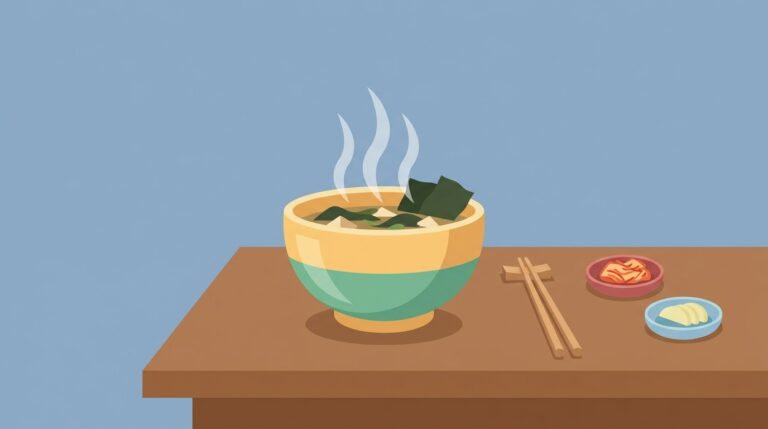
The Warmest Korean Birthday Ritual: Why We Eat Seaweed Soup
Phase 1: 공감 (Story-Driven Opening)
안녕하세요! 매일한글 에디터입니다. (Hello! I’m your Daily Hangul editor.)
Picture this: You wake up in Seoul on your birthday expecting your Korean roommate or coworkers to surprise you with confetti and a slice of chocolate cake. Instead, someone places a steaming, dark green bowl of savory broth in front of you. It is brimming with strands of seaweed and tender beef. Before anyone even sings a song, they look at you with deep, genuine warmth and ask: “생일인데 미역국은 먹었어? (Saeng-il-inde miyeok-guk-eun meogeo-sseo? / Did you eat seaweed soup for your birthday?)”
If you have watched classic K-Dramas like Reply 1988 or Hospital Playlist, you know that a birthday morning without miyeok-guk feels almost tragic. But as an intermediate learner, you might wonder: why seaweed soup? Isn’t seaweed something you wrap around kimbap or eat dried as a snack? Why does this specific soup evoke tears of gratitude in every Korean drama?
Many learners hit an awkward plateau here. You know the textbook phrase for happy birthday, but you miss the cultural pulse of how Koreans actually show love. Understanding the language of miyeok-guk bridges the gap between sounding like an automated translation app and sounding like a caring, culturally fluent insider. Based on years of feedback from our B2 students, mastering this conversation unlocks deeper connections with Korean friends, in-laws, and colleagues. Let us dive in!
Phase 2: 핵심 표현 3선 심층 분석 (Top 3 Core Expressions)
1. 생일인데 미역국은 먹었어? (Saeng-il-inde miyeok-guk-eun meogeo-sseo?)
- Pronunciation: [Saeng-il-in-de mee-yeok-guk-eun meo-geo-sseo?] (Sounds like saying me-yuck-gook with a smooth glide on the vowels)
- Meaning: Literal: “It is your birthday, but did you eat seaweed soup?” | Nuance: “Happy birthday! I care about your well-being and hope you are being celebrated today.”
- K-Culture Moment: In virtually every slice-of-life K-Drama, a devoted mother wakes up at 5:00 AM, roasts sesame oil and beef, and sets down this bowl before her child heads out for school or work.
- Editor’s Insight: In Korean society, asking if someone ate is the ultimate expression of affection. Asking about miyeok-guk on a birthday elevates this to acknowledging the person’s birth and mother.
- Situation Spectrum: Casual: ✅ | Semi-formal: ⚠️ (Use 존댓말: “생신인데 미역국 드셨어요?”) | Formal: 🚫
- 🤔 Think About It: In your culture, is a birthday primarily about personal self-celebration, or does it honor the parents who brought you into the world?
2. 미역국을 끓이다 / 엄마표 미역국 (Miyeok-guk-eul kkeur-ida / Eom-ma-pyo miyeok-guk)
- Pronunciation: [Mee-yeok-guk-eul kkeul-ee-da / Eom-ma-pyo mee-yeok-guk] (kkeur-ida rhymes loosely with ‘pour it-ah’ with a tense, popping double ‘kk’)
- Meaning: Literal: “To boil seaweed soup” / “Mom-style (mom’s signature) seaweed soup.”
- K-Culture Moment: When idols go on live streams on their birthdays, fans flood the chat asking if their agency staff or mothers cooked them eom-ma-pyo miyeok-guk.
- Editor’s Insight: The suffix “~표 (pyo)” denotes a special homemade trademark. Saying “엄마표 (eom-ma-pyo)” triggers immediate nostalgia for home cooking and maternal sacrifice.
- Situation Spectrum: Casual: ✅ | Semi-formal: ✅ | Formal: ⚠️
- 🤔 Think About It: What specific dish in your hometown represents unconditional maternal love?
3. 미역국 먹다 (Miyeok-guk meokda – Idiomatic Double Meaning)
- Pronunciation: [Mee-yeok-guk meok-da]
- Meaning: Literal: “To eat seaweed soup.” | Idiomatic Nuance: “To slip and fail an exam or interview.”
- K-Culture Moment: A student sighs heavily after a college entrance exam and texts their best friend: “나 오늘 시험에서 미역국 먹은 것 같아… (Na oneul siheom-eseo miyeok-guk meogeun geot gata… / I think I slipped up and failed my test today…)”
- Editor’s Insight: Seaweed is slippery (미끄럽다). Because of this tactile association, eating seaweed soup before a major test or interview is a huge taboo (징크스). Never feed miyeok-guk to someone taking an exam!
- Situation Spectrum: Casual: ✅ | Semi-formal: ✅ | Formal: 🚫
- 🤔 Think About It: Why do linguistic idioms across cultures associate slippery physical textures with failure?
Phase 3: 교과서 한국어 vs 진짜 한국어 (Textbook vs. Real Korean)
Situation 1: Congratulating a close Korean friend on their birthday morning
- 📖 교과서 한국어: 생일을 진심으로 축하드립니다. 좋은 하루 보내세요. (Saeng-ir-eul jinsim-euro chuk-ha-deurim-nida. Joeun haru bonaeseyo.)
- 🗣️ 진짜 한국어: 생일 축하해! 오늘 미역국은 챙겨 먹었어? 케이크는 저녁에 같이 먹자! (Saeng-il chuk-ha-hae! Oneul miyeok-guk-eun chaeng-gyeo meogeo-sseo? Keikeu-neun jeonyeog-e gachi meokja!)
- 💡 왜 다를까?: Textbook phrases sound like an automated bank notification. Real Koreans immediately check whether you were nourished (챙겨 먹다) before talking about party food like cake.
Situation 2: Replying when asked if you celebrated your birthday
- 📖 교과서 한국어: 네, 저는 어제 생일 파티를 즐겁게 했습니다. (Ne, jeoneun eoje saeng-il pati-reul jeulgeopge haessseumnida.)
- 🗣️ 진짜 한국어: 친구들이 깜짝 파티도 해주고, 아침에 미역국도 든든하게 먹었어요. (Chingu-deuri kkamjjak pati-do hae-jugo, achim-e miyeok-guk-do deundeun-hage meogeo-sseoyo.)
- 💡 왜 다를까?: Intermediate speakers shine by using descriptive adverbs like 든든하게 (heartily/satisfyingly) paired with traditional food customs.
Phase 4: K-Culture 딥다이브 & 비언어적 매너 (Deep Dive & Non-Verbal Manners)
4-1. 눈치 (Nunchi) & Gestures
When someone serves you birthday miyeok-guk:
* Two-Handed Acceptance: Always receive the bowl with both hands, lowering your head slightly to acknowledge the labor that went into simmering it.
* The First Sip Protocol: Do not reach for the side dishes (반찬) or rice first. Take a spoonful of the broth first, let out an appreciative “시원하다~ (Si-won-ha-da~ / It’s so refreshing and deep!)”, and smile at the host.
* The Test Day Taboo: If someone tells you they have a job interview or the Korean SAT (수능), never invite them to eat miyeok-guk. Even progressive modern Koreans feel a superstitious twinge of bad luck.
4-2. Cultural Code Analysis: Postpartum Care and Samsin Halmeoni
Why seaweed? Historically, Korean mothers have consumed miyeok-guk for weeks after childbirth (산후조리). Rich in iodine, calcium, and iron, seaweed cleanses the blood and aids uterine recovery. Before modern medicine, new mothers offered a fresh bowl of miyeok-guk and white rice to Samsin Halmeoni (삼신할머니), the mythical goddess of childbirth, praying for the infant’s health.
Therefore, eating miyeok-guk on your birthday is not just self-celebration; it is an act of filial piety (효도). It is an embodied reminder of the labor pains your mother endured to bring you into the world. When you eat it, you are remembering your mother’s sacrifice.
Phase 5: 실전 롤플레이 시나리오 (Interactive Roleplay Scenario)
Setting: It is 8:30 AM in a cozy shared apartment in Mapo-gu, Seoul. Min-ji (your Korean roommate) has spent an hour cooking in the kitchen before you wake up.
- 민지 (Min-ji): (국자를 들고 환하게 웃으며) 일어났어? 생일 축하해! 얼른 식탁에 앉아 봐.
(Gukja-reul deulgo hwan-hage useumyeo) Ireo-nasseo? Saeng-il chuk-ha-hae! Eolleun siktak-e anja bwa.
“(Holding a ladle and smiling brightly) You’re up? Happy birthday! Hurry and take a seat at the table.” -
나 (You): 🎭 (눈을 비비며 식탁 위에 놓인 김이 모락모락 나는 국을 보고 놀란 표정으로)
이게 다 뭐야? 아침부터 요리한 거야?
(Ige da mwo-ya? Achim-buteo yori-han geo-ya?)
“What is all this? Did you cook from early morning?” -
민지 (Min-ji): (자랑스러운 눈빛으로 국그릇을 건네며) 생일인데 미역국은 먹어야지! 소고기 듬뿍 넣고 한 시간 동안 푹 끓였어.
(Jarang-seureoun nunbich-euro guk-geureus-eul geonnemyeo) Saeng-il-inde miyeok-guk-eun meogeo-yaji! Sogogi deumpuk neoko han sigan dongan puk kkeuryeo-sseo.
“(Handing the soup bowl with a proud look) It’s your birthday, of course you have to eat miyeok-guk! I put in tons of beef and simmered it for a full hour.” -
나 (You): 🎭 (두 손으로 국그릇을 조심스레 받으며)
진짜 감동이다… 혼자 맞이하는 생일인 줄 알았는데 고마워.
(Jinjja gamdong-ida… Honja maji-haneun saeng-il-in jul aranneunde gomawo.)
“I’m genuinely moved… I thought I’d be spending my birthday alone, thank you so much.” -
민지 (Min-ji): (숟가락을 쥐여주며 재촉하듯) 식기 전에 국물 먼저 한입 먹어봐. 간은 맞아?
(Sutgarak-eul jwiyeo-jumyeo jaechok-hadeut) Sikgi jeone gukmul meonjeo han-ip meogeo-bwa. Gan-eun maja?
“(Pressing a spoon into your hand) Taste the broth before it gets cold. Is the seasoning right?” -
나 (You): 🎭 (국물을 한 숟가락 떠먹고 눈이 커지며)
와, 국물이 진짜 깊고 진하다! 우리 엄마 생각날 정도야.
(Wa, gukmuri jinjja gipgo jinhada! Uri eomma saeng-gak-nal jeongdo-ya.)
“Wow, the broth is so deep and rich! It even makes me miss my mom.” -
민지 (Min-ji): (안도하는 미소를 지으며) 다행이다! 밥 말아서 김치 얹어 먹어. 오늘 하루 제일 행복해야 돼!
(Dahaeng-ida! Bap maraseo gimchi eonjeo meogeo. Oneul haru jeil haengbok-haeya dwae!)
“What a relief! Mix your rice into the soup and top it with kimchi. You must have the happiest day today!” -
나 (You): 🎭 (밝게 고개를 끄덕이며)
응! 덕분에 오늘 하루 든든하게 시작한다. 저녁엔 내가 맛있는 거 쏠게!
(Eung! Deokbun-e oneul haru deundeun-hage sijak-handa. Jeonyeog-en naega masinneun geo ssolge!)
“Yeah! Thanks to you, I’m starting the day strong. Dinner’s on me tonight!”
🔀 인터랙티브 분기점 (Interactive Choice)
Min-ji suddenly asks: “근데 너 오늘 오후에 어학당 레벨 테스트 본다고 하지 않았어? (Wait, didn’t you say you have a language school level test this afternoon?)” What do you say?
- Choice A: “어? 미역국 먹으면 시험에서 미역국 먹는다던데… 어떡하지?!”
- Feedback (Best! ⭐): Brilliant wordplay! By referencing the idiom 미역국 먹다 self-deprecatingly, you show both humor and cultural mastery. Min-ji will laugh and reassure you.
- Choice B: “미역국 먹는 거랑 시험이랑 무슨 상관이야? 미신이야.”
- Feedback (Bad ❌): Too blunt and dismissive. Even if it is superstition, cold rationalism dampens the cozy cultural mood.
- Choice C: “시험 점수 떨어지면 다 네 미역국 때문이야!”
- Feedback (Risk ⚠️): Playful teasing between very close friends, but if your tone misses slightly, it may sound genuinely ungrateful for her morning effort.
Phase 6: 10초 감정 섀도잉 드릴 (Emotion Shadowing Drill)
Practice these with natural pause points (/) and authentic voice inflection!
[🥺 감동받아 울컥한 목소리로 / Deeply moved and touched]
“아침부터 / 나 때문에 / 미역국 끓인 거야? / 진짜 고마워…”
(Achim-buteo / na ttaemun-e / miyeok-guk kkeurin geo-ya? / Jinjja gomawo…)-
[😊 따뜻하고 정성스럽게 챙겨주며 / Warm and caring tone]
“생일인데 / 굶지 말고 / 미역국 든든하게 챙겨 먹어!”
(Saeng-il-inde / gumji malgo / miyeok-guk deundeun-hage chaeng-gyeo meogeo!) -
[🤣 장난기 가득하고 유쾌하게 / Playful and teasing]
“나 오늘 중요한 면접인데 / 미역국 먹어서 / 미끄러지면 어쩌지?”
(Na oneul jung-yohan myeonjeob-inde / miyeok-guk meogeoseo / mikkeureojimyeon eojjeoji?)
Phase 7: K-Culture 미니 사전 (Mini Dictionary)
- 산후조리 (Sanhujori) | Postpartum recuperation | The holistic Korean tradition of caring for a mother after childbirth, revolving around thermal warmth, physical rest, and eating miyeok-guk three times a day.
- 효도 (Hyodo) | Filial piety | The bedrock Confucian virtue of loving and respecting one’s parents. Celebrating a birthday with miyeok-guk is an expression of hyodo toward the mother.
- 미역국 먹다 (Miyeok-guk meokda) | To fail or get rejected | Slang originated from seaweed’s slick texture. Frequently used when flunking an exam, getting rejected from an interview, or being cut from auditions.
- 정 (Jeong) | Warm emotional bonding | The uniquely Korean feeling of selfless affection, attachment, and mutual solidarity demonstrated when cooking someone a hot bowl of soup.
Phase 8: 여행자를 위한 생존 키트 (Traveler’s Survival Kit)
Top 3 Survival Phrases
- 생일인데 미역국 나오는 정식 있나요?
(Saeng-il-inde miyeok-guk naoneun jeongsik innayo?)
Pro Tip: At traditional Korean table d’hôte (한정식) restaurants, asking this can sometimes earn you special birthday hospitality or seasonal side dishes. - 국물 리필 가능한가요?
(Gukmul ripil ganeung-han-gayo?)
Pro Tip: In most Korean restaurants, asking politely for extra broth (국물) is free and welcomed with a smile. - 소고기 미역국으로 주세요.
(Sogogi miyeok-guk-euro juseyo.)
Pro Tip: Miyeok-guk varieties include beef (소고기), clam (바지락), and sea urchin (성게). If you want the hearty classic, specify sogogi.
Editor’s Travel Note
Looking for an authentic gourmet experience? Search on the 네이버 지도 앱 다운로드 (Naver Map App Download) for renowned specialty houses like 풍원장 (Pungwonjang) or 오복미역 (Obok Miyeok). These restaurants turn miyeok-guk into an opulent feast served in sizzling stone pots (뚝배기) alongside grilled mackerel and regional side dishes.
Phase 9: “한 발 더 깊이” (Cultural Reflection)
In Western cultures, birthdays often center on personal autonomy—it is my day, celebrated with candles blown out over a sugar-dusted cake. Yet Korean birthday culture shifts the lens inward toward the community and the mother. By sipping the exact same sea broth consumed by a recovering mother centuries ago, an individual acknowledges that their life is an inherited gift rather than a solo achievement. Language and food act as an umbilical cord connecting past generations to the present dinner table.
💬 Your Turn: Have you ever celebrated a birthday in Korea or been asked if you ate miyeok-guk? How does your culture express gratitude to parents on your birthday? Share your story in the comments below!
Phase 10: FAQ & 오해 방지 (FAQ Schema)
Q: Can foreigners eat miyeok-guk if they aren’t Korean?
A: Absolutely! Koreans are immensely thrilled when foreign guests appreciate traditional soups. It is seen as a sign of high cultural empathy and respect.
Q: Why do Koreans put beef in seaweed soup instead of just vegetables?
A: Traditionally, beef was a precious luxury. Adding beef to miyeok-guk symbolized honoring the mother and the newborn with the most nutritious, high-status ingredient available in agrarian society.
Q: Is it rude if I eat birthday cake before eating miyeok-guk?
A: It is not strictly rude, but elderly relatives might tease you: “밥도 안 먹고 케이크부터 먹어? (You’re eating cake before real food?)” Having a warm meal before sweet dessert aligns with Korean dining etiquette.
🚨 흔한 실수 (Common Mistakes) 경고판
- Mistake: Wishing a friend good luck on their exam and offering them miyeok-guk.
- Correct Action: Give them sticky rice cakes (찹쌀떡) or Korean taffy (엿) so they “stick” (붙다) to the exam.
- Mistake: Assuming miyeok-guk is only eaten once a year on birthdays.
- Correct Action: It is a regular staple at school cafeterias, military barracks, and home lunches. Birthdays are just the mandatory occasion!
- Mistake: Slurping loudly and throwing rice into the soup immediately when dining with elders.
- Correct Action: Taste the soup with your spoon first, sample the side dishes, and ask before mixing your rice into the bowl.
Phase 11: 액션 미션 & 참여 유도 (Action Missions)
- 🥉 Bronze Mission (Solo Shadowing): Stand in front of a mirror and practice saying: “생일 축하해! 미역국은 챙겨 먹었어?” with natural warm eyes and a conversational smile three times.
- 🥈 Silver Mission (Social Check-in): Check your calendar for an upcoming Korean friend’s birthday and send them a text asking about miyeok-guk instead of a generic “Happy Birthday” sticker.
- 🥇 Gold Mission (Culinary Immersion): Visit a local Korean market or restaurant this weekend, order or cook a bowl of sogogi miyeok-guk, and upload a photo describing its flavor using the word 든든하다 (hearty/fulfilling).
- 🎮 K-Culture Mission: Watch an episode of Reply 1988 (응답하라 1988) or Our Blues (우리들의 블루스) and identify the specific scene where someone serves soup to comfort an emotionally hurt character.
Phase 12: 인터랙티브 퀴즈 챌린지 (Interactive Quiz Challenge)
1. Situation Challenge: Your coworker Min-ho is walking into a final-round job interview this afternoon. You want to cheer him on. Which phrase should you NEVER say?
* A) 긴장하지 말고 평소 실력대로 보여줘!
* B) 점심으로 든든하게 미역국 한 그릇 먹고 힘내!
* C) 시험 끝나고 맛있는 거 먹으러 가자!
👉 정답 및 해설 확인하기 (Click to reveal answer)
정답: B
해설: Seaweed soup is associated with slipping and failing (미역국을 먹다 = 시험에 떨어지다). Suggesting miyeok-guk before an important interview is a huge taboo in Korean culture!
2. Fill-in-the-Blank: Complete the sentence using the appropriate B2-level cultural expression.
“오늘 제 생일이라서 어머니께서 아침 일찍 (____________) 미역국을 정성껏 끓여주셨어요.”
* A) 엄마표 (Eom-ma-pyo)
* B) 친구표 (Chingu-pyo)
* C) 식당표 (Sikdang-pyo)
👉 정답 및 해설 확인하기 (Click to reveal answer)
정답: A) 엄마표
해설: 엄마표 (Mom’s signature/style) is the most natural, affectionate modifier used by native speakers when praising homemade cooking prepared by their mother.
3. True or False Cultural Quiz:
True or False: Eating miyeok-guk on one’s birthday began as a celebration of the mother’s recovery and gratitude for the goddess of childbirth (Samsin Halmeoni).
👉 정답 및 해설 확인하기 (Click to reveal answer)
정답: True (참)
해설: Exactly right! The high nutrient density helped postpartum mothers recover, and offering it to Samsin Halmeoni evolved into a birthday ritual honoring motherly love and life itself.







