

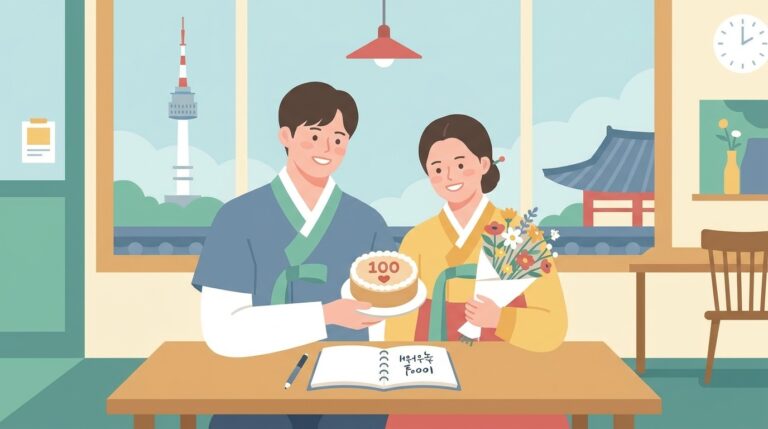
Phase 1: Empathy (Diving into Korean Romance)
안녕하세요! 매일한글 에디터입니다. (Hello! This is your Daily Hangul editor.)
Imagine this scenario: you’ve been dating an amazing person in Seoul for a little over three months. The romance feels like something straight out of a tvN drama—rooftop cafes in Itaewon, strolls along the Han River, and endless KakaoTalk messages filled with cute emojis. Then suddenly, your partner casually slips in: “벌써 다음 주면 우리 백 일인 거 알지?” (You know next week is already our 100th day, right?)
Your mind instantly races. Wait, 100 days? Is that an actual anniversary? Do we exchange gifts? Are we booking a five-star restaurant or just splitting fried chicken? What am I even supposed to say?
If you come from a culture where romantic milestones only start clicking at the one-year mark, the sheer velocity of Korean relationship anniversaries can feel overwhelming. In Korea, calculating relationship milestones is an art form—there are dedicated couple smartphone apps counting down every milestone from day 100 to day 1,000.
Over the past decade of coaching intermediate learners (B2 level), I’ve seen countless international daters freeze up not because their grammar was lacking, but because they didn’t know the exact emotional pitch and cultural nuances expected on these special days. Mastering these expressions will do more than help you survive the date; it will prove to your partner that you genuinely understand and respect how intimacy and dedication are expressed in modern Korean culture.
Phase 2: Core Expressions Deep Dive (핵심 표현 3선)
Here are three indispensable, natural B2-level phrases that every native speaker uses to mark milestone dates.
1. 우리 벌써 백 일이야? 시간 진짜 빠르다. (Uri beolsseo baeg-iriya? Sigan jinjja ppareuda.)
- Pronunciation: [oo-ri beol-sseo baek-il-ee-ya? shi-gan jin-jja bpa-reu-da] (Think of ‘beol’ like the ‘bul’ in bullet, and ‘jinjja’ with an emphatic snap).
- Meaning: Literal: “Are we already at 100 days? Time is really fast.” / Actual Nuance: “I can’t believe it’s already our 100th day! Time flies so fast when I’m with you.”
- K-Culture Moment: The quintessential opening line delivered across a candle-lit table in a cozy Yeonnam-dong bistro before the dessert arrives.
- Editor’s Insight: The magic here lies in “벌써” (already). It implies that every moment has been so effortless and enjoyable that time melted away without you noticing.
- Situation Spectrum: Casual ✅ | Semi-formal ⚠️ | Formal 🚫
- 🤔 Think About It: In many Western cultures, celebrating 100 days might be perceived as moving too fast or being clingy. Why do you think Korean society values early milestone markers so heavily?
2. 오늘을 위해 준비한 게 있어. (Oneureul wihae junbihan ge isseo.)
- Pronunciation: [oh-neu-reul wee-hae joon-bi-han geh ees-seo]
- Meaning: Literal: “I have something I prepared for today.” / Actual Nuance: “I’ve prepared a little something special just for today / for you.”
- K-Culture Moment: The moment the protagonist reaches into their coat pocket or pulls a delicately wrapped box from their tote bag.
- Editor’s Insight: Using “준비한 게 있어” focuses on the care, forethought, and effort rather than the material object itself. In Korean romance, thoughtfulness (정성) always beats a flashy price tag.
- Situation Spectrum: Casual ✅ | Semi-formal ✅ | Formal ⚠️
- 🤔 Think About It: Notice how this avoids the transactional word “선물” (present). How does focusing on the act of “preparation” change the intimacy of the gesture?
3. 앞으로도 지금처럼만 예쁘게 만나자. (Apeurodo jigeumcheoreomman yeoppeuge mannaja.)
- Pronunciation: [ap-eu-ro-do jee-geum-cheo-reom-man yeh-bpeu-geh man-na-ja]
- Meaning: Literal: “Let’s meet prettily in the future, just like right now.” / Actual Nuance: “Let’s keep cherishing and loving each other beautifully, just the way we do now.”
- K-Culture Moment: Handwritten inside the final line of a milestone greeting card (손편지).
- Editor’s Insight: The phrase “예쁘게 만나다” literally means “to date prettily.” It encapsulates a relationship free of unnecessary toxicity, drama, or mistrust—a harmonious, affectionate bond.
- Situation Spectrum: Casual ✅ | Semi-formal ⚠️ | Formal 🚫
- 🤔 Think About It: Translating “to date prettily” into English sounds unnatural. What cultural ideals of harmony and aesthetic romance are hidden in the Korean verb “예쁘게 만나다”?
Phase 3: Textbook Korean vs. Real Korean (교과서 한국어 vs 진짜 한국어)
Situation 1: Expressing amazement at reaching your 1-year mark
- 📖 교과서 한국어 (Textbook): “우리의 1주년을 축하합니다. 행복한 시간입니다.” (Uri-ui il-junyeoneul chukhahamnida. Haengbokhan sigan-imnida.) — “Congratulations on our 1st anniversary. It is a happy time.”
- 🗣️ 진짜 한국어 (Real Korean): “우리가 만난 지 벌써 1년이라니, 실감이 안 난다!” (Uriga mannan ji beolsseo il-nyeon-irani, silgami an nanda!) — “I can’t believe it’s already been a year since we started dating, it doesn’t even feel real!”
- 💡 Why the difference? Textbook phrasing sounds like an automated company newsletter. Real couples emphasize personal disbelief and wonder (“실감이 안 난다” – it doesn’t feel real).
Situation 2: Asking your partner about their anniversary plans or wishes
- 📖 교과서 한국어 (Textbook): “기념일에 무엇을 하고 싶습니까?” (Ginyeom-ire mueoseul hago sipseumnikka?) — “What would you like to do on our anniversary?”
- 🗣️ 진짜 한국어 (Real Korean): “기념일에 가보고 싶었던 데 있어? 예약해 둘게.” (Ginyeom-ire gabogo sipeotdeon de isseo? Yeyakhae dulge.) — “Is there anywhere you’ve been wanting to go for our anniversary? I’ll make a reservation.”
- 💡 Why the difference? At intermediate B2, proactive consideration is key. Offering to book (“예약해 둘게”) displays dependability and thoughtfulness, high virtues in Korean dating.
Phase 4: K-Culture Deep Dive & Non-Verbal Manners
4-1. Nunchi (눈치) & Non-Verbal Manners on Anniversaries
- The Two-Handed Handover: Even between couples who speak casually (반말), when presenting an anniversary gift, handing it over with both hands or supporting your right wrist with your left hand shows a gentle layer of respect and deep appreciation.
- The Letter Etiquette (손편지): In Korea, a luxury gift without a handwritten letter can feel hollow. Do not hand someone an open card; seal it in an envelope, often sealed with a wax stamp or a cute sticker. Expect your partner to read it in private or look visibly moved if they read it in front of you.
- Subtle Eye Contact & Smiles: Avoid aggressive, unblinking eye contact while waiting for their reaction to a gift. Keep a soft gaze, tilt your head slightly, and watch with warm attentiveness (눈치).
4-2. Cultural Codes: The 100-Day Milestone vs. The 1-Year Milestone
In Western dating, Day 1 is usually ambiguous—did it start at the first kiss or after the “exclusivity talk”? In Korea, couples explicitly define Day 1 (오늘부터 1일).
- The 100-Day (백일 – Baek-il): Originating historically from celebrating a baby’s survival through their first 100 days of delicate life, modern couples adopted this to celebrate surviving the initial trial period of a relationship. Typical celebrations include custom mini-cakes (도시락 케이크), matching couple rings (커플링), or an intimate dinner.
- The 1-Year (일 년 – Il-nyeon): This cements commitment. Couples often plan weekend getaways (호캉스 or pension trips to Gangneung/Jeju) and exchange higher-end gifts.
Phase 5: Real-World Roleplay Scenario
- Setting: A reservation-only wine bar in Ikseon-dong, illuminated by dim yellow Edison bulbs and soft jazz.
- Characters:
- 민호 (Minho): Your sweet, observant Korean partner of 100 days.
- Alex (You): An intermediate Korean learner celebrating your first major milestone together.
민호: "여기 분위기 진짜 좋다. 예약하느라 고생했어, Alex."
(Yeogi bunwigi jinjja jota. Yeyakhaneura gosaenghaesseo, Alex.)
[The atmosphere here is really great. You worked hard to book this, Alex.]
🎭 행동 지문: 메뉴판을 내려놓으며 당신을 다정하게 바라본다.

Alex: "마음에 든다니 다행이야. 오늘 우리 백 일이잖아!"
(Maeume deundani dahaeng-iya. Oneul uri baeg-irijana!)
[I'm so glad you like it. Today is our 100th day, after all!]
🎭 행동 지문: 쑥스러운 듯 웃으며 물잔을 매만진다.

민호: "맞아. 우리 처음 만난 날이 엊그제 같은데, 벌써 백 일이라니... 시간 진짜 빠르다."
(Maja. Uri cheoeum mannan nari eotgeuje gateunde, beolsseo baeg-irirani... sigan jinjja ppareuda.)
[Right. It feels like just yesterday when we first met, but it's already 100 days... Time flies so fast.]
🎭 행동 지문: 주머니에서 작은 리본 상자를 꺼내 테이블 위에 살며시 올려놓는다.

Alex: "어? 이게 뭐야? 설마 준비한 거야?"
(Eo? Ige mwoya? Seolma junbihan geoya?)
[Huh? What is this? Don't tell me you prepared something?]
🎭 행동 지문: 눈이 휘둥그레지며 손으로 입을 가린다.

민호: "별건 아니고, 우리가 같이 맞춘 첫 커플링이야. 앞으로도 지금처럼만 예쁘게 만나자고."
(Byeolgeon终端anigo, uriga gachi matchun cheot keopeulling-iya. Apeurodo jigeumcheoreomman yeoppeuge mannajago.)
[It's nothing extravagant, just our first matching couple rings. A promise to keep dating sweetly just like now.]
🎭 행동 지문: 상자를 조심스레 열어 반지를 보여주며 쑥스럽게 미소 짓는다.

Alex: "민호야... 진짜 감동이다. 나 손 떨려."
(Minhoya... jinjja gamdong-ida. Na son tteollyeo.)
[Minho... I'm truly touched. My hands are shaking.]
🎭 행동 지문: 떨리는 손으로 반지를 보며 민호의 눈을 응시한다.

민호: "직접 끼워줄게, 손 줘봐. 마음에 들어?"
(Jikjeop kkiwojulge, son jwobwa. Maeume deureo?)
[Let me put it on you, give me your hand. Do you like it?]
🎭 행동 지문: 당신의 왼손 네 번째 손가락에 조심스럽게 반지를 끼워준다.
🔀 Interactive Branching Moment
How do you respond to Minho after he slips the ring on your finger?
- Option A: “너무 예쁘다! 고마워. 사실 나도 오늘을 위해 준비한 게 있어. 이거 편지랑 작은 선물이야.” (It’s so pretty! Thank you. Actually, I also prepared something for today. Here is a letter and a small gift.)
- Option B: “반지 비싸 보인다! 다음 1주년에는 내가 더 비싼 거 사줄게.” (The ring looks expensive! I’ll buy an even more expensive one for our 1-year anniversary.)
- Option C: “백 일인데 반지는 좀 부담스러운데… 그래도 고마워.” (A ring is a bit overwhelming for 100 days… but thanks anyway.)
- Feedback on Choice A (Best): 🌟 Perfect! You match his sentimental gesture with emotional sincerity and reciprocity (준비한 게 있어 + 손편지). This strengthens relationship bonds deeply.
- Feedback on Choice B (Bad): ⚠️ Awkward. Focusing purely on the financial cost turns an emotional, romantic milestone into a financial competition.
- Feedback on Choice C (Risk): 🚫 Dangerous! While honesty is good, couple rings (커플링) on the 100th day are a standard cultural symbol of affection in Korea, not an engagement proposal. Refusing it like this can crush your partner’s feelings.
Phase 6: 10-Second Emotion Shadowing Drill
Read these lines aloud, observing the pauses (/) and capturing the precise emotional delivery:
[😊 설레고 감격스럽게 - Excited & Gushing]
“우리가 만난 지 벌써 백 일이라니, / 진짜 꿈만 같다!”
(Uriga mannan ji beolsseo baeg-irirani, / jinjja kkumman gatda!)
“I can’t believe we’ve been together for 100 days already, / it really feels just like a dream!”-
[🥺 진심을 담아 애틋하게 - Sincere & Tenderly]
“부족한 나 데리고 만나느라 고생 많았지? / 항상 고마워.”
(Bujokhan na derigo mannaneura gosaeng manatji? / Hangsang gomawo.)
“It must not have been easy dating someone imperfect like me, right? / Thank you, always.” -
[🥰 다정하고 약속하듯이 - Sweet & Pledging]
“앞으로도 서운한 거 있으면 바로 말하고, / 지금처럼만 예쁘게 만나자.”
(Apeurodo seounhan geo isseumyeon baro malhago, / jigeumcheoreomman yeoppeuge mannaja.)
“Going forward, if something upsets you let’s talk right away, / and let’s keep dating beautifully just like now.”
Phase 7: K-Culture Mini Dictionary (기념일 필수 어휘)
- 백일 (Baek-il) | 100-Day Anniversary
Usage: The very first formal milestone in Korean relationship culture. Usually celebrated on the exact 100th day calculated from Day 1. - 커플링 (Keopeulling) | Couple Ring
Usage: Silver or simple gold matching bands worn on the left ring finger. In Korea, this denotes “we are happily taken”—not an engagement. - 손편지 (Son-pyeonji) | Handwritten Letter
Usage: The emotional centerpiece of any Korean anniversary. Without it, even expensive gifts can feel incomplete. - 기념일을 챙기다 (Ginyeom-ireul chaenggida) | To celebrate / take care of an anniversary
Usage: Active collocation. Example: “내 남자친구는 사소한 기념일도 다 챙겨줘.” (My boyfriend commemorates even minor anniversaries.)
Phase 8: Survival Kit for Travelers & Expats
Top 3 On-the-Spot Survival Expressions
- “혹시 케이크에 레터링 가능한가요?” (Hoksi keikeue reteoring ganeunghangayo?)
Pro Tip: Use this at trendy cake bakeries to ask if you can write a customized phrase (e.g., “Minho ♥ Alex 100일”) on a bento cake. - “창가 쪽 조용한 자리로 부탁드릴게요.” (Chang-ga jjok joyonghan jariro butakdeurilgeyo.)
Pro Tip: Say this when booking restaurants in Seongsu or Apgujeong to secure romantic, quiet seating. - “포장 예쁘게 해주실 수 있나요?” (Pojang yeoppeuge haejusil su innayo?)
Pro Tip: Ask retail or flower shops to wrap your gift nicely for an anniversary presentation.
Editor’s Travel Note
When planning milestone dates in Korea, avoid walking in without a booking. Utilize the CatchTable restaurant reservation app to book sought-after anniversary dining spots in advance. To navigate scenic routes, couple photo studios, or pick-up bakeries smoothly, download the Naver Map navigation app, which gives real-time pedestrian and subway directions across Seoul.
Phase 9: “한 발 더 깊이” (Cultural Reflection)
Why do Koreans count days instead of simply years? Historically and sociologically, contemporary Korean society moves at a rapid pace (Ppalli-ppalli culture). Surviving the intense stress of education and career culture requires everyday solidarity. Reaching 100 days, 200 days, or 1 year serves as emotional oasis check-ins, allowing two people to reassure each other: “In this hectic city, we are surviving and thriving together as a team.”
💬 Your Turn: In your home country, what is the first major milestone a couple celebrates? Would you enjoy counting every 100 days with an app, or does it sound exhausting? Share your thoughts in the comments below!
Phase 10: FAQ & Common Mistakes
Q: What is the difference between 백일 (dating) and a baby’s 백일?
A: While both share the name 백일 (100 days), a baby’s 100th day involves a traditional family feast (백일상) with rice cakes (백설기). For couples, it is an intimate date focused on celebrating the first milestone of their relationship.
Q: Which day is actually Day 1 in Korea? Do we count the day we confess?
A: Yes! In Korea, the day you both agree to date is Day 1, not Day 0. Thus, your 100th day is 99 days after you start dating. Use popular Korean dating apps to avoid math errors!
Q: On which finger do Koreans wear couple rings (커플링)?
A: Almost exclusively on the left-hand ring finger (the fourth finger). Don’t panic if your partner wears it there; it represents committed dating, not marriage!
🚨 Common Mistakes Alert!
| Mistake | Why It Happens | Correct Action |
|---|---|---|
| Counting Day 1 as Day 0 | Western calendars start counting 1 day after an event occurs. | Count confession day as Day 1, or download a D-Day counter app. |
| Skipping the Handwritten Letter | Thinking an expensive meal or designer gift is enough. | Always write a sincere 손편지, even if it is just 5-6 sweet Korean sentences. |
| Confusing 반말 and 존댓말 in cards | Mixing polite endings with intimate confessions randomly. | Match your verbal intimacy level. If you speak casually, keep the letter in warm 반말. |
Phase 11: Action Missions
- 🥉 Bronze Mission (Solo Practice): Practice saying “우리 벌써 백 일이야? 시간 진짜 빠르다” three times in front of the mirror with a natural, affectionate smile.
- 🥈 Silver Mission (Social Media): Post a picture of your favorite romantic K-Drama couple or your own date spot with the caption: “앞으로도 예쁘게 만나자!”
- 🥇 Gold Mission (Real-life Execution): Write a 3-sentence Korean handwritten letter (손편지) to your partner or language exchange partner expressing gratitude for the time spent together.
- 🎮 K-Culture Mission: Watch an episode of a dating reality show like Single’s Inferno (솔로지옥) or Transit Love (환승연애) and spot how couples talk about time passing together!
Phase 12: Interactive Quiz Challenge
1. Situation Judgment
Your Korean partner hands you a small box on your 100th day containing matching silver rings. What is the most culturally fitting response?
(A) “우리 아직 결혼할 때 아니잖아?” (Isn’t it too early for us to marry?)
(B) “고마워! 우리 첫 커플링이네. 앞으로도 예쁘게 만나자.” (Thank you! Our first couple ring. Let’s keep dating sweetly.)
(C) “다음 주까지 환불할 수 있어?” (Can we refund this by next week?)
👉 Click to reveal Answer & Explanation
Correct Answer: (B)
Explanation: Couple rings (커플링) signify dedication and dating exclusivity in Korea, not a marriage proposal. Thanking them and pledging to date sweetly (예쁘게 만나자) is the ideal reaction.
2. Fill-in-the-Blank
Complete the sentence expressing that you prepared something special:
“오늘을 _____ 준비한 게 있어.”
(A) 위해 (wihae)
(B) 때문에 (ttaemune)
(C) 통해서 (tonghaeseo)
👉 Click to reveal Answer & Explanation
Correct Answer: (A) 위해
Explanation: ~을/를 위해 means “for the sake of / in preparation for.” ~때문에 means “because of” (often with negative or causal connotations), and ~통해서 means “through/via.”
3. True or False: Cultural Fact
True or False: In Korea, you start counting your anniversary starting as “Day 0” on the confession day.
👉 Click to reveal Answer & Explanation
Correct Answer: False!
Explanation: The day you officially begin dating is counted as Day 1 (1일). That’s why the famous phrase says “오늘부터 1일!” (From today, it’s Day 1!).







