

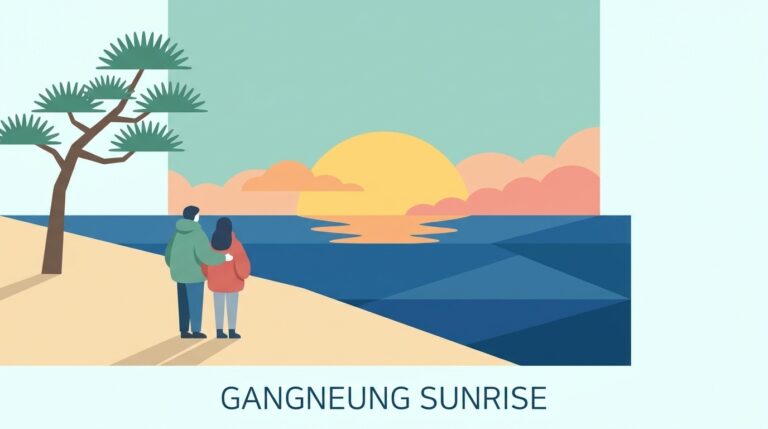
Phase 1: Empathy (Story-Immersive Opening)
안녕하세요! 매일한글 에디터입니다. (Hello! I’m your Daily Hangul editor.)
Picture this: It is 9:45 PM on a humid Thursday evening in Seoul. You and your Korean close friend are sitting in a dimly lit, noisy pocha (street pub) in Euljiro, surrounded by empty plates of stir-fried pork and half-drunk bottles of green soju. Your friend lets out a deep, heavy sigh, slumps against the plastic chair, and murmurs about endless project deadlines and a demanding manager. You want to offer a breath of fresh air. You want to say, “Let’s just drop everything this Saturday, jump on the early morning KTX, and go look at the deep blue waves of the East Sea!”
But suddenly, your brain freezes. How do you propose a spontaneous weekend getaway in Korean without sounding like an overbearing tour guide reading from a 2005 textbook? If you say something rigid like “동해에 관광하러 가시겠습니까?” (Donghaee gwangwanghareo gasigesseumnikka?), you will instantly turn a heartfelt, cozy moment into an awkward corporate meeting. On the other hand, just shouting “바다 가자!” (Bada gaja!) might feel a bit abrupt if you want to capture that specific, poetic Korean sentiment of needing an emotional reset by the open ocean.
Suggesting an escape to 동해 (Donghae – the East Sea) is one of the most culturally loaded, comforting rituals in modern Korean friendships. In this lesson, built on real feedback from intermediate learners just like you who felt stuck between robotic textbook grammar and genuine intimacy, we will master the art of inviting someone on an East Sea escape. By the end of this guide, you won’t just know the words—you’ll speak the exact emotional wavelength of a Seoulite craving the sea breeze.
Phase 2: In-Depth Analysis of 3 Key Expressions
1. 우리 이번 주말에 동해 바다 보러 갈래? (Uri ibeon jumare Donghae bada boreo gallae?)
- Pronunciation: [Uri ibeon jumare Donghae bada boreo gallae?] (Pronunciation tip: The ending “갈래?” sounds like saying “gal-leh?” with a soft, rising lilt like you’re gently tossing an idea into the air.)
- Meaning: Literal: “Shall we go see the East Sea ocean this weekend?” / Actual Nuance: “Hey, do you want to break free and catch some ocean views with me this weekend?”
- K-Culture Moment: Seen repeatedly in coming-of-age K-Dramas like Twenty-Five Twenty-One or Our Blues when characters need an escape from daily reality and look at each other with a mischievous spark.
- Editor’s Insight: The grammar point
-(으)ㄹ래(요)?is the gold standard for friendly suggestions. Unlike-(으)ㅂ시다(let’s do it), which sounds like an executive decision,-(으)ㄹ래?shows 배려 (baeryeo – consideration) by gently checking the other person’s mood and desire.- Situation Spectrum: Casual ✅ | Semi-formal (우리 이번 주말에 동해 바다 보러 갈래요?) ✅ | Formal 🚫
- 🤔 Think About It: In English, we often say “Let’s go to the beach,” focusing on swimming or sunbathing. Why do Koreans almost always say “바다 보러 가다” (go to see the sea) rather than just “go swimming”?
2. 바람 좀 쐬러 강릉 다녀오자. (Baram jom ssoereo Gangneung danyeooja.)
- Pronunciation: [Baram jom ssoereo Gangneung danyeooja.] (Pronunciation tip: “쐬러” sounds like “sso-eh-raw”—hit the double ‘ss’ with crisp, tense breath.)
- Meaning: Literal: “Let’s go and come back from Gangneung to expose ourselves to some wind.” / Actual Nuance: “Let’s make a quick trip to Gangneung to clear our heads and get some fresh air.”
- K-Culture Moment: The quintessential line spoken in office healing dramas when a trusted colleague notices someone burning out and offers a wholesome, quick road trip.
- Editor’s Insight:
바람을 쐬다 (barameul ssoeda)is one of the most culturally authentic Korean idioms. It doesn’t mean standing in front of an electric fan; it represents stepping away from a suffocating routine to refresh your mental state. Combining it with다녀오다 (danyeooda - to go and come back)reassures the listener that this won’t be an exhausting trek, but an easy, restorative day trip.- Situation Spectrum: Casual ✅ | Semi-formal (바람 좀 쐬러 강릉 다녀와요) ⚠️ | Formal 🚫
- 🤔 Think About It: How does your native language express the link between physical nature (like wind or water) and psychological healing?
3. 기차 타고 바다 보러 가면 딱이겠다. (Gicha tago bada boreo gamyeon ttagigetta.)
- Pronunciation: [Gicha tago bada boreo gamyeon ttagigetta.] (Pronunciation tip: “딱이겠다” begins with a sharp, punchy “ttak” sound, like clicking your tongue in satisfaction.)
- Meaning: Literal: “If we ride a train to see the sea, it would be just right.” / Actual Nuance: “Taking the train out to see the ocean would be absolute perfection right now.”
- K-Culture Moment: Often muttered when friends are sipping iced Americanos at a café, looking up the Gangneung KTX timetable on their phones, daydreaming of escaping city traffic.
- Editor’s Insight:
딱이다 (ttagida)means “to fit precisely” or “to be spot-on.” Adding the conjectural suffix-겠-(딱이겠다) softens the assertion into a shared daydream: “Wouldn’t that be heavenly?” It invites the other person to agree without putting pressure on them.- Situation Spectrum: Casual ✅ | Semi-formal (기차 타고 바다 보러 가면 딱이겠어요) ✅ | Formal ⚠️
- 🤔 Think About It: Why does pitching an idea as a hypothetical daydream feel more polite in Korean society than a direct plan?
Phase 3: Textbook Korean vs Real Korean
Situation 1: Proposing a getaway to a tired friend
- 📖 교과서 한국어 (Textbook): 동해안으로 여행을 떠나는 것이 어떻습니까? (Donghaeaneuro yeohaengeul tteonaneun geosi eotteoseumnikka? – How about departing on a trip to the East Coast?)
- 🗣️ 진짜 한국어 (Real-Life): 우리 동해 바다 보러 드라이브 갈래? (Uri Donghae bada boreo deuraibeu gallae? – Want to go for a drive to see the East Sea?)
- 💡 왜 다를까? Textbook Korean treats travel like an official expedition with heavy verbs like 떠나다 (to depart). Native speakers frame it around sensory activities—바다 보다 (seeing the sea) or 드라이브 가다 (going for a drive)—which feels immediate, casual, and romantic.
Situation 2: Explaining why you need this trip
- 📖 교과서 한국어 (Textbook): 저는 지금 스트레스가 심해서 휴식이 필요합니다. (Jeoneun jigeum seuteureseuga simhaeseo hyusigi piryohamnida. – I am currently under severe stress and need relaxation.)
- 🗣️ 진짜 한국어 (Real-Life): 가슴이 너무 답답해서 바다 보면서 멍 때리고 싶어. (Gaseumi neomu dapdaphaeseo bada bomyeonseo meong ttaerigo sipeo. – My chest feels so stuffy; I just want to stare blankly at the ocean waves.)
- 💡 왜 다를까? Instead of abstract clinical terms like 휴식 (relaxation), real Korean conversation leans on physical, visceral metaphors like 가슴이 답답하다 (stuffy/suffocated chest) and modern slang like 멍 때리다 (meong ttaerida – to space out / zone out peacefully).
Phase 4: K-Culture Deep Dive & Non-Verbal Manners
4-1. 눈치 (Nunchi) & Body Language: The Subtle Art of the East Sea Pitch
In Korea, you don’t just slam a travel brochure on someone’s desk. You gauge their 눈치 (nunchi – contextual situational awareness). Notice how your companion looks: Are their shoulders tensed? Are they sighing repeatedly? That is your green light.
* The Head Tilt & Soft Gaze: When proposing “동해 바다 보러 갈래?”, lower your volume slightly, tilt your head about 15 degrees, and maintain a warm, expectant gaze. This non-verbally conveys: “I see you’re suffering, and I’m offering an escape, not an obligation.”
* The Phone Glance: Pull out your phone and scroll to scenic photos of Gangneung or Sokcho, gently angling the screen toward them. Say, “여기 봐봐, 너무 예쁘지?” (Look at this, isn’t it gorgeous?) before dropping the formal question.
4-2. Cultural Code: Why the East Sea (동해) is Korea’s Emotional Sanctuary
Geographically, South Korea is surrounded by water on three sides, but each coast holds a completely different psychological archetype:
* 서해 (West Sea): Mudflats, calm tides, crimson sunsets. Ideal for contemplative solo walks.
* 남해 (South Sea): Warm, archipelago-dotted, tranquil fishing towns.
* 동해 (East Sea): Deep, cobalt-blue, crashing waves, and the birthplace of the sunrise (일출).
For Koreans living in the dense vertical concrete of the Seoul Metropolitan Area, the East Sea is uniquely cathartic. Because Gangwon Province is flanked by the massive Taebaek Mountain Range, arriving at the East Sea feels like breaking through a physical wall. Watching the sun surge above the horizon after an overnight highway drive or an early KTX-Eum train ride symbolizes renewal, washing away failure, and making new promises. When someone invites you to the East Sea, they aren’t just inviting you to a beach; they are offering you a reset button for your soul.
Phase 5: Real-Life Roleplay Scenario
Setting: A small, warm craft beer pub in Mangwon-dong on a rainy Friday evening.
Characters:
* You (민우 / Minwoo): An observant friend who senses your buddy is close to total burnout.
* 지수 (Jisoo): A hardworking designer who hasn’t left Gangnam in three months and looks completely depleted.
Turn 1
지수: 하아… 이번 주 내내 야근했더니 온몸이 부서질 것 같아.
(Haa… ibeon ju naenae yageunhaetdeoni onmomi buseojil geot gata.)
“Sigh… Working late every day this week feels like my whole body is breaking apart.”
🎭 [지수가 맥주잔을 만지작거리며 멍하니 테이블을 바라본다 / Jisoo fiddles with her beer glass, staring blankly at the table.]
Turn 2
민우: 지수야, 너 요즘 얼굴이 너무 안 좋아. 숨 좀 쉬어야 돼.
(Jisuya, neo yojeum eolguri neomu an joa. Sum jom swieoya dwae.)
“Jisoo, you look so worn out these days. You really need to catch your breath.”
🎭 [민우가 걱정스러운 눈빛으로 지수를 가만히 쳐다본다 / Minwoo looks at Jisoo with genuine concern.]
Turn 3
지수: 알아… 근데 주말에도 그냥 침대에 누워만 있을 것 같아서 더 우울해.
(Ara… geunde jumar-edo geunyang chimdaee nuwomyeon isseul geot gataseo deo u-ulhae.)
“I know… but thinking I’ll just end up lying in bed all weekend makes me feel even more depressed.”
Turn 4
민우: 그러면 우리 내일 아침에 동해 바다 보러 갈래?
(Geureomyeon uri naeil achime Donghae bada boreo gallae?)
“Then… want to head out to see the East Sea tomorrow morning?”
🎭 [민우가 살짝 장난기 어린 미소를 지으며 제안한다 / Minwoo suggests with a slight, playful smile.]
Turn 5
지수: 갑자기 동해? 너무 멀지 않아? 차도 막힐 텐데…
(Gapjagi Donghae? Neomu meolji ana? Chado makhil tende…)
“Suddenly the East Sea? Isn’t it way too far? The traffic will be awful too…”
🎭 [지수가 눈을 동그랗게 뜨며 놀란 표정을 짓는다 / Jisoo’s eyes widen in surprise.]
Turn 6
민우: 청량리에서 KTX 타면 강릉까지 한 시간 반이면 가! 바람 좀 쐬고 오자.
(Cheongnyangnieseo KTX tamyeon Gangneunggaji han sigan banimyeon ga! Baram jom ssoego oja.)
“If we take the KTX from Cheongnyangni, we’re in Gangneung in just an hour and a half! Let’s just go catch some fresh air.”
Turn 7
지수: 한 시간 반? 그렇게 빨라? 가서 맛있는 초당순두부도 먹고 올까?
(Han sigan ban? Geureoke ppalla? Gaseo masinneun chodang sundubudo meokgo olkka?)
“An hour and a half? It’s that fast? Should we go and grab some delicious Chodang soft tofu while we’re there?”
🎭 [지수의 표정이 환해지며 휴대폰을 꺼내 맛집을 검색한다 / Jisoo's face brightens up as she pulls out her phone to search for restaurants.]
Turn 8
민우: 바로 그거지! 바다 보면서 커피 한잔 마시면 딱이겠다. 지금 바로 예매하자!
(Baro geugeoji! Bada bomyeonseo keopi hanjan masimyeon ttagigetta. Jigeum baro yemaehaja!)
“Now you’re talking! Having a coffee overlooking the waves will be absolute perfection. Let’s book the tickets right now!”
🔀 Interactive Choice Point
How would you reply if Jisoo hesitated in Turn 5, saying: “돈도 많이 들고 피곤할 것 같은데…” (It sounds expensive and exhausting…)?
- Option A: “야, 인생 뭐 있어? 그냥 가자! 내가 쏠게!” (Hey, what is life anyway? Let’s just go! It’s on me!)
- Feedback (Risk): While generous, offering to pay for everything might make your Korean friend feel an uncomfortable sense of debt (부담감 / budamgam), causing them to decline harder.
- Option B: “그럼 그냥 집에서 잠이나 자자.” (Then let’s just sleep at home.)
- Feedback (Bad): Too dismissive and cold. It abruptly kills the emotional warmth you just established.
- Option C (BEST): “우리 당일치기로 가서 바다만 보고, 저녁에 일찍 돌아오자. 무리하지 말자.” (Let’s just do a quick day trip, see the sea, and come back early in the evening. No stress, let’s keep it light.)
- Feedback (Best!): Perfect B1-level empathy! Highlighting 당일치기 (day trip) and 무리하지 말자 (let’s not overdo it) dismantles their anxiety immediately while keeping the plan accessible.
Phase 6: 10-Second Emotion Shadowing Drill
Practice these lines out loud. The / marks represent natural pause and breath points.
[🥺 지쳐있는 친구를 조심스레 위로하듯 / Gently comforting an exhausted friend]
“너 요즘 / 너무 힘들어 보여. / 주말에 바람 좀 쐬러 가자.”
(Neo yojeum / neomu himdeureo boyeo. / Jumare baram jom ssoereo gaja.)-
[✨ 눈을 반짝이며 설레는 목소리로 / With sparkling eyes and an excited, adventurous tone]
“우리 내일 / KTX 타고 / 동해 바다 보러 갈래?”
(Uri naeil / KTX tago / Donghae bada boreo gallae?) -
[☕ 상상만 해도 힐링된다는 편안한 어조로 / In a relaxed tone, visualizing sheer bliss]
“탁 트인 바다 보면서 / 커피 한잔하면 / 진짜 딱이겠다.”
(Tak teuin bada bomyeonseo / keopi hanjanhamyeon / jinjja ttagigetta.)
Phase 7: K-Culture Mini Dictionary
-
당일치기 (Dang-il-chigi)
- Meaning: A day trip (leaving and returning on the same calendar day without an overnight stay).
- Real-world Usage: When asking busy Korean friends to travel, pitch it as “당일치기로 다녀오자”. It lowers psychological resistance by 80% because nobody needs to pack an overnight bag or book expensive lodging.
- 바람 쐬다 (Baram ssoeda)
- Meaning: To take in fresh air / to step out for a mental change of scenery.
- Real-world Usage: Frequently used in business and personal settings alike: “회의실에만 있으니까 답답하네. 옥상 가서 바람 좀 쐬고 올까?” (It feels stuffy staying only in the meeting room. Shall we head to the rooftop to get some fresh air?)
- 힐링 (Healing)
- Meaning: Rest, emotional restoration, therapy through relaxation (Konglish keyword).
- Real-world Usage: Essential buzzword for Korean travel culture. Restaurants, boutique pensions, forest trails, and oceanfront coffee shops in Gangneung are frequently labeled 힐링 코스 (healing courses).
- 일출 (Ilchul)
- Meaning: Sunrise.
- Real-world Usage: The iconic reason to visit the East Sea. Places like Jeongdongjin (정동진) and Homigot (호미곶) are world-famous for their 일출 명소 (sunrise hotspots). At New Year’s or during life milestones, millions travel to the East Coast overnight just to catch the 3-minute emergence of the sun.
Phase 8: Traveler’s Survival Kit
Top 3 Survival Phrases
- 강릉행 KTX 표 남아 있어요? (Gangneunghaeng KTX pyo nama isseoyo?)
- Translation: Are there any KTX tickets left bound for Gangneung?
- Pro Tip: Weekend trains to the East Coast sell out extremely fast. If tickets are sold out, ask the station agent for 입석 (ipseok – standing ticket) or 자유석 (jayuseok – unreserved seat)!
- 바다가 잘 보이는 자리로 부탁드려요. (Badaga jal boineun jariro butakdeuryeoyo.)
- Translation: Could we please have a seat with a good view of the ocean?
- Pro Tip: Use this when entering famous ocean-view cafes along Anmok Beach Coffee Street (안목해변 커피거리).
- 여기서 해돋이 보려면 몇 시에 나와야 돼요? (Yeogiseo haedoji boryeomyeon myeot sie nawaya dwaeyo?)
- Translation: What time do I need to come out to watch the sunrise from here?
- Pro Tip: 해돋이 (haedoji) is the native Korean word for 일출 (ilchul – sunrise) and sounds very natural when talking to guesthouse owners.
Editor’s Travel Note
- Transport Navigation: Forget global map apps; they lack full walking and public transit integration in Korea. Make sure to download the Naver Map app for real-time bus arrivals and walking paths along the coastal boardwalks.
- Train Reservations: For high-speed travel, check tickets directly on the KorailTalk app booking guide. The KTX-Eum from Seoul Station or Cheongnyangni Station delivers you right into Gangneung or Donghae City without the weekend highway gridlock.
Phase 9: “One Step Deeper” (Reflective Cultural Essay)
In many Western cultures, seeking solitude often means shutting yourself inside your room or booking an off-grid cabin in the woods. But in South Korea—where communal living, high-density apartments, and workplace expectations are tightly woven—true solitude is rarely found in isolation. Instead, it is found in shared escapes. When a Korean says, “우리 바다 보러 가자” (Let’s go see the sea), they are inviting you into a collective breathing space. Standing shoulder-to-shoulder, gazing into the identical horizon of the East Sea without exchanging words, constitutes one of the highest forms of emotional bonding (정 / Jeong) in Korean culture. It honors the unspoken exhaustion we carry while silently reaffirming that we don’t have to carry it alone.
💬 Your Turn: Have you ever taken an impromptu trip just to clear your head? If a close friend offered to take you to the East Sea right now, which Korean phrase from today would you say back to them? Share your thoughts in the comments below!
Phase 10: FAQ & Common Mistakes (FAQ Schema)
Q: Why do Koreans specify “동해 바다” instead of just “바다”?
A: While Koreans do say “바다 가자”, specifying 동해 바다 (Donghae bada – East Sea) carries a distinct imagery of deep, clean, wide-open water, dramatic waves, and high-speed KTX accessibility from Seoul. Calling out the East Sea evokes an immediate romantic, refreshing vision compared to the tidal mudflats of the West Sea.
Q: Can I use “-자” (-ja) with anyone when suggesting a trip?
A: Absolutely not! The ending -자 (e.g., 바다 보러 가자) is strictly 반말 (informal/casual language). Use it only with friends of the same age, younger people you have a close relationship with, or after mutually agreeing to drop honorifics. If you are speaking to an older acquaintance or coworker, use -(으)ㄹ래요? (e.g., 우리 바다 보러 갈래요?).
Q: What is the difference between “바다 보러 가다” and “해수욕하러 가다”?
A: 해수욕하러 가다 (haesuyokhareo gada) specifically means going to swim, sunbathe, and play in the seawater in a swimsuit, which only happens in peak summer (July-August). 바다 보러 가다 (bada boreo gada) means visiting the seaside to walk on the sand, feel the wind, enjoy a café, and watch the waves regardless of the season.
🚨 Common Mistakes Alert Board
- Mistake: Saying “동해로 여행을 제안합니다” (I propose a trip to the East Sea).
- Why it’s wrong: Sounds like a diplomatic treaty proposal.
- Correct Action: Say “우리 동해 바다 보러 갈래?” (Uri Donghae bada boreo gallae?).
- Mistake: Confusing 쐬다 (ssoeda) with 쉬다 (swida).
- Why it’s wrong: 쉬다 is just “to rest”, but saying “바람 좀 쉬다” is grammatically incorrect.
- Correct Action: The idiom is strictly “바람 좀 쐬다” (baram jom ssoeda).
- Mistake: Pronouncing 동해 as “Dong-ha-ae”.
- Why it’s wrong: “해” is pronounced smoothly as “hae” (rhymes with “say”).
- Correct Action: Pronounce it seamlessly as [Dong-hae].
Phase 11: Action Mission & Engagement
- 🥉 Bronze Mission (Solo Practice): Record a 10-second voice memo on your phone pretending to invite a friend to Gangneung: “지수야, 이번 주말에 바람 좀 쐬러 강릉 다녀오자!” Listen to your intonation on “다녀오자!”
- 🥈 Silver Mission (Social Media): Post a scenic photo of the ocean or a nature spot on Instagram with the Korean caption: “가슴이 뻥 뚫리는 바다 보러 가고 싶다 🌊 #동해바다 #힐링여행”.
- 🥇 Gold Mission (Real-life Execution): Next time you chat with a Korean friend, language exchange partner, or tutor who mentions they had a tough week, text them: “이번 주말에 바다 보러 갈래요? 딱이겠어요!”
🎮 K-Culture Mission: Watch an episode of any slice-of-life K-drama (like Hospital Playlist or Welcome to Samdal-ri) and listen carefully for when a character says “바람 좀 쐬고 올게” or suggests taking off for the coast. Write down the timestamp and the exact emotion on their face!
Phase 12: Interactive Quiz Challenge
1. Situational Judgment:
Your Korean friend Minji just failed a critical job certification exam and is sitting dejectedly at a diner. Which phrase shows the most sensitive 눈치 (nunchi) and comforting intent?
* (A) 시험 다시 보면 되니까 공부해라.
* (B) 우리 기분 전환도 할 겸, 동해 바다 보러 드라이브 갈래?
* (C) 동해안으로 단체 관광을 신청하십시오.
2. Fill-in-the-Blank:
Complete the sentence to mean: “Having a hot coffee while looking at the sea would be absolute perfection.”
* “바다 보면서 따뜻한 커피 마시면 ______________.”
3. True / False Cultural Check:
* Koreans only visit the East Sea during July and August to swim in the ocean. (True / False)
👉 Click here for Answers & Explanations!
- Answer: (B)
- Explanation: Option (B) “우리 기분 전환도 할 겸, 동해 바다 보러 드라이브 갈래?” (Shall we go for a drive to see the East Sea to clear our heads?) combines empathy (기분 전환 – changing one’s mood) with a gentle, non-pressuring invitation. (A) is harsh, and (C) is unnaturally formal.
- Answer: 딱이겠다 (ttagigetta)
- Explanation: 딱이다 means “to be perfect/ideal,” and adding -겠다 expresses that delightful hypothetical feeling: “It would be absolute perfection!”
- Answer: False
- Explanation: In Korea, winter ocean trips (겨울 바다 / gyeoul bada) and sunrise viewing (일출) are celebrated all year round. The East Sea is visited for mental healing, scenic cafes, and contemplation far more than just summer swimming!
- Explanation: In Korea, winter ocean trips (겨울 바다 / gyeoul bada) and sunrise viewing (일출) are celebrated all year round. The East Sea is visited for mental healing, scenic cafes, and contemplation far more than just summer swimming!







