

Phase 1: 공감 (Story-Immersive Opening)
안녕하세요! 매일한글 에디터입니다. Have you ever scrolled through Danggeun Market (당근마켓) or Bunjang (번개장터) hunting for that sold-out K-pop photocard or a stylish vintage windbreaker, only to freeze when opening the chat? You want to know if the item has scratches, stains, or worn-out edges, but you worry: “Will I sound rude if I ask too directly?” You definitely don’t want to receive a damaged jacket after paying hard-earned Won!
Asking about an item’s condition requires a gentle blend of politeness and clarity in Korean culture. This guide is crafted directly from our real A2 tutoring sessions to help you ask questions smoothly, protect your wallet, and trade with genuine local confidence.
Phase 2: 핵심 표현 3선 심층 분석 (3 Core Expressions)
1. 사용감 있어요? (Sayonggam isseoyo?)
- Pronunciation: [Sa-yong-gam is-seo-yo?] (Think: “Sigh-yong-gahm eat-seoy-yo”)
- Meaning: Literal: “Is there a feeling of use?” | Actual Nuance: “Does it show signs of wear and tear?”
- K-Culture Moment: In lifestyle vlogs or web dramas, you will often hear college students asking this before picking up a secondhand textbook or tablet from a local seller.
- Editor’s Insight: Koreans avoid blunt words like “Is this old?” or “Is it dirty?” Instead, the noun 사용감 (signs of use) gently softens the inquiry.
- Situation Spectrum: Casual: ✅ | Semi-formal: ✅ | Formal: ⚠️
- 🤔 Think About It: Why does Korean focus on the “feeling of use” rather than labeling an item “damaged”? How does indirect speech protect interpersonal harmony?
2. 흠집이나 하자 있어요? (Heumjib-ina haja isseoyo?)
- Pronunciation: [Heum-jib-i-na ha-ja is-seo-yo?] (Think: “Hoom-jeeb-ee-nah ha-jah eat-seoy-yo”)
- Meaning: Literal: “Are there flaws or defects?” | Actual Nuance: “Does it have any scratches, dents, or functional defects?”
- K-Culture Moment: Commonly typed in Karrot Market chat rooms when buying pre-owned smartphones or collectible merchandise.
- Editor’s Insight: 흠집 refers to cosmetic blemishes (scratches), while 하자 denotes functional faults. Combining both covers all your bases politely.
- Situation Spectrum: Casual: ⚠️ | Semi-formal: ✅ | Formal: ✅
- 🤔 Think About It: In English, we might ask “Is anything broken?” Notice how Korean splits cosmetic and functional issues into two distinct concepts.
3. 실물 사진 더 볼 수 있을까요? (Silmul sajin deo bol su isseulkkayo?)
- Pronunciation: [Sil-mul sa-jin deo bol su it-seul-kka-yo?] (Think: “Seel-mool sah-jeen duh bohl soo eat-seul-kkah-yo”)
- Meaning: Literal: “Could I possibly see more photos of the real object?” | Actual Nuance: “Would you mind sharing a few more close-up photos of the actual item?”
- K-Culture Moment: Frequently seen in online K-Pop trading communities on X (formerly Twitter) before transferring money for rare idol merchandise.
- Editor’s Insight: Ending with -ㄹ 수 있을까요? adds a layer of humble deference, transforming a demand into a very respectful request.
- Situation Spectrum: Casual: ⚠️ | Semi-formal: ✅ | Formal: ✅
- 🤔 Think About It: How does changing a statement into a gentle hypothetical question change the mood of an online transaction?
Phase 3: 교과서 한국어 vs 진짜 한국어 (Textbook vs. Real Korean)
Situation 1: Asking if an item is completely new
- 📖 교과서 한국어: 이것은 새 제품입니까? (Igeoseun sae jepum-imnikka? / “Is this a new product?”)
- 🗣️ 진짜 한국어: 미개봉 새상품 맞나요? (Migaebong saesangpum mannayo? / “Is it an unopened, brand-new item, right?”)
- 💡 왜 다를까?: Native traders prefer specific terms like 미개봉 (unopened box) and end with ~맞나요? to confirm details naturally and casually.
Situation 2: Asking where scratches are located
- 📖 교과서 한국어: 손상된 부분이 어디에 있습니까? (Sonsangdoen bubun-i eodie itseumnikka? / “Where is the damaged part?”)
- 🗣️ 진짜 한국어: 기스 난 곳 사진 찍어주실 수 있나요? (Giseu nan got sajin jjigeo-jusil su innayo? / “Could you snap a photo of where the scratch is?”)
- 💡 왜 다를까?: 기스 (colloquial for scratch) paired with a visual request is far more practical than asking textbook-style abstract questions.
Phase 4: K-Culture 딥다이브 & 비언어적 매너 (Culture & Non-Verbal Manners)
4-1. 눈치 (Nunchi) & Gestures during In-Person Trades (직거래)
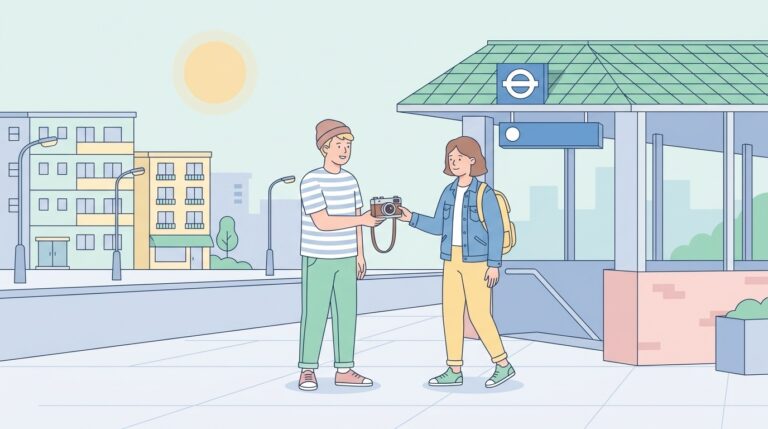
When meeting at a subway exit, never aggressively inspect the item within two inches of the seller’s nose. Use two hands when receiving the item (두 손으로 받기), step back slightly to check the corners with a calm expression, and say a soft “아, 깨끗하네요!” (Oh, it looks clean!) before handing over cash or completing the bank transfer.
4-2. Cultural Code: 당근마켓 매너온도 (Manner Temperature)
In South Korea’s premier neighborhood app, Karrot Market, every user starts at 36.5°C (human body temperature). If you ask questions overly aggressively or demand discounts rudely, your rating drops. Polite questions about condition preserve the seller’s good mood and your own temperature!
Phase 5: 실전 롤플레이 시나리오 (Roleplay Dialogue)
- Background: You are meeting a seller named Minji near Hongik University Station Exit 3 to purchase a secondhand film camera.
-
Turn 1 (Seller Minji): 안녕하세요! 카메라 보러 오신 분 맞으시죠? (Annyeonghaseyo! Kamera boreo osin bun majeosijyo? / “Hello! You are here to see the camera, right?”)
🎭 Hands over the small pouch gently with both hands. - Turn 2 (You): 네, 맞아요! 상태 확인 잠깐 해도 될까요? (Ne, majayo! Sangtae hwagin jamkkan haedo doelkkayo? / “Yes, that’s right! May I check the condition for a moment?”)
🎭 Smiling softly while accepting the camera. - Turn 3 (Seller Minji): 네, 천천히 보세요. 렌즈 캡 열어보셔도 돼요. (Ne, cheoncheonhi boseyo. Renjeu kaep yeoreobosyeodo dwaeyo. / “Sure, take your time. You can take off the lens cap.”)
🎭 Steps back half a step to give you space. - Turn 4 (You): 혹시 렌즈에 기스나 먼지 있나요? (Hoksi renjeue giseuna meonji innayo? / “By any chance, are there scratches or dust on the lens?”)
🎭 Holding the camera toward the light respectfully. - Turn 5 (Seller Minji): 아, 렌즈는 필터 끼고 써서 완전 깨끗해요! (A, renjeuneun pilteo kkigo sseoseo wanjeon kkaekkeuthaeyo! / “Ah, I always used a filter, so the lens is completely clean!”)
🎭 Points gently toward the clean glass element. - Turn 6 (You): 작동은 다 잘 되죠? (Jakdongeun da jal doejo? / “Everything works properly, right?”)
🎭 Testing the shutter button carefully. - Turn 7 (Seller Minji): 네! 배터리도 새로 넣어뒀어요. (Ne! Baeteorido saero neoeodwoesseoyo. / “Yes! I even inserted a fresh battery for you.”)
🎭 Smiles warmly. - Turn 8 (You): 와, 설명대로 사용감 거의 없네요. 감사합니다! (Wa, seolmyeongdaero sayonggam geoui eomneyo. Gamsahamnida! / “Wow, just as described, there’s barely any sign of use. Thank you!”)
🎭 Prepares to make the payment transfer.
🔀 Interactive Choice Branch
After checking the camera, you notice a tiny scratch on the bottom baseplate. What do you say?
* Choice A: “여기 기스 있는데 깎아주세요.” (There’s a scratch here, give me a discount.)
* Choice B: “아, 밑에 작은 스크래치가 살짝 있네요! 작동에는 문제없죠?” (Ah, there’s a tiny scratch on the bottom! It doesn’t affect operation, right?)
* Choice C: “이거 불량품인데요? 환불해주세요.” (This is defective! Refund me now.)
Feedback:
* Choice A (Risk): Demanding an unannounced discount on-site (현장 네고) is considered very bad manners in Korea and will ruin the deal.
* Choice B (Best): Perfect! You politely acknowledge cosmetic wear without being confrontational or accusing the seller.
* Choice C (Bad): Calling a pre-owned cosmetic scratch a “defective product” (불량품) creates immediate awkward tension.
Phase 6: 10초 감정 섀도잉 드릴 (10-Second Emotional Shadowing)
[😊 Polite & Inquiring]
실제 / 사용감은 / 어느 정도인가요?
(Silje / sayonggam-eun / eoneu jeongdo-ingayo? / “How much wear and tear is there in reality?”)-
[🥺 Careful & Soft]
혹시 / 눈에 띄는 / 흠집이 / 있을까요?
(Hoksi / nun-e ttwineun / heumjib-i / isseulkkayo? / “By any chance, is there any noticeable scratch?”) -
[✨ Pleasant & Assured]
생각보다 / 상태가 / 진짜 / 좋네요!
(Saenggakboda / sangtaega / jinjja / jonneyo! / “The condition is really better than I expected!”)
Phase 7: K-Culture 미니 사전 (Mini Dictionary)
-
미개봉 (Migae-bong) | Unopened Box
Used to describe an item in its original factory-sealed packaging. Highly sought-after for electronics and cosmetics. -
풀박스 (Pul-bak-seu) | Full Box Set
Refers to an item that retains all original accessories, cables, manuals, and retail packaging. -
직거래 (Jik-geo-rae) | In-Person Direct Deal
Meeting the seller face-to-face (often at a subway station gate) to verify condition and pay directly. -
네고 (Ne-go) | Negotiation (Price Discount)
Short for negotiation. Tip: Always check if the listing says “네고 불가” (No bargaining allowed) before asking!
Phase 8: 여행자를 위한 생존 키트 (Traveler’s Survival Kit)
Survival Expressions TOP 3
- 작동 잘 돼요? (Jakdong jal dwaeyo?) – “Does it work well?”
Pro Tip: Crucial when buying second-hand vintage electronics or K-pop lightsticks. - 실물 색상이랑 사진이랑 똑같나요? (Silmul saeksang-irang sajin-irang ttokgannayo?) – “Does the real color match the photo?”
Pro Tip: Essential for pre-loved fashion and streetwear. - 혹시 언제 구매하셨어요? (Hoksi eonje gumaehasyeosseoyo?) – “By any chance, when did you purchase it?”
Pro Tip: A gentle way to estimate how old an appliance or gadget is.
Editor’s Travel Note
Before entering transactions, consult the Karrot Market official app download guide to understand local community guidelines. Remember that local sellers prefer instant mobile transfers (계좌이체) via Korean bank apps or crisp, exact paper cash for in-person subway transactions.
Phase 9: “한 발 더 깊이” (Cultural Reflection)
In South Korea, secondhand trading is not just an economic transaction; it is a manifestation of neighborhood trust and social harmony. Phrases like 사용감 (feeling of use) exist so people can assess objects critically without making human interactions abrasive. When you ask about an item’s condition with empathy, you show respect for both the seller and the journey the item has lived.
💬 Your Turn: What is the most important question you ask when buying secondhand items in your home country? Share with us in the comments below!
Phase 10: FAQ & 흔한 실수 (FAQ & Common Mistakes)
Q: Can I ask the seller for a video of the item working?
A: Yes, absolutely! You can write: “혹시 작동하는 영상 보여주실 수 있나요?” (Could you show me a video of it operating?). Sellers of electronics are usually happy to oblige.
Q: What does “S급” (S-geub) or “A급” (A-geub) mean in Korean listings?
A: Koreans use grade levels to classify item conditions. “S급” means practically brand-new, while “A급” means very light signs of use with zero functional problems.
Q: Is it okay to ask for a refund if I discover scratches later?
A: In Korean secondhand culture, once a direct deal (직거래) is finalized, refunds for cosmetic flaws are generally not accepted. Inspect thoroughly on site!
🚨 흔한 실수 (Common Mistakes) 경고판
- Mistake 1: Saying “이거 더러워요?” (Is this dirty?).
Correct Action: Use “사용감 있나요?” (Are there signs of use?) to keep the conversation polite. - Mistake 2: Asking for price cuts immediately after asking about flaws.
Correct Action: Clarify item condition first, then negotiate gently only if the post allows negotiation. - Mistake 3: Not showing up on time for an in-person meetup (잠수/노쇼).
Correct Action: Always message 10 minutes ahead if you are running late via subway.
Phase 11: 액션 미션 & 참여 유도 (Action Missions)
- 🥉 Bronze Mission: Stand before a mirror and repeat 사용감 있어요? 5 times with a bright, curious intonation.
- 🥈 Silver Mission: Find a photo of a secondhand item you own and write two sentences describing its condition in Korean in your study journal.
- 🥇 Gold Mission: Open a secondhand app or online community and ask a seller politely for condition details using our Phase 2 expressions!
- 🎮 K-Culture Mission: Watch an episode of a Korean variety show (like Hangout with Yoo or an idol flea market vlog) and spot how stars barter second-hand items!
Phase 12: 인터랙티브 퀴즈 챌린지 (Interactive Quiz)
1. Situational Judgment: You want to know if a jacket has stains before meeting the seller. What is the best phrase?
* A) 왜 이렇게 더러워요? (Why is it so dirty?)
* B) 혹시 오염이나 얼룩 있나요? (By any chance, are there stains or smudges?)
* C) 옷 버릴 건가요? (Are you throwing this clothes away?)
2. Fill-in-the-Blank: Complete the polite request: “혹시 실물 사진 더 볼 수 ____?”
* (Hint: “Could I possibly see…?”)
3. True / False Cultural Quiz: In Korea, it is polite to aggressively negotiate the price in person at the meeting spot even if the seller stated “네고 불가”. (True / False)
Click here to reveal answers & explanations!
- Answer: B – 오염 (stain) and 얼룩 (smudge) combined with 혹시 creates a polite, clear inquiry.
- Answer: 있을까요 (isseulkkayo) – The complete phrase is “혹시 실물 사진 더 볼 수 있을까요?”
- Answer: False – Bargaining on-site when “네고 불가” was stated will significantly harm your buyer reputation and may cancel the sale immediately.







