

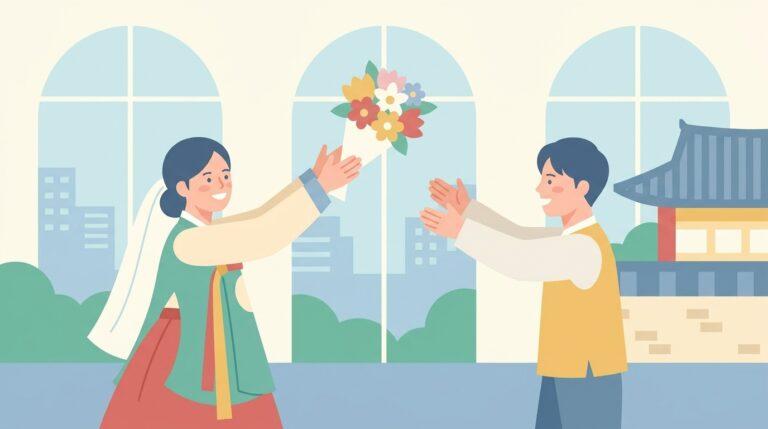
Phase 1: Empathy (Catching the Bouquet Without the Panic!)
안녕하세요! 매일한글 에디터입니다.
Picture this: You are dressed in your best semi-formal outfit, admiring the floral arches of a chic wedding hall in Gangnam. You’ve watched countless K-dramas where the bride playfully tosses her bouquet and a crowd of single friends scramble across the floor in slow-motion slapstick to grab it. Suddenly, your friend—the bride—looks right at you, beams, and says, “Here it comes!”
Your heart skips a beat. Wait, am I supposed to dive across the carpet? What if I drop it? What do I say when dozens of flashbulbs pop in my face?
If the thought of being called up in front of a hundred Korean wedding guests gives you butterflies, take a deep breath! In Korea, bouquet catching is actually a warm, beautifully choreographed tradition—and nobody expects you to tackle anyone. Based on real questions from our Daily Hangul beginner students, this guide breaks down the exact words, body language, and cultural etiquette you need so you can step onto the stage with total confidence, even if this is your very first week learning Korean.
Phase 2: Essential Expressions for the Big Moment
1. 축하해요! (Chukhahaeyo!)
- Pronunciation: Chook-ha-hae-yo (Sounds like a cheerful steam engine train going “Choo!” followed by “ha-hae-yo”).
- Meaning: Literal: “[I] celebrate!” | Nuance: “Congratulations!”
- K-Culture Moment: You will hear this everywhere from drama wedding scenes to friends celebrating a new job. It is the gold standard of joyful celebration.
- Editor’s Insight: At level A1, dropping the complicated honorifics and sticking with -해요 (-haeyo) keeps your tone polite, natural, and friendly without sounding like a robotic textbook.
- Situation Spectrum:
- Casual: ⚠️ (Use 축하해! with same-age close friends)
- Semi-formal: ✅ (Perfect for peers, colleagues, and friendly weddings)
- Formal: ⚠️ (Use 축하드립니다 for senior bosses or grandparents)
- 🤔 Think About It: In English, we say “congratulations” to both the groom and the bride. In Korean, 축하해요 shares the joy equally with both partners!
2. 잘 받을게요! (Jal badeulgeyo!)
- Pronunciation: Jahl bah-deul-geh-yo (Jal rhymes with the musical note “sol”, badeul sounds like “bah-dull”).
- Meaning: Literal: “I will receive [it] well!” | Nuance: “I’ll catch it safely! Don’t worry!”
- K-Culture Moment: Said right before the bride turns her back to toss the flowers. It reassures everyone that you are ready and paying attention.
- Editor’s Insight: The word 잘 (jal) means “well” or “skillfully.” Adding it shows warmth and enthusiasm—it’s like saying, “I got your back!”
- Situation Spectrum:
- Casual: ⚠️ (Use 잘 받을게! with close besties)
- Semi-formal: ✅ (Polite, sweet, and ideal for the photographer’s cues)
- Formal: 🚫 (Rarely used in strict formal address)
- 🤔 Think About It: Why does Korean emphasize “receiving well” rather than just “catching”? It turns an athletic feat into an act of receiving a cherished gift.
3. 행복하세요! (Haengbokhaseyo!)
- Pronunciation: Haeng-bok-ha-seh-yo (Haeng sounds like “hang” with an open vowel, bok like “book” with a crisp end).
- Meaning: Literal: “Please be happy!” | Nuance: “Wishing you a lifetime of happiness together!”
- K-Culture Moment: Whispered during the quick hug or photo session right after you catch the flowers.
- Editor’s Insight: Unlike English, which often focuses on the wedding day itself, Korean wedding wishes look ahead to the couple’s entire everyday journey together.
- Situation Spectrum:
- Casual: ⚠️ (To close friends, say 행복해라! or 잘 살아!
- Semi-formal: ✅ (Warm and very respectful)
- Formal: ✅ (Always safe and polite)
- 🤔 Think About It: Why do Koreans wish for “happiness” rather than just “good luck”? Reflect on how Korean blessings focus on harmony and peace in the household.
Phase 3: Textbook Korean vs. Real Korean
Situation 1: Congratulating the Bride in the Waiting Room (신부대기실)
- 📖 Textbook Korean:
- 결혼을 진심으로 축하드립니다. (Gyeorhoneul jinsimeuro chukhadeurimnida.)
- “I sincerely offer my congratulations on your marriage.”
- 🗣️ 진짜 한국어 (Real Korean):
- 오늘 진짜 예뻐요! 결혼 축하해요! (Oneul jinjja yeppeoyo! Gyeorhon chukhahaeyo!)
- “You look so pretty today! Congratulations on the wedding!”
- 💡 왜 다를까? (Why is it different?):
- The textbook version is ultra-formal, suitable for a corporate speech or greeting the bride’s grandparents. When talking directly to a friend or friendly peer, complimenting how gorgeous they look with 진짜 예뻐요 breaks the ice instantly.
Situation 2: Accepting the Request to Catch the Bouquet
- 📖 Textbook Korean:
- 제가 부케를 수령하도록 하겠습니다. (Jega bukereul suryeonghadorok hagetseumnida.)
- “I shall receive the bouquet.”
- 🗣️ 진짜 한국어 (Real Korean):
- 와, 제가 받아요? 잘 받아볼게요! (Wa, jega bad-ayo? Jal bad-abolgeyo!)
- “Wow, is it me? I’ll do my best to catch it!”
- 💡 왜 다를까? (Why is it different?):
- In real life, Korean speakers use expressive particles (와!) and dynamic verbs (받아볼게요 – “I’ll try my best to receive it”) to convey joyful humility rather than business-meeting acceptance.
Phase 4: K-Culture Deep Dive & Non-Verbal Manners
4-1. 눈치 (Nunchi) & Stage Gestures
In Korean weddings, the bouquet toss is not a free-for-all scrimmage. The bouquet catcher is chosen weeks in advance! If you are chosen, here is your playbook:
* Two-Hand Ready Pose: Stand about 2.5 to 3 meters behind the bride. Keep both hands open in front of your chest. Catching with two hands shows respect and prevents embarrassing drops.
* The Re-Do Smile: If the flowers fall to the floor, do not panic! The photographer will almost always ask the bride to throw it 2 or 3 times to get the perfect shot from different angles. Just laugh politely, pick it up, and reset your stance.
* Eye Contact with the Photographer: Listen for the photographer’s cues (“하나, 둘, 셋!” – One, two, three!). React with genuine smiles rather than competitive athletic seriousness.
4-2. Culture Code: The 6-Month Myth
Why is the bouquet catcher chosen in advance? Korean popular lore says that whoever catches the bouquet must get married within 6 months, or else they won’t get married for 3 years!
While today’s younger generation treats this as a fun, affectionate superstition, brides usually ask a close friend who is already engaged or dating someone seriously to be the designated 부케순이 (Bouquet-suni). If you are single and asked to catch it, it simply means the couple considers you one of their dearest friends and wants you to receive the blessing of good love!
Phase 5: Real-Life Roleplay Scenario
Setting: The main hall at a wedding venue in Seoul. The ceremony has just ended, and the photographer is lining up guests for the commemorative photos. Minji, the bride, spots you.
Character NPC: Minji (민지) – The beaming bride holding a pastel rose bouquet.
Player: You (Alex) – A supportive friend attending your first Korean wedding.
- Turn 1 (Minji): 알렉스 씨, 사진 찍으러 이쪽으로 와요!
(Alex-ssi, sajin jjigeureo ijjogeuro wayo!)
“Alex, come over this way for photos!”
🎭 Waving her hand gently with a bright smile. -
Turn 2 (You): 네! 오늘 진짜 예뻐요!
(Ne! Oneul jinjja yeppeoyo!)
“Yes! You look so pretty today!”
🎭 Walking up with two hands lightly clasped in front. -
Turn 3 (Minji): 고마워요. 알렉스 씨, 오늘 부케 잘 받아줘요!
(Gomawoyo. Alex-ssi, oneul buke jal bad-ajwoyo!)
“Thank you. Alex, please catch the bouquet nicely today!”
🎭 Gesturing toward the floral bouquet with a twinkle in her eye. -
Turn 4 (You): 걱정 마세요, 잘 받을게요!
(Geokjeong maseyo, jal badeulgeyo!)
“Don’t worry, I’ll catch it well!”
🎭 Smiling and giving an encouraging nod. -
Turn 5 (Photographer): 자, 신부님 던집니다! 하나, 둘, 셋!
(Ja, sinbunim deonjimnida! Hana, dul, set!)
“Alright, bride is tossing! One, two, three!”
🎭 Holding up a high-end DSLR camera lens. -
Turn 6 (You): 와, 잡았다!
(Wa, jab-atda!)
“Wow, caught it!”
🎭 Catching the bouquet securely with both hands and beaming at the camera. -
Turn 7 (Minji): 대박! 한 번에 잘 잡았어요!
(Daebak! Han beone jal jab-asseoyo!)
“Awesome! You caught it in one try!”
🎭 Clapping softly with pure relief. -
Turn 8 (You): 감사합니다! 두 분 행복하세요!
(Gamsahamnida! Du bun haengbokhaseyo!)
“Thank you! Wishing you both a lifetime of happiness!”
🎭 Giving a respectful mini-bow while holding the flowers carefully.
🔀 Interactive Decision Point: What do you do right after catching the bouquet?
- Option A: Run around the hall cheering and spike the flowers like a touchdown football.
- Feedback: [Bad 🚫] A classic K-drama disaster! Wedding bouquets are delicate fresh flowers. Spiking or waving them frantically can break the stems and ruin the formal photo session.
- Option B: Stand right beside the bride and groom, hold the bouquet gently at waist height with both hands, and smile for the camera.
- Feedback: [Best ⭐] Perfect 100-point Korean manners! You create an elegant commemorative photo (원판 사진) that the couple will cherish forever.
- Option C: Hide behind another guest because you feel shy about your outfit.
- Feedback: [Risk ⚠️] The photographer will pause everything and search for the bouquet catcher! Stepping up promptly keeps the fast-paced wedding schedule running smoothly.
Phase 6: 10-Second Emotion Shadowing Drill
Practice reading these lines aloud. Focus on pausing at the slashes (/) and channeling the mood inside the brackets!
[😊 Radiant & Excited]
결혼 / 진짜 축하해요!
(Gyeorhon / jinjja chukhahaeyo!)
“Congratulations / so much on your wedding!”-
[🤝 Reassuring & Confident]
걱정 마세요, / 제가 잘 받을게요!
(Geokjeong maseyo, / jega jal badeulgeyo!)
“Don’t worry, / I will catch it well!” -
[💖 Warm & Heartfelt]
두 분, / 예쁘게 잘 살아요!
(Du bun, / yeoppeuge jal sarayo!)
“You two, / please live a beautiful, sweet life together!”
Phase 7: K-Culture Mini Dictionary
-
하객 (Hagaek)
- Meaning: Wedding guest.
- Real-World Use: Used constantly in Korean wedding planning and hospitality. For instance: 하객 여러분, 자리에 앉아 주세요 (“Dear wedding guests, please take your seats”).
- 부케순이 (Bouquet-suni)
- Meaning: The designated bouquet receiver (slang/affectionate).
- Real-World Use: Combining “bouquet” with an old-school friendly female name ending (-suni). Friends will say, 오늘 부케순이가 누구야? (“Who’s the designated bouquet girl today?”).
- 축의금 (Chug-uigeum)
- Meaning: Congratulatory gift money given in a crisp white envelope at the entrance desk.
- Real-World Use: Standard guest etiquette in Korea instead of a physical gift registry. Amounts usually start at 50,000 KRW or 100,000 KRW.
- 원판 사진 (Wonpan sajin)
- Meaning: The formal stage commemorative group photo taken immediately after the ceremony.
- Real-World Use: Friends, family, and colleagues line up in neat rows. The bouquet toss photo is the centerpiece of this session!
Phase 8: Traveler’s Wedding Survival Kit
TOP 3 Survival Phrases
- 식권 어디서 받아요? (Sikgwon eodiseo bad-ayo?)
- Romanization: Seek-gwon eo-dee-seo bah-dah-yo?
- Pro Tip: After handing over your wedding gift money envelope at the reception desk, ask this to receive your meal voucher ticket for the banquet buffet.
- 사진 한 장 찍어 드릴까요? (Sajin han jang jjigeo deurilkkayo?)
- Romanization: Sah-jin hahn jahng jjee-geo deu-ril-kkah-yo?
- Pro Tip: Offer this to guests or the couple’s family in the foyer: “Shall I take a photo for you?” It’s the fastest way to make friends.
- 화장실이 어디예요? (Hwajangsiri eodiyeyo?)
- Romanization: Hwah-jang-sheel-ee eo-dee-yeh-yo?
- Pro Tip: Essential before the ceremony starts so you can check your clothes and freshen up.
Editor’s Travel Note
Korean wedding venues (예식장) are often located near subway stations or large department store complexes. Use the 네이버 지도 앱 다운로드 to check the precise hall name and building floor before you arrive, as large venues often host 3 to 4 weddings simultaneously on different floors! Always prepare crisp cash from an ATM beforehand, as reception desks do not take card swipes for gift money.
Phase 9: A Step Deeper: Community in Every Toss
In Western weddings, tossing the bouquet can feel like a game of chance or athletic fun. In Korea, however, the pre-arranged bouquet handoff reflects the deep Korean cultural value of 배려 (Baeryeo – thoughtful consideration) and shared community responsibility.
By designating a specific friend in advance, the couple ensures that no guest feels publicly singled out or put on the spot, while bestowing a meaningful public blessing upon someone they love. When you hold those flowers, you aren’t just holding pretty petals—you are holding the couple’s heartfelt wish for your future happiness.
💬 Your Turn: Have you ever caught a bouquet at a wedding in your home country? What is the tradition where you live? Share your story in the comments below!
Phase 10: FAQ & Common Mistakes
Q: What should I do with the bouquet after the wedding?
A: Traditionally, the person who catches the bouquet dries the flowers beautifully for 100 days, places them in a clear glass jar or turns them into a commemorative candle, and gifts them back to the couple! It is a sweet tradition representing lasting luck.
Q: What if I drop the bouquet during the toss?
A: Don’t stress at all! Korean wedding photographers routinely ask the bride to throw it 2 or 3 times to capture diverse shutter angles. If it drops, everyone laughs warmly. Simply dust it off and get ready for take two.
Q: Can men or male friends catch the bouquet in Korea?
A: While traditionally given to a female friend, modern Korean weddings often feature grooms tossing a special “boutonniere” or a vegetable bouquet (like a giant broccoli!) to close male friends (부케돌이).
🚨 Common Mistakes Warning Board
- Mistake: Wearing pure white dresses or head-to-toe bright white suits.
- Correct Action: Avoid white entirely out of respect for the bride’s white gown. Opt for navy, beige, pastel tones, or clean dark suits.
- Mistake: Jumping aggressively and knocking other guests aside.
- Correct Action: Remember, the catch is staged for photography! Stand in your designated spot and catch it comfortably with two hands.
- Mistake: Using informal banmal (축하해!) with people you’ve only met once.
- Correct Action: Stick with polite -해요 endings like 축하해요! to maintain warmth and etiquette.
Phase 11: Action Missions
- 🥉 Bronze Mission (Solo Practice): Stand in front of your bedroom mirror. Hold your hands up in catching position and practice saying “축하해요! 잘 받을게요!” three times with a bright smile.
- 🥈 Silver Mission (Social Media): Watch a scene of a Korean wedding in a drama (like Queen of Tears or Crash Landing on You). Leave a comment or social post identifying what the guests say when congratulating the couple.
- 🥇 Gold Mission (Real-World Challenge): The next time a Korean friend or acquaintance shares good news (an engagement, a promotion, or graduation), send them a message saying: “와, 진짜 축하해요! 행복하세요!”
🎮 K-Culture Mission: Next time you watch a K-drama wedding episode, count how many times the characters say 축하해요 versus 행복하세요. Notice how the atmosphere shifts from high energy to heartfelt tenderness!
Phase 12: Interactive Quiz Challenge
Test what you’ve learned today! Click each question to reveal the answers and explanations.
Q1. Situation Judgment: You are called up to catch the bouquet. How should you stand?
Answer: Stand about 2 to 3 meters behind the bride with both hands gently open near chest height, smiling toward the photographer.
Explanation: Bouquet tosses in Korea are cooperative photo moments, not athletic competitions! Two hands show politeness and keep the flowers intact.
Q2. Fill in the Blank: Complete this polite congratulatory wish: “두 분, _______!” (Du bun, _______!)
Answer: 행복하세요! (Haengbokhaseyo!)
Explanation: 두 분, 행복하세요! translates to “Wishing you two a lifetime of happiness!”
Q3. True or False: In Korea, any guest in the crowd can jump in and fight to catch the bouquet.
Answer: False.
Explanation: The bouquet receiver (부케순이) is selected in advance by the bride to ensure beautiful photos and honor a special friendship.







