

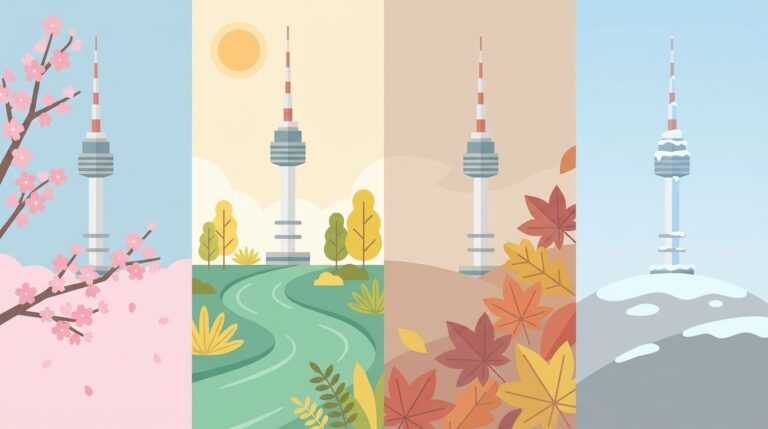
Phase 1: 공감 (Story-driven Opening)
안녕하세요! 매일한글 에디터입니다.
Picture this: You are sitting by the breezy Han River on a crisp October afternoon. Golden ginkgo leaves flutter down like confetti, and your Korean friend turns to you while wrapping their scarf, asking with a smile, “어떤 계절 제일 좋아해요?” (What season do you like most?). Suddenly, your mind freezes. You remember grammar charts from textbooks, but the words feel stiff and unnatural. You hesitate and awkwardly murmur, “저는 가을을… 매우 사랑합니다…” Your friend nods politely, but the conversation kind of dwindles out.
Talking about weather and seasons isn’t just small talk in Korea—it is the ultimate cultural bonding ritual. Korea experiences four intensely distinct seasons (사계절), each with its own fashion, menu, and emotional rhythm. As a Korean language navigator for over a decade, I have guided hundreds of A2 learners through this exact hurdle. Once you master a few natural patterns, you will instantly pivot from awkward bookish phrases to sounding warm, genuine, and culturally tuned in.
Phase 2: Core Expressions Deep Dive
1. 저는 가을을 제일 좋아해요 (Jeoneun gaeureul jeil joahaeyo)
- Pronunciation: Jeo-neun gah-eul-eul je-il joh-ah-hae-yo (Think of gah-eul sounding like “gull” with a gentle open “ah” sound).
- Meaning: Literal: “As for me, autumn I like the most.” / Nuance: “Autumn is my favorite season.”
- K-Culture Moment: Commonly heard in cozy slice-of-life dramas like Hospital Playlist when doctors relax outside with warm iced-americano lattes discussing the changing leaves.
- Editor’s Insight: While textbooks teach 가장 (gajang) and 제일 (jeil) interchangeably, 제일 is far more common, fluid, and natural in spoken casual Korean.
- Situation Spectrum:
- Casual (반말): ⚠️ (Use 난 가을이 젤 좋아 instead)
- Semi-formal (해요체): ✅ Perfect for coworkers, acquaintances, and elders.
- Formal (하십시오체): ⚠️ (Too casual; use 저는 가을을 가장 좋아합니다 in formal interviews)
- 🤔 Think About It: In English, you say “Autumn is my favorite season” (season as subject), but Korean places the speaker (저는) first and uses an active verb (좋아해요). How does this reflect personal preference as an action rather than a state?
2. 날씨가 선선해서 딱 좋아요 (Nalssiga seonseonhaeseo ttak joayo)
- Pronunciation: Nahl-ssi-gah sun-sun-hae-seo ttahk joh-ah-yo (Ttak sounds like the firm “tack” sound when snapping fingers).
- Meaning: Literal: “The weather is crisp/cool, so it is just right.” / Nuance: “The weather is refreshingly cool and breezy—absolutely perfect!”
- K-Culture Moment: Used constantly on Instagram stories and vlogs when strolling through Bukchon Hanok Village or Olympic Park in September.
- Editor’s Insight: 선선하다 specifically captures that breezy, non-sweaty cool feeling of autumn, distinctly different from 시원하다 (refreshing cold drink or AC) or 쌀쌀하다 (chilly/nippy).
- Situation Spectrum:
- Casual: ⚠️ (Say 날씨 선선해서 딱 좋아)
- Semi-formal: ✅ Natural and polite.
- Formal: ⚠️
- 🤔 Think About It: Korean possesses rich mimetic and descriptive adjectives for subtle weather sensations. Why do you think micro-climates are so deeply embedded in Korean vocabulary?
3. 봄 타나 봐요 (Bom tana bwayo)
- Pronunciation: Bohm tah-nah bwah-yo (Bom sounds like “ball” meets “comb”).
- Meaning: Literal: “It seems I am riding the spring.” / Nuance: “I guess I’m catching spring fever / feeling restless and sentimental with the warm breeze.”
- K-Culture Moment: Classic K-Pop lyric trope (like in Roy Kim’s folk-pop ballads) describing someone daydreaming out the window as cherry blossoms drift down.
- Editor’s Insight: Koreans say 계절을 타다 (to ‘ride’ a season), meaning the change of season visibly shifts your emotional state and mood. 가을 타다 is for melancholic autumn moods, while 봄 타다 is for dreamy, fluttering spring restlessness.
- Situation Spectrum:
- Casual: ⚠️ (Say 나 봄 타나 봐)
- Semi-formal: ✅ Shows charming cultural fluency.
- Formal: 🚫 (Too personal and poetic for boardrooms!)
- 🤔 Think About It: Does your native culture attribute specific mood shifts to seasons in a single colloquial phrase like “riding the spring”?
Phase 3: Textbook Korean vs. Real Korean
Situation 1: Saying winter is your favorite season
- 📖 교과서 한국어 (Textbook):
저는 겨울을 가장 선호합니다.
(Jeoneun gyeoureul gajang seonhohamnida. – “I prefer winter the most.”) - 🗣️ 진짜 한국어 (Real Korean):
전 겨울이 젤 좋아요! 눈 오는 날 분위기가 대박이거든요.
(Jeon gyeouri jel joayo! Nun oneun nal bunwigiga daebagigeodeunyo. – “I like winter best! The snowy atmosphere is just awesome.”) - 💡 왜 다를까?: 선호하다 (to prefer) sounds like a multiple-choice survey response. Real Koreans shorten 저는 to 전, 제일 to 젤, and immediately share a sensory detail using -거든요 (because…).
Situation 2: Expressing why summer is exhausting
- 📖 교과서 한국어 (Textbook):
여름은 기온이 높아 매우 덥습니다.
(Yeoreumeun gioni nopa maeu deopseumnida. – “Summer has high temperatures and is very hot.”) - 🗣️ 진짜 한국어 (Real Korean):
여름은 너무 덥고 습해서 힘들어요.
(Yeoreumeun neomu deopgo seuphaeseo himdeureoyo. – “Summer is so hot and humid that it’s exhausting.”) - 💡 왜 다를까?: 기온이 높다 belongs on the 9 o’clock weather forecast. Everyday speakers focus on bodily discomfort caused by the humidity (습하다) making them feel tired (힘들다).
Phase 4: K-Culture Deep Dive & Non-verbal Manners
4-1. 눈치 (Nunchi) & Gestures
When discussing seasons in Korea, your body language paints half the picture:
* The Breezy Hand Wave: When describing summer humidity or longing for autumn, a gentle palm-fan gesture toward your face paired with an audible exhale (휴~) establishes instant camaraderie.
* The Shoulder Shiver: When mentioning winter cold (추위), lightly rubbing both forearms with hands displays sensory alignment before speaking.
* Shared Gaze: Instead of holding continuous direct eye contact, look up toward the sky, trees, or window when answering what season you like. It shows you are picturing the scenery together.
4-2. Cultural Code: Seasonal Synchronization
Koreans live in deep synchronization with seasonal changes. Spring is not just a season; it is the official season of 벚꽃놀이 (Cherry blossom picnics) and sweet strawberry desserts. Autumn triggers 단풍놀이 (Foliage tours) and trips to grab freshly baked sweet potatoes and roasted chestnuts. Sharing your favorite season is never just about temperature—it is an implicit invitation to share food, outfits, and seasonal day-trips.
Phase 5: Real-World Roleplay Scenario
- Setting: An outdoor cafe terrace near Yeouido Park, Seoul. Late afternoon in late March. A cool breeze gently shakes the newly budding branches.
- Characters:
- 민지 (Min-ji): Your warm, sociable Korean study partner.
- Alex: An A2 Korean learner eager to express personal preferences.
- 민지: 🎭 (sips warm yuzu tea and pulls her cardigan tighter) 알렉스 씨, 바람이 아직 좀 쌀쌀하죠?
(Alex-ssi, barami ajik jom ssalssalhajyo? / “Alex, the wind is still a bit nippy, isn’t it?”) - Alex: 🎭 (nods gently, looking up at the buds on the trees) 네, 그래도 햇살은 정말 따뜻해요.
(Ne, geuraedo haessareun jeongmal ttatteuthaeyo. / “Yes, but the sunshine is truly warm.”) - 민지: 🎭 (smiles warmly) 맞아요! 이제 진짜 봄이 오나 봐요. 알렉스 씨는 사계절 중에 어떤 계절 제일 좋아해요?
(Majayo! Ije jinjja bomi ona bwayo. Alex-ssineun sagyejeol junge eotteon gyejeol jeil joahaeyo? / “Exactly! Spring really seems to be coming. Which season do you like most among the four?”) - Alex: 🎭 (grins enthusiastically) 저는 가을을 제일 좋아해요. 선선해서 산책하기 딱 좋거든요.
(Jeoneun gaeureul jeil joahaeyo. Seonseonhaeseo sanchaekhagi ttak jokeodeunyo. / “I like autumn the most. It’s breezy, so it’s just perfect for taking walks.”) - 민지: 🎭 (claps hands lightly) 오, 가을! 하늘도 높고 단풍도 예쁘잖아요. 저도 가을 사랑해요.
(O, gaeul! Haneuldo nopgo danpungdo yeppeujanhayo. Jeodo gaeul saranghaeyo. / “Oh, autumn! The sky is high and autumn leaves are pretty, right? I love autumn too.”) - Alex: 🎭 (chuckles softly) 민지 씨는 봄 좋아하지 않아요?
(Minji-ssineun bom joahaji anayo? / “Minji, don’t you like spring?”) - 민지: 🎭 (sighs jokingly, tapping her heart) 봄도 좋은데… 요즘 괜히 마음이 붕 떠서 봄 타나 봐요!
(Bomdo joeunde… yojeum gwaenhi maeumi bung tteoseo bom tana bwayo! / “I like spring too, but… these days my heart feels all restless, I guess I’m catching spring fever!”) - Alex: 🎭 (nods in understanding and smiles) 하하, 저도 알 것 같아요. 우리 주말에 벚꽃 구경 갈까요?
(Haha, jeodo al geot gatayo. Uri jumare beotkkot gugyeong galkkayo? / “Haha, I think I understand that feeling. Shall we go see the cherry blossoms this weekend?”)
🔀 Interactive Decision Point
How would you respond if Min-ji asked: “여름은 왜 싫어요?” (Why do you dislike summer?)
- Choice A: “저는 여름의 높은 기온을 거부합니다.” (Jeoneun yeoreumui nopeun gioneul geobuhamnida.)
- ❌ Bad (Stiff & Robotic): Sounds like a court declaration rejecting high temperatures!
- Choice B: “여름은 너무 덥고 땀이 많이 나서 조금 힘들어요.” (Yeoreumeun neomu deopgo ttami mani naseo jogeum himdeureoyo.)
- 🏆 Best (Natural & Empathetic): Perfectly polite A2 sentence describing physical sensation (sweating, tiring) naturally.
- Choice C: “여름 완전 극혐이야!” (Yeoreum wanjeon geukhyeomiya!)
- ⚠️ Risk (Too Slangy/Aggressive): 극혐 (extreme disgust) is very casual youth slang that sounds overly harsh unless speaking to your closest elementary school buddy.
Phase 6: 10-Second Emotion Shadowing Drill
Practice these pauses (/) and tones aloud to build muscle memory:
[😊 밝고 경쾌하게 / Bright & Upbeat]- 저는 / 가을을 / 제일 좋아해요! / 날씨가 선선하잖아요.
- Jeoneun / gaeureul / jeil joahaeyo! / Nalssiga seonseonhajanhayo.
- (I like / autumn / the most! / The weather is breezy and pleasant, after all.)
[🥺 아쉽고 실감나게 / Relatable Discomfort]- 여름은 / 습해서 / 너무 힘들어요. / 겨울이 더 나아요.
- Yeoreumeun / seuphaeseo / neomu himdeureoyo. / Gyeouri deo naayo.
- (Summer / because it’s humid / is so exhausting. / Winter is better.)
[🌸 설레고 감성적으로 / Dreamy & Fluttering]- 날씨가 / 따뜻해지니까, / 괜히 / 봄 타나 봐요.
- Nalssiga / ttatteuthaejinikka, / gwaenhi / bom tana bwayo.
- (Since the weather / is warming up, / I guess / I have spring fever.)
Phase 7: K-Culture Mini Dictionary
- 꽃샘추위 (Kkot-saem-chu-wi)
- Literal: Cold weather that envies the flowers.
- Meaning: Early spring cold snap (the sudden chill just before spring arrives).
- Context: When it suddenly freezes in March, locals say, “꽃샘추위 때문에 패딩 다시 꺼냈어요” (I pulled out my winter puffer jacket again because of kkot-saem-chu-wi).
- 환절기 (Hwan-jeol-gi)
- Literal: Changing season period.
- Meaning: In-between season transition period.
- Context: Pharmacists and friends will say, “환절기 감기 조심하세요” (Be careful of catching a cold during the seasonal transition).
- 단풍 (Dan-pung)
- Literal: Tinted leaves.
- Meaning: Autumn foliage / colorful autumn leaves.
- Context: Autumn peak phrase: “이번 주말에 설악산 단풍 보러 가요” (Let’s go view Seoraksan foliage this weekend).
- 얼죽아 (Eol-juk-ah)
- Literal: Freezing to death, still iced Americano.
- Meaning: The iconic Korean subculture of drinking Iced Americanos even in midwinter sub-zero weather.
- Context: In a December cafe: “날씨가 영하 10도여도 저는 얼죽아예요!” (Even at minus 10 degrees, I’m an eol-juk-ah!).
Phase 8: Traveler’s Survival Kit
Top 3 Survival Phrases
- 오늘 날씨 어때요? (Oneul nalssi eottaeyo?)
- Meaning: “How is the weather today?”
- Pro Tip: Use this when asking your hotel concierge or guesthouse host in the morning.
- 일교차가 심하니까 외투 챙기세요. (Ilgyochaga simhanikka oetu chaenggiseyo.)
- Meaning: “The temperature difference between day and night is big, so pack a light jacket.”
- Pro Tip: If a local tells you this in spring or autumn, heed their advice—Seoul mornings and nights get surprisingly cold.
- 눈/비 올 것 같아요. (Nun/bi ol geot gatayo.)
- Meaning: “It looks like it will snow/rain.”
- Pro Tip: Perfect for asking if you should buy a transparent umbrella at the nearest convenience store.
Editor’s Travel Note
Before stepping outside into Seoul’s rapidly changing weather, avoid relying solely on global phone apps. Ensure you download the Naver Map app to view hyperlocal micro-weather forecasts integrated alongside public transit routing, and carry a rechargeable climate card for subway transit during unexpected heavy monsoon rains.
Phase 9: 한 발 더 깊이 (A Step Deeper)
In Western cultures, preference for a season is often framed as an individual quirk: “I’m a winter person” or “I’m a summer person.” In Korea, however, seasons are an intensely collective sensory experience. When 가을 arrives, nationwide grocery stores simultaneously roll out seasonal persimmons, office workers schedule corporate mountain hikes, and coffee shops transition their playlists. Talking about your favorite season isn’t just an exchange of personal trivia; it is an invitation to harmonize with the collective rhythm of nature and community life.
💬 Your Turn: Which season feels like home to you? Drop a comment below using the pattern: “저는 [계절]을 제일 좋아해요!” and tell us why!
Phase 10: FAQ & Common Mistakes
Q: Can I use “사랑해요” (I love) instead of “좋아해요” (I like) when talking about seasons?
A: While grammatically understood, saying “저는 봄을 사랑해요” can sound dramatic or poetic, like you are reciting verse. In everyday conversation, Koreans consistently prefer “[계절]을/를 제일 좋아해요”.
Q: What is the real difference between “시원하다” and “선선하다”?
A: 선선하다 is strictly reserved for gentle, crisp autumn winds. 시원하다 has a much broader range: it can describe cool summer air conditioning, a cold beverage, a relaxing massage, or even a piping hot bowl of spicy noodle soup!
Q: How do I say my favorite season without sounding like a robot?
A: Add the conversational ending -거든요 (-geodeunyo) to explain your reason! Instead of just saying “봄을 좋아해요,” say “봄을 제일 좋아해요. 꽃이 예쁘거든요!” (I like spring the most because the blossoms are pretty!).
🚨 Common Mistakes Warning Board
- Mistake: Saying 저는 따뜻한 날씨를 원해요 (I want warm weather).
- Correct Action: Use 따뜻한 날씨가 좋아요 (I like warm weather). In Korean, 원하다 sounds overly formal and intense for basic preferences.
- Mistake: Mixing up 가장 and 제일 in casual texts.
- Correct Action: Both mean “most,” but use 제일 (or shortened slang 젤) in spontaneous daily chats.
- Mistake: Forgetting object markers (봄을 instead of 봄 in spoken Korean).
- Correct Action: While dropping particles is common in casual talk, keep them clear when practicing at A2 level: 봄을 제일 좋아해요 or 봄이 제일 좋아요.
Phase 11: Action Missions
- 🥉 Bronze Mission (Solo Vocal Drill): Stand in front of your mirror and practice saying your favorite season 3 times using the formula:
저는 [봄 / 여름 / 가을 / 겨울]을 제일 좋아해요! - 🥈 Silver Mission (Social Output): Post a photo of today’s sky on your social media with the Korean caption:
오늘 날씨 딱 좋아요!(Today’s weather is just right!). - 🥇 Gold Mission (Real Connection): Next time you talk to a Korean speaker or tutor, ask them:
어떤 계절 제일 좋아하세요?and follow up with a reason using-거든요. - 🎮 K-Culture Mission: Watch an episode of your favorite Korean drama or variety show and spot someone mentioning the cold or heat using 덥다, 춥다, or 선선하다.
Phase 12: Interactive Quiz Challenge
1. Situation Judgment: Your Korean language tutor asks which season you prefer. You want to say autumn is your favorite because it is pleasantly cool. Which sentence is best?
* A) 가을을 선호해서 기분이 높습니다.
* B) 가을을 제일 좋아해요. 날씨가 선선하거든요.
* C) 저는 가을을 진짜 원합니다.
👉 Click to reveal Answer & Explanation
Correct Answer: B
Explanation: B uses the natural spoken form 제일 좋아해요 followed by the explanatory suffix 선선하거든요 (because it is crisp and breezy). Option A uses bizarre phrasing, and C misuses 원합니다.
2. Fill-in-the-Blank: Fill in the missing word for “spring fever” or feeling emotional in spring:
“날씨가 따뜻해서 요즘 자꾸 (____) 타나 봐요.”
👉 Click to reveal Answer & Explanation
Correct Answer: 봄
Explanation: 봄 타다 is the idiomatic phrase meaning to experience spring restlessness or spring fever.
3. True or False Cultural Quiz: In Korea, calling someone an “얼죽아” means they strongly dislike cold winter weather and stay indoors.
👉 Click to reveal Answer & Explanation
Correct Answer: False!
Explanation: 얼죽아 stands for “얼어 죽어도 아이스 아메리카노” (Even if I freeze to death, I’ll drink Iced Americano!). It describes someone who loyally drinks iced coffee no matter how freezing the winter gets!







