

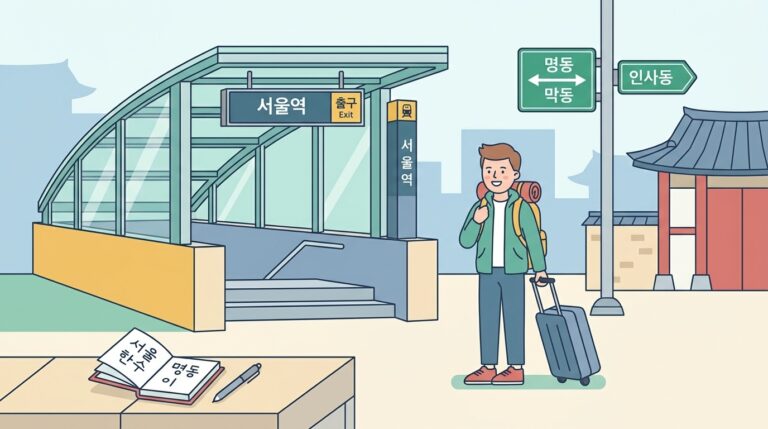
Lost in Seoul? How to Ask for Hotel Directions Like a True Local
Phase 1: Empathy (Story-Driven Opening)
안녕하세요! 매일한글 에디터입니다.
Imagine this: You just landed at Incheon Airport, navigated the subway like a seasoned traveler, and stepped out into the bustling, neon-lit streets of Hongdae or Euljiro. It feels straight out of a classic K-Drama scene. But then, reality hits. Your suitcase wheels are clattering loudly on the brick pavement, your smartphone battery drops to 4%, and Google Maps is spinning in circles because, let’s be honest, global map apps notoriously struggle with Korea’s intricate alleyways. You know your boutique hotel is within a 300-meter radius, tucked behind a cozy BBQ restaurant, but you simply cannot find the entrance.
You see a friendly-looking convenience store clerk or a local checking their phone by the station entrance. You want to ask for help, but your mind goes blank. Will they understand you? What if your Korean sounds awkward or too stiff? Over the past 10 years of coaching international learners at Daily Hangul, “Finding the hotel after arriving in Korea” is consistently ranked as the #1 real-world panic moment for beginners. But here is the good news: Korean locals are remarkably kind and eager to help if you know just two or three natural, polite phrases. In this guide, we are going to unlock the exact sentences that real Koreans use, ditching the robotic textbook lines so you can walk into your hotel lobby with total confidence.
Phase 2: Deep Dive into 3 Core Expressions
1. 실례지만, 혹시 [호텔 이름]이 어디에 있어요? (Sil-lye-ji-man, hok-si [hotel i-reum]-i eo-di-e iss-eo-yo?)
- Pronunciation: Sheel-lyae-jee-mahn, hohk-shee [Hotel Name]-ee uh-dee-ae eess-uh-yoh? (Think of “sil-lye” sounding close to the English word “silly”, but smooth and soft!)
- Meaning: Literal: “It is a discourtesy, but by any chance, where is [Hotel Name]?” / Real Nuance: “Excuse me, could you tell me where [Hotel Name] is?”
- K-Culture Moment: Think of that classic rom-com moment where the female lead arrives in an unfamiliar neighborhood, clutching a wrinkled flyer or a paper note, asking a neighborhood resident for directions before bumping into the male lead.
- Editor’s Insight: Adding 혹시 (hok-si) (“by chance”) is your golden ticket in Korean society. It instantly softens your request, transforming a blunt query into a humble, considerate question that naturally makes the listener want to help you.
- Situation Spectrum:
- Casual (반말): 🚫 (Never use with strangers on the street!)
- Semi-formal (해요체): ✅ (Perfect for asking passersby, shop owners, or subway staff)
- Formal (하십시오체): ⚠️ (A bit too stiff for street navigation; keep it for high-end concierge desks)
- 🤔 Think About It: In English, “Where is the hotel?” sounds neutral. But in Korean, dropping “혹시” (by chance) or “실례지만” (excuse me) can sound like a direct demand. Why do you think Korean place such high linguistic value on self-lowering and giving the other person an easy way out?
2. 이 주소로 가려면 어떻게 가요? (I ju-so-ro ga-ryeo-myeon eo-tteo-ke ga-yo?)
- Pronunciation: Ee joo-soh-roh gah-ryuh-myuhn uh-ttuh-kae gah-yoh? (Say “eo-tteo-ke” like “uh-tuh-kay” with bouncy intonation on the “kay”).
- Meaning: Literal: “If I intend to go by this address, how do I go?” / Real Nuance: “How do I get to this address?”
- K-Culture Moment: Frequently heard in Korean reality travel shows (Running Man or 2 Days & 1 Night) when cast members get dropped off in an unknown town with just a mystery address card in hand.
- Editor’s Insight: When a hotel has an English or French name that might be tricky to pronounce in Korean phonetics (like “L’Escape Hotel” or “Glad Mapo”), showing the Korean address on your phone while saying this sentence saves you 100% of potential pronunciation misunderstandings.
- Situation Spectrum:
- Casual (반말): 🚫
- Semi-formal (해요체): ✅ (Ideal when showing your phone screen to taxi drivers or pedestrians)
- Formal (하십시오체): ⚠️ (Acceptable, but “어떻게 가야 합니까?” sounds slightly robotic)
- 🤔 Think About It: Notice how Korean attaches the conditional ending -(으)려면 (“in order to / if you want to”). You are stating your intention first rather than simply asking for road instructions. How does sharing intention alter the warmth of communication?
3. 여기서 걸어서 갈 수 있나요? (Yeo-gi-seo geol-eo-seo gal su inn-a-yo?)
- Pronunciation: Yuh-gee-suh gull-uh-suh gahl soo een-nah-yoh? (“Geol-eo-seo” flows like “gull-uh-suh”).
- Meaning: Literal: “Can one go by walking from here?” / Real Nuance: “Is it walkable from here?”
- K-Culture Moment: That moment in travel vlogs where tourists debate whether to drag luggage up Seoul’s legendary hills or hail a Kakao T taxi.
- Editor’s Insight: Seoul is a city of hidden hills and stairs! Even if a distance looks like a 5-minute straight line on a flat 2D map, it could be a 45-degree incline. Asking this will prompt a local to say either “네, 가까워요!” (Yes, it’s close!) or wave their hands in warning: “아니요, 택시 타세요!” (No, take a taxi!).
- Situation Spectrum:
- Casual (반말): 🚫
- Semi-formal (해요체): ✅ (Very natural and universally polite)
- Formal (하십시오체): ⚠️ (Grammatically “갈 수 있습니까?” is fine, but sounds like an interview question)
- 🤔 Think About It: Why does Korean frequently separate “going” into specific physical modes like “걸어서 가다” (to go walking) instead of having a single concise verb like “to walk somewhere”?
Phase 3: Textbook Korean vs. Real Korean
Situation 1: Asking if a specific hotel is around the station
- 📖 교과서 한국어 (Textbook): “호텔이 어디에 위치합니까?” (Hotel-i eo-di-e wi-chi-ham-ni-kka? / Where is the hotel positioned/located?)
- 🗣️ 진짜 한국어 (Real-World): “혹시 근처에 [호텔 이름] 있어요?” (Hok-si geun-cheo-e [hotel i-reum] iss-eo-yo? / By any chance, is [Hotel Name] around here?)
- 💡 왜 다를까? (Why the difference?): The word 위치하다 (to be situated/located) sounds like an excerpt from a real estate contract or a formal geography exam. Real Koreans simply ask if the place “exists around here” using 있어요? (Is there?).
Situation 2: Asking someone to look at your navigation map
- 📖 교과서 한국어 (Textbook): “이 지도를 보아 주십시오.” (I ji-do-reul bo-a ju-sip-si-o. / Please look at this map.)
- 🗣️ 진짜 한국어 (Real-World): “여기 지도 좀 봐주실 수 있으세요?” (Yeo-gi ji-do jom bwa-ju-sil su iss-eu-se-yo? / Could you take a quick look at the map here?)
- 💡 왜 다를까? (Why the difference?): Traditional textbooks love the commanding “-(으)십시오” imperative, which sounds harsh or robotic in casual street encounters. Real Koreans use the magical softening word 좀 (jom – a little bit) combined with honorific request forms.
Phase 4: K-Culture Deep Dive & Non-Verbal Manners
4-1. 눈치 (Nunchi) & Gestures on the Street
When you approach a Korean stranger to ask for directions, your body language communicates before your words do:
1. The Two-Hand Phone Presentation: If you are showing your phone screen with the hotel address, hold the phone with both hands or rest your right elbow on your left hand. Pointing a single finger or shoving the phone right in front of someone’s nose with one hand is considered slightly aggressive.
2. The Polite Neck Angle (The Micro-Bow): Start with a slight 15-degree head bow as you utter “실례지만…”. This instantly signals that you have no ill intentions and respect their personal bubble.
3. Eye Contact Calibration: Don’t maintain intense, unbroken eye contact, which can feel intimidating in Korea. Make eye contact, nod politely, look down at your screen together, and smile warmly.
4-2. Cultural Code: The Mystery of Seoul’s Subway Exits & Landmarks
If you ask an American or European for directions, they might say, “Head north on 5th Avenue and turn right on Maple Street.” But in Korea, street names (도로명 주소) were only popularized recently! Traditional Korean mental maps are built entirely on Landmarks (랜드마크) and Subway Station Exits (지하철 출구).
* Every major subway station in Korea has numbered exits (1번 출구, 2번 출구, up to 14 or more!).
* When asking for a hotel, locals will almost always orient you by saying: “Go out exit 3, pass the Olive Young, turn right at the GS25 convenience store, and it is right behind the Starbucks.”
* Pro Tip: When booking your hotel, always look up which 출구 (Exit number) is closest. It makes asking directions three times easier!
Phase 5: Real-Life Role-Play Scenario
Setting: Outside Exit 4 of Hongik University Station at 6:30 PM. Dusk is falling, neon signs are flickering to life, and the aroma of roasted tteokbokki wafts from street carts. You are pulling your suitcase, searching for “Nine Brick Hotel”. You stop near a local resident, Mr. Park, who is holding an iced Americano.
- Turn 1 (Learner): 저기요, 실례지만 혹시 나인브릭 호텔이 어디에 있어요?
(Jeo-gi-yo, sil-lye-ji-man hok-si Na-in-beu-rik ho-tel-i eo-di-e iss-eo-yo?)
“Excuse me, by any chance, do you know where Nine Brick Hotel is?”
🎭 [Holding phone with two hands, bowing head slightly] -
Turn 2 (Mr. Park): 아, 나인브릭 호텔이요? 잠시만요…
(A, Na-in-beu-rik ho-tel-i-yo? Jam-si-man-yo…)
“Ah, Nine Brick Hotel? Just a moment…”
🎭 [Squinting at your phone screen while sipping coffee] -
Turn 3 (Learner): 네, 여기 주소도 있어요!
(Ne, yeo-gi ju-so-do iss-eo-yo!)
“Yes, here is the address as well!”
🎭 [Gently tilting the screen closer for him to read] -
Turn 4 (Mr. Park): 아! 알아요. 여기서 직진해서 5분만 가면 사거리가 나와요.
(A! Al-a-yo. Yeo-gi-seo jik-jin-hae-seo o-bun-man ga-myeon sa-geo-ri-ga na-wa-yo.)
“Ah! I know it. If you go straight from here for just 5 minutes, an intersection appears.” -
Turn 5 (Learner): 여기서 걸어서 갈 수 있나요?
(Yeo-gi-seo geol-eo-seo gal su inn-a-yo?)
“Can I walk there from here?”
🎭 [Looking at heavy suitcase with a bashful smile] -
Turn 6 (Mr. Park): 네! 충분히 걸어갈 수 있어요. 사거리에서 올리브영 끼고 우회전하세요.
(Ne! Chung-bun-hi geol-eo-gal su iss-eo-yo. Sa-geo-ri-e-seo Ol-li-beu-young kki-go u-hoe-jeon-ha-se-yo.)
“Yes! It’s totally walkable. At the intersection, turn right around Olive Young.” -
Turn 7 (Learner): 올리브영에서 오른쪽이요? 정말 감사합니다!
(Ol-li-beu-young-e-seo o-reun-jjok-i-yo? Jeong-mal gam-sa-ham-ni-da!)
“Right turn at Olive Young? Thank you so very much!”
🎭 [Beaming with relief, performing a grateful bow] -
Turn 8 (Mr. Park): 네, 조심히 가세요. 즐거운 여행 되세요!
(Ne, jo-sim-hi ga-se-yo. Jeul-geo-un yeo-haeng doe-se-yo!)
“Yes, take care. Have a pleasant trip!”
🎭 [Giving a friendly wave with a warm smile]
🔀 Interactive Branching Decision Point
Mr. Park just told you: “사거리에서 올리브영 끼고 우회전하세요.” (Turn right around Olive Young at the intersection). But you didn’t quite catch the word “우회전” (right turn). What do you say?
- Option A: “죄송하지만, 한 번만 다시 말씀해 주시겠어요?” (I’m sorry, could you please say that one more time?)
- Outcome: 🌟 Best Choice! Extremely polite, natural, and shows respect. The local will slow down their speech and likely point with their hand to visually demonstrate the direction.
- Option B: “뭐라고요? 이해 못 해요.” (What? I don’t understand.)
- Outcome: 🚫 Bad Choice! “뭐라고요?” can sound confrontational (like “What did you just say to me?!”). The local might feel flustered or offended.
- Option C: “오른쪽? 왼쪽?” (Right? Left?)
- Outcome: ⚠️ Risk Choice! Using raw words without polite sentence endings (요) sounds abrupt like kindergarten speech. It gets the job done in an emergency, but misses the mark for polite etiquette.
Phase 6: 10-Second Emotion Shadowing Drill
Train your vocal muscles with these rhythmic emotional repetitions. Pay attention to the pause markers / and mimic the feeling!
[🥺 Desperate but super polite]
저기요… / 실례지만 / 호텔이 어디에 있어요?
(Jeo-gi-yo… / sil-lye-ji-man / ho-tel-i eo-di-e iss-eo-yo?)-
[🤔 Curious & hopeful]
여기서 / 걸어서 / 갈 수 있나요?
(Yeo-gi-seo / geol-eo-seo / gal su inn-a-yo?) -
[😊 Bright, cheerful & relieved]
아, 올리브영 오른쪽이요? / 정말 감사합니다!
(A, Ol-li-beu-young o-reun-jjok-i-yo? / Jeong-mal gam-sa-ham-ni-da!)
Phase 7: K-Culture Mini Dictionary
-
길치 (Gil-chi)
Literal translation: Road-blind.
Real-world usage: In Korea, if someone has a terrible sense of direction, they laugh and call themselves a “길치” (just like “몸치” for bad dancers or “음치” for tone-deaf singers). You can break the ice by joking: “제가 길치라서요!” (It’s because I have no sense of direction!). -
출구 (Chul-gu)
Literal translation: Exit.
Real-world usage: The cornerstone of Korean navigation. Never say “Meet me at the subway station.” Always specify: “3번 출구 앞에서 만나요!” (Meet me in front of Exit 3!). -
직진 (Jik-jin)
Literal translation: Direct-advance.
Real-world usage: Going straight ahead. When locals direct you, they will rhythmically say, “여기서 쭉 직진하세요!” (Just go straight-straight from here!). -
랜드마크 (Laen-deu-ma-keu)
Literal translation: Landmark.
Real-world usage: Koreans rarely use block counts. Instead, major brand chains serve as navigation beacons: Olive Young (화장품 가게), GS25/CU (편의점), or Starbucks (스타벅스).
Phase 8: Traveler’s Survival Kit
TOP 3 Emergency Phrases
- 이쪽으로 가는 거 맞아요? (I-jjok-eu-ro ga-neun geo maj-a-yo?)
Pro Tip: Walking down a sketchy alley and feeling doubtful? Point down the street and ask this to verify you are heading in the right direction. - 여기서 택시 타는 게 나을까요? (Yeo-gi-seo taek-si ta-neun ge na-eul-kka-yo?)
Pro Tip: If the local hesitates or mentions uphill stairs (언덕길), ask this. If they nod vigorously, it is time to open your taxi app. - 지도에 여기 찍어주실 수 있나요? (Ji-do-e yeo-gi jjik-eo-ju-sil su inn-a-yo?)
Pro Tip: Hand them your phone with map open so they can physically tap the destination pin for you.
Editor’s Travel Note: Tech Setup for Korea
- Forget Google Maps: Google Maps cannot offer step-by-step pedestrian walking routes in South Korea due to national security map data laws. Make sure to download the [Naver Map app navigation guide] and set the language to English before landing.
- KakaoMap backup: Another lifesaver is [KakaoMap transit application], which displays real-time bus arrivals down to the exact second.
- Screenshot in Korean: Always save a screenshot of your hotel booking voucher displaying the Korean address (한글 주소) and local telephone number. Wi-Fi can drop when you need it most!
Phase 9: “A Step Deeper” (Cultural Reflection)
In many Western cultures, interrupting a stranger on their commute can feel like an imposition or a minor breach of privacy. But in South Korea, there is a deep-rooted concept called 정 (Jeong)—a warm, invisible bond of communal empathy and collective responsibility. When you ask an older Korean for directions with genuine politeness, do not be startled if they literally stop what they are doing, grab the handle of your luggage, and walk with you two blocks just to ensure you don’t take a wrong turn. Asking for help in Korea isn’t viewed as a nuisance; it is an invitation for human connection.
💬 Your Turn: Have you ever experienced an unexpected moment of kindness from a stranger while traveling abroad? Or what is the one thing that worries you most about getting lost in Korea? Drop your thoughts in the comments below!
Phase 10: FAQ & Avoiding Misunderstandings
Q: What should I do if the person I ask panics and says “No English!”?
A: Stay calm and smile! Many Koreans understand basic English written down, but feel immense performance anxiety about spoken English. Immediately switch to short Korean: “한국어 조금 할 수 있어요!” (I can speak a little Korean!) or simply show the Korean address on your screen with “여기 주소예요” (Here is the address). Their tension will melt instantly.
Q: Can I use “어디예요?” instead of “어디에 있어요?”?
A: Yes! Both are completely grammatically correct and interchangeable at the A2 level. “호텔 어디예요?” is slightly shorter and punchier, while “호텔이 어디에 있어요?” sounds slightly more formal and precise.
Q: Should I call elderly passersby “아저씨” (Ajusshi) or “아줌마” (Ajumma)?
A: Avoid this! While common in 90s dramas, calling a modern stranger “아줌마” can be perceived as insulting or sensitive. Instead, stick to the universally safe, respectful greeting: “저기요, 실례지만…” (Excuse me, pardon me…) or refer to store staff as “사장님” (Sajangnim / Business owner).
🚨 Common Mistakes Alert (Top 3)
- Mistake: Pointing your index finger directly at someone’s face while speaking.
Correct Action: Keep your hands open or gesture with an open palm facing upward. - Mistake: Pronouncing English hotel names with strong native accents (e.g., “Marriott” with an unreleased ‘t’).
Correct Action: Use Korean phonetic pronunciation: “메리어트 호텔” (Me-ri-eo-teu ho-tel). - Mistake: Forgetting to close the sentence with “-요” when nervous.
Correct Action: Never drop the “요” with strangers! If you forget the rest of the sentence, even saying “호텔… 요?” is better than raw 반말.
Phase 11: Action Mission & Community Challenge
- 🥉 Bronze Mission (Solo Practice): Stand in front of your mirror with your phone. Practice saying “실례지만, [Your Hotel Name]이 어디에 있어요?” smoothly 5 times in under 15 seconds.
- 🥈 Silver Mission (Social Share): Record an audio voice note of you asking for directions and upload it to our Daily Hangul study community or your Instagram story tagging @DailyHangul with the hashtag #KoreanDirectionsChallenge.
- 🥇 Gold Mission (Real-World Test): Next time you visit a Korean town or restaurant, ask the staff where the restroom or subway station is using our formula: “실례지만 화장실이 어디에 있어요?”.
- 🎮 K-Culture Media Mission: Watch an episode of any travel-based variety show (like Youth Over Flowers or Castaway Diva) and spot whenever a character says “어디” or points out a “출구”. Type the timestamp in our comments!
Phase 12: Interactive Quiz Challenge
1. Situation Judgment Quiz
You have arrived at Seoul Station Exit 1, but your hotel is on the other side of an 8-lane road with no crosswalk nearby. You want to ask a commuter how to cross. Which expression is the most natural and polite?
* A) 야! 길 어떻게 건너? (Ya! Gil eo-tteo-ke geon-neo?)
* B) 실례지만, 저쪽으로 어떻게 건너가요? (Sil-lye-ji-man, jeo-jjok-eu-ro eo-tteo-ke geon-neo-ga-yo?)
* C) 건너는 길을 지금 알려주십시오. (Geon-neo-neun gil-eul ji-geum al-ryeo-ju-sip-si-o.)
2. Fill-in-the-Blank Quiz
Complete the sentence to politely ask if the hotel is walkable from here:
* 여기서 ______ 갈 수 있나요? (Can I go by walking from here?)
3. True or False Cultural Quiz
In Korea, pedestrians primarily navigate dense urban areas using street numbers rather than subway exits and convenience store landmarks. (True / False)
👉 Click here to reveal answers & explanations!
1. Answer: B
Explanation: Option B uses the respectful buffer “실례지만” (Excuse me) and the polite “-요” ending. Option A is rude informal speech (반말), and Option C sounds like a robotic military command.
2. Answer: 걸어서 (geol-eo-seo)
Explanation: “걷다” (to walk) conjugates into “걸어서” when combined with “가다” (to go), expressing “going on foot”.
3. Answer: False
Explanation: While street name addresses exist officially, day-to-day navigation in Korean culture revolves almost entirely around subway exits, major landmarks, and familiar storefronts!






