

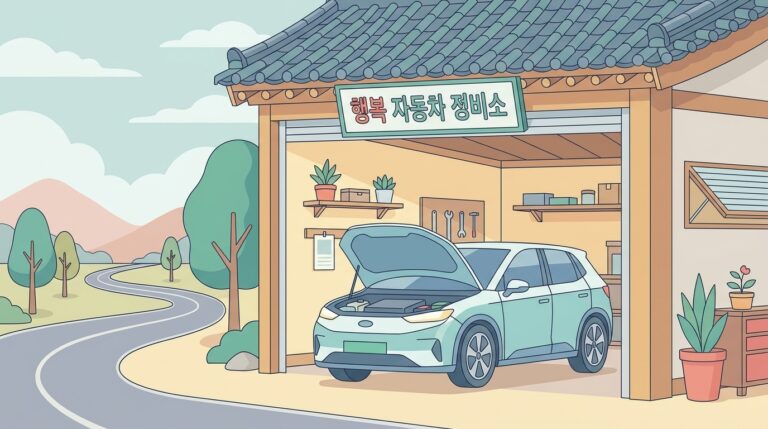
Phase 1: 공감 (Story-Immersive Opening)
안녕하세요! 매일한글 에디터입니다.
Picture this: You are on an epic road trip along the breathtaking coastal highways of Gangwon-do or cruising beneath the palm trees of Jeju Island. The playlist is hitting all the right K-indie notes, and the scenic view looks straight out of a slice-of-life K-drama like Welcome to Samdal-ri. Suddenly, a sharp chime rings out. An eerie yellow horseshoe-shaped symbol illuminates your dashboard: the tire pressure warning light (TPMS).
Your heart skips a beat. You pull up to a local roadside mechanic—a classic Korean ka-senteo (카센터)—surrounded by stacks of black rubber tires and the rhythmic hiss of pneumatic wrenches. The mechanic greets you with a brisk, “어떻게 오셨어요? (What brings you in?)” Suddenly, your mind freezes. How do you describe tire pressure in natural Korean? Do you ask to “fill up air” or “measure barometric tension”?
Navigating auto maintenance in a foreign language can be intimidating, but knowing how to articulate car issues isn’t just about passing a language test—it is about your safety and confidence on the road. This guide draws from real questions asked by intermediate expatriates and road-trip enthusiasts living in Korea. By the time you finish reading, you will be able to stride into any garage in Seoul or Sokcho and handle tire maintenance like a seasoned local.
Phase 2: 핵심 표현 3선 심층 분석 (Top 3 Essential Expressions)
1. 타이어 공기압 좀 봐주실 수 있나요?
- Pronunciation: [Ta-i-eo gong-gi-ap jom bwa-ju-sil su in-na-yo?] (Think: “Tire gong-ghee-up johm bwah-joo-sheel soo een-nah-yo?”)
- Meaning: Literal: “Could you look at the tire air pressure a bit?” | Real Nuance: “Could you please check my tire pressure?”
- K-Culture Moment: Seen frequently in road-trip variety shows like House on Wheels, where cast members stop by a service station before embarking on a long drive through mountain passes.
- Editor’s Insight: Koreans rarely use technical verbs like “측정하다” (to measure) in casual conversation. Instead, they soften requests with “좀 봐주다” (take a quick look for me), which sounds polite, conversational, and respectful of the technician’s expertise.
- Situation Spectrum: Casual: ⚠️ | Semi-formal: ✅ | Formal: ✅
- 🤔 Think About It: In English, we often demand the action directly (“Check my tire pressure”). Why does Korean culture favor visual perception verbs like “보다” (to see/look) when asking for diagnostic services?
2. 타이어 마모가 심해서 교체해야 할 것 같아요.
- Pronunciation: [Ta-i-eo ma-mo-ga sim-hae-seo gyo-che-hae-ya hal geot gat-a-yo.] (Think: “Tire mah-moh-gah seem-hae-seo gyo-che-hae-yah hal geot gah-tah-yo.”)
- Meaning: Literal: “Tire wear is severe, so it seems like I need to replace it.” | Real Nuance: “The tread wear looks pretty bad; I think it’s time for a replacement.”
- K-Culture Moment: The classic line from a cautious partner or cab driver in a corporate thriller drama before embarking on a high-speed pursuit on the Gyeongbu Expressway.
- Editor’s Insight: The ending “~할 것 같아요” (it seems like / I think that) softens your assessment. It avoids sounding like you are telling the expert what to do, leaving room for their professional diagnosis while showing you know your vehicle.
- Situation Spectrum: Casual: ⚠️ | Semi-formal: ✅ | Formal: ✅
- 🤔 Think About It: Why is indirect hedging (“it seems like…”) preferred in professional service encounters across East Asian speech communities?
3. 계기판에 공기압 경고등이 계속 떠요.
- Pronunciation: [Gye-gi-pan-e gong-gi-ap gyeong-go-deung-i gye-sok tteo-yo.] (Think: “Gyeh-ghee-pahn-eh gong-ghee-up gyung-goh-deung-ee gyeh-sok ttuh-yo.”)
- Meaning: Literal: “On the dashboard, the air pressure warning light keeps floating up.” | Real Nuance: “The tire pressure warning light on the dashboard won’t turn off.”
- K-Culture Moment: When a protagonist rents a shared car via SoCar and calls customer service in distress as dash lights flicker on a dark country road.
- Editor’s Insight: In Korean, UI notifications, warning lamps, and digital errors “뜨다” (float up/pop up) rather than “turn on” (켜지다). Using “떠요” instantly marks you as an authentic, fluent speaker.
- Situation Spectrum: Casual: ⚠️ | Semi-formal: ✅ | Formal: ✅
- 🤔 Think About It: Reflect on how your native language conceptualizes dashboard indicators: do they “light up”, “turn on”, or “pop up” like in Korean?
Phase 3: 교과서 한국어 vs 진짜 한국어 (Textbook vs. Real-World Korean)
Situation 1: Asking a mechanic to inspect low tire pressure
- 📖 교과서 한국어 (Textbook): 타이어의 공기압을 측정해 주시겠습니까? (Ta-i-eo-ui gong-gi-ab-eul cheuk-jeong-hae ju-si-get-seum-ni-kka? / Would you please measure the barometric pressure of the tire?)
- 🗣️ 진짜 한국어 (Real-World): 사장님, 공기압 체크 좀 부탁드려요! (Sa-jang-nim, gong-gi-ap che-keu jom bu-tak-deu-ryeo-yo! / Boss, could I get a quick tire pressure check?)
- 💡 왜 다를까? (Why the difference?): Standard textbooks push formal Sino-Korean roots like “측정” (measurement), but real auto shops use friendly loanwords like “체크” (check) and address shop owners with the warm honorific “사장님” (boss/proprietor) to build instant rapport.
Situation 2: Inquiring whether tires can last a bit longer
- 📖 교과서 한국어 (Textbook): 이 타이어를 언제까지 사용할 수 있습니까? (I ta-i-eo-reul eon-je-kka-ji sa-yong-hal su it-seum-ni-kka? / Until when can I utilize this tire?)
- 🗣️ 진짜 한국어 (Real-World): 이거 얼마나 더 탈 수 있을까요? 앞뒤 위치 교환해야 하나요? (I-geo eol-ma-na deo tal su iss-eul-kka-yo? Ap-dwi wi-chi gyo-hwan-hae-ya ha-na-yo? / How much longer can I ride on these? Should I rotate front and back?)
- 💡 왜 다를까? (Why the difference?): Native drivers talk about tires in terms of “riding” (타다) rather than “using” (사용하다), and proactively ask about “위치 교환” (tire rotation) to extend tread life.
Phase 4: K-Culture 딥다이브 & 비언어적 매너 (Deep Dive & Manners)
4-1. 눈치 (Nunchi) & Mechanic Etiquette
- Step Back to the Customer Lounge (고객 대기실): When your car is hoisted onto the hydraulic lift, step back immediately into the designated yellow-line zone or customer lounge. Hovering directly under the lift is considered unsafe and disrupts the mechanic’s workflow.
- The Beverage Courtesy: If you visit an independent neighborhood garage on a hot summer or freezing winter day, handing the mechanic a chilled Vita500 or warm canned Bacchus coffee from the lounge fridge is a beloved Korean cultural touchpoint that ensures top-tier service.
- Two-Handed Key Handoff: Always hand your car smart key over with both hands (or your right hand supported by your left elbow). It shows basic respect before work begins.
4-2. Culture Code Analysis: The Korean Road Safety Culture
In Korea, seasonal temperature swings are extreme—scorching summers cause tire expansion while frigid Siberian winter winds drop tire pressure by 10–20% overnight. Consequently, checking tire pressure before major national holidays like Chuseok (추석) or Seollal (설날) is practically a national ritual. Furthermore, many modern highway rest stops (휴게소) and self-service gas stations (셀프 주유소) feature free self-service air stations (타이어 공기 주입기), underscoring Korea’s proactive culture of preventive vehicle care.
Phase 5: 실전 롤플레이 시나리오 (Interactive Roleplay Scenario)
Setting: A tidy Speedmate garage on the outskirts of Chuncheon. The smell of hot engine oil lingers in the air.
Characters:
* Alex: An expat driving a rental sedan for a weekend getaway.
* 박 반장 (Mechanic Park): A seasoned, friendly technician in his 50s wearing a navy uniform with grease-stained gloves.
[Turn 1]
박 반장: 어서 오세요! 차에 무슨 문제 있으세요?
(Eo-seo o-se-yo! Cha-e mu-seun mun-je iss-eu-se-yo?)
“Welcome! What seems to be the issue with the car?”
🎭 [Wiping his hands on a clean shop rag and nodding pleasantly]
[Turn 2]
Alex: 안녕하세요! 계기판에 공기압 경고등이 계속 떠서요. 한번 봐주실 수 있나요?
(An-nyeong-ha-se-yo! Gye-gi-pan-e gong-gi-ap gyeong-go-deung-i gye-sok tteo-seo-yo. Han-beon bwa-ju-sil su in-na-yo?)
“Hello! The tire pressure light keeps showing up on my dashboard. Could you take a look?”
🎭 [Pointing cautiously toward the front left tire]
[Turn 3]
박 반장: 아, 경고등이요? 잠깐 시동 끄고 내려보세요. 제가 공기압 수치 한번 찍어볼게요.
(A, gyeong-go-deung-i-yo? Jam-kkan si-dong kkeu-go nae-ryeo-bo-se-yo. Je-ga gong-gi-ap su-chi han-beon jji-geo-bol-ge-yo.)
“Ah, the warning lamp? Turn off the ignition and step out for a second. Let me gauge the readings.”
🎭 [Retrieving a digital pressure gauge from his tool rack]
[Turn 4]
Alex: 네, 감사합니다. 고속도로 달릴 때 핸들이 살짝 떨리더라고요.
(Ne, gam-sa-ham-ni-da. Go-sok-do-ro dal-ril ttae haen-deul-i sal-jjak tteol-li-deo-ra-go-yo.)
“Sure, thank you. When I drove on the expressway, the steering wheel shook slightly.”
🎭 [Stepping aside to the safety walkway while handing over the key]
[Turn 5]
박 반장: 조수석 앞바퀴가 25 psi밖에 안 나오네요. 어디 펑크 났나 본데요?
(Jo-su-seok ap-ba-kwi-ga i-sip-o psi-bak-e an na-o-ne-yo. Eo-di peong-keu nat-na bon-de-yo?)
“The passenger front tire is only at 25 psi. Looks like you picked up a puncture somewhere.”
🎭 [Spraying soapy bubble water across the tire grooves]
[Turn 6]
Alex: 펑크요? 못이라도 박혔나요? 수리가 가능한가요?
(Peong-keu-yo? Mot-i-ra-do bak-hyeot-na-yo? Su-ri-ga ga-neung-han-ga-yo?)
“A puncture? Did a nail get stuck? Is it repairable?”
🎭 [Bending down with a concerned expression]
[Turn 7]
박 반장: 여기 작은 나사가 박혔네요. 트레드 한가운데라 지렁이 하나 때우면 문제없어요. 그런데 마모 한계선 보니까 슬슬 타이어 갈 때가 됐네요.
(Yeo-gi jak-eun na-sa-ga bak-hyeot-ne-yo. Teu-re-deu han-ga-un-de-ra ji-reong-i ha-na ttae-u-myeon mun-je-eop-seo-yo. Geu-reon-de ma-mo han-gye-seon bo-ni-kka seul-seul ta-i-eo gal ttae-ga dwaet-ne-yo.)
“Found a small screw right here. It’s right in the center tread, so plugging it with a tire worm will fix it fine. But looking at your wear wear bar, it’s about time you replaced these tires.”
🎭 [Pointing with a screwdriver at the shallow tread wear bar]
[Turn 8]
Alex: 아, 그렇군요! 일단 펑크 먼저 때워주시고, 교체 비용 견적도 알려주세요.
(A, geu-reoh-gun-yo! Il-dan peong-keu meon-jeo ttae-wo-ju-si-go, gyo-che bi-yong gyeon-jeok-do al-ryeo-ju-se-yo.)
“Ah, I see! Please patch the puncture first, and let me know an estimate for replacement costs as well.”
🎭 [Smiling with relief and bowing slightly]
🔀 인터랙티브 분기점 (Interactive Choice)
The mechanic asks: “당장 갈으시겠어요, 아니면 위치 교환만 해드릴까요? (Would you like to replace them right now, or should I just rotate them?)” How will you respond?
- Option A: “지금 시간이 없어서 일단 지렁이만 때워주세요. (I don’t have time right now, so please just plug the puncture.)”
- Result: [Best] Pragmatic and cost-effective if you are driving a rental or pressed for time. Perfectly natural expression.
- Option B: “새 타이어 공짜로 주시면 바꿀게요! (If you give me new tires for free, I’ll switch!)”
- Result: [Bad] Overly blunt humor that feels awkward or rude to a Korean technician in a business setting.
- Option C: “그냥 타이어 다 버리고 새 차 살래요. (I’ll just throw the tires away and buy a new car.)”
- Result: [Risk] Sarcasm rarely translates cleanly in transactional Korean and may simply cause confusion.
Phase 6: 10초 감정 섀도잉 드릴 (Shadowing Drill)
Read aloud matching the emotional tone and rhythm. The / indicates a micro-pause for natural cadence.
[🥺 조심스럽고 걱정스럽게 (Worried and cautious)]
저기요, 사장님… / 고속도로 달리는데 / 공기압 경고등이 / 갑자기 떴어요.
(Jeo-gi-yo, sa-jang-nim… / go-sok-do-ro dal-ri-neun-de / gong-gi-ap gyeong-go-deung-i / gap-ja-gi tteot-eo-yo.)-
[🤔 꼼꼼하게 질문하듯 (Curious and observant)]
타이어 마모 한계선 보니까 / 슬슬 / 교체할 때가 된 것 같은데요?
(Ta-i-eo ma-mo han-gye-seon bo-ni-kka / seul-seul / gyo-che-hal ttae-ga doen geot gat-eun-de-yo?) -
[😊 안도하며 시원스럽게 (Relieved and decisive)]
다행이네요! / 펑크 난 곳 때워주시고 / 네 바퀴 공기압 / 다 맞춰주세요.
(Da-haeng-i-ne-yo! / Peong-keu nan got ttae-wo-ju-si-go / ne ba-kwi gong-gi-ap / da mat-chwo-ju-se-yo.)
Phase 7: K-Culture 미니 사전 (Mini Dictionary)
- 공기압 (Gong-gi-ap / Air Pressure): Short for 공기 압력. Used universally at garages when asking for routine seasonal pressure top-ups (e.g., “공기압 맞춰주세요”).
- 지렁이 (Ji-reong-i / Tire Plug): Literally translates to “earthworm.” In Korean mechanic slang, this refers to the brown vulcanized rubber string inserted to seal tubeless tire punctures.
- 마모 한계선 (Ma-mo Han-gye-seon / Tread Wear Indicator): The built-in safety bar inside tire grooves indicating whether tread depth has worn past the legal minimum (1.6 mm).
- 휠 얼라인먼트 (Hwil Eol-la-in-meon-teu / Wheel Alignment): Frequently paired with tire changes when steering drifts or uneven wear (편마모) occurs.
Phase 8: 여행자를 위한 생존 키트 (Traveler’s Survival Kit)
서바이벌 표현 TOP 3
- “공기압 무료로 넣어주실 수 있나요?” (Gong-gi-ap mu-ryo-ro neo-eo-ju-sil su in-na-yo? / Can you fill up tire air for free?)
- Pro Tip: Many Korean gas stations offer free automated air dispensers, but repair garages might charge a tiny token fee (₩5,000–₩10,000) if you don’t purchase other services.
- “바퀴에 못이 박힌 것 같아요.” (Ba-kwi-e mot-i bak-hin geot gat-a-yo. / I think there’s a nail stuck in the wheel.)
- Pro Tip: Mention this immediately so the mechanic checks for leaks with soapy water before doing a full tire mount.
- “앞뒤 타이어 위치 교환 비용이 얼마예요?” (Ap-dwi ta-i-eo wi-chi gyo-hwan bi-yong-i eol-ma-ye-yo? / How much does it cost to rotate front and rear tires?)
- Pro Tip: Rotation in Korea typically costs between ₩15,000 and ₩30,000 and takes less than 15 minutes.
Editor’s Travel Note
- If you run into a flat tire on the highway, do not panic. Call your rental car company or dial the 한국도로공사 무료 긴급견인 서비스 (Korea Expressway Corporation Free Emergency Towing Service at 1588-2504), which will tow you safely to the nearest rest area or depot.
- Always search for “카센터” (car center) or “타이어전문점” (tire shop) on 네이버 지도 앱 다운로드 to find open shops with real customer reviews near you.
Phase 9: “한 발 더 깊이” (A Step Deeper)
In Korea, the auto garage is an intriguing cross-section of old-school community bonds and modern hyper-efficient service culture. Calling an independent mechanic “사장님” (Company President) or “반장님” (Section Chief) is not just flattering—it recognizes specialized manual mastery in a society that highly values title etiquette. Furthermore, mechanics often explain safety issues with an older sibling’s protective directness, prioritizing immediate safety over long-winded technical jargon. Building this small bridge of trust through polite Korean turns a stressful breakdown into a heartwarming cultural exchange.
💬 Your Turn: Have you ever experienced car trouble while traveling in another country? How did you manage the language barrier? Share your story in the comments below!
Phase 10: FAQ & 흔한 실수 (FAQ & Mistakes)
Q: Does a mechanic charge money just to check and refill tire air pressure?
A: At independent ka-senteo, a quick tire pressure check is often provided as a courtesy service if you are having oil changed or an inspection done. However, if you drop by exclusively for air during busy hours, offering a modest fee (approx. ₩5,000) or buying a bottled drink is customary and appreciated.
Q: How do I know the correct tire pressure specification in Korean?
A: Open the driver’s side door and inspect the sticker placed on the B-pillar jamb. You will see “적정 공기압” (Standard recommended air pressure), usually listed in psi and bar for both front (전륜) and rear (후륜) tires.
Q: What is the difference between “펑크 때우다” and “타이어 갈다”?
A: “펑크 때우다” (Peong-keu ttae-u-da) means patching or plugging a small nail puncture without replacing the tire. “타이어 갈다” (Ta-i-eo gal-da) is the colloquial way of saying “to swap/replace the tire completely.”
🚨 흔한 실수 (Common Mistakes) 경고판
- Mistake: Asking “타이어 바람 불어주세요” (Please blow wind into the tire).
- Correction: Say “타이어 공기압 넣어주세요” (Ta-i-eo gong-gi-ap neo-eo-ju-se-yo) or “공기압 맞춰주세요” (Match the pressure). “바람” sounds like blowing a balloon.
- Mistake: Confusing “마모” (abrasion/wear) with “고장” (mechanical breakdown).
- Correction: Tires wear down rather than break. Say “타이어가 많이 닳았어요” (The tire is worn down) or “마모가 심해요”.
- Mistake: Demanding service aggressively without using honorific address.
- Correction: Always open with “사장님, 바쁘시겠지만…” (Boss, I know you’re busy, but…) to show respect for their queue.
Phase 11: 액션 미션 & 참여 유도 (Action Missions)
- 🥉 Bronze Mission (Solo Practice): Practice stating your car’s problem aloud 3 times: “계기판에 공기압 경고등이 떠서 왔어요.” (I came because the tire pressure warning light popped up on the dash.)
- 🥈 Silver Mission (Community Share): Inspect your own car or rental car’s driver-door sticker, snap a photo of the “적정 공기압” rating, and post it on your Instagram Story tagging
@DailyHangulwith the hashtag#KoreanCarMaintenance. - 🥇 Gold Mission (Real-World Execution): Next time you pass a self-service gas station or service bay, ask the staff: “공기 주입기 어디에 있어요?” (Where is the air inflator?) and adjust your tire pressure yourself!
- 🎮 K-Culture Mission: In the next K-drama you watch featuring an accident or chase sequence, listen closely to see if characters mention “펑크” (puncture) or “핸들” (steering wheel)!
Phase 12: 인터랙티브 퀴즈 챌린지 (Quiz Challenge)
Q1. Situational Judgment:
You are at a garage in Incheon. The mechanic holds up a worn tire and points to the rubber ridges. Which phrase best explains that the tire tread is critically low?
* A) 타이어가 고장 났어요.
* B) 타이어 마모 한계선까지 다 닳았어요.
* C) 타이어에 바람이 너무 많아요.
🔍 정답 및 해설 확인하기 (Click to reveal answer)
Correct Answer: B
Explanation: “마모 한계선까지 다 닳았어요” (It has worn all the way down to the tread wear indicator) accurately diagnoses heavy tire wear. “고장” refers to malfunctioning machinery rather than tread wear.
Q2. Fill-in-the-Blank:
Fill in the blank with the natural Korean verb used when warning lights pop up on dashboards:
“계기판에 타이어 경고등이 계속 ( ).”
* Hint: Think of something “floating up”!
🔍 정답 및 해설 확인하기 (Click to reveal answer)
Correct Answer: 떠요 (or 뜹니다)
Explanation: In modern Korean, on-screen icons and warning lights “float up” using the verb 뜨다 (to float/pop up).
Q3. Cultural True or False:
True or False: In Korea, calling an independent car mechanic “사장님” (President/Boss) is considered overly formal and should be avoided.
🔍 정답 및 해설 확인하기 (Click to reveal answer)
Correct Answer: False
Explanation: “사장님” is the most respectful, standard, and welcoming way to address small-business owners and mechanics across South Korea.







