

Sleeping in a Korean Jjimjilbang: Your Essential Guide to the Sleeping Room
Phase 1: Empathy (Welcome to the Midnight Haven)
안녕하세요! 매일한글 에디터입니다.
Picture this: It is 1:30 AM after an exhilarating trek through the neon-lit alleys of Seoul. Your legs ache from ascending Namsan Tower, and your belly is full of late-night street food. You step inside a 24-hour Jjimjilbang (찜질방, traditional Korean sauna and bathhouse). You have soaked in herbal hot tubs, sipped iced sweet rice drink (sikhye), and cracked sauna-baked eggs against your forehead. Now, exhaustion hits you like a tidal wave.
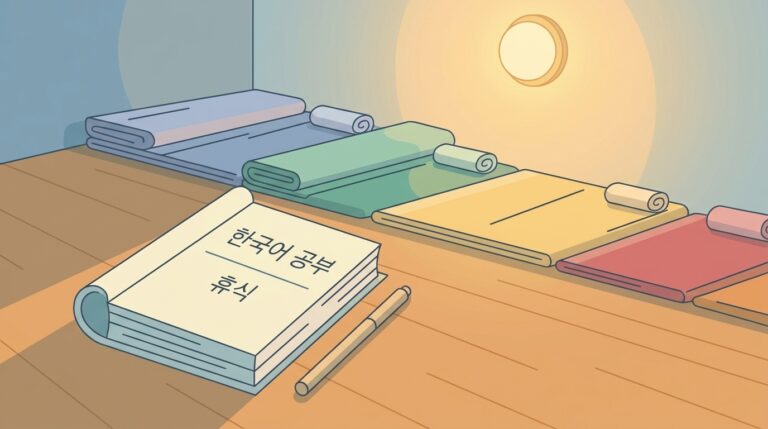
You shuffle toward the sumyeonsil (수면실, sleeping room). As you push open the heavy door, you enter a softly lit room glowing with warm amber light. The heated floor (ondol) radiates gentle comfort, and dozens of people are resting quietly side by side on thin floor mats with small rectangular pillows.
Suddenly, anxiety takes over: Where can I lie down? Is this mat claimed? What if I accidentally wake someone up? How do I ask for a blanket without sounding rude?
Take a deep breath! Many international travelers freeze at this very moment. Based on hundreds of real coaching conversations with our learners at Daily Hangul, we designed this practical cultural survival guide. You will learn natural, friendly Korean expressions and subtle social cues (nunchi) so you can navigate the Jjimjilbang sleeping quarters with total confidence.
Phase 2: Core Expressions Deep Dive
Here are the three most practical A2-level Korean expressions you will need in the sleeping area.
1. 여기 자리 있어요? (Yeogi jari isseoyo?)
- Pronunciation: Yeo-gi ja-ri i-sseo-yo? (Sounds like “Yuh-ghee jah-ree ee-ssuh-yo?”, asking gently with rising intonation)
- Meaning: Literal: “Does this place have a seat?” | Actual Nuance: “Is this spot taken? / May I lie down here?”
- K-Culture Moment: Commonly heard in popular travel variety shows when cast members hunt for sleeping floor space in crowded overnight retreats.
- Editor’s Insight: In Korean public spaces, people often mark their spot with a small towel or water bottle. If an open mat looks unoccupied, always whisper this phrase to the person next to it before lying down.
- Situation Spectrum:
- Casual (반말): ⚠️ 여기 자리 있어? (Yeogi jari isseo? – Only with close friends)
- Semi-formal (해요체): ✅ 여기 자리 있어요? (Yeogi jari isseoyo? – Perfect for strangers in the sauna)
- Formal (하십시오체): 🚫 여기 자리가 있습니까? (Yeogi jariga itseumnikka? – Too stiff and unnatural)
- 🤔 Think About It: In English, we often ask “Is anyone sitting here?” focusing on the person. In Korean, the question focuses on the spot (jari). How does this reflect the shared communal perception of space?
2. 조금만 조용히 해 주세요 (Jogeumman joyonghi hae juseyo)
- Pronunciation: Jo-geum-man jo-yong-hi hae ju-se-yo (Sounds like “Joh-geum-mahn joh-yong-hee hae joo-seh-yo”)
- Meaning: Literal: “Just a little, quietly please do.” | Actual Nuance: “Could you please keep it down a little?”
- K-Culture Moment: A scene in classic K-dramas where an exhausted character discreetly pleads with noisy late-night arrivals in a sleeping cave.
- Editor’s Insight: The word jogeumman (just a little) acts as a linguistic cushion. Koreans rarely make blunt requests; softening your phrase keeps the atmosphere peaceful.
- Situation Spectrum:
- Casual: ⚠️ 조금만 조용히 해 (Jogeumman joyonghi hae – Rude to strangers)
- Semi-formal: ✅ 조금만 조용히 해 주세요 (Jogeumman joyonghi hae juseyo – Polite, firm, yet soft)
- Formal: ⚠️ 조용히 해 주십시오 (Joyonghi hae jusipsio – Sounds like an official public announcement)
- 🤔 Think About It: Why do cultures use minimizing words like “a little bit” when making requests? Does your native language soften direct requests similarly?
3. 담요 어디서 받아요? (Damnyo eodiseo badayo?)
- Pronunciation: Dam-nyo eo-di-seo ba-da-yo? (Sounds like “Dahm-nyoh uh-dee-suh bah-dah-yo?”)
- Meaning: Literal: “Blanket where from receive?” | Actual Nuance: “Where can I get a blanket?”
- K-Culture Moment: Backpackers arriving late at a suburban bathhouse asking the counter attendant for extra bedding supplies.
- Editor’s Insight: While mats and wooden pillows are usually stacked openly on racks, blankets often require a small rental fee (around 1,000 to 2,000 KRW) via your electronic key bracelet.
- Situation Spectrum:
- Casual: 🚫 담요 어디서 받아? (Damnyo eodiseo bada? – Never use with bathhouse staff)
- Semi-formal: ✅ 담요 어디서 받아요? (Damnyo eodiseo badayo? – Natural and respectful)
- Formal: ⚠️ 담요는 어디에서 수령합니까? (Damnyoneun eodieseo suryeonghamnikka? – Overly bureaucratic)
- 🤔 Think About It: Notice the verb bada-yo (to receive/get) instead of sa-yo (to buy). You are borrowing or receiving a service item rather than purchasing a product.
Phase 3: Textbook Korean vs. Real Korean
Let’s upgrade stiff book phrases into the natural Korean you will hear on the heated floor.
Situation 1: Checking if a mat area is unoccupied
- 📖 교과서 한국어: 이 자리는 비어 있습니까? (I jarineun bieo itseumnikka? / Is this seat vacant?)
- 🗣️ 진짜 한국어: 여기 자리 있어요? (Yeogi jari isseoyo? / Is this spot taken?)
- 💡 왜 다를까?: Nobody uses formal descriptive verbs like bieo itda (to be vacant) in real-life casual spaces. Real Koreans prefer the simple existence verb isseoyo? with a gentle head tilt.
Situation 2: Asking a staff member where spare pillows are
- 📖 교과서 한국어: 베개를 어디에서 찾을 수 있습니까? (Begaereul eodieseo chajeul su itseumnikka? / Where can I locate pillows?)
- 🗣️ 진짜 한국어: 베개 더 있어요? (Begae deo isseoyo? / Are there any more pillows?)
- 💡 왜 다를까?: Instead of asking an elaborate sentence about location ability (chajeul su itseumnikka), locals simply ask if extra stock exists (deo isseoyo?). Staff will instantly point you to the storage cubbies.
Phase 4: K-Culture Deep Dive & Non-Verbal Manners
4-1. 눈치 (Nunchi) & Sleeping Room Manners
- The Whisper Rule: In the sumyeonsil, normal speaking is strictly off-limits. If you must talk, lean in close and whisper below a breathy murmur.
- Screen Glare Discipline: The room is pitch black or tinted with low crimson sleep lights. Drop your smartphone brightness to the absolute lowest setting. Blinding your neighbor with a flashlight beam earns heavy sighs.
- Footstep Stealth: Walk on the balls of your feet. Wooden and tile floors transfer thumping footsteps directly to resting heads on thin mats.
- The Mat Courtesy: Take only one floor mat (maeteu) and one wooden pillow (mokchim). Hoarding three mats to build a luxury nest breaks communal bathhouse decorum.
4-2. Cultural Code: The Ondol Legacy and Communal Vulnerability
In Western cultures, sleeping in a room with fifty quiet strangers in loungewear might feel unusual. In Korea, this stems from ondol (underfloor heating) culture. For centuries, Korean families gathered on the warmest patch of the oiled paper floor during harsh winters. Sharing warmth in a collective sanctuary represents security, safety, and mutual trust. When you enter a sleeping room, you are stepping into a centuries-old tradition of communal rest.
Phase 5: Real-Life Roleplay Scenario
Setting: 2:00 AM at a 24-hour Jjimjilbang in Hongdae. You are holding your locker key, looking for a spot in the quiet sleeping area. You see a warm wooden alcove with an empty mat next to a friendly Korean regular (Imo / Auntie).
- Turn 1 (You): 저기요, 여기 자리 있어요? (Jeogiyo, yeogi jari isseoyo? / Excuse me, is this spot taken?)
🎭 Whispering barely above a breath, pointing softly to the empty mat - Turn 2 (Imo): 아니요, 없어요. 누우세요. (Aniyo, eopseoyo. Nuuseyo. / No, it isn’t. Please lie down.)
🎭 Smiling warmly and sliding her mat an inch over to give you space - Turn 3 (You): 감사합니다! 그런데 담요는 어디서 받아요? (Gamsahamnida! Geurende damyoneun eodiseo badayo? / Thank you! By the way, where can I get a blanket?)
🎭 Making a slight, shivering gesture while whispering politely - Turn 4 (Imo): 매점 옆 카운터에서 키 찍고 빌려요. (Maejeom yeop kaunteoeseo ki jjikgo billyeoyo. / Rent one at the counter next to the snack bar by tapping your key.)
🎭 Tapping her own wristband to illustrate - Turn 5 (You): 아, 그렇군요! 혹시 여기 충전할 곳도 있나요? (A, geureokgunyo! Hoksi yeogi chungjeonhal gotdo innayo? / Ah, I see! By any chance, is there a place to charge my phone here?)
🎭 Holding up your unplugged smartphone with a curious smile - Turn 6 (Imo): 저기 기둥 뒤에 콘센트 있어요. 얼른 꽂아 둬요. (Jeogi gidung dwie konsenteu isseoyo. Eolleun kkoja dwoyo. / There is an outlet behind that pillar over there. Go plug it in quickly.)
🎭 Pointing discreetly toward the corner pillar - Turn 7 (You): 정말 감사합니다. 편히 주무세요. (Jeongmal gamsahamnida. Pyeonhi jumuseyo. / Thank you so much. Sleep comfortably.)
🎭 Giving a small, seated bow with hands clasped together - Turn 8 (Imo): 그래요, 푹 자요! (Geuraeyo, puk jayo! / Sure thing, sleep well!)
🎭 Pulling her small towel under her head and closing her eyes
🔀 Interactive Branching Point
You realize the person two mats away is watching short videos on their phone with the speaker volume turned on.
* Choice A: Loudly clear your throat, stare at them aggressively, and snap your fingers.
* Choice B: Walk over quietly, lean down, and softly whisper: “저기요, 조금만 조용히 해 주세요.” (Jeogiyo, jogeumman joyonghi hae juseyo.)
* Choice C: Unplug their phone charger from the wall without saying anything.
▶ Feedback:
- Choice A [Bad]: Aggressive body language causes confrontation and disturbs everyone in the room.
- Choice B [Best]: Calm, respectful, and uses standard soft phrasing. They will almost certainly apologize and put on earphones.
- Choice C [Risk]: Touching another person's personal electronics can lead to serious disputes and security involvement.
Phase 6: 10-Second Emotional Shadowing Drill
Practice matching the cadence and breathing of a polite midnight visitor. The slash (/) marks a pause.
[🤫 조심스럽고 낮게 / Soft, cautious whisper]
저기요… / 여기 자리 있어요? (Jeogiyo… / yeogi jari isseoyo?)[😴 나른하고 공손하게 / Tired, polite request]
담요 하나만 / 빌릴 수 있을까요? (Damnyo hanaman / billil su isseulkkayo?)[🙏 따뜻하고 진심 어린 어조 / Warm, grateful whisper]
친절하게 알려주셔서 / 정말 감사합니다. (Chinjeolhage allyeojusyeoseo / jeongmal gamsahamnida.)
Phase 7: K-Culture Mini Dictionary
- 수면실 (Sumyeonsil) | Sleeping Room | The designated quiet sleeping zone in a Jjimjilbang, often divided into male-only, female-only, and co-ed rooms.
- 목침 (Mokchim) | Wooden Block Pillow | Rectangular cedar or pine pillows provided in saunas; Koreans position them right under the curve of the neck to stimulate pressure points.
- 온돌 (Ondol) | Traditional Heated Flooring | Korea’s classic radiant floor heating system that warms the body directly from below, making bed mattresses unnecessary.
- 토굴방 (Togulbang) | Sauna Cave / Capsule Pod | Mini single-person sleeping capsules shaped like clay igloos or wooden cubbies built into the walls of modern Jjimjilbangs for enhanced privacy.
Phase 8: Survival Kit for Travelers
Top 3 Survival Expressions
- 여성 전용 수면실 어디예요? (Yeoseong jeonyong sumyeonsil eodieyo? / Where is the women-only sleeping room?)
- Pro Tip: Most larger Jjimjilbangs have dedicated women-only and men-only sleeping quarters that offer quieter rest than the main co-ed hall.
- 충전기 빌릴 수 있어요? (Chungjeongi billil su isseoyo? / Can I borrow a phone charger?)
- Pro Tip: Many front counters have rental charging blocks or secure charging lockers accessible with your wristband key.
- 몇 시에 불 꺼져요? (Myeot sie bul kkeojyeoyo? / What time do the lights turn off?)
- Pro Tip: In common sauna lounging halls, main ambient lights dim between 11:00 PM and midnight.
Editor’s Travel Note
Always search ahead using the Naver Map app download for English users to check whether a sauna is officially open 24 hours (24si). Remember: you don’t need physical cash inside! Every transaction—from renting a blanket to buying late-night shaved ice—is recorded digitally onto your electronic locker key bracelet (rakkeoki) and settled when you check out.
Phase 9: “One Step Deeper” (Cultural Reflection)
Sleeping on a warm floor alongside dozens of strangers requires an implicit pact of mutual consideration. In Korean society, the boundary between public and private shifts under the umbrella concept of Uri (우리, “we” or “our communal group”). When you slip into the bathhouse loungewear, status indicators vanish: CEOs and university students sleep on the exact same 2-centimeter vinyl mats. Respecting the quietness of the sleeping room is an act of preserving this collective sanctuary.
💬 Your Turn: Have you ever slept in a communal room or public sleeper train while traveling? How did the etiquette compare to Korea’s sumyeonsil? Share your thoughts below!
Phase 10: FAQ & Avoiding Misunderstandings
Q: Can I bring my large suitcase into the sleeping room?
A: No. Large luggage must be checked at the front reception desk or stored in designated luggage lockers near the entrance. The sleeping room floor is reserved strictly for mats and people.
Q: What should I do if someone near me is snoring very loudly?
A: Do not shout or shake them. If you cannot sleep, look for a togulbang (individual sleeping cave) or move to another floor. Earplugs (gwimagae) are often available for purchase at the front desk or snack counter.
Q: Is it safe to leave my phone charging while I sleep?
A: Korea is famous for low petty theft rates, but basic caution is still recommended. Many travelers sleep with their phone charging right next to their mat, or utilize the secure key-locked charging boxes near the snack bar.
🚨 Common Mistakes Alert
- Mistake: Wearing outdoor shoes or locker slippers onto the sleeping room floor.
- Correct Action: Walk completely barefoot. Bathhouse floors are treated as living room floors.
- Mistake: Using your day towel to claim three empty floor mats for friends who are still bathing.
- Correct Action: Only claim a mat when you are ready to use it. Holding multiple empty mats during peak hours causes friction with tired visitors.
- Mistake: Setting an alarm on loud speaker for 6:00 AM.
- Correct Action: Switch your morning alarm to vibration only or wear a smartwatch vibrating alarm to prevent waking the entire room.
Phase 11: Action Mission & Engagement
- 🥉 Bronze Mission (Solo Practice): Stand in front of a mirror and whisper: “여기 자리 있어요?” (Yeogi jari isseoyo?) three times with a gentle head nod.
- 🥈 Silver Mission (Audio Check): Record yourself whispering “조금만 조용히 해 주세요” (Jogeumman joyonghi hae juseyo) on your phone and listen to make sure your pitch sounds polite rather than demanding.
- 🥇 Gold Mission (Real-Life Sauna Run): Visit a local Korean bathhouse or Jjimjilbang, locate the sleeping mats, rent a blanket at the counter, and order a cup of sweet sikhye!
🎮 K-Culture Mission: Watch an episode of a Korean reality travel show (like Running Man or I Live Alone). Spot the cast members sleeping in bathhouse loungewear with folded towel hats (yangmeori, sheep head towels). Notice how they set up their mats!
Phase 12: Interactive Quiz Challenge
Test your Jjimjilbang sleeping skills!
- Situational Judgment: You enter the sleeping room at midnight. All floor mats seem taken, but there is an open space between two sleeping visitors. What should you do first?
- A) Drop your mat down with a thud and start a loud phone call.
- B) Whisper “여기 자리 있어요?” to check if the neighboring person is holding the spot for someone.
- C) Turn on the main room ceiling lights so you can see better.
- Fill in the Blank: When asking someone politely to lower their volume, you should soften your request with the word meaning ‘just a little’:
- “________ 조용히 해 주세요.” (________ joyonghi hae juseyo.)
- True or False Cultural Quiz: In a Korean Jjimjilbang, you must pay physical cash immediately to rent an extra blanket in the sleeping hall.
- [True / False]
Click here to check the answers and explanations!
- Correct Answer: B | Always check with quiet courtesy using “여기 자리 있어요?” before claiming ambiguous floor space.
- Correct Answer: 조금만 (Jogeumman) | Jogeumman cushions the sentence, making your request polite and non-confrontational.
- Correct Answer: False | All charges inside the sauna are billed to your electronic wristband key and paid at the checkout counter upon leaving!







