

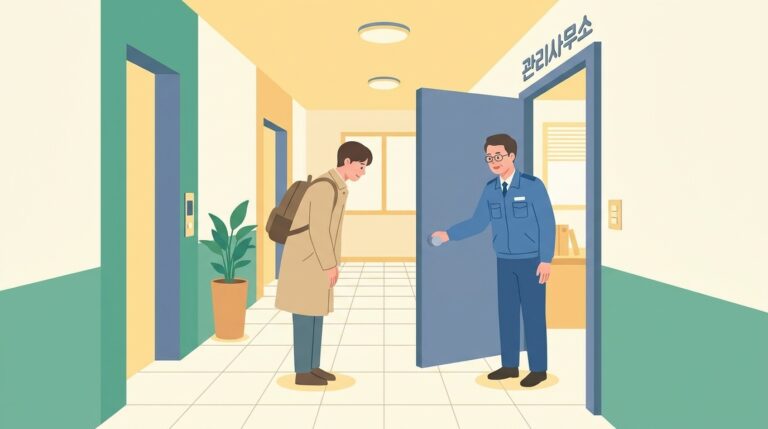
How to Complain to Your Korean Apartment Office Without Being Rude
Phase 1: Empathy (Real-Life Story Opening)
안녕하세요! 매일한글 에디터입니다. (Hello! This is your Daily Hangul editor.)
Picture this: It is 11:30 PM on a freezing January night in Seoul. You just got home from a long day, craving a steaming hot shower, but your boiler starts flashing an ominous red error code 03. Ice-cold water blasts from the showerhead. Or perhaps your upstairs neighbor has decided midnight is the prime hour for a tap-dancing rehearsal, shaking your ceiling light like a scene straight out of a K-drama thriller such as Strangers from Hell.
You know you need to contact the building management office—the famous 관리사무소 (gwalli-samuso)—or talk to the security master 경비 아저씨 (gyeongbi ajeossi). But panic freezes your fingers. If I sound too direct, will they think I’m an angry foreigner? If I sound too soft, will they ignore me? What if I use the wrong honorifics and sound confrontational?
You are not alone. Over 80% of our intermediate learners living in Korean officetels and apartments report feeling immense anxiety when reporting maintenance or noise problems. In Korea, asking for repairs or submitting a grievance (민원, minwon) is an art form rooted in polite indirectness, relational etiquette, and social harmony. This guide will equip you with native-approved phrases and cultural tact so you can solve any housing problem smoothly and respectfully.
Phase 2: Top 3 Core Expressions for Maintenance & Inquiries
1. 보일러가 작동을 안 해서 확인 좀 부탁드려요. (Boileoga jakdongeul an haeseo hwagin jom butakdeuryeoyo.)
- Pronunciation: [Boi-lleo-ga jak-dong-eul an hae-seo hwa-gin jom bu-tak-deu-ryeo-yo] (Sounds like: Boy-ler-ga jack-dong-eul an hae-suh hwa-geen jom boo-tahk-deu-ryeo-yo)
- Meaning: The boiler isn’t working, so could you please check it?
- K-Culture Moment: Seen frequently in slice-of-life dramas like Because This Is My First Life, where young tenants navigate the chilly realities of studio life.
- Editor’s Insight: Notice the word 좀 (jom) inserted before 부탁드려요. Literally meaning “a little,” it functions as a verbal shock absorber, softening the request so it sounds like a polite plea rather than a bossy demand.
- Situation Spectrum: Casual 🚫 | Semi-formal ✅ | Formal ✅
- 🤔 Think About It: In English, we often demand: “My heater is broken; send someone now.” Why does Korean culture prioritize framing a service request as asking for a mutual favor (부탁) rather than asserting a tenant’s contractual right?
2. 위층 소음 때문에 너무 힘든데, 방송 한번 해주실 수 있나요? (Wicheung soeum ttaemune neomu himdeunde, bangsong hanbeon haejusil su innayo?)
- Pronunciation: [Wi-cheung so-eum ttae-mu-ne neo-mu him-deun-de, bang-song han-beon hae-ju-sil su in-na-yo?] (Sounds like: Wee-cheung soh-eum tae-moo-neh nuh-moo him-deun-deh, bahng-song han-buhn hae-joo-sheel soo een-nah-yo?)
- Meaning: The noise from upstairs is giving me a very hard time; could you make an announcement?
- K-Culture Moment: Inter-floor noise (층간소음) is a regular theme in Korean variety shows and sitcoms. Direct confrontation between neighbors is culturally taboo; the management office acts as the diplomatic intermediary.
- Editor’s Insight: Ending the first clause in ~는데 (~neunde) leaves the sentence backgrounded and gently trail-off, prompting the listener to sympathize before hearing the actual request.
- Situation Spectrum: Casual 🚫 | Semi-formal ✅ | Formal ✅
- 🤔 Think About It: Why does Korean urban culture prefer building-wide loudspeaker announcements over knocking directly on a neighbor’s door?
3. 싱크대 밑에서 물이 새는 것 같은데 와서 봐주실 수 있을까요? (Singkeudae mit-eseo muri saeneun geot gateunde waseo bwajusil su isseulkkayo?)
- Pronunciation: [Sing-keu-dae mi-te-seo mu-ri sae-neun geot ga-teun-de wa-seo bwa-ju-sil su is-seul-kka-yo?] (Sounds like: Sing-keu-dae meet-eh-suh moo-ree seh-noon gut gah-toon-deh wah-suh bwah-joo-sheel soo ee-ssul-kkah-yo?)
- Meaning: It seems like water is leaking under the sink; could you come and take a look?
- K-Culture Moment: Every Korean tenant’s worst nightmare before security deposit deductions. When leaks occur, showing deference while moving swiftly protects your wallet and relationship with building staff.
- Editor’s Insight: Using ~는 것 같다 (~neun geot gatda – “it seems like”) even when you are 100% positive the pipe is bursting softens the certainty, letting the technician inspect the issue with their professional authority intact.
- Situation Spectrum: Casual 🚫 | Semi-formal ✅ | Formal ✅
- 🤔 Think About It: How does softening a clear statement of fact build trust and avoid defensive reactions from service workers?
Phase 3: Textbook Korean vs. Real Native Korean
Situation 1: Reporting a Broken Wall Intercom or Entrance Code
- 📖 교과서 한국어 (Textbook):
현관 도어락이 고장 났습니다. 수리해 주십시오. (Hyeongwan do-eoragi gojang natseumnida. Surihae jusipsio.)
“The entrance door lock has malfunctioned. Please repair it.” - 🗣️ 진짜 한국어 (Real Native):
저기요, 도어락 번호가 안 눌려서 그러는데, 잠깐 와서 봐주실 수 있을까요? (Jeogiyo, do-eorak beonhoga an nullyeoseo geureoneunde, jamkkan waseo bwajusil su isseulkkayo?)
“Excuse me, the keypad isn’t responding; could you step over for a quick minute to see what’s going on?” - 💡 왜 다를까? (Why the difference?): Textbook Korean uses rigid imperative endings (
-하십시오). Real-life Koreans cushion the request with 그러는데 (~geureoneunde – “it’s happening, so…”) and invite the staff to assess the issue collaboratively rather than giving orders.
Situation 2: Inquiring About Uncollected Recyclables
- 📖 교과서 한국어 (Textbook):
쓰레기를 왜 안 가져갑니까? 수거해 가세요. (Sseuregireul wae an gajyeogamnigakka? Sugeohae gaseyo.)
“Why did you not take the trash? Please collect it.” - 🗣️ 진짜 한국어 (Real Native):
안녕하세요, 분리수거함에 상자를 뒀는데 아직 안 치워져 있어서 문의드려요. 제가 잘못 둔 걸까요? (Annyeonghaseyo, bunrisugeohame sangjareul dweonneunde ajik an chiwojyeo isseoseo mun-uideuryeoyo. Jega jalmot dun geolkkayo?)
“Hello! I left boxes at the recycling bin, but they haven’t been picked up yet, so I’m calling to ask. Did I perhaps leave them in the wrong spot?” - 💡 왜 다를까? (Why the difference?): Asking “Did I do something wrong?” first is a classic high-context Korean politeness technique. It prevents the manager from feeling accused and instantly triggers their instinct to help you fix the error.
Phase 4: K-Culture Deep Dive & Non-Verbal Manners
4-1. 눈치 (Nunchi) & Physical Etiquette at the Office
When visiting the management office (관리사무소) in person:
* Bring Visual Evidence First: Never try to explain complex plumbing terminology with broken gestures. Whip out your smartphone and show a short 5-second video of the dripping pipe or rattling air conditioner. Precede it with: 영상 찍어왔는데 한번 봐주실래요? (Yeongsang jjigeowanneunde hanbeon bwajusillaeyo? / “I filmed a video, would you mind taking a look?”)
* The Two-Hand Phone Hold: Hand over your phone using both hands with elbows slightly tucked in. This demonstrates deference and seriousness.
* The Mild Bow of Gratitude: A 15-degree bow when entering and exiting sets a collaborative tone. Even when you are frustrated by apartment noise, maintain an even vocal pitch. Shouting in Korea instantly marks you as a jinsang (진상, an unreasonable troublemaker).
4-2. Cultural Code: The Sacred Rule of Inter-Floor Noise (층간소음)
Korea’s apartment living is characterized by Ondol (온돌, underfloor radiant heating). Because floors are built directly over structural heating pipes, footfalls, dropped objects, and late-night washing machine cycles resonate straight through the concrete slabs.
Directly knocking on an upstairs neighbor’s door to complain is legally and socially discouraged in Korea—it frequently sparks hostile confrontations. Instead, the management office acts as an official neutral buffer. They make polite general PA system announcements (안내 방송) reminding residents to wear padded indoor slippers (실내화) and maintain quiet hours after 10 PM.
Phase 5: Real-Life Roleplay Scenario
Setting: The 1st-floor management office of an officetel in Mapo-gu, Seoul.
Characters:
* Alex (알렉스): An expat tenant whose hot water has stopped working on a chilly autumn morning.
* Manager Park (박 소장님): A diligent 50-something building manager wearing a blue work vest, checking clipboard logs.
- Turn 1 (Alex):
안녕하세요, 소장님! 502호 입주민인데요, 잠깐 말씀 좀 여쭤봐도 될까요?
(Annyeonghaseyo, sojangnim! Obaegi-ho ipjumin-inde-yo, jamkkan malsseum jom yeojjwobwado doelkkayo?)
“Hello, Manager! I’m the resident from Unit 502. May I ask you something for a brief moment?”
🎭 Hands gently folded in front, giving a modest 15-degree bow. -
Turn 2 (Manager Park):
네, 어서 오세요. 502호요? 무슨 일 있으세요?
(Ne, eoseo oseyo. Obaegi-ho-yo? Museun il isseuseyo?)
“Yes, welcome. Unit 502? What seems to be the problem?”
🎭 Puts down his pen and looks up with attention. -
Turn 3 (Alex):
다름이 아니라, 어제저녁부터 온수가 아예 안 나와서요.
(Dareumi anira, eojejeonyeokbuteo onsuga aye an nawaseoyo.)
“It’s just that hot water hasn’t been coming out at all since yesterday evening.”
🎭 Shows an apologetic smile while pointing slightly toward his phone. -
Turn 4 (Manager Park):
그래요? 보일러 계량기 쪽에 에러 코드 번호 깜빡이는 거 있었어요?
(Geuraeyo? Boilleo gyeryanggi jjoge ereo kodeu beonho kkamppagineun geo isseosseoyo?)
“Really? Was there an error code number blinking on the boiler meter?”
🎭 Tilts head curiously and checks the master unit status monitor. -
Turn 5 (Alex):
네, ’02’라고 뜨던데 제가 사진 찍어왔어요. 한번 봐주시겠어요?
(Ne, ‘gong-i’rago tteudeonde jega sajin jjigeowasseoyo. Hanbeon bwajusigesseoyo?)
“Yes, it displayed ’02’, so I took a photo. Could you please take a look?”
🎭 Presents the smartphone screen with both hands. -
Turn 6 (Manager Park):
아이고, 밸브 센서 문제 같네요. 지금 바로 기사님하고 같이 올라가 볼게요.
(Aigo, baelbeu senseo munje gatneyo. Jigeum baro giganim-hago gachi ollaga bolkeyo.)
“Oh dear, looks like a valve sensor issue. I will head up with the technician right away.”
🎭 Grabs his walkie-talkie and toolbox from the desk shelf. -
Turn 7 (Alex):
바쁘실 텐데 바로 와주셔서 정말 감사합니다!
(Bappeusil tende baro wajusyeoseo jeongmal gamsahamnida!)
“I know you are busy; thank you so much for coming over immediately!”
🎭 Steps back to clear the doorway with an appreciative nod. -
Turn 8 (Manager Park):
아닙니다, 추운데 고생하셨네. 얼른 가서 해결해 드립시다.
(Animnida, chuunde gosaenghasyeonne. Eolleun gaseo haegyeolhae deuripsida.)
“Not at all, you must have suffered in the cold. Let’s get up there and fix it right now.”
🎭 Smiles warmly and gestures for Alex to lead the way to the elevator.
🔀 Interactive Scenario Branching: Your Next Move
Suppose Manager Park said he couldn’t come right now because he’s waiting for a delivery. How do you respond?
- Option A: “지금 안 오시면 월세 안 낼 거예요!” (If you don’t come right now, I won’t pay rent!)
❌ Bad: Extreme threat. Landlords manage rent, not the building staff. This will ruin your relationship with the manager instantly. - Option B: “바쁘시면 언제쯤 방문 가능하신지 시간만 대략 알려주실 수 있을까요?” (If you’re busy, could you roughly let me know around what time you might be able to visit?)
⭐ Best: Empathetic, respectful of their workload, while securing a firm timeline. - Option C: “그냥 제가 드라이버로 뜯어서 고쳐볼게요.” (I’ll just pry it open with a screwdriver and fix it myself.)
⚠️ Risk: Touching boiler or pipe installations without permission makes you legally liable for total replacement costs if damages spread.
Phase 6: 10-Second Emotion Shadowing Drill
Repeat these lines out loud with the designated emotion. Focus on the pitch rise before the slash / and drop gently after it.
[🥺 조심스럽고 미안한 톤 / Hesitant and polite]
저기 실례지만… / 관리실에서 나오셨나요?
(Jeogi sillyejiman… / gwallisireseo naosyeonnayo?)
“Excuse me… / Are you from the management office?”-
[😤 답답하지만 정중함을 잃지 않고 / Frustrated but composed]
어젯밤부터 전기가 자꾸 나가서요… / 두꺼비집 좀 봐주실 수 있나요?
(Eojetbambuteo jeongiga jakku nagaseoyo… / dukkeobijip jom bwajusil su innayo?)
“The power keeps tripping since last night… / could you check the circuit breaker?” -
[🙏 깊은 감사와 안도감 / Relieved and warmly grateful]
추운 날씨에 / 직접 와서 손봐주셔서 / 정말 든든해요!
(Chuun nalssie / jikjeop waseo sonbwajusyeoseo / jeongmal deundeunhaeyo!)
“In this freezing weather / coming in person to fix it / gives me such peace of mind!”
Phase 7: K-Culture Mini Dictionary
-
관리비 (Gwallibi)
Translation: Monthly Maintenance Fee.
Usage: The monthly building upkeep charge covering hallway lights, cleaning, elevator maintenance, and sometimes water/heating. Make sure to check your itemized bill (관리비 명세서) every month. -
층간소음 (Cheung-gan soeum)
Translation: Inter-Floor Noise.
Usage: The single most sensitive social issue in Korean modern apartment complexes. Refers to heavy footsteps, children jumping, late-night vacuuming, or thumping bass. -
분리수거 (Bunrisugeo)
Translation: Waste Sorting & Recycling.
Usage: Korea maintains one of the strictest recycling systems in the world (separating clear PET bottles, colored plastics, vinyl, paper, and food waste). Improper disposal leads to surveillance warnings and fines. -
민원 (Minwon)
Translation: Civil Complaint / Formal Grievance.
Usage: The official term used when reporting facility failures, hygiene issues, or community rule infractions to a district office or building management desk.
Phase 8: Survival Kit for Residents & Long-Term Travelers
Top 3 Immediate Survival Phrases
- 누수가 있는 것 같아요. (Nusuga inneun geot gatayo.)
Romanization: Nu-su-ga in-neun geot ga-ta-yo.
Pro Tip: 누수 (nusu) specifically means water leakage through ceilings, floors, or walls. Saying this triggers top-priority emergency response. - 음식물 쓰레기 카드가 안 먹혀요. (Eumsikmul sseuregi kadeuga an meokhyeoyo.)
Romanization: Eum-sing-mul sseu-re-gi ka-deu-ga an meok-hyeo-yo.
Pro Tip: Modern RFID food disposal bins require a sensor key. If it doesn’t scan, use 안 먹혀요 (“it’s not responding/working”). - 택배 보관함 비밀번호를 분실했어요. (Taekbae bogwanham bimilbeonhoreul bunsilhaesseoyo.)
Romanization: Taek-bae bo-gwan-ham bi-mil-beon-ho-reul bun-sil-haes-seo-yo.
Pro Tip: For automated parcel locker issues, the guard or office can reset your unit’s access code.
Editor’s Expat Note
- Install the 아파트아이 앱 다운로드 to monitor your monthly maintenance fees, compare electricity consumption with neighbors, and view building-wide notices.
- If you are looking for the nearest hardware store to replace specialized LED bulbs, open 네이버 지도 길찾기 and search for 철물점 (cheolmuljeom).
Phase 9: “One Step Deeper” (Cultural Reflection)
In Western individualist housing traditions, paying rent confers an uncompromised sovereignty over one’s private space, and issues are framed strictly around rights and contractual liabilities. In contrast, Korean high-density living reflects a deeply communal architecture where hundreds of households share thin ceilings, shared vents, and collective garbage disposal zones. Korean communication within residential complexes is deliberately softened with hedges like ~것 같다 (it seems) and 부탁드립니다 (I ask a favor) because direct confrontation disrupts the fragile collective harmony of the building. Politeness here is not weakness; it is the social lubricant that ensures a community of strangers can live stacked upon one another in peace.
💬 Your Turn: Have you ever experienced a sudden maintenance emergency or noise dispute while living abroad? How did you handle it? Share your story in the comments below!
Phase 10: FAQ & Common Mistakes
Q: Can I call the management office late at night if there is an emergency?
A: Yes, but only for true emergencies like pipe bursts, major water leaks, total power blackouts, or someone stuck in the elevator. The night guard (당직 경비원) handles nighttime calls. For non-urgent matters like lightbulb replacements or daytime noise inquiries, wait until standard office hours (09:00 – 18:00).
Q: Who pays when the air conditioner or boiler breaks down in a rented studio?
A: In standard Korean rental law, major built-in appliances (옵션, opsyeon) like wall-mounted ACs, boilers, and built-in washing machines are the landlord’s (임대인) responsibility to repair, provided the tenant didn’t break them through negligence. Contact the management office first to identify the cause, then report the quote to your landlord.
Q: Can I knock on my upstairs neighbor’s door if the noise is unbearable at 2 AM?
A: It is strongly advised not to do so. In South Korea, direct confrontation over noise has led to heated legal disputes and police interventions. Instead, call the building guard desk (경비실) via the wall-pad intercom phone. They will handle the notification neutrally.
🚨 Common Mistakes Alert Board
| Mistake | Why It Causes Problems | Correct Action |
|---|---|---|
| 1. Demanding immediate fixes using “빨리 고쳐요!” | Sounds like an aggressive command; offends staff elders. | Use “불편해서 그러는데, 가능한 한 빨리 확인 부탁드릴게요.” |
| 2. Throwing trash in regular plastic bags | City sanitation will tag it with an uncollected fine sticker. | Buy official district trash bags (종량제 봉투) at the local convenience store. |
| 3. Trying to fix complex plumbing yourself | Can crack older pipes and void landlord liability protections. | Take photos/video and request an on-site check from the office first. |
Phase 11: Action Missions
- 🥉 Bronze Mission (Solo Practice): Stand in front of your home’s boiler panel or kitchen sink. Practice the core sentence: “싱크대 밑에서 물이 새는 것 같은데 와서 봐주실 수 있을까요?” 5 times smoothly without reading notes.
- 🥈 Silver Mission (Shadowing & Recording): Record yourself reading the Phase 6 shadowing drill on your phone’s voice memo app. Listen back and make sure your tone sounds polite and gentle rather than flat.
- 🥇 Gold Mission (Real-World Application): The next time you see your building’s security guard or cleaner, greet them with a slight bow and say: “날씨가 추운데 고생 많으십니다! (It’s cold out, thank you for your hard work!)”
🎮 K-Culture Media Mission: Watch an episode of a slice-of-life K-drama (like Hospital Playlist or My Liberation Notes). Listen for characters using the cushion phrase 다름이 아니라… (Dareumi anira… / “The reason I’m reaching out is…”) when raising a topic.
Phase 12: Interactive Quiz Challenge
1. Situational Judgment
Your water heater is broken on a Sunday morning. You call the guard office. Which sentence is the most culturally polite and effective?
* A) 왜 보일러가 안 돼요? 오늘 당장 고치세요!
* B) 안녕하세요, 보일러 작동이 안 돼서 문의드리는데요, 기사님 점검이 가능할까요?
* C) 보일러 고장 났습니다. 수리비 입금하세요.
2. Fill-in-the-Blank
Fill in the missing softening particle to make the request gentle:
“소음 때문에 힘든데 방송 ( ) 해주실 수 있나요?”
* A) 당장
* B) 한번
* C) 반드시
3. True or False
- If your neighbor is vacuuming noisily at 11 PM, Korean social etiquette recommends knocking on their door immediately and confronting them face-to-face. (True / False)
👉 Click here for answers and explanations!
-
Answer: B
Explanation: Option B uses polite background framing (-문의드리는데요) and asks if an inspection is feasible, avoiding aggressive demands. -
Answer: B (한번 / hanbeon)
Explanation: Adding 한번 (“once / a try”) softens an imperative request into an unobtrusive favor. -
Answer: False
Explanation: Direct confrontation over inter-floor noise is strongly discouraged in Korea. Always contact the management office or guard post via your intercom so they can handle it impartially!







