

Phase 1: Empathy (Story-Immersive Opening)
안녕하세요! 매일한글 에디터입니다.
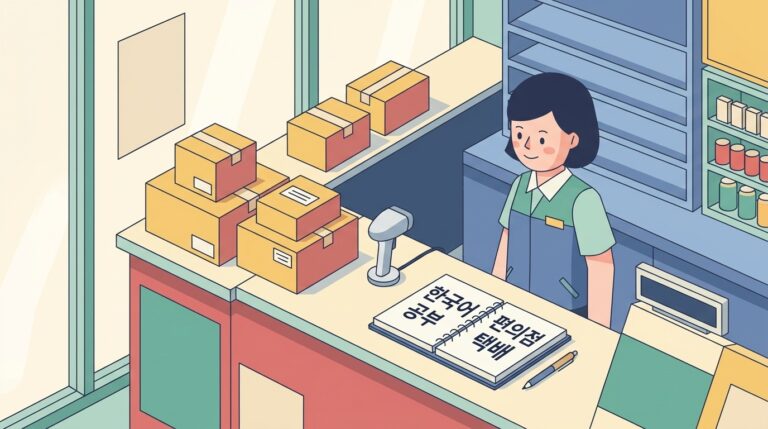
Picture this: You finally scored that sold-out limited-edition K-pop photo card or vintage jacket on a Korean secondhand app like Karrot Market (당근마켓) or Bunjang (번개장터). The seller sent you a message: “반값택배로 보냈어요! 편의점에서 찾아가세요!” (I sent it via half-price parcel! Please pick it up at the convenience store!). You march confidently into the brightly lit GS25 on the corner. But as the door chime rings, reality hits. Behind the counter, a busy clerk is ringing up iced cups and triangle kimbap at lightning speed, while next to the register sits a sleek, intimidating electronic post kiosk flickering with Korean touchscreen menus.
Your heart rate spikes. What do I say? Do I scan a QR code first, or do I talk to the clerk? Where do I get the shipping label? If this sounds familiar, take a deep breath. Over 80% of intermediate learners tell us that navigating Korea’s automated convenience store services is their ultimate “language trial by fire.” In this guide, tailored specifically for B2 learners, we’ll break down the exact conversational cadence, kiosk navigation tricks, and subtle nunchi gestures you need to drop off and pick up packages smoothly without breaking a sweat.
Phase 2: Core Expressions Deep Dive
Here are the three high-impact expressions you need to own the convenience store parcel counter.
1. 택배 찾으러 왔는데요. (Taekbae chajeureo wanneundeyo.)
- Pronunciation: Taek-bae cha-jeu-reo wan-neun-de-yo (Think “tech-bay” + “cha-joo-row” + “wan-neun-day-yo”).
- Meaning: Literal: “I came to find a parcel.” | Real Nuance: “Hi there, I’m here to pick up a package.”
- K-Culture Moment: In slice-of-life K-dramas, university students or busy freelancers pop into their local CU in sweatpants, flashing their smartphone barcode to the part-timer with this exact breezy line.
- Editor’s Insight: Ending with
-는데요softens the delivery compared to the blunt-왔습니다. It signals to the clerk that you are presenting a topic and politely waiting for their instruction (e.g., asking for your phone number or barcode).- Situation Spectrum: Casual ⚠️ | Semi-formal ✅ | Formal 🚫
- 🤔 Think About It: Why do Koreans prefer ending sentences with open-ended connectors like
-는데요instead of direct imperative statements when requesting counter services?2. 사전 예약 바코드 찍어주세요. (Sajeon yeyak bakodeu jjigeojuseyo.)
- Pronunciation: Sa-jeon ye-yak ba-ko-deu jji-geo-ju-se-yo (“Sah-jeon yea-yahk bar-code jjee-gaw-joo-say-yo”).
- Meaning: Literal: “Please scan the pre-booking barcode.” | Real Nuance: “Could you scan this pre-registered reservation barcode for my parcel?”
- K-Culture Moment: When shipping out an item you sold online, you save several minutes by pre-filling the address details on your smartphone app. When you step up to the kiosk or counter, this phrase instantly shows the clerk you are an experienced, efficient customer.
- Editor’s Insight: Using the compound verb
찍어주세요(literally “please stamp/scan for me”) sounds much more natural in retail tech environments than formal verbs like스캔해 주세요.- Situation Spectrum: Casual ⚠️ | Semi-formal ✅ | Formal ✅
- 🤔 Think About It: In fast-paced urban Korea, how does pre-registering administrative tasks reflect the national cultural value of ppalli-ppalli (빨리빨리, hurry-hurry)?
3. 송장 출력해서 카운터로 가져가시면 돼요. (Songjang chullyeokaeseo kaunteoro gajyeogasimyeon dwaeyo.)
- Pronunciation: Song-jang chul-lyeok-hae-seo ka-un-teo-ro ga-jyeo-ga-si-myeon dwae-yo.
- Meaning: Literal: “If you print the waybill and take it to the counter, it works.” | Real Nuance: “Just print out the shipping label sticker from the machine and bring it over to the register.”
- K-Culture Moment: You will often hear a helpful clerk or a fellow customer in line say this when you are standing hesitantly in front of the scale weighing your box.
- Editor’s Insight: The pattern
-(으)시면 돼요is Korea’s favorite polite guideline phrase. It tells the listener, “This is the simple condition needed to complete the task smoothly.”- Situation Spectrum: Casual 🚫 | Semi-formal ✅ | Formal ✅
- 🤔 Think About It: Notice how the speaker adds honorifics (
-(으)시-) even when giving step-by-step technical instructions. How does this maintain interpersonal harmony in customer service?
Phase 3: Textbook Korean vs. Real Korean
Situation A: Asking where to place your parcel box after weighing it
- 📖 교과서 한국어: 이 소포를 어디에 놓아야 합니까? (I soporeul eodie noaya hamnikka? – Where should I place this parcel?)
- 🗣️ 진짜 한국어: 이 박스 저기 택배 수거함에 두면 되나요? (I bakseu jeogi taekbae sugeohame dumyeon doenayo? – Can I just leave this box over there in the pickup bin?)
- 💡 왜 다를까? Sopo (소포) is an archaic postal term rarely used in convenience stores. Modern locals say taekbae (택배) or simply bakseu (박스). Asking with
~두면 되나요?is gentle, collaborative, and natural.
Situation B: Inquiring about half-price shipping eligibility
- 📖 교과서 한국어: 반값택배 서비스를 이용하는 것이 가능합니까? (Banggaptackbae seobiseureul iyonghaneun geosi ganeunghamnikka? – Is it possible to use the half-price parcel service?)
- 🗣️ 진짜 한국어: 이거 반값택배 접수 지금도 되죠? (Igeo banggaptackbae jeopsu jigeumdo doejo? – I can still register this as a half-price parcel right now, right?)
- 💡 왜 다를까? Intermediate speakers often overuse literal translations of “Is it possible to…” using
-(으)ㄹ 수 있습니까. Native speakers use tag questions with-지요? / -죠?to confirm assumptions quickly.
Phase 4: K-Culture Deep Dive & Non-Verbal Etiquette
4-1. 눈치 (Nunchi) & Counter Body Language
Convenience stores are micro-ecosystems operating at peak velocity. Mastering non-verbal cues prevents unnecessary friction:
* The Screen Turn (화면 돌리기): When presenting your pickup barcode on your phone, maximize your screen brightness in advance and turn the display toward the scanner before the clerk asks. Never push the phone aggressively into their personal space; hold it steady about 10–15 centimeters above the counter scanner.
* The Two-Handed Handover: When handing over the printed adhesive waybill (songjang), present it with both hands or with your right hand supported lightly by your left forearm. This small gesture instantly softens retail interactions.
* The Scale Placement: When placing your box on the postbox scale, align it gently within the designated outline so the sensor reads the weight on the first try. Blocking the cashier’s main checkout counter with oversized packages while customers are waiting is considered a significant breach of nunchi.
4-2. Cultural Code Analysis: The “Half-Price Parcel” Phenomenon
In South Korea, Ban-gap Taekbae (반값택배 at GS25) or Kkiri Taekbae (끼리택배 at CU) has revolutionized C2C commerce. Unlike traditional couriers that deliver to your doorstep, these services utilize the convenience store chain’s existing logistical supply trucks that replenish store shelves daily. Because the delivery travels from store to store, the shipping fee is cut in half (typically under 2,000 KRW). This system has become the lifeblood of Korea’s booming secondhand resale economy, especially among Gen Z fans trading idol merchandise and vintage fashion.
Phase 5: Real-Life Roleplay Scenario
Setting: It’s 7:30 PM on a brisk evening in Mapo-gu, Seoul. Min-jun, a seasoned part-time university student with neat wire-rimmed glasses, is restocking sandwiches behind the counter. You walk in with a small, neatly taped box.
- Turn 1 (User):
저기요, 택배 접수하러 왔는데요. 무인 키오스크로 먼저 접수해야 하나요?
(Jeogiyo, taekbae jeopsuhareo wanneundeyo. Muin kioseukeuro meonjeo jeopsuhaeya hanayo?)
Excuse me, I’m here to send a parcel. Should I register it at the kiosk first?
🎭 [Holding the parcel box lightly with both hands, making brief, polite eye contact] -
Turn 2 (Min-jun):
네, 앱으로 미리 예약하셨으면 키오스크에서 ‘쇼핑몰/사전예약’ 누르고 로그인하시면 돼요.
(Ne, aebeuro miri yeyakhayeosseumyeon kioseukeueseo ‘syopingmol/sajeonyeyak’ nureugo rogeuinhasi-myeon dwaeyo.)
Yes! If you already booked it via the app, tap ‘Shopping Mall/Pre-booking’ on the kiosk and log in.
🎭 [Points toward the postbox machine near the entrance with an open palm] -
Turn 3 (User):
아, 네! 예약 번호 입력하고 무게만 재면 되죠?
(A, ne! Yeyak beonho imnyeokhago mugeman jaemyeon doejo?)
Ah, got it! I just input the reservation number and weigh it, right?
🎭 [Nodding slightly while walking toward the weighing platform] -
Turn 4 (Min-jun):
네, 맞아요. 무게 측정 끝나면 출력되는 운송장 스티커 카운터로 가져와 주세요.
(Ne, majayo. Muge cheukjeong kkeutnamyeon chullyeokdoeneun unsongjang seutikeo kaunteoro gajyeowa juseyo.)
Exactly. Once the weight measurement finishes, bring the printed waybill sticker over to the counter.
🎭 [Resumes checking the beverage inventory with a friendly smile]
(A minute passes. The user returns to the counter with two printed paper strips.)
- Turn 5 (User):
스티커 나왔습니다. 왼쪽 큰 부분은 박스에 붙였고, 이건 카운터 보관용 맞나요?
(Seutikeo nawasseumnida. Oenjjok keun bubeuneun bakseue buchyeotgo, igeon kaunteo bogwanyon mannayo?)
The stickers came out. I stuck the big left part on the box; is this one for the counter to keep?
🎭 [Hands over the receipt slip using both hands] -
Turn 6 (Min-jun):
네, 잘하셨어요. 결제는 선불이세요, 착불이세요?
(Ne, jalhasyeosseoyo. Gyeoljeneun seonburiseyo, chakburiseyo?)
Yes, you did it right. Would you like to pay prepaid or cash-on-delivery?
🎭 [Scans the barcode on the counter slip with a beep] -
Turn 7 (User):
선불로 할게요. 신용카드로 결제 가능한가요?
(Seonbullo halkeyo. Sinyongkadeuro gyeolje ganeunghangayo?)
Prepaid, please. Can I pay by credit card?
🎭 [Prepares card in hand, keeping phone away] -
Turn 8 (Min-jun):
네, IC 칩 위로 향하게 꽂아주시고요, 박스는 계산대 옆 수거함에 넣어주시면 됩니다. 영수증 드릴까요?
(Ne, IC chip wiro hyanghage kkojajusigoyo, bakseuneun gyesandae yeop sugeohame neoeojusimyeon doemnida. Yeongsujeung deurilkkayo?)
Sure, insert your card chip-side up here, and drop the box into the bin next to the counter. Would you like a receipt?
🎭 [Gestures toward the card terminal and hands over the customer receipt strip]
🔀 Interactive Decision Branch
What would you say if the kiosk suddenly errors out with the red text: “무게 측정 오류 (Weight measurement error)”?
- Option A: 저기요! 기계가 고장 난 것 같은데 와서 좀 봐주세요! (Jeogiyo! Gigyega gojang nan geot gateunde waseo jom bwajuseyo!)
- Option B: 저 죄송한데요, 무게 측정이 잘 안 넘어가는데 잠깐 도와주실 수 있을까요? (Jeo joesonghandeyo, muge cheukjeongi jal an neomeoganeunde jamkkan dowajusil su isseulkkayo?)
- Option C: (Silently tap the screen repeatedly until the clerk looks up.)
Detailed Feedback:
* Option A (Risk): While grammatically correct, announcing that the machine is broken (고장 났다) can sound accusatory and demanding in retail settings.
* Option B (Best ✅): Polite, humble, and uses 죄송한데요 and 도와주실 수 있을까요? to invite help without placing blame on the store equipment.
* Option C (Bad 🚫): Clerks are often busy with multiple tasks; standing in silent frustration might cause delays or miscommunication.
Phase 6: 10-Second Emotion Shadowing Drill
Read these sentences aloud, matching the pitch drops and emotional markers:
[😊 자신감 있고 경쾌하게 - Confidently and bright]
안녕하세요! / 택배 찾으러 왔는데요, / 바코드 여기 있어요!
(Annyeonghaseyo! / Taekbae chajeureo wanneundeyo, / bakodeu yeogi isseoyo!)-
[🤔 공손하고 조심스럽게 - Polite and cautious]
죄송한데요, / 운송장 출력이 안 나오는데 / 확인 한 번만 부탁드려요.
(Joesonghandeyo, / unsongjang chullyeogi an naoneunde / hwagin han beonman butakdeuryeoyo.) -
[🤝 명확하고 깔끔하게 - Clear and professional]
선불로 계산해 주시고요, / 영수증은 버려주셔도 돼요!
(Seonbullo gyesanhae jusigoyo, / yeongsujeungeun beoryeojusyeodo dwaeyo!)
Phase 7: K-Culture Mini Dictionary
- 송장 / 운송장 (Song-jang / Un-song-jang) | Shipping Waybill / Tracking Label
- Usage: The two-part barcode sticker generated by the postbox kiosk. The larger section sticks to the box; the smaller receipt slip is scanned at the counter.
- 반값택배 (Ban-gap-taek-bae) | Half-Price Convenience Delivery
- Usage: GS25’s proprietary store-to-store shipping system. The recipient picks it up at their designated local branch rather than home delivery.
- 선불 / 착불 (Seon-bul / Chak-bul) | Prepaid / Cash on Delivery
- Usage: Essential payment terminology asked at the counter.
선불means sender pays now;착불means the recipient pays upon package arrival.
- Usage: Essential payment terminology asked at the counter.
- 수거함 (Su-geo-ham) | Package Collection Bin
- Usage: The large plastic cart or labeled fabric container inside the store where you deposit your labeled box after settling payment.
Phase 8: Traveler’s Survival Kit
Survival Expressions TOP 3
- 택배 픽업 바코드 보여드릴게요. (Taekbae pik-eop bakodeu boyeodeurilkeyo. – I’ll show you my pickup barcode.)
- Pro Tip: Keep the SMS/KakaoTalk notification open before reaching the front of the queue.
- 박스 테이프 혹시 빌릴 수 있을까요? (Bakseu teipeu hoksi billil su isseulkkayo? – Could I possibly borrow some box tape?)
- Pro Tip: Stores often keep packing tape near the kiosk for customer use, but asking politely first is common courtesy.
- 착불로 접수 부탁드립니다. (Chakbullo jeopsu butakdeurimnida. – Please process this as cash-on-delivery.)
- Pro Tip: Essential when returning online rental equipment or secondhand exchanges.
Editor’s Travel Note
- App Advantage: Avoid struggling with Korean keyboard inputs on kiosk touchscreens by registering in advance through the GS25 편의점 택배 앱 사전 예약 서비스 or 포켓CU 편의점 택배 간편 접수 안내. Both let you save domestic addresses beforehand so you only need to scan a QR code at the machine.
- Box Requirements: Korean convenience stores will reject packages packed in paper shopping bags or loose plastic bags. Always pack items in a rigid cardboard box taped securely in an “H-shape.”
Phase 9: “One Step Deeper” (Reflective Essay)
In many countries, a convenience store is merely a stop for late-night sodas or candy. In South Korea, it functions as the hyper-localized nervous system of civic life. The integration of logistics into 24-hour retail reflects the core values of contemporary Korean society: absolute efficiency, mutual civic trust, and friction-free technology. When you drop off a package at midnight and pick it up across the country 36 hours later for less than the price of a latte, you are experiencing the real Ppal-li Ppal-li culture at work—not as frantic rushing, but as streamlined collective consideration for everyone’s time.
💬 Your Turn: Have you ever tried picking up a parcel in Korea or your home country? What is the biggest difference you noticed in store interactions? Share your story in the comments below!
Phase 10: FAQ & Avoiding Misunderstandings
Q: Can I ship a package internationally at any Korean convenience store?
A: Not all stores offer international shipping. You must look for branches with the designated “EMS / DHL 국제특송” logo on the kiosk interface, primarily found in major tourist zones and near university campuses.
Q: How long will a convenience store hold my pickup package before returning it?
A: For store-to-store pick-ups like 반값택배, packages are held for exactly 3 to 4 days from the moment you receive the notification KakaoTalk message. If uncollected, it will automatically be returned to the sender.
Q: Do I need a Korean phone number to pick up a parcel?
A: Yes, generally pickup authentication is tied to a domestic Korean mobile number or the secure alphanumeric pick-up barcode sent via KakaoTalk or SMS. If you are a traveler without a local number, ensure the sender registers your email or friend’s contact.
🚨 Common Mistakes Warning Board
- Mistake: Throwing away the printed counter slip with the waybill.
- Correct Action: Keep both slips! Give the counter slip to the clerk to complete transaction registration, and stick the large adhesive part onto the package.
- Mistake: Forgetting to tape the bottom of your recycled box.
- Correct Action: Convenience store couriers will strictly deny pickup for unsealed or irregularly shaped parcels. Ensure the box is sturdy and fully taped.
- Mistake: Confusing GS25’s 반값택배 with CU’s 끼리택배.
- Correct Action: These are rival systems! You cannot send or pick up a GS25 logistics package at a CU or 7-Eleven store.
Phase 11: Action Mission & Engagement
- 🥉 Bronze Tier (Solo Drill): Practice speaking the phrase
"택배 찾으러 왔는데요, 바코드 찍어드릴게요!"out loud three times until you can say it smoothly within 4 seconds. - 🥈 Silver Tier (Community): Screenshot your favorite K-drama convenience store scene and post it on social media using the hashtag
#DailyHangulConvenienceStore. - 🥇 Gold Tier (Real-World Execution): Next time you buy something on Karrot Market or order from a Korean friend, request 반값택배 and collect it in person using only Korean at the counter!
🎮 K-Culture Mission: Watch an episode of the K-drama Backstreet Rookie (편의점 샛별이). Spot at least two scenes where customers interact at the counter and observe how they hold their payment cards or phones when interacting with the clerk.
Phase 12: Interactive Quiz Challenge
Q1. [Situational Judgment] You finished printing your two-part shipping label stickers at the kiosk. What is the immediate next step?
a) Place the box in the collection box and leave immediately.
b) Stick the large label on the box and take the customer/counter slip to the cash register for scanning and payment.
c) Hand both unpeeled stickers to the clerk and ask them to tape your box.
Q2. [Fill in the Blank] Recipient pays for shipping fees upon package arrival:
“이 택배는 ( )(으)로 보내주세요.”
Q3. [True / False Cultural Check] You can drop off your parcel at any Korean convenience store using your own paper shopping bag as long as you tie the handles.
🔍 Click here to view Answer Key & Detailed Explanations
- Q1 Answer: b)
Explanation: Until the cashier scans the barcode on the counter slip and issues your payment confirmation, the parcel is not officially in the postal system! - Q2 Answer: 착불 (Chak-bul)
Explanation:착불(Cash on delivery / Recipient pays) vs.선불(Prepaid / Sender pays). - Q3 Answer: False
Explanation: Korean courier networks require rigid cardboard boxes. Envelopes are only accepted for specific paper document items, and shopping bags are strictly rejected due to automated conveyor belt jamming risks.







