

Phase 1: Empathy (Story-immersive Opening)
안녕하세요! 매일한글 에디터입니다.
Picture this: It’s a chilly Wednesday night in Seoul. You’ve just battled the suffocating rush-hour crowd on Line 2, your shoulders are practically glued to your ears from tension, and your brain feels fried after hours of Korean work emails. You walk into your cozy officetel, kick off your shoes, and wonder: How on earth do Koreans survive this intense pace and still wake up glowing?
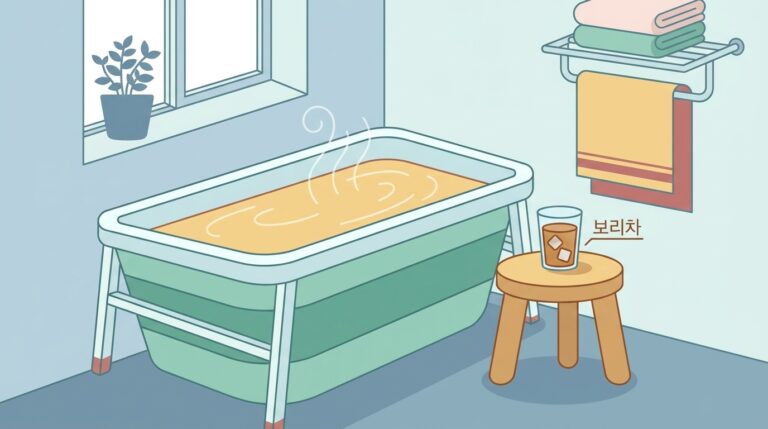
If you watch lifestyle K-dramas or reality shows like I Live Alone (나 혼자 산다), you’ve probably seen celebrities end their chaotic days not with a quick shower, but submerged up to their belly buttons in water, sipping iced barley tea with a chilled towel neatly balanced on their heads. This is 반신욕 (Bansinyok – Half-body Bath), Korea’s ultimate restorative ritual.
Many of our advanced learners told us: “I bought a portable folding tub, but when talking to my Korean coworkers about relaxing at home, I ended up using stiff, medical-sounding words like ‘온수 목욕을 즐겼습니다’ (I enjoyed a warm water bath).” Let’s fix that! Today, we are diving deep into high-level, natural C1 Korean expressions that capture the exact sensory bliss of melting your fatigue away at home. Based on real cultural navigation and feedback from hundreds of expats, this guide will make your Korean sound effortlessly local.
Phase 2: Core Expressions Deep Dive
1. 반신욕 하면서 땀을 쫙 뺐어요. (Bansinyok hamyeonseo ttameul jwwak ppaesseoyo.)
- Pronunciation: [Bansinyok hamyeonseo ttameul jwwak ppaesseoyo] (Sound tip: The mimetic word ‘쫙 (jjwak)’ sounds like a towel being snapped open with sharp, full momentum).
- Meaning: Literal: “I took a half-body bath and drained sweat out fully.” | Actual Nuance: “I sweated out all the toxins and stress during my bath; I feel totally detoxed!”
- K-Culture Moment: Commonly heard when an actor on I Live Alone explains their evening reset routine before an important red-carpet event or shoot.
- Editor’s Insight: ‘쫙 (jjwak)’ is a powerhouse adverb. Pairing it with ‘땀을 빼다 (to sweat out)’ emphasizes a satisfying, deep purge rather than uncomfortable perspiration.
- Situation Spectrum:
- Casual (Friends/Coworkers): ✅
- Semi-formal (Polite conversation): ✅
- Formal (News/Academic presentation): ⚠️ (Use ‘노폐물을 배출했습니다’ instead)
- 🤔 Think About It: In English, sweating is often associated with strenuous exertion or discomfort. Why do you think Korean culture views sweating in hot water as an active form of healing and rejuvenation?
2. 몸이 사르르 녹아내리는 것 같아요. (Momi sareureu noganaerineun geot gat-ayo.)
- Pronunciation: [Momi sareureu noganaerineun geot gat-ayo] (Sound tip: ‘사르르 (sareureu)’ flows like warm honey or melting snowflakes on your tongue).
- Meaning: Literal: “It feels like my body is melting gently.” | Actual Nuance: “All my physical tension has dissolved into thin air; absolute heavenly relaxation.”
- K-Culture Moment: That euphoric sigh character actors let out in cozy healing dramas like Summer Strike the moment they sink into warm water.
- Editor’s Insight: ‘사르르’ specifically portrays soft, gradual dissolution without resistance. Using it transforms you from an intermediate speaker who says ‘편해요 (it’s comfortable)’ to an advanced expressive communicator.
- Situation Spectrum:
- Casual: ✅
- Semi-formal: ✅
- Formal: 🚫 (A bit too poetic/emotional for business reports)
- 🤔 Think About It: How does your mother tongue express bodily relaxation? Does it evoke temperature, texture, or weight?
3. 피로가 한 방에 싹 풀렸어요. (Piroga han bang-e ssak pullyeosseoyo.)
- Pronunciation: [Piroga han bang-e ssak pullyeosseoyo] (Sound tip: ‘한 방에 (han bang-e)’ lands punchy like a clean bullseye hit).
- Meaning: Literal: “My fatigue untied completely in one punch.” | Actual Nuance: “All my exhaustion vanished in an instant!”
- K-Culture Moment: What middle-aged office managers (부장님) shout after soaking in hot water on weekend morning variety shows.
- Editor’s Insight: ‘풀리다 (to be untied/resolved)’ is the gold standard predicate for stress, muscle knots, and tiredness in Korea. ‘한 방에’ (in one shot) + ‘싹’ (completely/cleanly) shows authentic mastery.
- Situation Spectrum:
- Casual: ✅
- Semi-formal: ✅
- Formal: ⚠️ (Better: ‘피로가 말끔히 해소되었습니다’)
- 🤔 Think About It: Koreans view stress and tiredness as tangles or knots (엉킨 매듭) that need to be unraveled (풀다). How does this change the way you picture self-care?
Phase 3: Textbook Korean vs. Real Korean
Situation 1: Describing the bath temperature
- 📖 교과서 한국어 (Textbook Korean):
물이 따뜻해서 기분이 상쾌합니다.
(Muri ttatteut-haeseo gibuni sangkwaehamnida.)
“The water is warm, so I feel refreshed.” - 🗣️ 진짜 한국어 (Real Native Korean):
와, 물 온도 딱 맞아서 완전 극락이에요.
(Wa, mul ondo ttak maj-aseo wanjeon geungnak-ieyo.)
“Wow, the water temperature is spot-on; this is sheer nirvana.” - 💡 왜 다를까? (Why the difference?):
Native speakers rarely use the sterile textbook formula ‘기분이 상쾌합니다’ at home. Slang and figurative words like ‘극락 (paradise/nirvana)’ or ‘딱 맞다 (to hit the sweet spot)’ bring emotional vibrancy and color to your conversations.
Situation 2: The post-bath feeling
- 📖 교과서 한국어 (Textbook Korean):
목욕을 마치니 피곤함이 사라졌습니다.
(Mokyogeul machini pigonhami sarajyeotseumnida.)
“Having finished the bath, tiredness disappeared.” - 🗣️ 진짜 한국어 (Real Native Korean):
아, 온몸이 노곤노곤하면서 속이 다 개운하네요.
(A, onmomi nogonnogonhamyeonseo sogi da gaeunhaneyo.)
“Ah, my whole body is blissfully languid and I feel thoroughly refreshed from inside out.” - 💡 왜 다를까? (Why the difference?):
‘노곤노곤하다’ describes that sweet, heavy, sleepy warmth right after a bath, while ‘개운하다’ captures deep physical and psychological clarity. They represent culturally specific sensory states that textbook Korean ignores.
Phase 4: K-Culture Deep Dive & Non-Verbal Manners
4-1. 눈치 (Nunchi) & Bathroom Etiquette
Korean residential bathrooms are usually ‘wet rooms’—there is no dry zone or separate shower stall in standard apartments (원룸 or 빌라).
* The Ventilation Imperative: When you finish your half-body bath, never just leave the tub filled or the bathroom door open. Condensation (결로) can cause rapid mold buildup in modern Korean floor plans. Turn on the exhaust fan (환풍기) immediately and drain the tub cleanly.
* The Shared Water Golden Rule: Even when practicing 반신욕 at home with family or housemates, if you share bathwater, Korean manners dictate washing hair and soaping your body thoroughly before soaking in the tub. The water must remain clean.
4-2. Cultural Code: The Anti-Speed Therapy (Ppalli-ppalli Antidote)
Korea is famous for its hyper-efficient, lightning-fast 빨리빨리 (hurry, hurry) lifestyle. But 반신욕 sits at the exact opposite end of that spectrum. Rooted in East Asian medicine (두한족열 – 頭寒足熱: keep the head cool and feet warm), keeping the water strictly below the chest (명치 아래) for 20 minutes stimulates systemic blood circulation without straining the heart. For modern city dwellers living in compact studio spaces, buying a foldable bathtub (접이식 욕조) from Coupang is a celebrated rite of urban self-love.
Phase 5: Real-Life Roleplay Scenario
- Setting: Ji-woo’s sunlit Mapo-gu officetel. Ji-woo, a 30-year-old UX designer, just invited you over for a Friday movie night after both of you survived a grueling sprint week. You notice a sleek, collapsed silicone bathtub propped neatly against the bathroom tile wall.
Characters:
* 지우 (Ji-woo): Your Korean friend, tech worker, wellness fanatic.
* 나 (You): Advanced Korean learner discovering the joys of home wellness.
- 지우: 너 이번 주 내내 야근하느라 다크서클 턱 밑까지 내려왔어! (Neo ibeon ju naenae yageunhaneura dakeuseokeul teok mitkkaji naeryeowasseo!)
(You’ve been working overtime all week; your dark circles are down to your chin!) - 나: 🎭 한숨을 푹 쉬며 소파에 기대앉는다. (Sighs deeply and leans back on the sofa.)
진짜 목이랑 어깨가 돌덩이처럼 굳었어요. (Jinjja mog-irang eokkaega doldeong-icheoreom gudeosseoyo.)
(My neck and shoulders feel rock solid.) - 지우: 🎭 욕실 문을 가리키며 윙크한다. (Points to the bathroom and winks.)
저거 보여? 내가 얼마 전에 장만한 접이식 욕조인데, 오늘 여기서 반신욕 하고 갈래? (Jeogeo boyeo? Naega eolma jeone jangmanhan jeob-i-sik yokjoin-de, oneul yeogiseo bansinyok hago gallae?)
(See that? It’s a folding tub I recently got. Want to take a half-body bath here today before the movie?) - 나: 🎭 눈이 커지며 욕조를 신기하게 쳐다본다. (Eyes widen, looking at the tub with curiosity.)
우와, 원룸 욕실에도 저런 욕조가 쏙 들어가네요? (Uwa, wonrum yokshil-edo jeoreon yokjoga ssok deureoganeyo?)
(Wow, a tub like that actually fits right into a studio bathroom?) - 지우: 완전 꿀템이지! 물 온도는 38도로 맞춰뒀으니까, 딱 20분만 땀 쫙 빼고 나와. (Wanjeon kkultem-iji! Mul ondoneun samsip-pal-doro matchwo-dwo-sseunikka, ttak isip-bun-man ttam jjwak ppaego nawa.)
(Total game-changer item! I set the water heater to 38 degrees, so go sweat it all out for just 20 minutes.) - 나: 🎭 욕조에 몸을 담그고 만족스러운 미소를 짓는다. (Soaks into the tub and smiles in pure bliss.)
으아… 물 온도 진짜 예술이다. 몸이 사르르 녹아내리는 것 같아요! (Eua… mul ondo jinjja yesurida. Momi sareureu noganaerineun geot gat-ayo!)
(Ahhh… the water temperature is an art form. My whole body feels like it’s melting gently!) - 지우: 🎭 욕실 문 너머로 시원한 보리차 컵을 건넨다. (Hands a glass of iced barley tea through the slightly opened door.)
그치? 피로가 한 방에 싹 풀리는 기분이지? (Geuchi? Piroga han bang-e ssak pullineun gibun-iji?)
(Right? Feels like your fatigue just dissolved in one shot, doesn’t it?) - 나: 🎭 이마에 맺힌 땀을 닦으며 잔을 받는다. (Wipes sweat from forehead and accepts the glass.)
네! 이 맛에 한국 사람들이 반신욕에 진심인가 봐요. (Ne! I mase hanguk saramdeuri bansinyoge jinsim-inga bwayo.)
(Totally! No wonder Koreans are dead serious about half-body baths.)
🔀 Interactive Choice Point
How would you conclude your bath routine and thank Ji-woo as you step out into the living room?
- Option A: “목욕탕 사업 하셔도 되겠어요. 돈 받으셔야 할 것 같아요.” (You should start a public bathhouse business; you should charge me money.)
- Option B: “덕분에 온몸이 노곤노곤해지면서 제대로 힐링했어요. 저도 접이식 욕조 하나 질러야겠어요!” (Thanks to you, I feel blissfully languid and totally healed. I need to impulse-buy a folding tub too!)
- Option C: “물이 너무 뜨거워서 화상 입는 줄 알았지만 참았어요.” (The water was so scalding hot I thought I got burned, but I endured it.)
- Feedback on A (Risk): Witty, but slightly dramatic or awkward for close friends unless delivered with spot-on deadpan comic timing.
- Feedback on B (Best): Perfect C1 natural delivery! Shows genuine gratitude, uses sensory nuance (노곤노곤하다), native loanword nuance (힐링), and authentic colloquial slang (지르다 – to impulse buy).
- Feedback on C (Bad): Kills the warm mood instantly and makes your thoughtful host feel apologetic and uncomfortable.
Phase 6: 10-Second Emotional Shadowing Drill
Practice matching native rhythmic flow and pauses (/) with true feeling:
[😌 나른하고 황홀하게 - Languid & Euphoric]- “와… / 물 온도가 딱 맞아서 / 몸이 사르르 녹아내려요.”
- (Wa… / mul ondoga ttak maj-aseo / momi sareureu noganaeryeoyo.)
[🔥 시원하고 통쾌하게 - Relieved & Exhilarated]- “땀을 쫙 뺐더니 / 한 주 동안 쌓인 피로가 / 한 방에 싹 풀렸어요!”
- (Ttameul jjwak ppaetteoni / han ju dong-an ssain piroga / han bang-e ssak pullyeosseoyo!)
[🤤 잠에 취한 듯 나른하게 - Sweetly Drowsy]- “온몸이 노곤노곤한 게… / 오늘 밤엔 머리 대자마자 기절할 것 같아요.”
- (Onmomi nogonnogonhan ge… / oneul bamen meori daejamaja gijeolhal geot gat-ayo.)
Phase 7: K-Culture Mini Dictionary
- 반신욕 (Bansinyok): Half-body bath. The practice of submerging yourself in water strictly from the belly button downwards (navel height) to balance thermal circulation.
- 접이식 욕조 (Jeob-i-sik yokjo): Portable foldable bathtub. A collapsible silicone tub popular among young Koreans living in apartments without built-in bathtubs.
- 개운하다 (Gae-un-hada): Refreshed, clear, unburdened. Used to describe that light, cleansed sensation after a bath, a good cry, or waking up from restorative sleep.
- 노곤하다 (Nogon-hada): Pleasantly weary, drowsy-warm. The relaxed, heavy limb sensation after soaking in warm water or sunbathing.
Phase 8: Survival Kit for Travelers
Top 3 Survival Expressions
- 한글: 보일러 온수 온도 어디서 올려요?
- Romanization: Boiler onsu ondo eodiseo ollyeoyo?
- Pro Tip: In Korean homes, hot water won’t run unless the wall controller (보일러 컨트롤러) is switched to 온수 (Hot Water) or 목욕 (Bath) mode.
- 한글: 입욕제 넣어도 배수구 안 막히나요?
- Romanization: Ipyokje neoeodo baesugu an mak-hinayo?
- Pro Tip: Essential when staying at an Airbnb. Some traditional Korean drains clog easily from bath bomb glitters or dried flower petals.
- 한글: 찬물 좀 타야겠어요.
- Romanization: Chanmul jom tayagesseoyo.
- Pro Tip: Means “I need to mix in some cold water.” Highly natural idiom used when the bath is slightly too hot.
Editor’s Travel Note
Need bath supplies in Korea? Don’t head to expensive department stores. Instead, open your 네이버 지도 앱 and search for the nearest 올리브영 (Olive Young) or 다이소 (Daiso). Daiso sells bubble bath powders (버블 입욕제) for just 2,000–3,000 KRW, while Olive Young stocks premium Epsom salts and eucalyptus steam tablets perfect for hotel or portable tubs.
Phase 9: One Step Deeper
In Western cultures, bathing is frequently treated as an individual luxury or a hurried hygienic requirement. In Korean society, however, the concept of bath (목욕) has long symbolized communal ritual, purification, and spiritual reset. While older generations congregated in neighborhood public bathhouses (목욕탕) to scrub back-to-back and trade village gossip, the 2030 generation has reimagined this collective bath ethos inside their single-person apartments (1인 가구). The home 반신욕 is not merely washing dirt; it is a sacred boundary marking the end of demanding societal performance and the reclaiming of one’s private autonomy.
💬 Your Turn: How does your culture view taking a bath—is it a quick daily chore, or an intentional wellness ritual? Have you ever tried sitting in water strictly up to your belly button? Drop your thoughts below in Korean or English!
Phase 10: FAQ & Common Mistakes
Q: Why does 반신욕 specify water only up to the navel or chest?
A: East Asian therapeutic traditions emphasize keeping your vital heart and lungs cool while warming your cold extremities. Submerging your entire chest in hot water can elevate blood pressure and strain your cardiovascular system. Keeping water below the solar plexus allows you to sit comfortably for 20–30 minutes without feeling dizzy.
Q: Can I drink cold water or beer while taking a 반신욕?
A: Chilled barley tea (보리차) or cold 식혜 (sweet rice punch) is fantastic! However, alcohol causes rapid dehydration and vasodilation when combined with hot water, which native Koreans warn could lead to lightheadedness (어지럼증).
Q: What is the ideal water temperature and duration?
A: Native wellness enthusiasts recommend 38°C to 40°C (100°F–104°F) for approximately 15 to 20 minutes. The moment light beads of sweat form on your forehead and upper lip, you have reached peak therapeutic benefit.
🚨 Common Mistakes Foreigners Make
- Mistake: Calling all baths “목욕탕 가다” when doing it at home.
- Correct Action: Use “집에서 반신욕 하다” (taking a half-body bath at home). “목욕탕 가다” specifically means traveling to a commercial public bathhouse.
- Mistake: Using ‘시원하다’ only to mean ‘cold’.
- Correct Action: In Korean bath culture, sinking into hot water warrants the classic exclamation: “아, 시원하다!” Here, it means deep internal relief and release, not cold temperature.
- Mistake: Leaving the bathwater inside the portable folding tub overnight.
- Correct Action: Korean floor drains are sensitive to overflow; drain water in stages and rinse the tub walls to prevent sticky soap scum (물때).
Phase 11: Action Mission & Engagement
- 🥉 Bronze Mission: Stand in front of your mirror and practice saying: “몸이 사르르 녹아내려요” with your eyes gently half-closed.
- 🥈 Silver Mission: Next time you take a shower or bath, record a quick 5-second Instagram story or journal entry using the caption: “오늘 반신욕 하면서 땀 쫙 뺌! 🧖♀️ (Sweated everything out in my bath today!)”
- 🥇 Gold Mission: In your next Korean conversation class or language exchange, tell your partner about your fatigue reset method using: “저는 주말마다 집에서 반신욕으로 피로를 한 방에 싹 풀어요.”
🎮 K-Culture Mission: Watch an episode of MBC’s 나 혼자 산다 (I Live Alone). Spot how many times the cast mentions either 반신욕 or exclaims 개운하다 while unwinding at home!
Phase 12: Interactive Quiz Challenge
Question 1 (Situational Judgement)
You just soaked in your home tub after a stressful presentation. Your Korean coworker asks: “주말에 푹 쉬었어요? (Did you rest well over the weekend?)” Which response shows natural C1 fluency?
* A) 물이 40도라서 상쾌하게 샤워했습니다.
* B) 네, 집에서 반신욕 하면서 땀 쫙 뺐더니 피로가 싹 풀렸어요!
* C) 네, 목욕탕에서 모든 피부의 먼지를 제거했습니다.
👉 Click to reveal Answer & Explanation
Answer: B
Explanation: Option B seamlessly combines the dynamic phrase ‘땀 쫙 뺐더니’ with ‘피로가 싹 풀렸어요’. Option A sounds like a lab manual, and Option C is overly literal and awkward.
Question 2 (Fill-in-the-Blank)
Complete the sentence with the authentic Korean sensory adverb:
“따뜻한 물에 들어가자마자 긴장했던 근육이 ________ 녹아내렸어요.”
* Hint: Think of soft snowflakes melting without a sound.
👉 Click to reveal Answer & Explanation
Answer: 사르르 (Sareureu)
Explanation: ‘사르르’ captures that soft, gradual, blissful dissolution of physical tension in warm water.
Question 3 (True or False Cultural Quiz)
Statement: In authentic Korean lifestyle terminology, saying “아, 물이 시원하다!” when dipping into a 40°C bath means you think the water is physically cold.
👉 Click to reveal Answer & Explanation
Answer: FALSE
Explanation: ‘시원하다’ in Korean bath culture refers to an invigorating sensation of physical tension being released and chest congestion clearing up. It is one of the most beloved linguistic paradoxes in Korea!







