

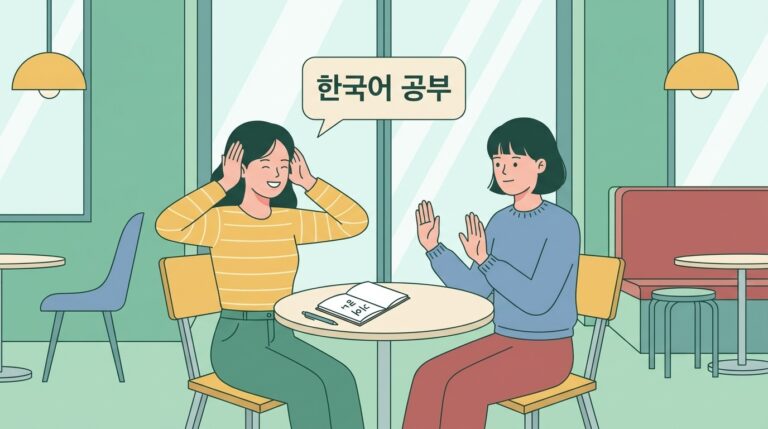
Stop! Don’t Spoil It: How to Warn Friends ‘No Spoilers’ in Natural Korean
Phase 1: 공감 (Story-Driven Opening)
안녕하세요! 매일한글 에디터입니다. (Hello! I’m your Daily Hangul editor.)
Picture this: It is Friday night. You just rushed home, kicked off your shoes, ordered a sizzling box of crispy Korean fried chicken, and queued up the latest hit mystery K-drama everyone in Seoul has been raving about. You are halfway through episode 10, completely glued to the screen. On Saturday morning, you meet your Korean friend Ji-hoon at a lively café in Yeonnam-dong. With glowing eyes and a massive grin, Ji-hoon slaps his knee and blurts out: “Hey, did you see who the real killer was? When the detective’s brother walked in with the bloody jacket—”
Your heart instantly drops into your stomach. Panic mode sets in! You want to scream, slam your hands over your ears, and tell him to stop talking this instant before he ruins sixty hours of emotional investment. But in that split second, your brain scrambles: How do I say ‘No spoilers!’ in Korean? Is ‘하지 마세요’ (Haji maseyo) too stiff? Will ‘스포일러’ be understood, or do Koreans use slang? What if I accidentally sound too angry and make it awkward?
You are not alone. Over 80% of our intermediate B1 learners tell us that reacting in real-time to social media drops, water-cooler drama debates, and movie plot twists is one of the most stressful conversational hurdles in Korea. When someone is about to spoil a climactic plot twist, you don’t have five seconds to conjugate formal grammar tables in your head. You need snappy, natural, culturally authentic expressions that instantly hit the brakes while keeping the vibe fun and friendly.
In this lesson, crafted from real classroom feedback and native social etiquette, you will learn the exact phrases, body language, and cultural cues needed to protect your binge-watching sanctuary. Let’s make sure your favorite plots stay safe!
Phase 2: 핵심 표현 3선 심층 분석 (Deep Dive into 3 Core Expressions)
1. 스포하지 마! (Seupohaji ma!)
- Pronunciation: [Seu-po-ha-ji ma!] (Sounds like: “SPO-hah-jee mah!”—rhymes with “spa” and “grandma”)
- Meaning: Literal: “Don’t do spo!” / Actual Nuance: “Don’t spoil it!” or “No spoilers!”
- K-Culture Moment: You are sitting around a table with university classmates, and someone is about to reveal who wins the dating survival show Single’s Inferno.
- Editor’s Insight: Koreans love abbreviations. “스포일러” (seupoilleo) is almost always clipped down to a punchy two-syllable noun: 스포 (seupo). Adding the verb ending ~하지 마 (~haji ma) creates an immediate, highly colloquial imperative. If you are speaking to someone older or in a polite setting, soften it to 스포하지 마세요 (Seupohaji maseyo) or 스포는 안 돼요! (Seuponeun an dwaeyo!).
- Situation Spectrum: Casual: ✅ | Semi-formal: ⚠️ (Use ‘스포하지 마세요’) | Formal: 🚫
- 🤔 Think About It: In English, “Don’t spoil it” focuses on ruining the story’s freshness. In Korean, clipping it to seupo turns it into an energetic warning sticker. Why do you think modern Korean slang prefers snappy two-syllable acronyms?
2. 결말 말하지 마! (Gyeolmal malhaji ma!)
- Pronunciation: [Gyeol-mal mal-ha-ji ma!] (Sounds like: “Gyul-mahl mahl-hah-jee mah!”—think of “gull” with a y glide)
- Meaning: Literal: “Do not speak the ending!” / Actual Nuance: “Don’t tell me the ending!”
- K-Culture Moment: The finale of a weekend drama like Queen of Tears just aired, and your coworker is inhaling air, ready to discuss the final five minutes.
- Editor’s Insight: 결말 (gyeolmal) specifically denotes the resolution or ending of a story, film, or novel. While 스포 (seupo) covers any twist or plot point throughout the show, 결말 (gyeolmal) draws a firm boundary around the grand finale. Using this phrase makes your boundary razor-sharp: “You can tell me if the episode was good, but don’t you dare touch the ending!”
- Situation Spectrum: Casual: ✅ | Semi-formal: ⚠️ (Add ‘~세요’ -> 결말 말하지 마세요) | Formal: 🚫
- 🤔 Think About It: Does your native language differentiate between revealing a tiny plot twist versus revealing the final ending? How does targeting the word 결말 (ending) change the stakes of a conversation?
3. 입 뻥긋도 하지 마! (Ip ppeonggeutdo haji ma!)
- Pronunciation: [Ip ppeong-geut-do ha-ji ma!] (Sounds like: “Eep pbung-gut-doh hah-jee mah!”—pop the double ‘pp’ like popping a bubble gum)
- Meaning: Literal: “Don’t even open your mouth a tiny peep!” / Actual Nuance: “Zip your lips! Don’t say a single syllable!”
- K-Culture Moment: Your close buddy gives you a mischievous side-eye, knowing a massive secret that will blow your mind in the season finale of a cinema release.
- Editor’s Insight: 입 (ip) means mouth, and 뻥긋 (ppeonggeut) is a sensory mimetic word (의태어) that imitates slightly parting one’s lips to make a whisper or peep. This expression is wonderfully dramatic and playful. It signals intense, theatrical desperation among close friends. Never use this with superiors or in business contexts unless you want a human resources intervention!
- Situation Spectrum: Casual: ✅ | Semi-formal: 🚫 | Formal: 🚫
- 🤔 Think About It: Korean is rich with mimetic words like 뻥긋 (ppeonggeut) that describe microscopic physical actions. How does picturing the physical mouth movement help you remember the idiom?
Phase 3: 교과서 한국어 vs 진짜 한국어 (Textbook vs. Real Korean)
Scenario 1: Warning a friend before they disclose a murder mystery suspect
- 📖 교과서 한국어 (Textbook Korean):
- 저에게 줄거리를 미리 누설하지 마십시오. (Jeoege julgeorireul miri nuseolhaji masipsio. / Please do not disclose the plot to me in advance.)
- 🗣️ 진짜 한국어 (Real-Life Korean):
- 아 잠깐만, 스포 금지! 아직 다 안 봤어! (A jamkkanman, seupo geumji! Ajik da an bwasseo! / Ah, wait a second, spoiler ban! I haven’t watched it all yet!)
- 💡 왜 다를까? (Why the difference?):
Textbook phrases sound like courtroom litigation. In real life, Koreans shout “스포 금지!” (Spoiler prohibited / No spoilers!) as a punchy conversational catchphrase. Notice the casual filler 아 잠깐만! (Ah, wait a second!), which gives you an immediate conversational pause button.
Scenario 2: Politely asking colleagues in a group chat not to talk about the finale
- 📖 교과서 한국어 (Textbook Korean):
- 영화의 결말에 관한 대화를 삼가 주시기를 청합니다. (Yeonghwaui gyeolmare gwanhan daehwareul samga jusigireul cheonghamnida. / I request that you refrain from conversations regarding the film’s ending.)
- 🗣️ 진짜 한국어 (Real-Life Korean):
- 저 오늘 퇴근하고 정주행할 거라서, 스포는 제발 참아주세요! (Jeo oneul toegeunhago jeongjuhaenghal georaseo, seuponeun jebal cham-aju-se-yo! / I’m going to binge-watch it after work today, so please hold back on spoilers!)
- 💡 왜 다를까? (Why the difference?):
Real Koreans communicate politeness through empathy and personal excuses rather than cold formal decrees. By stating you plan to binge-watch it tonight (정주행할 거라서), people naturally sympathize and hold back their excitement without feeling scolded.
Phase 4: K-Culture 딥다이브 & 비언어적 매너 (K-Culture Deep Dive & Non-Verbal Manners)
4-1. 눈치(Nunchi) & Defensive Body Language
In Korea, communication is deeply multisensory. When someone is on the brink of dropping a spoiler, relying solely on words is often too slow. You must deploy fast 눈치 (nunchi) and physical drama shields:
1. The Cross-Arms Barrier (X 제스처): Instantly cross your forearms in front of your chest to form an ‘X’ while making eye contact. This universal symbol stops native speakers mid-sentence.
2. The Dramatic Ear Cover (귀 막기): Cup both hands over your ears and hum loudly: “아아아 안 들려! 말하지 마!” (Aaa-an deullyeo! Malhaji ma! / Ahhh I can’t hear you! Don’t talk!). This is not considered childish; it is a beloved, comedic trope seen in countless variety shows.
3. The Palm Stop (손바닥 가드): Extend your right palm straight toward their mouth like a traffic officer. It clearly says: Pause right there, friend.
4-2. Cultural Code: The Sacred Rule of 본방사수 (Bonbangsasu)
K-Dramas air on tight weekly schedules (usually Wednesday-Thursday or Saturday-Sunday). The concept of 본방사수 (bonbangsasu – watching the original live broadcast) is a national sport. Because millions watch at the exact same hour, social media platforms like X (formerly Twitter), Naver Cafe, and online communities like TheQoo explode with real-time commentary.
To keep peace in society, Korean internet etiquette (네티켓) mandates tagging posts with [스포주의] (Spoiler Alert) or [스포포함] (Contains Spoilers) at the very beginning of the post title. Failing to do this will earn you stern scoldings in the comments! In person, the polite protocol is always to ask first: “어디까지 봤어?” (Eodikkaji bwasseo? / How far did you watch?) before offering any opinion.
Phase 5: 실전 롤플레이 시나리오 (Interactive Roleplay Scenario)
Setting: A bustling Chimaek (Chicken & Beer) joint near Gangnam Station on a rainy Friday night. Neon signs reflect on the wet pavement outside, and the ambient noise of clinking glasses fills the room.
Characters:
* Minji (민지): Your passionate Korean friend who watched the midnight finale of the hit sci-fi drama Parasyte: The Grey.
* You (당신): Currently stuck on episode 4 because of your busy Korean study schedule.
Minji: 야, 너 그 드라마 어제 마지막 회 봤어? 대박이야 진짜!
(Ya, neo geu deurama eoje majimak hoe bwasseo? Daebagiya jinjja!)
[🎭 Leaning over the table with wide eyes, holding a chicken drumstick like a microphone]
“Hey, did you watch the final episode of that drama yesterday? It’s seriously insane!”
You: 아니, 나 아직 4화까지밖에 못 봤어. 요즘 너무 바빴거든.
(Ani, na ajik sahwa-kkajibakke mot bwasseo. Yojeum neomu bappatgeodeun.)
[🎭 Shaking your head and taking a nervous sip of cold draft beer]
“No, I only managed to watch up to episode 4. I’ve been way too busy lately.”
Minji: 헐, 진짜? 4화? 야, 그럼 그 형사 정체가 누군지도 아직 모르겠네?
(Heol, jinjja? Sahwa? Ya, geureom geu hyeongsa jeongchega nugunjido ajik moreugetne?)
[🎭 Gasping in disbelief, eyes twinkling with the urge to spill]
“OMG, really? Episode 4? Then you still don’t know who that detective really is?!”
You: 잠깐만! 스포 금지! 입 뻥긋도 하지 마!
(Jamkkanman! Seupo geumji! Ip ppeonggeutdo haji ma!)
[🎭 Rapidly crossing your hands into an X and leaning back in mock terror]
“Wait! No spoilers! Zip your lips!”
Minji: 아, 진짜 입이 근질근질해서 미치겠는데… 딱 한 가지만 말해주면 안 돼?
(A, jinjja ip-i geunjil-geunjilhaeseo michigetneunde… Ttak han gajiman malhaejumyeon an dwae?)
[🎭 Squirming in her chair, tapping her fingers on the beer mug]
“Ah, my mouth is seriously itching to tell you, it’s driving me crazy… Can’t I just say one tiny thing?”
You: 절대 안 돼! 결말 말하면 오늘 치킨값 너가 다 내야 해!
(Jeoldae an dwae! Gyeolmal malhamyeon oneul chikinkap neoga da naeya hae!)
[🎭 Pointing your chopsticks playfully with a firm smile]
“Absolutely not! If you spoil the ending, you are paying for all the chicken tonight!”
Minji: 알았어, 알았어! 꾹 참을게. 빨리 주말에 다 보고 와. 월요일에 토론하자!
(Arasseo, arasseo! Kkuk chameulge. Ppalli jumare da bogo wa. Woryoire toronhaja!)
[🎭 Laughing out loud, making a visible zipping motion across her mouth]
“Fine, fine! I’ll hold it in. Go binge the rest this weekend. We debate on Monday!”
You: 약속했다? 나 이번 주말에 무조건 정주행 끝낸다!
(Yaksokhaetda? Na ibeon jumare mujogeon jeongjuhaeng kkeunnaenda!)
[🎭 High-fiving her over the table and raising your beer mug]
“That’s a promise! I am definitely finishing my binge-watch this weekend!”
🔀 인터랙티브 분기점 (Interactive Choice)
Minji still looks like she is about to accidentally drop a hint about the main character’s fate. What do you do?
- Choice A: You shout: “조용히 하십시오! 듣고 싶지 않습니다!” (Joyonghi hasipsio! Deutgo sipji anseumnida!)
- ❌ Result [BAD]: Way too stiff, archaic, and uncomfortably aggressive. Minji might think you are genuinely angry and the cheerful pub atmosphere will freeze over.
- Choice B: You cover your ears and say: “귀 막았어! 아무것도 안 들려! 스포하면 절교야!” (Gwi magasseo! Amugeotdo an deullyeo! Seupohamyeon jeolgyoya!)
- 🏆 Result [BEST]: Perfect balance of native wit, drama, and lighthearted boundary-setting! Claiming “절교야” (We’re cutting ties!) in a joking tone seals the deal harmlessly.
- Choice C: You stay silent, smile awkwardly, and let her ramble.
- ⚠️ Result [RISK]: She will mistake your silence for consent and reveal the biggest villain reveal within ten seconds. Goodbye, weekend drama excitement!
Phase 6: 10초 감정 섀도잉 드릴 (10-Second Emotional Shadowing Drill)
Read these aloud while matching the rhythmic slashes (/) for breath pauses and embodying the emotional cues in brackets.
- [😱 Panic & Urgent Defense]
아, 잠깐만! / 스포하지 마! / 아직 안 봤단 말이야!
(A, jamkkanman! / Seupohaji ma! / Ajik an bwatdan mariya!)
“Ah, wait! / Don’t spoil it! / I told you I haven’t watched it yet!” -
[🤫 Playful Blackmail & Eye Contact]
결말 말하면 / 오늘 커피 / 네가 쏘는 거다?
(Gyeolmal malhamyeon / oneul keopi / nega ssoneun geoda?)
“If you reveal the ending, / today’s coffee / you’re treating, right?” -
[🥺 Whiny & Desperate Groan]
안 돼, 제발! / 나 퇴근하고 / 정주행할 거란 말이야!
(An dwae, jebal! / Na toegeunhago / jeongjuhaenghal georan mariya!)
“No, please! / I’m going to binge-watch it / right after work, I swear!”
Phase 7: K-Culture 미니 사전 (Mini Dictionary)
-
스포 (Seupo) [Noun]
- Meaning: Spoiler (clipping of 스포일러).
- Usage: Used ubiquitously in digital text, verbal chats, and YouTube thumbnails. Often combined as 스포 방지 (spoiler prevention) or 스포 주의 (spoiler warning).
- 결말 (Gyeol-mal) [Noun]
- Meaning: Conclusion, ending, resolution.
- Usage: Pertains to literary or cinematic endings. You will often hear 열린 결말 (yeollin gyeolmal – open ending) or 새드 결말 (sad ending).
- 본방사수 (Bon-bang-sa-su) [Compound Verb/Noun]
- Meaning: Defending the original broadcast; watching a TV show live when it first airs.
- Usage: Fans often write “오늘 밤 10시 본방사수!” (Tuning in live tonight at 10 PM!) on fan cafes to boost TV ratings.
- 정주행 (Jeong-ju-haeng) [Noun / Verb]
- Meaning: Binge-watching a series sequentially from episode 1 to the end.
- Usage: Literally means “driving in the right direction.” When you watch back-to-back episodes over the weekend, tell your friends: “주말에 드라마 정주행했어” (I binge-watched the drama over the weekend).
Phase 8: 여행자를 위한 생존 키트 (Traveler’s Survival Kit)
Top 3 Survival Phrases
- 스포일러 조심해 주세요! (Seupoilleo josimhae juseyo!)
- Pro Tip: Use this polite formula when entering a film discussion group, hostel lounge, or meetup with people you don’t know well.
- 아직 중간까지밖에 못 봤어요. (Ajik junggankkajibakke mot bwasseoyo.)
- Pro Tip: “I’ve only watched up to the halfway mark.” This gently sets your boundary so the other person knows what part of the storyline is safe to mention.
- 듣기 싫어요, 쉿! (Deutgi sileoyo, swit!)
- Pro Tip: “I don’t want to hear it, shh!” Quick, expressive, and fun when teasing a friend who is itching to brag about knowing a spoiler.
Editor’s Travel Note: Living the Screen Life in Korea
If you are traveling in Seoul and love dramas and films, download the 왓챠피디아 콘텐츠 추천 앱 다운로드 (Watcha Pedia App Download) to track ratings and see how Koreans review plotlines with spoiler-blind toggles. When visiting major cinema complexes like CGV Yongsan I’Park Mall, pick up the official photo tickets at self-service kiosks. And if you are taking the subway late at night after a cinema screening, remember that on Friday and Saturday, Seoul Metro lines 1–9 run extended hours—check the official timetable via the 네이버 지도 길찾기 앱 다운로드 (Naver Map Transit Guide) so you never miss the last train home while debating drama endings!
Phase 9: “한 발 더 깊이” (Cultural Reflection)
Why are Koreans so fiercely emotional about spoilers compared to some other cultures? In South Korea, contemporary storytelling is not merely passive entertainment; it is an active communal event. From historical dramas (사극) to cutting-edge webtoon adaptations, audiences share a collective emotional rhythm. When everyone gathers on Monday morning around office water coolers or campus benches, discussing shared cliffhangers creates instantaneous social bonding (정, Jung). Robbing someone of that authentic moment of revelation by spoiling a twist feels like robbing them of a communal ritual.
💬 Your Turn: Has anyone ever spoiled a massive K-Drama or movie plot twist for you before you had the chance to watch it? How did you react, and which Korean phrase from today would have saved you? Share your drama heartbreak in the comments below!
Phase 10: FAQ & 오해 방지 (FAQ & Common Mistakes)
Q: Can I use “스포 (Seupo)” in a business or workplace setting?
A: In a strict corporate environment or when speaking to a corporate client, “스포” might sound slightly too casual. If you are having casual lunchtime chatter with colleagues of similar rank, “스포는 비밀이에요!” (Spoilers are a secret!) is completely fine. However, with department heads or executives, choose the formal term: 스포일러 (seupoilleo) or say “내용을 미리 말씀하지 말아 주십시오” (Please do not tell me the content in advance).
Q: What is the difference between “스포 금지” and “스포 하지 마”?
A: 스포 금지 (Seupo geumji) literally translates to “Spoiler Prohibited”—it functions like a signpost or slogan. You will often see it as a sticker, a meme, or shouted abruptly like a catchphrase. 스포 하지 마 (Seupo haji ma) is a direct imperative sentence directed at an individual: “Don’t you spoil it!”
Q: Does “결말” refer only to the very last scene?
A: Generally, yes. 결말 (Gyeol-mal) refers to the ultimate resolution or conclusion of the entire work. If you want to prevent someone from revealing a specific middle plot twist, say 반전 (banjeon – plot twist): “반전 말하지 마!” (Don’t reveal the twist!).
🚨 흔한 실수 (Common Mistakes TOP 3)
- Saying “스포일 하지 마세요” ❌ -> 스포하지 마세요 ✅
- Correction: In English, “spoil” is a verb. In Konglish, “스포” or “스포일러” is treated strictly as a noun. You must attach the Korean verb 하다 (hada – to do): 스포하다 (to spoil) -> 스포하지 마세요.
- Confusing ‘줄거리’ (Summary/Plot) with ‘결말’ (Ending) ❌
- Correction: If you say “줄거리 말하지 마”, you are saying “Don’t tell me the premise/synopsis.” If you just want to know what the show is about without knowing the ending, ask for the 줄거리 (julgeori), but forbid the 결말 (gyeolmal)!
- Using Banmal (반말) with older drama club members ❌
- Correction: Shouting “스포하지 마!” to someone older or of higher social status can sound rude. Always add the honorific buffer: “스포하지 마세요!” or “스포하시면 안 돼요~!” with a bright smile.
Phase 11: 액션 미션 & 참여 유도 (Action Missions)
- 🥉 Bronze Mission (Solo Practice):
Stand in front of a mirror. Practice the “Ear-Cover Drill” three times: Cup your ears, shake your head, and say out loud: “아 안 들려! 스포 금지!” (Ah, an deullyeo! Seupo geumji!) until the rhythm feels completely automatic. - 🥈 Silver Mission (Social Media Comment):
Go to your favorite K-Drama actor or streaming channel’s Instagram post. Leave a comment saying: “아직 안 봤으니까 스포 금지예요! 🤫” (I haven’t watched it yet, so no spoilers!). - 🥇 Gold Mission (Real-life Execution):
The next time a friend or language partner brings up a show or movie you haven’t seen yet, deploy: “어디까지 봤어? 나 아직 보는 중이라 스포하면 안 돼!” (How far did you watch? I’m still watching, so no spoilers!).
🎮 K-Culture Bonus Mission: Open your YouTube search bar and type in 스포주의. Observe how Korean YouTubers review drama recaps and see how many creator titles warn viewers before breaking down the storyline!
Phase 12: 인터랙티브 퀴즈 챌린지 (Interactive Quiz Challenge)
1. 상황 판단 퀴즈 (Context Judgment)
You are at lunch with your Korean team manager (부장님). The manager just saw the blockbuster movie you plan to see this evening and smiles, about to reveal the villain. What is the most polite and natural way to stop him?
* A) 야! 스포 금지! 입 뻥긋도 하지 마!
* B) 부장님, 저 오늘 저녁에 볼 예정이라 스포는 제발 참아주세요!
* C) 줄거리를 누설하는 것은 무례한 행동입니다.
🔍 정답 및 해설 확인하기 (Click to reveal answer)
정답: B
- 해설: Option B balances respect for a superior’s hierarchy (부장님, ~참아주세요) while warmly explaining your personal plan (오늘 저녁에 볼 예정이라). Option A uses casual slang (반말) that would be inappropriate for a manager, while Option C is an accusatory, robotic lecture!
2. 빈칸 채우기 (Fill in the Blank)
Complete the sentence using the correct verb ending meaning “Don’t do”:
* “나 아직 2화 보는 중이야. 제발 [ ______ ] 하지 마!” (I’m still watching episode 2. Please don’t spoil it!)
🔍 정답 및 해설 확인하기 (Click to reveal answer)
정답: 스포 (또는 스포일러)
- 해설: In Korean casual speech, the noun 스포 combines with 하다 to form the verb. Thus, “스포 하지 마!” is the quintessential way to warn your friend against revealing story twists.
3. 문화 상식 O/X 퀴즈 (Culture True or False)
- 문제: In Korean internet culture, when posting a review containing major plot twists, it is considered polite and customary to write [스포주의] at the beginning of the title.
- ( ) O / ( ) X
🔍 정답 및 해설 확인하기 (Click to reveal answer)
정답: O
- 해설: Correct! [스포주의] (Spoiler Warning) is the standard netiquette etiquette across Korean blogs, online communities, and social media platforms to respect viewers who have not caught up yet.







