

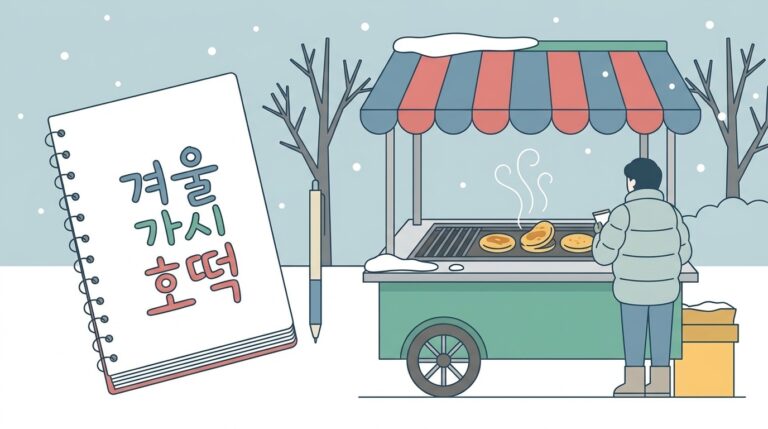
Phase 1: Empathy & K-Culture Immersion
안녕하세요! 매일한글 에디터입니다. (Hello! I am your Daily Hangul editor.)
Picture this: You are strolling through a vibrant Seoul alleyway in mid-December. The crisp winter air tingles against your nose, and your hands are buried deep inside your padded winter coat pockets. Suddenly, a heavenly scent of toasted dough, melted brown sugar, and roasted cinnamon stops you in your tracks. You peek past a fluttering clear vinyl tent and see it—a sizzling, golden disc being pressed on a flat iron griddle: hotteok (호떡)!
Your stomach grumbles, but your heart beats fast with hesitation. “How do I order just one? What if I burn my mouth on the boiling syrup? How do I talk to the friendly vendor without freezing up?” You are not alone! Countless A2-level learners have told us they ended up with scorching syrup on their tongues or sugar stains on their coats because nobody taught them the real rhythm of a Korean street cart. Master this guide, and you will stroll up to any winter stall with confidence, order like a local, and enjoy this iconic comfort treat completely burn-free!
Phase 2: Deep Dive into 3 Core Expressions
1. 하나 주세요 (Hana juseyo)
- Pronunciation: [Hana juseyo] (Pronounce ‘Hana’ like the English name Hannah with a soft ‘a’, followed by ‘Jew-say-yo’)
- Meaning: Literal: “Give me one.” vs. Actual Nuance: “One, please!” (polite, direct, and street-smart)
- K-Culture Moment: In countless winter K-dramas, characters sprint out of the snow into a roadside tent, raise an index finger, and cheerfully say, “사장님, 하나 주세요!” (Boss, one please!)
- Editor’s Insight: You don’t need complicated grammar at a street stall. Just pair a pure Korean number (하나 = 1, 둘 = 2, 셋 = 3) with 주세요 (please give me). Context does the rest!
- Situation Spectrum: Casual: ⚠️ (too blunt for an elder) | Semi-formal: ✅ (Perfect for stalls and shops) | Formal: 🚫 (Too casual for high-end dining)
- 🤔 Think About It: In English, we almost always say the noun (“One hotteok, please”), but Korean drops the noun naturally. Why do you think Korean culture values situational context so heavily?
2. 뜨거우니까 조심하세요 (Ddeugeounikka josimhaseyo)
- Pronunciation: [Ddeugeounikka josimhaseyo] (Tighten your lips on ‘Dd’, say ‘goo-nee-kka’, followed by ‘jo-seem-ha-say-yo’)
- Meaning: Literal: “Because it is hot, please be careful.” vs. Actual Nuance: “Careful, it’s piping hot inside!”
- K-Culture Moment: The stall owner gently slides the sizzling hotteok into a white paper cup, hands it over with a warm smile, and gives this signature warning.
- Editor’s Insight: The inside of hotteok contains molten brown sugar and nut syrup that retains extreme heat. When you hear this phrase, consider it your green light to pause and blow on it!
- Situation Spectrum: Casual: ⚠️ | Semi-formal: ✅ | Formal: ✅
- 🤔 Think About It: Notice how warnings in Korean often end in gentle requests (-하세요). How does this reflect the Korean cultural concept of jeong (affectionate care)?
3. 호호 불어 드세요 (Ho-ho bureo deuseyo)
- Pronunciation: [Ho-ho bureo deuseyo] (Like Santa’s ‘Ho-ho’ + ‘boo-ruh deu-seh-yo’)
- Meaning: Literal: “Blow ‘ho-ho’ and eat.” vs. Actual Nuance: “Take your time blowing on it before eating!”
- K-Culture Moment: Seen on variety shows like 2 Days & 1 Night, where cast members freeze in the snow and blow visible steam from their mouths over sizzling street food.
- Editor’s Insight: “호호” (ho-ho) is an onomatopoeia for gently puffing out breath to cool hot food. In fact, many locals playfully say hotteok got its name because you have to eat it “ho-ho”!
- Situation Spectrum: Casual: ✅ | Semi-formal: ✅ | Formal: ⚠️
- 🤔 Think About It: English uses the verb “blow,” but Korean uses an evocative sound word “호호”. How does your native language describe cooling hot food?
Phase 3: Textbook Korean vs. Real Korean
Situation 1: Ordering your snack
- 📖 교과서 한국어 (Textbook): “호떡 한 개를 주문하고 싶습니다.” (Hotteok han gaereul jumunhago sipseumnida. / “I would like to place an order for one hotteok.”)
- 🗣️ 진짜 한국어 (Real-Life): “사장님, 호떡 하나만 주세요!” (Sajangnim, hotteok hanaman juseyo! / “Boss, just one hotteok, please!”)
- 💡 왜 다를까? Textbook Korean sounds like you are drafting a formal corporate contract! Street food stalls are loud and bustling. Calling out “사장님” (Boss) followed by “하나만 주세요” creates immediate warmth and speed.
Situation 2: Warning a friend about the hot filling
- 📖 교과서 한국어 (Textbook): “내용물이 대단히 뜨거우니 화상에 주의하십시오.” (Naeyongmuri daedanhi ddeugeouni hwasange juuihasipsio. / “As the contents are exceedingly hot, beware of burns.”)
- 🗣️ 진짜 한국어 (Real-Life): “안에 꿀 진짜 뜨거워요! 조심해서 먹어요.” (Ane kkul jinjja ddeugeowoyo! Josimhaeseo meogeoyo. / “The honey syrup inside is super hot! Eat carefully.”)
- 💡 왜 다를까? Official signs use sterile safety jargon, but everyday spoken Korean relies on vivid adverbs like “진짜” (really/super) to convey genuine personal care.
Phase 4: K-Culture Deep Dive & Non-Verbal Manners
4-1. 눈치 (Nunchi) & Gestures
- The Two-Handed Cash Exchange: Always hand over cash or your payment card using both hands, or support your right forearm with your left hand. It signals deep respect toward the hardworking stall elder.
- The Cup Pinch: When handed hotteok inside a small folded paper cup, do not squeeze the middle! Hold it lightly at the bottom base. Squeezing the belly will shoot boiling syrup straight onto your chin or jacket.
- The Lean Forward: Take a half-step back and bend slightly at the waist when taking your first bite. This ensures that any stray melted brown sugar drops harmlessly to the ground instead of your shoes.
4-2. Culture Code: Winter Nostalgia
In Korea, winter officially begins when hotteok carts appear on neighborhood street corners. Made from fermented flour dough stuffed with brown sugar, cinnamon, and crushed peanuts, hotteok is pressed with a round stainless-steel press (nurigae). Standing shoulder-to-shoulder with strangers under a plastic stall tent while sipping warm fishcake broth (odeng gukmul) is the ultimate Korean winter soul remedy.
Phase 5: Real-Life Roleplay Scenario
Setting: A steamy street stall outside Mangwon Market on a windy evening. Golden discs sizzle on an oil-slicked griddle.
Characters: Sajangnim (The friendly hotteok master) & You (The eager learner).
- You: 사장님, 안녕하세요! 호떡 하나 주세요. (Sajangnim, annyeonghaseyo! Hotteok hana juseyo. / “Hello, boss! One hotteok, please.”) 🎭 Rubbing your cold hands together with a polite bow
- Sajangnim: 네, 어서 와요! 방금 구워서 엄청 뜨거워요. (Ne, eoseo wayo! Banggeum guwoseo eomcheong ddeugeowoyo. / “Welcome! I just grilled it, so it’s crazy hot.”) 🎭 Expertly flipping the puffy pancake with a wide spatula
- You: 와, 냄새 정말 좋아요! 얼마예요? (Wa, naemsae jeongmal joayo! Eolmayeyo? / “Wow, smells amazing! How much is it?”) 🎭 Looking at the golden crust with wide eyes
- Sajangnim: 꿀호떡 하나에 천오백 원이에요. (Kkulhotteok hana-e cheon-obaek won-ieyo. / “It’s 1,500 won for one honey hotteok.”) 🎭 Neatly pinching the hot pancake inside a folded paper cup
- You: 여기 현금 있어요. (Yeogi hyeongeum isseoyo. / “Here is the cash.”) 🎭 Handing two thousand-won bills with both hands
- Sajangnim: 아이고, 고마워요. 잔돈 오백 원 받아요. (Aigo, gomawoyo. Jandon obaek won badayo. / “Oh, thank you! Here is your 500 won change.”) 🎭 Passing coins back with a warm crinkled smile
- Sajangnim: 안에 설탕 꿀이 뜨거우니까 호호 불어 드세요! (Ane seoltang kkuri ddeugeounikka ho-ho bureo deuseyo! / “The sugar syrup inside is scalding, so blow ‘ho-ho’ and eat!”) 🎭 Carefully handing you the paper cup by its base
- You: 네, 감사합니다! 잘 먹겠습니다. (Ne, gamsahamnida! Jal meokgetseumnida. / “Yes, thank you! I will enjoy this.”) 🎭 Blowing gentle puffs of air over the steaming crust before taking a tiny nibble
🔀 Interactive Choice Point
The vendor hands you the smoking hotteok. What is your move?
* Option A: Bite straight into the fat center immediately because it smells too good to wait.
* Option B: Hold the cup base, blow “호-호” gently across the top edge, and start with a tiny nibble of the dough crust.
* Option C: Ask the vendor to cut it into pieces with scissors and pack it into a tightly sealed plastic bag.
- Option A Feedback [Bad]: Danger! The molten brown sugar inside will burn the roof of your mouth, and sticky syrup will drip all over your gloves.
- Option B Feedback [Best]: Perfect local etiquette! You acknowledge the vendor’s warning, protect your mouth, and let the trapped steam escape safely.
- Option C Feedback [Risk]: Sealing hotteok in a plastic bag traps moisture, turning the wonderfully crispy pancake soggy and rubbery within five minutes!
Phase 6: 10-Second Emotion Shadowing Drill
Read these aloud, pausing at the / marks while matching the listed emotions:
[😊 Exciting & Cheerful]사장님, / 꿀호떡 하나 / 주세요! (Sajangnim, / kkulhotteok hana / juseyo!)[😲 Amazed & Hungry]와, / 냄새가 / 진짜 좋아요! (Wa, / naemsaega / jinjja joayo!)[🥺 Caring & Gentle]안에 꿀이 / 뜨거우니까, / 호호 불어 드세요! (Ane kkuri / ddeugeounikka, / ho-ho bureo deuseyo!)
Phase 7: K-Culture Mini Dictionary
- 꿀호떡 (Kkul-hotteok) | Honey/Brown Sugar Hotteok | The classic winter hotteok packed with melted dark brown sugar, cinnamon, and crushed nuts.
- 씨앗호떡 (Ssiat-hotteok) | Busan Seed Hotteok | A specialty pancake famously sliced open and stuffed with pumpkin seeds, sunflower seeds, and pine nuts.
- 붕어빵 (Bungeo-ppang) | Fish-Shaped Waffle Snack | The eternal winter rival of hotteok, filled with sweet red bean paste or creamy custard.
- 길거리 음식 (Gilgeori eumsik) | Street Food | Fast, comforting snacks eaten standing up under canopies or beside sidewalk food trucks.
Phase 8: Survival Kit for Travelers
Top 3 Survival Phrases
- 포장해 주세요 (Pojanghae juseyo) | [Po-jang-hae joo-say-yo]
- Pro Tip: Use this when buying several hotteoks to carry back to your hotel lobby or Airbnb.
- 계좌이체 돼요? (Gyejwa-iche dwaeyo?) | [Gye-jwa-ee-che dway-yo]
- Pro Tip: Small stalls often lack card machines. If you run out of cash, almost all vendors accept direct Korean bank transfers!
- 휴지 있어요? (Hyuji isseoyo?) | [Hyu-jee ee-ssuh-yo]
- Pro Tip: Keep this handy in case sweet, sticky syrup trickles onto your fingers.
Editor’s Travel Note
Always carry 5,000 KRW in crisp 1,000 KRW bills during winter walks. To locate lively traditional markets with famous hotteok carts, check the KakaoMap street navigation app and search for Mangwon Market (망원시장) or Gwangjang Market (광장시장).
Phase 9: One Step Deeper (Reflective Thought)
Hotteok is far more than street food; it is an edible manifestation of Korean collective warmth (정, Jeong). When the harsh Siberian winter wind sweeps through Korean cities, a stall tent becomes an equalizer where office workers, students, and travelers huddle together. When a vendor tells you to blow “호-호,” they are caring for you like an auntie watching over family.
💬 Your Turn: Does your home country have a special street treat people eat only in freezing weather? What advice do elders always give you before you take a bite? Tell me in the comments below!
Phase 10: FAQ & Common Mistakes
Q: Can I pay with an international credit card at hotteok stalls?
A: Generally, no. Most sidewalk carts only accept local cash, T-money, or domestic bank transfer. Always keep a few 1,000 KRW bills ready in your coat pocket.
Q: Why does the vendor give hotteok in a paper cup instead of on a plate?
A: The paper cup serves as a portable heat insulator! Folding the pancake into a “U” shape keeps the hot syrup pooled inside while keeping your hands clean on the move.
Q: Is there an etiquette for drinking the fishcake broth nearby?
A: Yes! If a hotteok cart also sells fishcake skewers (eomuk), you can scoop broth into a paper cup for free. Just ask politely: “국물 좀 마셔도 돼요?” (Gungmul jom masyeodo dwaeyo? / May I drink some broth?).
🚨 Common Mistakes Alert!
- Mistake 1: Chomping into the center. The pressurized center will burst molten syrup. Correct Action: Nibble the dough border first to release steam!
- Mistake 2: Handing money with one hand. Seen as disrespectful to elders. Correct Action: Offer money with both hands and a small nod.
- Mistake 3: Throwing sticky cups into open bins. Wind blows them away. Correct Action: Hand the empty cup back to the vendor’s trash bag: “버려 주세요” (Beoryeo juseyo / Please throw this away).
Phase 11: Action Missions
- 🥉 Bronze Mission: Stand in front of your mirror and practice saying: “사장님, 호떡 하나 주세요!” (Sajangnim, hotteok hana juseyo!) with a warm, friendly smile 3 times.
- 🥈 Silver Mission: Snap a photo of your favorite sweet snack today, upload it to Instagram or Threads, and write: “호호 불어 드세요!” Tag @DailyHangul so we can cheer you on.
- 🥇 Gold Mission: Walk into a local Korean bakery or street stall, order your snack entirely in Korean, and hand over your payment using both hands.
- 🎮 K-Culture Mission: Watch a winter episode of a Korean vlog or K-drama, listen for someone using “호호 불다” (blowing to cool down food), and jot down the scene in your study notebook!
Phase 12: Interactive Quiz Challenge
1. Situation Quiz
You are at a street cart in Seoul. What is the most natural A2 Korean phrase to order two hotteoks?
A) 사장님, 호떡 두 개 주문해도 될까요?
B) 사장님, 호떡 둘 주세요!
C) 호떡 두 개를 당장 만들어 주십시오.
👉 Click to Reveal Answer & Feedback
Answer: B!
Explanation: “사장님, 호떡 둘 주세요!” (or “두 개 주세요!”) is polite, natural, and matches everyday street etiquette. Option A is unnecessarily stiff, and Option C sounds like an aggressive command!
2. Fill-in-the-Blank
When handing over a piping hot snack, the vendor smiles and says:
“안에 꿀이 뜨거우니까 __ __ 불어 드세요!”
👉 Click to Reveal Answer & Feedback
Answer: 호호 (Ho-ho)
Explanation: “호호” is the onomatopoeia for blowing warm puffs of breath to cool down hot food safely.
3. Cultural True or False
True or False: In Korea, it is considered rude to stand beside the cart and finish your hotteok before leaving.
👉 Click to Reveal Answer & Feedback
Answer: False!
Explanation: Eating right next to the cart under the winter tent while enjoying the warmth and chatting with the owner is one of the most beloved street food traditions in Korea! Just be mindful not to block new customers.







