

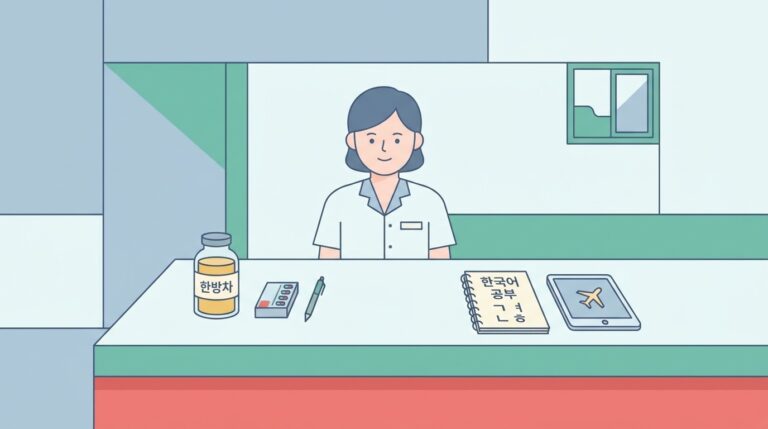
Phase 1: Empathy (Catching a Cold in Seoul)
안녕하세요! 매일한글 에디터입니다. (Hello! This is your Daily Hangul editor.)
Picture this: You have just landed in Seoul for your dream trip. You spent your first evening walking along the dazzling Cheonggyecheon Stream, munching on spicy tteokbokki in the crisp, brisk autumn wind. But the next morning, you wake up in your guesthouse with a scratchy throat, a pounding headache, and a sniffly nose. It is the classic K-drama turning point: your favorite character suddenly sneezes, wraps themselves in a thick blanket, and someone lovingly rushes in with a steaming bottle of herbal tonic.
Except, you are alone in a foreign city, and the thought of stepping into a neighborhood pharmacy (약국) with zero medical vocabulary feels utterly daunting. “What if they don’t speak English? What if I end up buying heartburn medicine instead of cold pills?”
Take a deep breath—we have all been there! Over the past ten years coaching thousands of beginner learners, this exact moment is where most travelers freeze up. The good news? You do not need to memorize complex medical textbooks. With just three foundational A1 phrases and a quick understanding of how Korean pharmacies operate, you will be walking out with the right relief in under two minutes. Let’s make sure a little seasonal bug doesn’t stop your Seoul adventures!
Phase 2: Core Expressions Deep Dive
Here are the three golden phrases you need when you feel under the weather.
1. 감기 걸렸어요 (Gamgi geollyeosseoyo)
- Pronunciation: [Gam-gi geol-lyeo-sseo-yo] (Sound analogy: Think of “Gahm-gee” + “gull-yuh-saw-yo”)
- Meaning: Literal: “Cold has caught me.” | Real Nuance: “I caught a cold.”
- K-Culture Moment: The bread-and-butter phrase heard in every workplace or campus K-drama when a character shows up wearing an oversized scarf.
- Editor’s Insight: In Korean, diseases “catch” you or you get hooked by them (걸리다). It sounds gentle and completely natural when stating your overall condition.
- Situation Spectrum: Casual: 감기 걸렸어 ⚠️ | Semi-formal: 감기 걸렸어요 ✅ | Formal: 감기 걸렸습니다 ✅
- 🤔 Think About It: In English, we say “I caught a cold” (active), whereas Korean often implies the cold hooked onto you (감기에 걸리다). How does shifting agency away from yourself change how you view being sick?
2. 목이 아파요 (Mogi apayo)
- Pronunciation: [Mog-i a-pa-yo] (Sound analogy: “Moe-gee” + “ah-pah-yo” like the word papaya without the first p)
- Meaning: Literal: “Throat hurts.” | Real Nuance: “I have a sore throat.”
- K-Culture Moment: When K-Pop idols go on live stream with a warm mug of honey citron tea, apologetically telling fans their voice sounds raspy.
- Editor’s Insight: 목 (mok) means both “neck” and “throat.” When you point to your neck and say this, any Korean immediately knows you have a sore throat.
- Situation Spectrum: Casual: 목 아파 ⚠️ | Semi-formal: 목이 아파요 ✅ | Formal: 목이 아픕니다 ✅
- 🤔 Think About It: Korean links internal and external anatomy using straightforward root words (목 = neck/throat). Does your native language separate throat and neck completely?
3. 감기약 주세요 (Gamgiyak juseyo)
- Pronunciation: [Gam-gi-yak ju-se-yo] (Sound analogy: “Gahm-gee-yahk” + “joo-seh-yo”)
- Meaning: Literal: “Cold medicine, please give.” | Real Nuance: “Please give me cold medicine.”
- K-Culture Moment: Stepping into the cozy warmth of a street-corner pharmacy while neon city lights flicker outside in the rain.
- Editor’s Insight: 주세요 (Juseyo) is your magic wand in Korea. Put any noun before it, and you have instantly created a polite, flawless request.
- Situation Spectrum: Casual: 감기약 줘 🚫 (Never to a pharmacist!) | Semi-formal: 감기약 주세요 ✅ | Formal: 감기약 주시겠어요? ✅
- 🤔 Think About It: 주세요 combines the verb “to give” with an honorific request ending. Isn’t it refreshing how easy it is to be respectful in Korean with just one universal ending?
Phase 3: Textbook Korean vs. Real Korean
Situation 1: Explaining your cold symptoms
* 📖 교과서 한국어 (Textbook): “저는 감기에 걸려 몸 상태가 좋지 않습니다.” (Jeoneun gamgie geollyeo mom sangtaega jochi anseumnida. – I have caught a cold and my physical condition is not good.)
* 🗣️ 진짜 한국어 (Real Korean): “감기 걸렸어요. 으슬으슬 추워요.” (Gamgi geollyeosseoyo. Euseul-euseul chuwoyo. – I caught a cold. I feel chilly and shivering.)
* 💡 왜 다를까? (Why is it different?): Textbook Korean often inserts “저는” (I) and stiff Latinate-style vocabulary. Native speakers drop the pronoun entirely and love vivid onomatopoeia like 으슬으슬 (chilly shivering).
Situation 2: Asking for a painkiller
* 📖 교과서 한국어 (Textbook): “두통 완화를 위한 진통제를 처방해 주시겠습니까?” (Dutong wanhwareul wihan jintongjereul cheobanghae jusigesseumnikka? – Could you please prescribe an analgesic for headache relief?)
* 🗣️ 진짜 한국어 (Real Korean): “머리 아픈데 타이레놀 있어요?” (Meori apeunde Tairenol isseoyo? – My head hurts, do you have Tylenol?)
* 💡 왜 다를까? (Why is it different?): In day-to-day life, over-the-counter medication doesn’t need prescription verbs (처방). Stating the symptom with -는데 (soft background explanation) and naming the brand or general item is the most natural approach.
Phase 4: K-Culture Deep Dive & Non-Verbal Manners
4-1. 눈치 (Nunchi) & Etiquette in the Pharmacy
- Mask Up Instantly: In Korea, if you cough or sniffle, wearing a mask (마스크) is considered basic public courtesy, especially post-pandemic. If you don’t have one on, pharmacists will appreciate you covering your mouth with your sleeve elbow.
- The Two-Handed Transaction: When handing over your credit card or cash, always hold it with both hands (or touch your right forearm lightly with your left hand). It shows immense respect to the medical professional helping you.
- Clear Body Pointing: If words fail, pharmacists are trained to interpret simple gestures. Gently touch your throat, temple, or tummy while using the expressions from Phase 2.
4-2. Culture Code: Ssanghwa-tang & The Cozy Korean Cure
When Koreans catch a cold, medicine is only half the battle! Enter 쌍화탕 (Ssanghwa-tang), a rich, dark traditional herbal tonic packed with cinnamon, licorice, peony root, and ginger. When you ask for cold medicine at an authentic local pharmacy, the pharmacist will often ask: “따뜻한 쌍화탕도 같이 드릴까요?” (Would you like a warm Ssanghwa-tang drink with it too?). They pull a small glass bottle out of a special countertop heating cabinet. You pop it open right there, swallow your pills with the warm herbal tea, and immediately feel a comforting heat radiate through your chest.
Phase 5: Real Roleplay Scenario
- Setting: A bright, tidy neighborhood pharmacy near Hongdae Station with soft jazz playing. The shelves are neatly packed with colorful vitamin boxes.
- Character: Pharmacist Kim Min-ji (김민지 약사), a warm and patient neighborhood professional wearing white spectacles and a lab coat.
-
Dialogue (8 Turns):
- You: 안녕하세요! (Annyeonghaseyo! – Hello!)
🎭 Action: Bow slightly at a 15-degree angle while holding your scarf. - Pharmacist Kim: 어서 오세요. 어디 불편하세요? (Eoseo oseyo. Eodi bulpyeonhaseyo? – Welcome! Where does it feel uncomfortable?)
🎭 Action: Puts down a clipboard and smiles warmly. - You: 감기 걸렸어요. (Gamgi geollyeosseoyo. – I caught a cold.)
🎭 Action: Sniffles softly and points toward your chest. - Pharmacist Kim: 아이고, 열도 나고 목도 아프세요? (Aigo, yeoldo nago mokdo apeuseyo? – Oh dear, do you have a fever and sore throat too?)
🎭 Action: Reaches toward the general cold medicine shelf. - You: 네, 목이 많이 아파요. (Ne, mogi mani apayo. – Yes, my throat hurts a lot.)
🎭 Action: Swallows and taps throat lightly. - Pharmacist Kim: 이 약 하루 세 번, 밥 먹고 드세요. 조금 졸릴 수 있어요. (I yak haru se beon, bap meokgo deuseyo. Jogeum jollil su isseoyo. – Take this three times a day after meals. It might make you a little drowsy.)
🎭 Action: Places a box of pills and a warm bottle on the counter. - You: 네, 알겠습니다. 얼마예요? (Ne, algesseumnida. Eolmayeyo? – Understood. How much is it?)
🎭 Action: Reaches for your payment card with both hands. - Pharmacist Kim: 6,000원입니다. 따뜻한 물 많이 드세요! (Yukcheon-won-imnida. Ttatteuthan mul mani deuseyo! – That is 6,000 won. Drink plenty of warm water!)
🎭 Action: Hands your card back with both hands and offers an encouraging nod.
🔀 Interactive Choice Point
At Turn 4, if Pharmacist Kim asks: “열도 나요?” (Do you have a fever too?), what is your best response?
* Choice A: “네, 열도 조금 나요.” (Ne, yeoldo jogeum nayo. – Yes, I also have a slight fever.)
* Outcome (Best): Perfect! Clear, concise, and helps the pharmacist give you a fever-reducing combo (해열진통제).
* Choice B: “몰라요. 그냥 약 주세요.” (Mollayo. Geunyang yak juseyo. – Don’t know. Just give me medicine.)
* Outcome (Risk): Rude nuance! Bluntly saying “몰라요” (I don’t know) can sound dismissive to the professional trying to diagnose you accurately.
* Choice C: “아니요, 목만 아파요.” (Aniyo, mongman apayo. – No, only my throat hurts.)
* Outcome (Good alternative): Excellent! Helps avoid unnecessary fever medication if you only need throat lozenges or an anti-inflammatory spray.
Phase 6: 10-Second Emotional Shadowing Drill
Practice reading these out loud, pausing at the slash marks (/) and matching the emotional cues:
[🤒 Weak and worn out]
“감기 / 걸렸어요.”
(Gamgi / geollyeosseoyo. – I caught / a cold.)-
[🥺 In pain, seeking relief]
“목이 / 너무 / 아파요.”
(Mogi / neomu / apayo. – My throat / hurts / so much.) -
[🙏 Polite, soft, and grateful]
“따뜻한 / 쌍화탕 / 주세요.”
(Ttatteuthan / ssanghwatang / juseyo. – Please give me / a warm / Ssanghwa-tang.)
Phase 7: K-Culture Mini Dictionary
- 약국 (Yakguk) | Pharmacy
Spot the bold red or blue Korean character “약” (Yak) on street signs. In Korea, pharmacies are virtually everywhere—often multiple on the same block! - 종합감기약 (Jonghap-gamgiyak) | Multi-symptom cold medicine
If you have a combo of runny nose, cough, and slight aches, asking for 종합감기약 covers all your bases in one single box. - 쌍화탕 (Ssanghwatang) | Herbal restorative tonic
The legendary dark herbal drink sold warm in glass bottles. It is traditional medicine meeting modern convenience. - 마스크 (Maseukeu) | Face mask
An absolute travel essential in Korea for chilly winds, yellow dust, and courtesy when you have cold symptoms.
Phase 8: Survival Kit for Travelers
Survival Expressions TOP 3
- 열나요 (Yeolnayo) – “I have a fever.”
Pro Tip: Use this if your forehead feels hot; it ensures you get acetaminophen or ibuprofen. - 콧물 나와요 (Konnul nawayo) – “My nose is running.”
Pro Tip: Pronounce it [kon-mul]. Great for when you need antihistamines without coughing symptoms. - 소화제 주세요 (Sohwaje juseyo) – “Please give me digestive medicine.”
Pro Tip: Bonus phrase! Korean food is delicious, but if all the garlic and chili upsets your stomach, this brings instant relief.
Editor’s Travel Note
- Late-night emergencies: What if it is 11:00 PM and all local pharmacies are closed? Head straight to any major convenience store (CU, GS25, 7-Eleven). Ask the clerk at the counter for 안전상비의약품 (Safe over-the-counter medicine). They stock basic Tylenol, pediatric fever syrups, digestive tablets, and pain relief patches behind the register.
- Finding open clinics: Download the Naver Map application for foreign visitors and search for the keyword “야간약국” (Night pharmacy) or “이비인후과” (ENT/Otolaryngology clinic) to locate doctors within walking distance.
Phase 9: “One Step Deeper” (Caring in Korean Culture)
In Western cultures, asking someone if they have eaten or telling them to put on a jacket might sound overly intrusive. But in Korea, asking “감기 걸렸어요?” (Did you catch a cold?) followed by “따뜻하게 입고 다녀요” (Dress warmly) is one of the deepest expressions of 정 (Jeong)—communal affection and care. When a pharmacist gently advises you to drink warm water and eat a full bowl of soup before taking your pills, they are extending this protective, family-like warmth to you as a visitor.
💬 Your Turn: Have you ever experienced a cold while traveling abroad? What is the comfiest comfort food or drink in your home country when you are sick? Tell us in the comments below!
Phase 10: FAQ & Common Mistakes
Q: Do I need a doctor’s prescription to buy cold medicine in Korea?
A: No! For standard mild colds, general pain, fever, or sore throat, you do not need a prescription (처방전). Just walk into any pharmacy (약국) and ask over the counter. You only need a doctor’s prescription for high-strength antibiotics or specialized medications.
Q: What if cold medicine makes me too sleepy during my daytime sightseeing?
A: Simply tell the pharmacist: “안 졸린 약 있어요?” (An jollin yak isseoyo? – Do you have non-drowsy medicine?). They will pick a daytime formula with low or non-sedating antihistamines.
Q: Can I pay with an international credit card at Korean pharmacies?
A: Yes! Almost all Korean pharmacies accept foreign credit cards (Visa, Mastercard) and modern mobile payments without any issue.
🚨 Common Mistakes Warning Board
- Saying just “아파요” without context: If you only say “아파요!” (It hurts!), the pharmacist has to guess where. Always pair it with a body word: 목이 아파요 (Throat hurts) or 머리가 아파요 (Head hurts).
- Dropping “주세요” at the end: Saying “감기약!” (Cold medicine!) sounds like a harsh command to an elder. Always append 주세요 (Juseyo).
- Taking medicine on an empty stomach: Most Korean pharmacists will specifically remind you: “식후 30분” (30 minutes after eating). Korean cold medicines can be strong on an empty stomach, so grab a light warm porridge (죽 – juk) or snack first!
Phase 11: Action Mission & Engagement
- 🥉 Bronze Mission (Solo Practice): Stand in front of your mirror. Look at your throat and say “목이 아파요. 감기약 주세요” three times with natural pronunciation.
- 🥈 Silver Mission (Social Share): Post a picture of your favorite warm tea mug on Instagram or Twitter, tag @DailyHangul, and caption it with: “감기 조심하세요! (Take care not to catch a cold!)”.
- 🥇 Gold Mission (Real Life Action): The next time you visit a Korean mart or K-town convenience store, find the tea section and spot a jar of 유자차 (Citron tea) or 쌍화탕 (Ssanghwa-tang). Buy one and taste the herbal magic!
- 🎮 K-Culture Mission: Watch an episode of your favorite slice-of-life K-drama and count how many times characters say “감기 조심해” (Watch out for colds) when saying goodbye in the cold weather!
Phase 12: Interactive Quiz Challenge
Test what you have learned today! Click the dropdown tabs to reveal the correct answers.
Q1. Situational Judgment
You walk into a pharmacy with a scratchy throat and headache. How should you politely ask the pharmacist for cold medicine?
* A) 감기약 줘. (Gamgiyak jwo.)
* B) 감기약 주세요. (Gamgiyak juseyo.)
* C) 약 안 먹어요. (Yak an meogeoyo.)
👉 Click to see the answer & explanation
Correct Answer: B) 감기약 주세요.
Explanation: 주세요 (juseyo) is the essential polite ending. Option A is informal banmal (rude to a stranger), and Option C means “I don’t take medicine!”
Q2. Fill-in-the-Blank
Complete the sentence to say “My throat hurts”:
[ _____ ]이 아파요. ( [ _____ ]-i apayo. )
👉 Click to see the answer & explanation
Correct Answer: 목 (Mok)
Explanation: 목 means neck/throat. Combined with subject particle 이, it becomes 목이 아파요 (My throat hurts).
Q3. True or False Culture Check
True or False: In Korea, basic cold medicine and headache painkillers can be purchased at convenience stores late at night.
👉 Click to see the answer & explanation
Correct Answer: True (참)
Explanation: Designated 24-hour convenience stores carry safety emergency medicines (안전상비의약품) such as Tylenol and cold tablets behind the counter!







