

Phase 1: Empathy (Story-Driven Opening)
안녕하세요! 매일한글 에디터입니다. (Hello! This is your Daily Hangul editor.)
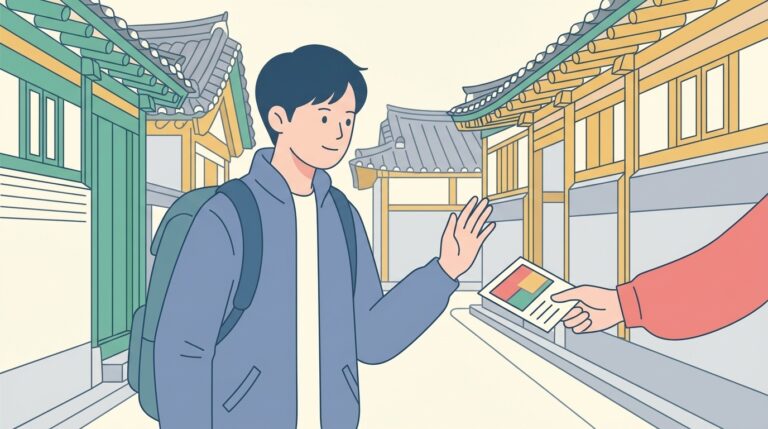
Picture this classic scenario: You are strolling through the vibrant, neon-lit alleyways of Hongdae or waiting near Gangnam Station Exit 11, basking in the excitement of Seoul. Suddenly, two exceedingly polite young Koreans with gentle smiles approach you with a clipboard. One of them tilts their head warmheartedly and says in melodious Korean, “인상이 참 맑으시네요! 혹시 전통문화나 심리 테스트에 관심 있으세요?” (Your face has such a clear, pure aura! Would you happen to be interested in traditional culture or a quick personality test?)
If your immediate reaction is to feel flattered and stop to chat—thinking, “Wow, Koreans are so approachable, and this is such a cool cultural exchange opportunity!”—you are definitely not alone. Nearly 9 out of 10 international students and travelers we surveyed admitted they fell right into this trap during their first months in South Korea. While South Korea proudly guarantees absolute religious freedom under Article 20 of its Constitution, this open environment has also paved the way for fringe pseudo-religions (사이비 종교) that actively target kindhearted, unsuspecting foreigners in bustling university districts.
In this guide, crafted with real feedback from seasoned expats and grounded in everyday cultural nuances, you will master the art of graceful yet ironclad boundaries. You will learn the exact intermediate-level expressions to discern genuine hospitality from manipulative street evangelism (포교), saving your precious time, money, and emotional safety while navigating Seoul like a savvy local.
Phase 2: 3 Key Expressions Deep Dive
Here are the top three critical expressions you need to spot street recruiters and smoothly disengage without escalating tension.
1. 인상이 참 맑으시네요 (Insangi cham malgeusineyo)
- Pronunciation: [In-sang-i cham mal-geu-si-ne-yo] (Sounds like: “een-sahng-ee chahm mahl-geu-shee-nay-yo” with a gentle rising intonation)
- Meaning: Literal: “Your impression/countenance is truly clear.” → Actual Nuance: The universal bait line used by pseudo-religious recruiters to flatter your aura before pitching a ritual.
- K-Culture Moment: You will hear variations of this line in thriller K-Dramas like Save Me (구해줘), where charismatic cult figures use spiritual flattery to break down personal defense mechanisms.
- Editor’s Insight: In standard everyday Korean, strangers rarely comment on the “clarity” of your facial aura (인상). If a stranger compliments your face using words like 기운 (energy), 복 (good fortune), or 맑다 (pure/clear), your internal radar should immediately beep!
- Situation Spectrum: Casual 🚫 | Semi-formal ⚠️ | Formal (Street Cult Bait) ✅
- 🤔 Think About It: Why do you think recruiters praise inner aura rather than outward physical style when approaching strangers?
2. 괜찮습니다, 관심 없어요 (Gwaenchansseumnida, gwansim eopseoyo)
- Pronunciation: [Gwaen-chan-sseum-ni-da, gwan-sim eop-seo-yo] (Sounds like: “gwen-chahn-seum-nee-dah, gwahn-sheem up-so-yo”)
- Meaning: Literal: “It is okay, I do not have interest.” → Actual Nuance: “No thank you, I have zero interest in this. Do not pursue this conversation.”
- K-Culture Moment: Characters in modern slice-of-life dramas use this flat, neutral phrase when turning down persistent door-to-door salespeople or pushy street petitioners.
- Editor’s Insight: Notice that 괜찮습니다 creates formal politeness, but following it immediately with 관심 없어요 (without honorific softening like 관심이 별로 없어서 죄송해요) establishes a crisp, impenetrable boundary.
- Situation Spectrum: Casual ⚠️ | Semi-formal ✅ | Formal ✅
- 🤔 Think About It: In your culture, is it considered rude to say “I have no interest” flat out, or is it respected as clear communication?
3. 그냥 제 갈 길 가겠습니다 (Geunyang je gal gil gagesseumnida)
- Pronunciation: [Geu-nyang je gal gil ga-get-sseum-ni-da] (Sounds like: “geu-nyahng jeh gahl geel gah-get-seum-nee-dah”)
- Meaning: Literal: “I will simply go my way.” → Actual Nuance: “I am walking away right now. Please back off.”
- K-Culture Moment: A decisive, cinematic boundary phrase used when a character refuses to be held back by someone hovering on the pavement.
- Editor’s Insight: This is your highest-level defense line. It signifies that the interaction is officially terminated. It sounds mature, uncompromising, yet entirely civil.
- Situation Spectrum: Casual ⚠️ | Semi-formal ✅ | Formal ✅
- 🤔 Think About It: How does stating an action (“I am going on my way”) function differently from expressing an emotion (“I want to leave”)?
Phase 3: Textbook Korean vs. Real Korean
Intermediate learners often sound overly robotic or inadvertently vulnerable because textbooks teach literal translations rather than strategic conversational shields.
Situation 1: Declining when stopped for a supposed ‘cultural survey’ or ‘tea ceremony’
- 📖 교과서 한국어 (Textbook Korean):
저는 당신들의 종교 행사에 참석하고 싶지 않습니다. (Jeoneun dangsindeul-ui jonggyo haengsa-e chamseokhago sipji anseumnida. / “I do not wish to attend your religious event.”) - 🗣️ 진짜 한국어 (Real Korean):
아, 제가 지금 약속이 있어서 먼저 가볼게요. (A, jega jigeum yaksogi isseoseo meonjeo gabolgeyo. / “Ah, I have an appointment right now so I must be on my way.”) - 💡 왜 다를까? (Why is it different?):
Directly debating religion gives recruiters a conversational opening to argue or reassure you (“Oh, it’s not a religion, it’s just Korean meditation!”). Stating a rigid time commitment cuts off all conversational leverage instantly.
Situation 2: Warning a fellow foreign friend about street recruiters
- 📖 교과서 한국어 (Textbook Korean):
저 사람들은 위험한 사이비 종교 신자들일 가능성이 높습니다. (Jeo saramdeureun wiheomhan saibi jonggyo sinjadeuril ganeungseongi nopeumnida. / “There is a high probability those people are members of a dangerous pseudo-religion.”) - 🗣️ 진짜 한국어 (Real Korean):
저기 ‘도를 아십니까’ 같은 사이비니까 그냥 쌩까고 지나가. (Jeogi ‘do-reul asimnikka’ gateun saibinikka geunyang ssaengkkago jinaga. / “Those are cultists like ‘Do you know the Tao’, just ignore them completely and keep walking.”) - 💡 왜 다를까? (Why is it different?):
Native speakers use the historic slang term 도를 아십니까 (Do you know the Way/Tao?) to refer to street evangelists, paired with natural colloquial verbs like 쌩까다 (to completely brush off / ignore).
Phase 4: K-Culture Deep Dive & Non-Verbal Manners
4-1. 눈치 (Nunchi) & Body Language Protocols
When encountering questionable individuals on Korean streets, your non-verbal cues matter just as much as your spoken vocabulary:
1. The Chest-High Palm (가슴 앞 손바닥 제스처): Raise one hand slightly below chin level with your palm facing outward. This is the universal, polite non-verbal barrier that says “Stop right there.”
2. Break Eye Contact Immediately (시선 차단): Street recruiters rely on sustained eye contact to read your empathy and hesitation. Look forward toward your destination, not into their eyes.
3. Do Not Break Your Stride (발걸음 유지): The biggest rookie mistake is slowing down your pace out of courtesy. Maintain your brisk Seoul commuter walk while delivering your refusal.
4-2. Cultural Code Analysis: Religious Freedom vs. Fringe Exploitation
South Korea is home to a unique religious mosaic: ancient Buddhism (불교), dominant Protestantism (개신교), Catholicism (천주교), and indigenous Korean shamanistic spiritualism (샤머니즘/무속신앙). The national embrace of religious freedom has fostered tremendous cultural charity and social reform. However, an unfortunate side effect has been the rise of aggressive pseudo-cult movements (such as 대순진리회 branches or apocalyptic fringe sects depicted in modern media).
These groups frequently exploit Korean cultural norms of harmony, social hospitality, and 정 (affectionate bonding) by framing their recruitment as “foreigner mentorship,” “free Korean language exchange,” or “traditional ancestral tea rituals” (제사). Being able to critically assess unexpected invitations ensures your stay in Korea remains safe, empowering, and culturally authentic.
Phase 5: Real-Life Roleplay Scenario
- Background: It is 4:30 PM outside Hongdae Station, Exit 9. Two well-dressed university-age Koreans holding survey sheets approach Michael, an exchange student.
- Characters:
- Recruiter Min-su (민수): Amiable, soft-spoken, overly complimentary.
- Michael (마이클): An intermediate Korean learner heading to meet classmates.
- 민수: 저기요, 실례지만 한국어 하실 줄 아세요? (Jeogiyo, sillyejiman hangugeo hasil jul aseyo?)
“Excuse me, pardon me, but do you know how to speak Korean?”
🎭 손에 든 파일철을 살짝 보여주며 조심스럽게 다가온다.(Approaches cautiously while gently showing a clipboard.) -
마이클: 네, 조금 해요. 무슨 일이세요? (Ne, jogeum haeyo. Museun iriseyo?)
“Yes, a little bit. What is this about?”
🎭 가던 걸음을 멈추지 않고 힐끔 쳐다본다.(Glances at them without stopping his pace.) -
민수: 와, 발음 너무 좋으세요! 인상이 정말 선하시고 조상 복이 많으신 얼굴이에요. (Wa, bareum neomu joeuseyo! Insangi jeongmal seonhasigo josang bogi maneusin eolgurieyo.)
“Wow, your pronunciation is incredible! You have such a virtuous countenance; your face shows immense ancestral blessings.”
🎭 두 손을 모으고 감탄하는 표정을 짓는다.(Clasps both hands together with an admiring expression.) -
마이클: 아, 칭찬은 감사합니다만… (A, chingchaneun gamsahamnidaman…)
“Ah, thank you for the compliment, but…”
🎭 거리를 두며 한 발짝 물러선다.(Steps back to maintain physical distance.) -
민수: 저희가 한국 전통 복을 비는 다도 체험을 무료로 해드리고 있거든요. 근처 카페에서 10분만 이야기 나눌 수 있을까요? (Jeohuiga hanguk jeontong bogeul bineun dado cheheomeul muryoro haedeurigo itgeodeunyo. Geuncheo kapeeseo sipbunman iyagi nanul su isseulkkayo?)
“We are offering a free traditional tea ceremony to pray for blessings. Could we talk for just 10 minutes at a nearby café?”
🎭 친절한 미소로 길을 가로막으려 한다.(Tries to gently block the walking path with a cordial smile.) -
마이클: 정중히 사양하겠습니다. 종교 관련 활동에는 관심 없습니다. (Jeongjunghi sayanghagesseumnida. Jonggyo gwanryeon hwaldong-eneun gwansim eopseumnida.)
“I respectfully decline. I have no interest in religious-related activities.”
🎭 가슴 높이로 손을 들고 단호한 눈빛으로 말한다.(Raises hand to chest level, speaking with a resolute gaze.) -
민수: 종교가 아니라 한국 전통 심리 치유예요! 차 한잔만 마시면 되는데… (Jonggyoga anira hanguk jeontong simni chiyeoyeyo! Cha hanjanman masimyeon doeneunde…)
“It’s not a religion, it’s traditional Korean psychological healing! It’s just a cup of tea…”
🎭 따라붙으며 계속 말을 건넨다.(Keeps walking alongside, persisting.) -
마이클: 약속에 늦어서요. 그냥 가던 길 가겠습니다. 따라오지 마세요. (Yaksoge neujeoseoyo. Geunyang gadeon gil gagesseumnida. Ttara-oji maseyo.)
“I am late for an appointment. I will simply go on my way. Please do not follow me.”
🎭 뒤도 돌아보지 않고 빠른 걸음으로 인파 속으로 걸어간다.(Walks briskly into the crowd without looking back.)
🔀 Interactive Choice Point
What would you do if Min-su followed you for more than 10 meters?
* Option A: Feel guilty, apologize repeatedly, and agree to go to the café for just 5 minutes.
* Feedback (Bad): High vulnerability trap! Once inside their private room or vehicle, pressure tactics escalate drastically to perform ritual payments (정성금).
* Option B: Duck into a brightly lit convenience store or subway turnstile, saying “도와주세요” (Please help me) or dial 112 if pursued.
* Feedback (Best): Excellent safety reflex! Cult recruiters rely on discretion; entering a public retail space immediately neutralizes their persistence.
* Option C: Stand on the street corner and debate Bible verses or Korean constitutional law with them.
* Feedback (Risk): Time-waster! Cult members undergo intense debate training; engaging in theological arguments only validates their recruitment attempt.
Phase 6: 10-Second Emotion Shadowing Drill
Practice these emotional cadences out loud. Pause at the slash marks / to master natural breath control.
[😐 단호하지만 군더더기 없이 깔끔하게 / Firm, calm, and minimal]- 괜찮습니다. / 관심 없으니까 / 먼저 가볼게요.
(Gwaenchansseumnida. / Gwansim eopseunikka / meonjeo gabolgeyo.)
“I am fine. / Since I have no interest / I’ll be on my way.”
- 괜찮습니다. / 관심 없으니까 / 먼저 가볼게요.
[🚶♂️ 바쁜 걸음을 재촉하며 쿨하게 / Brisk, busy, and unbothered]- 제가 지금 / 중요한 약속이 있어서요. / 실례하겠습니다.
(Jega jigeum / jung-yohan yaksogi isseoseoyo. / Sillyehagesseumnida.)
“Right now / I have an important appointment. / Excuse me.”
- 제가 지금 / 중요한 약속이 있어서요. / 실례하겠습니다.
[🛑 선을 넘었을 때 차갑고 단호하게 / Cold boundary setting when someone follows]- 길 막지 마시고요. / 제 갈 길 가겠습니다. / 따라오지 마세요.
(Gil makji masigoyo. / Je gal gil gagesseumnida. / Ttara-oji maseyo.)
“Please don’t block the way. / I will go my way. / Do not follow me.”
- 길 막지 마시고요. / 제 갈 길 가겠습니다. / 따라오지 마세요.
Phase 7: K-Culture Mini Dictionary
- 사이비 (Saibi): Pseudo-religion / Cult. Originates from the classical phrase meaning “seemingly authentic but actually false.” Used casually to describe manipulative sects.
- 포교 (Pogyo): Proselytization / Street evangelism. While traditionally a neutral Buddhist or religious term for spreading faith, among youth it carries a wary connotation of aggressive street recruitment.
- 도를 아십니까 (Do-reul asimnikka): “Do you know the Tao/Way?” The classic opening line popularized in the 1990s and 2000s by street proselytizers, now an iconic meme for any unsolicited street pitch.
- 종교의 자유 (Jonggyo-ui jayu): Freedom of Religion. A foundational constitutional right in South Korea that creates a vibrant tapestry of multi-faith coexistence across the country.
Phase 8: Survival Kit for Travelers
Top 3 Street Survival Phrases
- 1. 한국말 못해요. (Hangukmal mothaeyo.)
- Romanization: Han-guk-mal mot-hae-yo.
- Pro Tip: Even if your Korean is B2 level, pretending you cannot comprehend Korean is the fastest, lowest-friction escape hatch.
- 2. 친구 기다리고 있어요. 저기 오네요. (Chingu gidarigo isseoyo. Jeogi oneyo.)
- Romanization: Chin-gu gi-da-ri-go is-seo-yo. Jeo-gi o-ne-yo.
- Pro Tip: Points toward a fictional friend or public entrance to signal you are not solitary or isolated.
- 3. 경찰 부를게요. (Gyeongchal bureulgeyo.)
- Romanization: Gyeong-chal bu-reul-ge-yo.
- Pro Tip: Use only if someone physically grabs your sleeve, blocks your doorway, or refuses to let you pass.
Editor’s Travel Note
- If you feel followed or uneasy near crowded hotspots like Sinchon, Hongdae, or Gangnam, step directly into a chain coffee shop or navigate using the 네이버 지도 앱 다운로드 to find the nearest subway police center (지하철 경찰대) or convenience store (편의점). Korean convenience stores function as designated safe havens with direct police-alert switches under the cash register.
Phase 9: A Step Deeper (Reflective Insight)
South Korean society places profound emphasis on collective politeness (예의) and mutual accommodation (배려). Because of this, saying an outright, harsh “Get away from me!” feels foreign and uncomfortable even to native Koreans. Fringe groups weaponize this psychological reluctance: they count on the fact that your good manners will prevent you from walking away mid-sentence. Remember this vital truth: True respect is mutual. Setting a sharp linguistic boundary against an opportunistic stranger is not rude—it is an act of healthy self-preservation that even Seoulites practice daily.
💬 Your Turn: Have you ever encountered overly friendly strangers asking vague cultural questions while traveling in Korea or in your home country? How did your gut instinct react? Share your thoughts below!
Phase 10: FAQ & Avoiding Misunderstandings
Q: Are all people asking questions on Korean streets cult recruiters?
A: No! University students occasionally conduct genuine sociology surveys, volunteer campaigns, or directions inquiries. However, genuine volunteers will wear official badges, identify their university or NGO immediately, and will never compliment your spiritual energy (인상, 기운) or invite you to private rooms for tea ceremonies.
Q: What happens if someone invites me to a ‘hanbok ancestral ceremony’ (제사 체험)?
A: Never attend. This is the signature method of fringe groups like Daesoon Jinrihoe branches. They dress you in white hanbok, have you bow before a shrine, and subsequently demand cash payments (정성금) ranging from 50,000 to hundreds of thousands of won for “cleansing your family’s bad karma.”
Q: Will I get into legal trouble if I raise my voice or say “저리 가세요” (Go away)?
A: Absolutely not. You have every right to refuse unsolicited street interactions. While physical pushing should be avoided, speaking firmly and demanding space is fully protected and legally sound.
🚨 Common Mistakes Alert (흔한 실수 TOP 3)
| Mistake | Why It Backfires | Correct Action |
|---|---|---|
| 1. Making endless apologetic bows (죄송합니다 repeatedly) | Signals submissiveness and gullibility to recruiters | Say 괜찮습니다 once firmly, hold head high, and keep walking |
| 2. Giving your KakaoTalk ID to “be polite” | You will receive persistent invitations, messages, and calls | State: 개인 연락처는 알려드리지 않습니다. (I do not share personal contact info.) |
| 3. Following them to an enclosed café or office | Shifts control from public open space to their home turf | Firmly decline any change of location; stay in broad daylight |
Phase 11: Action Missions & Cultural Challenge
- 🥉 Bronze Mission (Self-Practice): Stand before a mirror. Practice the “Chest-High Palm” gesture while saying “괜찮습니다, 관심 없어요” three times with a flat, unwavering vocal tone.
- 🥈 Silver Mission (Social Recognition): Watch an episode of a Korean drama dealing with fringe sects (like OCN’s Save Me or Netflix’s In the Name of God: A Holy Betrayal documentary overview). Note how recruit tactics mimic everyday friendliness.
- 🥇 Gold Mission (Real-World Execution): The next time an unsolicited solicitor approaches you anywhere in public, apply the “No-Stop Walking Technique” (보행 유지) and observe how swiftly the interaction concludes.
🎮 K-Culture Bonus Mission: Search the Korean phrase 도를 아십니까 썰 on YouTube. Watch Korean YouTubers humorously recount their wild encounters with street proselytizers to attune your listening comprehension to real native street banter!
Phase 12: Interactive Quiz Challenge
Test your intermediate intuition and cultural defense skills!
Q1. Situational Judgment: You are taking photos in Insadong, and two people say: “조상님의 공덕이 얼굴에 보이네요. 복을 받는 의식을 함께 해요.” What is the safest response?
* (A) “정말요? 조상 복이 어떻게 보이나요?”
* (B) “제가 지금 바쁜 일이 있어서요. 관심 없으니 가보겠습니다.”
* (C) “돈은 얼마나 내야 하나요?”
Q2. Fill-in-the-Blank: Complete the decisive intermediate refusal.
* “길을 막지 마시고, 그냥 제 ( ) 길 가겠습니다.”
Q3. True or False Culture Check:
* In Korea, it is considered legally obligatory to answer street interviewers if they show you an official-looking clipboard. (T / F)
👉 Click here for Answers & Explanations
- Q1 Answer: (B)
- Explanation: Any mention of ancestral blessings (조상님의 공덕) combined with a ceremony (의식) is a classic cult bait hook. Option B provides a polite yet unyielding boundary.
- Q2 Answer: 갈
- Full Sentence: “길을 막지 마시고, 그냥 제 갈 길 가겠습니다.” (Please do not block the way; I will just go my way.)
- Q3 Answer: False (F)
- Explanation: You have no legal or social obligation to engage with anyone soliciting on the street. Complete disengagement is your sovereign right!
- Explanation: You have no legal or social obligation to engage with anyone soliciting on the street. Complete disengagement is your sovereign right!







