

Beyond the Cup: The Art of Seasoning a Teapot and Korean Tea Meditation
Phase 1: 공감 (Story-Driven Opening)
안녕하세요! 매일한글 에디터입니다. (Hello! This is your Daily Hangul editor.)
Have you ever slipped off your shoes and stepped onto the quiet wooden floor of an authentic Korean tea atelier (다실) in the winding alleys of Insadong or Samcheong-dong? The ambient rush of Seoul fades instantly into the rhythmic bubbling of an iron kettle and the rich, earthy scent of vintage aged Pu-erh tea (보이차). But just as you sink into relaxation, a gentle wave of anxiety hits: the tea master places an unglazed, porous purple clay teapot—a 자사호 (jasaho, Yixing teapot)—in front of you, inviting you to participate in the intimate ritual of 양호 (yangho): nourishing and seasoning the vessel with steaming tea liquor.
Suddenly, your inner monologue spikes: “What if I scald the clay with boiling water? What if my fingers leave an oily residue on this masterwork? And how do I express the subtle, meditative beauty of this process in natural, refined Korean without sounding like a robotic language textbook?”
Take a slow, restorative breath. At Daily Hangul, we know that reaching the C1 level isn’t just about clearing advanced grammar drills—it is about entering the cultural and emotional landscape of Korea. Based on real-world workshops with tea artisans and feedback from advanced Korean learners just like you, this guide unpacks the poetic vocabulary, unspoken etiquette, and mindful headspace of Korean tea culture. By the end of this article, you will be able to discuss tea seasoning with the grace, depth, and poise of a true connoisseur.
Phase 2: 핵심 표현 3선 심층 분석 (Top 3 Core Expressions)
1. 자사호에 차향을 입히다 (Jasahoe chahyang-eul ip-hida)
- Pronunciation: [Ja-sa-ho-e cha-hyang-eul ip-hi-da] (Sounds like “cha-hyang” where ‘hyang’ resonates gently in the palate like a warm breath)
- Meaning: Literal: “To dress the clay teapot in tea aroma” / Nuanced: To lovingly season an unglazed teapot so its porous walls absorb the soul and fragrance of a specific tea variety over time.
- K-Culture Moment: In historical and modern healing dramas (like Hospital Playlist or period dramas where scholars find solace), a mentor serves tea while stating how a beloved object absorbs the character of its owner: “좋은 차호는 주인의 결을 닮아 차향을 머금지요” (A fine teapot mirrors its owner’s temperament and absorbs the tea’s aroma).
- Editor’s Insight: Notice the verb 입히다 (to dress/coat). Koreans frequently use tactile clothing metaphors for abstract infusing processes—whether seasoning cookware or imbuing a space with an ambiance.
- Situation Spectrum: Casual ⚠️ | Semi-formal ✅ | Formal ✅
- 🤔 Think About It: In English, we use technical culinary terms like “seasoning” or “curing.” Why do you think Korean conceptualizes this process as clothing (입히다) the vessel in aroma?
2. 찻물을 골고루 끼얹으며 양호하다 (Chanmureul golgoru kkieonjeomyeo yanghohada)
- Pronunciation: [Chan-mu-reul gol-go-ru kki-eon-jeo-myeo yang-ho-ha-da] (Pay attention to the double consonant ‘ㄲ’ in 끼얹다; release it with a crisp, taut pop like a drop hitting water)
- Meaning: Literal: “To nurture the pot while evenly splashing tea liquor over it” / Nuanced: The mindful ritual of basting the hot exterior of the clay teapot with leftover tea broth to foster a deep, even glow.
- K-Culture Moment: Popular healing YouTube vlogs (such as Korean temple stay or tea atelier aesthetic videos) often capture the ASMR sound of tea water cascading down a purple clay pot accompanied by the caption: “온전히 나에게 집중하며 찻물을 끼얹는 시간” (A moment of pure focus, basting the pot with tea).
- Editor’s Insight: 양호 (養壺) combines ‘nourish’ (양) and ‘teapot’ (호). It implies treating the teaware as a living organism rather than an inanimate kitchen tool.
- Situation Spectrum: Casual ⚠️ | Semi-formal ✅ | Formal ✅
- 🤔 Think About It: Does your native culture treat domestic objects as living companions that require deliberate “nurturing”?
3. 손때가 묻어 윤택이 나다 (Sonttae-ga mudeo yuntaeg-i nada)
- Pronunciation: [Son-ttae-ga mu-deo yun-tae-gi na-da] (The word ‘손때’ has a soft glide into a firm ‘때’ [ttae])
- Meaning: Literal: “Hand-grime clings to it, bringing forth a shine” / Nuanced: Developing an antique, lustrous patina through years of fond, affectionate human handling.
- K-Culture Moment: Antique collectors on programs like TV Show Genuine Antiquities (TV쇼 진품명품) often praise a wooden or ceramic heirloom by noting its 손때, indicating cherished provenance rather than actual dirt.
- Editor’s Insight: While 때 technically means dirt or grime, 손때 carries immense sentimental value in Korean culture. It evokes warmth, familial legacy, and the tactile imprint of human care.
- Situation Spectrum: Casual ✅ | Semi-formal ✅ | Formal ✅
- 🤔 Think About It: How does shifting from seeing fingerprints as “smudges to be cleaned” to “patina to be treasured” alter our relationship with personal belongings?
Phase 3: 교과서 한국어 vs 진짜 한국어 (Textbook vs. Real-World Korean)
Situation 1: Describing the temperature readiness of the teapot
- 📖 교과서 한국어: 차호가 뜨거우니까 조심해서 만지세요. (The teapot is hot, so please touch it carefully.)
- 🗣️ 진짜 한국어: 차호에 온기(溫氣)가 은은하게 감도네요. 천천히 다뤄주세요. (A subtle, gentle warmth has enveloped the pot. Please handle it with leisure.)
- 💡 왜 다를까? In refined tea rituals, calling an object abruptly “뜨겁다” (hot) disrupts the serene atmosphere. C1-level connoisseurs use poetic, sensory phrasing such as 온기가 감돌다 (warmth hovers/lingers) to describe thermal states gracefully.
Situation 2: Praising the progressive darkening and maturation of the clay
- 📖 교과서 한국어: 보이차 때문에 주전자 색깔이 어둡게 변했어요. (Because of the Pu-erh tea, the kettle’s color changed dark.)
- 🗣️ 진짜 한국어: 차호를 정성스레 길들이셨네요. 빛깔이 참 그윽하게 익었어요. (You have seasoned the pot with such devotion. Its tone has ripened with profound depth.)
- 💡 왜 다를까? Native speakers rarely refer to a seasoned tea vessel as “darkened” (어둡다). Instead, they employ metaphors of natural aging—such as 익다 (to ripen/ferment)—highlighting the harmonious symbiosis between leaf and clay.
Phase 4: K-Culture 딥다이브 & 비언어적 매너 (Deep Dive & Non-Verbal Etiquette)
4-1. 눈치 (Nunchi) & Gestures: Handling the Jasaho
- The Two-Handed Reverence (양손 파지): Never lift a hot unglazed teapot by its handle with a single hand like a Western mug. Place your dominant index finger gently on the lid’s air button (공기구멍/단추) while your other three fingers hook the handle, supporting the base softly with your non-dominant hand holding a folded tea cloth (다건). This signals mindfulness and prevents catastrophic slips.
- The Soft Pour Gaze: When showering the pot with boiling rinse water during 양호, keep your shoulders lowered and breathe out gently. Rushing or splashing reveals inner turbulence—tea masters read your emotional state through how cleanly the water sheets down the pot’s curves.
4-2. Cultural Code: ‘차멍’ (Cha-meong) and Korea’s Mindfulness Renaissance
While Korea is renowned for its supersonic 빨리빨리 (hurry-hurry) lifestyle, the younger MZ generation in Seoul has spearheaded an opposing cultural counterweight: 멍때리기 (zoning out in contemplative stillness). The latest wave is 차멍 (tea-zoning): spending two quiet hours in minimalist tea bars across Seongsu-dong or Bukchon, listening solely to water droplets and watching the steam rise. Engaging in 양호 is not merely cleaning pottery; it is sensory therapy—a deliberate counter-cultural pause.
Phase 5: 실전 롤플레이 시나리오 (Interactive Role-Play)
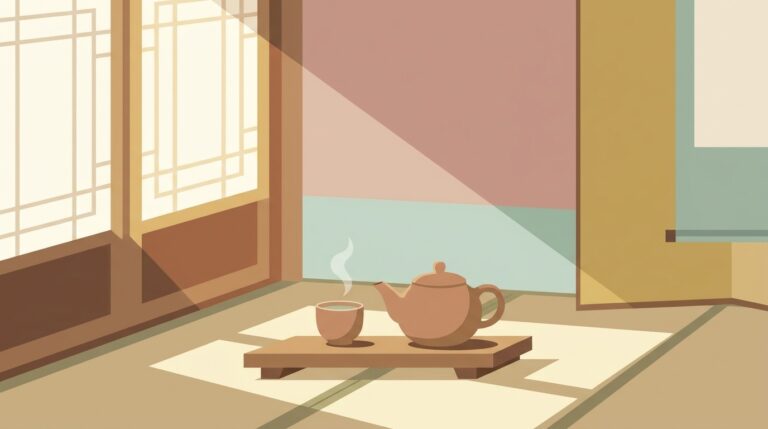
Setting: A sunlit, tatami-lined tea atelier in Bukchon. Sunlight filters through traditional hanji paper windows. Master Park (박 다장), a master ceramicist in modern hanbok, observes your movements.
- 박 다장: “보이차 첫 물은 찻잎을 깨우는 세차(洗茶) 과정이니, 마시지 않고 차호 위에 천천히 둘러주세요.”
(Bo-i-cha cheot mu-reun chan-niph-eul kkae-u-neun se-cha gwa-jeong-i-ni, ma-si-ji an-ko cha-ho wi-e cheon-cheon-hi dul-leo-ju-se-yo.)
(The first rinse of Pu-erh tea awakens the leaves; rather than drinking it, circle it slowly over the teapot’s exterior.)
🎭 따뜻한 숙우(물식힘 그릇)를 양손으로 들어 보이며 미소 짓는다. -
나 (Learner): “네, 선생님. 차호에 차향이 고루 배어들도록 부드럽게 끼얹어 보겠습니다.”
(Ne, seon-saeng-nim. Cha-ho-e cha-hyang-i go-ru bae-eo-deul-do-rok bu-deu-reop-ge kki-eon-jeo bo-get-seum-ni-da.)
(Yes, Master. I will pour gently so the tea aroma permeates the teapot evenly.)
🎭 두 손으로 조심스럽게 다완을 기울여 찻물을 차호 표면에 떨어뜨린다. -
박 다장: “허리를 세우고 호흡을 고르세요. 물줄기가 차호를 타고 흐르는 결이 아주 유려하군요.”
(Heo-ri-reul se-u-go ho-heub-eul go-reu-se-yo. Mul-jul-gi-ga cha-ho-reul ta-go heu-reu-neun gyeo-ri a-ju yu-ryeo-ha-gun-yo.)
(Straighten your posture and balance your breath. The stream tracing the contours of the teapot flows very gracefully.)
🎭 고개를 끄덕이며 그윽한 눈빛으로 흐르는 물줄기를 지켜본다. -
나 (Learner): “물을 머금으니 흙빛이 한층 짙어지며 은은한 광택이 올라오는 것 같아요.”
(Mu-reul meo-geu-meu-ni heuk-bich-i han-cheung jit-eo-ji-myeo eun-eun-han gwang-taek-i ol-la-o-neun geot gat-a-yo.)
(As it drinks the water, the clay tone deepens noticeably and a delicate luster seems to rise.)
🎭 다건(차 수건)으로 가볍게 차호 표면의 물기를 닦아내며 감탄한다. -
박 다장: “맞습니다. 자사호 양호는 단번에 이루어지지 않지요. 오랜 시간 주인의 정성을 먹고 자라는 법입니다.”
(Mat-seum-ni-da. Ja-sa-ho yang-ho-neun dan-beon-e i-ru-eo-ji-ji an-ji-yo. O-raen si-gan ju-in-ui jeong-seong-eul meok-go ja-ra-neun beob-im-ni-da.)
(Precisely. Seasoning a teapot does not happen in an instant. It thrives over long periods by feeding on the devotion of its keeper.)
🎭 다건을 건네며 다음 동작을 유도한다. -
나 (Learner): “기다림의 미학이네요. 매일 이렇게 차를 우리며 제 마음도 함께 닦아내는 기분입니다.”
(Gi-da-rim-ui mi-hag-i-ne-yo. Mae-il i-reot-ge cha-reul u-ri-myeo je ma-eum-do ham-kke ttak-a-nae-neun gi-bun-im-ni-da.)
(It is truly an aesthetic of patience. Brewing tea like this daily feels like polishing my own mind alongside the pot.)
🎭 차호를 양손으로 감싸 쥐며 정중하게 시선을 맞춘다. -
박 다장: “훌륭한 다도(茶道)의 자세입니다. 이제 이 차호에 남은 물기를 정리하고 첫 잔을 음미해 볼까요?”
(Hul-lyung-han da-do-ui ja-se-im-ni-da. I-je i cha-ho-e nam-eun mul-gi-reul jeong-ni-ha-go cheot jan-eul eum-mi-hae bol-kka-yo?)
(An admirable attitude toward tea. Shall we dry the remaining moisture and savor our first cup?)
🎭 정성껏 찻잔을 예열한 뒤 건넨다. -
나 (Learner): “감사합니다, 선생님. 온전한 차의 향을 오롯이 느껴보겠습니다.”
(Gam-sa-ham-ni-da, seon-saeng-nim. On-jeon-han cha-ui hyang-eul o-ro-si neu-kyeo-bo-get-seum-ni-da.)
(Thank you, Master. I will savor the unadulterated aroma of the tea with my complete presence.)
🎭 두 손으로 찻잔을 받쳐 들고 향을 먼저 맡는다.
🔀 인터랙티브 분기점 (Interactive Choice)
At this exact moment, Master Park asks you to finish wiping the teapot with the tea cloth. How do you respond?
- Option A: “빨리 마르고 윤나라고 세제로 뽀득뽀득 닦으면 되나요?” (Should I scrub it squeaky clean with dish soap so it dries fast and shines?)
- Option B: “차호의 숨구멍이 다치지 않게, 다건으로 남은 찻물만 부드럽게 쓸어주겠습니다.” (To avoid damaging the clay’s pores, I will gently wipe away only the residual tea water with the cloth.)
- Option C: “선생님, 그냥 자연 바람에 바짝 마르도록 가만히 두는 게 최고죠?” (Master, isn’t it best to just leave it untouched to bone-dry in the natural wind?)
[선택지 피드백]
* Option A (Bad): 🚫 Absolute disaster! Detergent will seep irreversibly into the unglazed purple clay pores, destroying your expensive teapot forever. The master will wince in horror!
* Option B (Best): ✅ Perfection! Demonstrates master-level comprehension of ceramic physics and tea etiquette. You respect the "breathing pores" (숨구멍) of the earthen craft.
* Option C (Risk): ⚠️ While drying is crucial, pooling tea water leaves uneven mineral water-rings (차 얼룩) on the clay surface if not gently buffed with a dedicated tea cloth while warm.
Phase 6: 10초 감정 섀도잉 드릴 (Emotional Shadowing Drill)
Practice reading these sentences aloud, matching the rhythm markers (/) and emotional cues:
[😌 차분하고 경건하게 / Calm & Reverent]
“차호에 / 찻물을 골고루 끼얹으며 / 번잡한 마음을 / 비워냅니다.”
(Cha-ho-e / chan-mu-reul gol-go-ru kki-eon-jeo-myeo / beon-jap-han ma-eum-eul / bi-wo-naem-ni-da.)
(Basting the teapot / evenly with tea water, / I empty out / my cluttered mind.)-
[✨ 감탄하며 그윽하게 / Admiring & Awe-inspired]
“정성스레 길들인 차호에서 / 은은하고 깊은 / 차향이 배어나오네요.”
(Jeong-seong-seu-re gil-deul-in cha-ho-e-seo / eun-eun-ha-go gip-eun / cha-hyang-i bae-eo-na-o-ne-yo.)
(From this devotedly seasoned teapot, / a subtle and profound / tea essence gently emanates.) -
[🧘 단호하면서도 평온하게 / Grounded & Serene]
“서두르지 않고 / 세월과 온기로 / 흙의 숨결을 깨웁니다.”
(Seo-du-reu-ji an-ko / se-wol-gwa on-gi-ro / heuk-ui sum-gyeol-eul kkae-um-ni-da.)
(Without rushing, / with time and gentle warmth, / I awaken the breathing of the earth.)
Phase 7: K-Culture 미니 사전 (Mini Glossary)
- 자사호 (Jasaho / 紫砂壺): Unglazed purple clay teapot crafted from Yixing clay. Due to its microporous structure, it retains tea oils and preserves aroma over decades of use.
- 양호 (Yangho / 養壺): Teapot maintenance and nourishment. The deliberate practice of bathing, buffing, and caring for an unglazed vessel so it develops a rich patina.
- 포다 (Poda / 泡茶): The art of infusing tea leaves. Beyond merely pouring water, it encompasses calculating water temperature, leaf ratio, and infusion timing.
- 차멍 (Chameong): A portmanteau of 차 (tea) and 불멍/물멍 (zoning out). Refers to the meditative leisure of watching tea steam, water droplets, and breathing quietly in a tea room.
Phase 8: 여행자를 위한 생존 키트 (Traveler’s Survival Kit)
Survival Phrases TOP 3
-
“이 차호는 어떤 차 전용으로 양호된 건가요?”
(I cha-ho-neun eo-tteon cha jeon-yong-eu-ro yang-ho-doen geon-ga-yo?)
Pro Tip: Unglazed clay absorbs flavor; fine teahouses dedicate one teapot exclusively to one category (e.g., ripe Pu-erh vs. raw Pu-erh vs. roasted Oolong). Asking this question instantly earns respect from Korean tea masters. -
“세차(洗茶)한 물로 겉면을 헹궈내도 괜찮을까요?”
(Se-cha-han mul-lo geot-myeon-eul heng-gwo-nae-do gwaen-chan-eul-kka-yo?)
Pro Tip: Use this before splashing water over a tray to confirm the table setup has a proper drainage box (배수식 다반). -
“다건(茶巾)으로 가볍게 닦아드리면 될까요?”
(Da-geon-eu-ro ga-byeop-ge ttak-a-deu-ri-myeon doel-kka-yo?)
Pro Tip: Use this phrase when volunteering to assist the host with post-session cleanup.
Editor’s Travel Note
- Finding Authentic Teahouses: Skip generic tourist cafes! Search keywords like “자사호 다실” or “티하우스 예약” on the 네이버 지도 앱 다운로드 (Naver Map application) to uncover hidden tea sanctuaries in Anguk-dong and Yeonhui-dong.
- Transit & Etiquette: Most authentic tea rooms require prior reservations via Naver or Instagram DM. Wear comfortable socks, as traditional rooms require removing shoes, and avoid wearing heavy synthetic perfumes that could overpower the delicate tea notes.
Phase 9: “한 발 더 깊이” (Cultural Reflection Essay)
In contemporary Korean society, where hyper-efficiency and automated digital convenience dominate every waking hour, the ancient discipline of 다도 (Dado – Way of Tea) serves as an intentional sanctuary of slowness. When a tea enthusiast seasons a jasaho, they engage in a relationship where results cannot be expedited by capital or computational speed. The clay remembers every bath of tea water, every touch of palm, and every patient year. In this sense, yangho reflects the Korean concept of 숙성 (Sukseong – Fermentation/Ripening): true beauty and character are not constructed overnight, but nurtured through steady, quiet devotion.
💬 Your Turn: How does your culture view objects that develop beauty through age and handling? Have you ever owned an item that you felt had a “soul”? Let’s discuss in the comments below!
Phase 10: FAQ & 오해 방지 (FAQ Schema)
Q: 자사호에 세제를 쓰면 정말 안 되나요?
A: 절대 안 됩니다! 자사호 표면에는 육안으로 보이지 않는 수많은 미세 기공(숨구멍)이 존재합니다. 주방 세제를 사용하는 순간 기공 속으로 세제 성분이 스며들어, 이후 어떤 차를 우려도 세제 냄새가 배어 나오게 되어 다시는 차호로 쓸 수 없게 됩니다. 반드시 끓는 온수로만 헹궈내세요.
Q: 여러 종류의 차를 한 자사호에 번갈아 우려도 되나요?
A: 가급적 피하는 것이 정석입니다. 자사호의 흙은 차의 향과 기름기를 흡수하는 성질이 있습니다. 숙차(발효 보이차), 생차(청병), 대홍포(우롱차) 등을 섞어 우리면 향이 충돌하여 차 본연의 풍미가 탁해집니다. 이를 차호가 “잡탕이 된다”고 표현합니다.
Q: 양호할 때 차호를 손으로 세게 문지르면 윤택이 더 빨리 나나요?
A: 절대 금물입니다. 마찰열이나 거친 손놀림으로 문지르면 기공이 깨지거나 불균일한 얼룩이 집니다. 찻물을 끼얹은 후 부드러운 순면 다건으로 가볍게 쓰다듬듯 물기만 걷어내는 것이 품격 있는 양호의 비결입니다.
🚨 흔한 실수 (Common Mistakes Top 3)
- Mistake: Washing the pot under cold running tap water while it is boiling hot.
Correct Action: Severe thermal shock can crack high-fire unglazed clay. Allow the pot to cool down gradually before cleaning. - Mistake: Storing the teapot closed with wet leaves inside overnight.
Correct Action: Pores lock in moisture, causing mold to flourish inside the clay. Empty spent leaves immediately and let the pot dry completely with the lid off. - Mistake: Touching the clay exterior with hand cream or oily fingers.
Correct Action: Lipids from cosmetics seal the pores permanently, creating greasy blotches rather than a natural glassy patina.
Phase 11: 액션 미션 & 참여 유도 (Action Missions)
- 🥉 Bronze Level: Stand in front of your mirror and practice the 3 Shadowing Sentences from Phase 6, paying close attention to pausing at each
/marker. - 🥈 Silver Level: Take a photo of your favorite mug, teapot, or warm drink today. Post it on Instagram Stories with the phrase: “온기가 은은하게 감도는 시간 🍵 #매일한글 #차멍” and tag us!
- 🥇 Gold Level: Visit a local Korean tea salon or converse with a Korean tea lover online, asking: “선생님, 이 차호는 어떤 차로 양호하고 계신가요?”
- 🎮 K-Culture Mission: Watch an episode of a healing Korean drama or a lifestyle documentary featuring a traditional setting. Spot whether the characters hold their tea cups with one hand or two hands!
Phase 12: 인터랙티브 퀴즈 챌린지 (Quiz Challenge)
Quiz 1. 다음 중 ‘자사호 양호(養壺)’에 대한 설명으로 가장 올바른 것은?
① 윤기를 내기 위해 주방 세제와 거친 수세미로 매일 닦아준다.
② 다양한 종류의 차를 매일 바꿔가며 우려야 차호가 건강해진다.
③ 찻물을 골고루 끼얹고 다건으로 물기를 닦아내며 흙의 숨결과 윤택을 살린다.
④ 찬물을 급격히 부어 흙을 단단하게 수축시키는 것이 핵심이다.
Quiz 2. 빈칸 채우기 (Fill-in-the-blank)
“차호에 차를 오래 우려내어 손때가 묻으면 은은한 ( )이/가 난다.”
(Hint: Gloss, luster, or moist radiance)
Quiz 3. True / False 문화 퀴즈
한국의 전통 다도 공간에서 차호의 온도를 표현할 때 “앗, 주전자가 너무 뜨거워요!”라고 직설적으로 표현하는 것이 가장 세련된 예절이다. ( T / F )
👉 정답 및 해설 확인하기 (Click to Reveal Answers)
Quiz 1 정답: ③
해설: 양호는 unglazed porous clay pot에 찻물을 끼얹고 부드럽게 닦아주며 자연스러운 광택(윤택)을 길들이는 과정입니다. 세제 사용(①), 잡다한 차 혼합(②), 급냉(④)은 모두 차호를 망가뜨립니다.
Quiz 2 정답: 윤택 (또는 광택)
해설: ‘손때가 묻어 윤택이 나다’는 오랜 시간 소중히 다루어 깊은 빛깔이 올라오는 미학적 상태를 뜻하는 고급 표현입니다.
Quiz 3 정답: F
해설: 다도 공간에서는 직설적인 ‘뜨겁다’ 대신 ‘차호에 온기가 은은하게 감돈다’와 같이 시적이고 정중한 표현을 사용하는 것이 C1 수준의 다도 매너입니다.







