

Phase 1: Empathy (Story-Immersive Opening)
안녕하세요! 매일한글 에디터입니다. (Hello! I’m your Daily Hangul editor.)
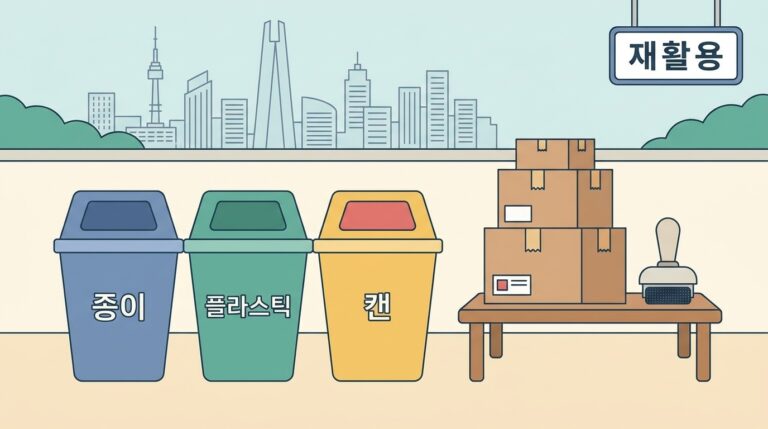
Picture this: It is 11:30 PM on a Tuesday in Mapo-gu, Seoul. You hear the signature metallic chime of your front door sensor, followed by the soft, satisfying thump of two cardboard boxes landing right on your welcome mat. Coupang Rocket Delivery has arrived with pinpoint punctuality. You enthusiastically slice through the paper tape, extract your fresh groceries and new skincare serums, and flatten the boxes to head down to the building’s shared recycling depot (분리수거장).
Just as you are about to fling the flattened boxes into the overflowing cardboard bin, an older neighbor casually glance over, clicks her tongue, and gently stops your arm: “총각/아가씨, 운송장은 떼고 버려야지! 요즘 세상이 얼마나 흉흉한데 그래.” (Young man/lady, you should peel off the shipping label before tossing it! Don’t you know how dangerous the world is these days?)
Your heart skips a beat. You freeze. Looking down at the glossy thermal sticker pasted onto the box, you notice your full legal name, unfiltered phone number, and exact apartment unit number (101동 402호) glowing under the harsh fluorescent basement lights. In South Korea’s hyper-dense residential clusters—where hundreds of neighbors, couriers, and random passersby share the exact same ground-floor disposal stations—that tiny sticky label is essentially your digital footprint printed on paper. Discarding it intact isn’t just considered poor recycling etiquette; in local eyes, it is an open invitation to stalking, voice phishing (보이스피싱), and targeted burglaries.
Today, we are taking you beyond rudimentary vocabulary. Drawing on a decade of on-the-ground cultural navigation and feedback from advanced expats living in Seoul, this guide covers the nuanced, C2-level communicative strategies and cultural etiquette surrounding logistics privacy (택배 박스 개인정보 보호). By the end of this masterclass, you will speak with the instinctive street-smart fluency of a native Seoulite who knows how to navigate convenience without compromising personal security.
Phase 2: Deep Dive into Core Expressions
1. 운송장 떼서 따로 버려야 해 (Unsongjang tteseo ttaro beoryeoya hae)
- Pronunciation: [Un-song-jang tte-seo tta-ro beo-ryeo-ya hae] (Phonetic rhythm: imagine saying “Oon-song-jang” followed by a snappy “tte-seo”, like snapping a taut rubber band)
- Meaning: Literal: “You must detach the shipping waybill and throw it away separately.” | Nuance: A non-negotiable household safety axiom shared among roommates, close friends, or family to enforce parcel privacy.
- K-Culture Moment: In realistic urban thrillers like Unlocked (스마트폰을 떨어뜨렸을 뿐인데) or slice-of-life dramas like Because This Is My First Life, single-person apartment dwellers rigorously obsess over this step the moment a parcel enters their foyer.
- Editor’s Insight: Note the precise verb choice 떼다 (to detach/peel an adhesive) rather than generic verbs like 버리다 (to throw) or 자르다 (to cut). In C2 Korean, using the right physical verb for stickers (스티커를 떼다) reveals your tactile familiarity with the language.
- Situation Spectrum: Casual: ✅ | Semi-formal: ⚠️ (Use: 운송장은 떼어서 따로 폐기하셔야 해요) | Formal: 🚫
- 🤔 Think About It: Why does Korean culture treat home addresses as communal within the apartment complex yet hyper-private toward anonymous passersby? How does your native language demarcate private domestic boundaries compared to shared disposal spaces?
2. 개인정보 노출될까 봐 불안해요 (Gaeinjeongbo nochuldoelkka bwa buranhaeyo)
- Pronunciation: [Gae-in-jeong-bo no-chul-doel-kka bwa bu-ran-hae-yo] (Think: “Gay-in-jung-bo”, glide into “no-chul”, then a soft rhythmic finish on “bu-ran-hae-yo”)
- Meaning: Literal: “I’m anxious that my personal information might be exposed.” | Nuance: A polished, articulate way to express legitimate data privacy concerns without sounding paranoid or confrontational.
- K-Culture Moment: Commonly heard in modern K-Dramas when office colleagues discuss living alone (자취) or when ordering sensitive deliveries to corporate desks rather than home addresses.
- Editor’s Insight: The grammatical construct -을까 봐 / -ㄹ까 봐 indicates prospective dread or preemptive caution. Paired with the Sino-Korean noun 노출 (露出, exposure), this elevates your statement from an emotional complaint (무서워요) to an objective, sophisticated assessment of risk.
- Situation Spectrum: Casual: ✅ (개인정보 털릴까 봐 쫄려) | Semi-formal: ✅ | Formal: ✅ (개인정보 노출 우려가 있습니다)
- 🤔 Think About It: In your culture, is discarding a package with your address considered reckless, or is post-delivery theft and phishing predominantly handled as an online digital concern?
3. 송장 번호랑 주소 매직으로 벅벅 그었어 (Songjang beonhorang juso maejigeuro beokbeok geueosseo)
- Pronunciation: [Song-jang beon-ho-rang ju-so mae-ji-geu-ro beok-beok geu-eot-seo] (Pay special attention to the mimetic sound “벅벅” [beok-beok]—hollow, assertive, and rhythmic)
- Meaning: Literal: “I vigorously scribbled over the tracking number and address with a permanent marker.” | Nuance: Colloquial, highly descriptive confession of taking physical action to obliterate data when a thermal sticker refuses to peel off cleanly.
- K-Culture Moment: A staple line in variety vlogs or web-dramas when roommates complain about stubborn thermal labels manufactured with industrial-grade glue.
- Editor’s Insight: The iconic Korean onomatopoeia/mimetic adverb 벅벅 (beok-beok) portrays repetitive, forceful scraping or scribbling strokes. Utilizing such sensory words instills authentic native texture into your spoken anecdotes.
- Situation Spectrum: Casual: ✅ | Semi-formal: ⚠️ | Formal: 🚫
- 🤔 Think About It: How do Korean mimetic words (의성어/의태어) like 벅벅, 쓱쓱, and 북북 alter the emotional tension when describing everyday domestic chores?
Phase 3: Textbook Korean vs. Real Korean
Situation 1: Giving domestic advice on box disposal
- 📖 교과서 한국어 (Textbook Style):
“택배 상자에 부착된 송장을 반드시 떼어낸 후 종이류로 분리수거를 하십시오.”
(Taekbae sangja-e buchakdoen songjangeul bandeusi tteeonaen hu jong-iryuro bunrisugeoreul hasipsio. – Please discard the parcel box as paper waste after ensuring the attached waybill is removed.) - 🗣️ 진짜 한국어 (Real Native Style):
“상자 버릴 때 송장 무조건 뜯어서 갈기갈기 찢어 버려.”
(Sangja beoril ttae songjang mujogeon tteudeoseo galgigalgi jjijeo beoryeo. – When throwing out boxes, peel the waybill off without fail and rip it to absolute shreds.) - 💡 왜 다를까? (Why the Shift?):
Textbook formulations lean on passive procedural nomenclature (부착된,제거하다). Real-world native speech in intimate settings replaces clinical words with visceral action imperatives (무조건,갈기갈기 찢다), emphasizing urgent street-smart self-defense.
Situation 2: Explaining why leaving shipping labels intact is dangerous
- 📖 교과서 한국어 (Textbook Style):
“운송장에 기재된 개인 식별 정보는 악의적인 범죄에 악용될 가능성이 존재합니다.”
(Unsongjange gijaedoen gaein sikbyeol jeongboneun ak-uijeogin beomjoe agyongdoel ganeungseongi jonjaehamnida. – There is a possibility that personal identifying information recorded on the waybill may be misappropriated for malicious crimes.) - 🗣️ 진짜 한국어 (Real Native Style):
“요즘 세상 흉흉해서 송장 안 떼고 그냥 버렸다가는 신상 다 털려.”
(Yojeum sesang hyunghyunghaeseo songjang an ttego geunyang beoryeottaganeun sinsang da teollyeo. – People are ruthless these days; if you throw it out without peeling the waybill, your entire identity gets doxed.) - 💡 왜 다를까? (Why the Shift?):
Locals bypass abstract legal terms (악용될 가능성) in favor of vivid social idioms like 세상이 흉흉하다 (the world is turbulent/dangerous) and the modern internet-born idiom 신상(이) 털리다 (to have one’s personal identity pillaged/doxed).
Phase 4: K-Culture Deep Dive & Non-Verbal Manners
4-1. 눈치 (Nunchi) & Recycling Yard Body Language
When standing at an apartment recycling bank (분리수거장) in Korea, your non-verbal cues signal civic consideration and personal hygiene:
* The Flattening Ritual (상자 납작하게 접기): Never drop an intact box into the bin. You are expected to slice the bottom tape, collapse the box flat, and bundle it. Doing this shows basic courtesy (배려) to the building security guard (경비원 아저씨) who manually sorts waste.
* The Label Concealment Manner (송장 은닉 매너): If a shipping sticker refuses to detach cleanly despite your fingernails scraping against the corrugated paper, do not leave it face-up for everyone to read. Natives fold the cardboard so the remaining label faces inward, or they crush the label area with their foot before leaning the box against the stack.
* Pocketing the Remnants: The peeled thermal label is strictly non-recyclable general waste (일반 쓰레기). Do not drop the sticker onto the ground or into the paper bin; discreetly crumple it into your palm or pocket, then toss it into your own domestic trash bag (종량제 봉투).
4-2. Culture Code: The “One-Room” Safety Culture & Daiso Gadgets
South Korea’s high concentration of single-person households (1인가구)—particularly female professionals living in studio apartments (원룸 or 오피스텔)—has created a hyper-vigilant industry around parcel privacy. It is now common practice to list fake male names (such as “곽두팔” or “마동석”) on the recipient line or opt for contactless doorstep deliveries (문 앞 배송).
Walk into any Korean Daiso (다이소) or neighborhood stationery store, and you will encounter an entire shelf dedicated to 개인정보 보호 스탬프 (privacy protection roller stamps) and 송장 지우개 (thermal label solvent erasers that chemically dissolve ink within two seconds). This isn’t irrational paranoia; it is institutionalized urban hygiene in a country where logistics are blazingly fast and physical density is among the highest in the developed world.
Phase 5: Real-Life Roleplay Scenario
Setting: The communal basement recycling facility of a modern officetel in Yeouido on a breezy Sunday evening. Cardboard boxes are stacked neatly against the wall.
Characters:
* Min-ji (민지): A savvy 29-year-old marketing specialist and longtime officetel tenant who takes domestic recycling protocols very seriously.
* Alex (알렉스): An expat professional living independently in Seoul for over two years, fluent in Korean but still refining domestic logistical habits.
1. 알렉스: 민지 씨, 오늘 택배 온 거 정리하느라 박스가 산더미처럼 쌓였어요.
   (Minji ssi, oneul taekbae on geo jeongnihaneura bakseuga sandeomicheoreom ssayeosseoyo.)
   "Minji, I spent the evening organizing my parcels, and now I have a mountain of boxes."
   🎭 [Carrying three flattened boxes under his arm, looking slightly exhausted]

2. 민지: 와, 진짜 많네요! 근데 알렉스 씨, 잠깐만요... 혹시 박스 겉에 붙은 운송장 스티커 다 뗐어요?
   (Wa, jinjja manneyeo! Geunde Alex ssi, jamkkanmanyo... hoksi bakseu geote buteun unsongjang seutikeo da ttesseoyo?)
   "Wow, that really is a lot! But wait, Alex... by any chance, did you peel off all the shipping stickers on the outside?"
   🎭 [Points sharply at the corner of Alex's top box with an alert expression]

3. 알렉스: 아, 박스 테이프는 다 뜯었는데... 스티커는 접착력이 너무 세서 그냥 뒀거든요. 어차피 버릴 거잖아요?
   (A, bakseu teipeuneun da tteudeonneunde... seutikeoneun jeopchakryeogi neomu seso geunyang dwotgeodeunyo. Eochapi beoril geojanhayo?)
   "Ah, I peeled off all the box tape... but the stickers had such strong glue that I just left them. They're going to be thrown out anyway, right?"
   🎭 [Shrugging innocently while stepping toward the paper bin]

4. 민지: 아이고, 큰일 날 소리! 요즘 같은 세상에 운송장 그대로 버리면 이름이랑 번호, 호수까지 고스란히 다 털려요.
   (Aigo, keunil nal sori! Yojeum gateun sesange unsongjang geudaero beoryeomyeon ireum-irang beonho, hosukkaji goseuranhi da teollyeoyo.)
   "Oh goodness, perish the thought! If you toss the shipping label as-is these days, your name, phone number, and even your apartment unit will be completely leaked."
   🎭 [Frowning with genuine concern, waving both hands defensively]

5. 알렉스: 듣고 보니 아차 싶네요. 접착면이 엉겨 붙어서 손톱으로 잘 안 떨어지던데, 보통 어떻게 처리해요?
   (Deutgo boni acha simneyo. Jeopchakmyeoni eong-gyeo buteoseo sontobeuro jal an tteoreojideonde, botong eotteoke cheorihaeyo?)
   "Now that you mention it, that hits home. The adhesive is so tacky it wouldn't come off with my fingernails—how do people usually deal with it?"
   🎭 [Scratching the back of his neck, looking down sheepishly at the label]

6. 민지: 다이소에서 파는 송장 지우개로 쓱 문지르거나, 안 되면 가위로 그 부분만 도려내서 종량제 봉투에 넣어야죠.
   (Daiso-eseo paneun songjang ji-ugae-ro sseuk munjireugeona, an doemyeon gawiro geu bubunman doryeonaeseo jongryangje bongtue neoeoyajyo.)
   "You can rub it with a waybill remover roller from Daiso, or if that fails, snip that section out with scissors and throw it into your general trash bag."
   🎭 [Pulling out a pocket-sized privacy roller from her hoodie and demonstrating in mid-air]

7. 알렉스: 와, 그런 꿀팁이 있었군요! 마침 제 주머니에 유성 매직이 있는데, 일단 정보부터 새까맣게 칠해둘게요.
   (Wa, geureon kkultipi isseotgunyo! Machim je jumeonie yuseong maejigi inneunde, ildan jeongbobuteo saekkamatge chilhaedulgeyo.)
   "Wow, what a lifesaver tip! I actually have a permanent marker in my pocket; I'll black out all the personal info right away."
   🎭 [Smiles relieved, un-capping a black marker and vigorously blacking out the barcode]

8. 민지: 나이스! 자취 9단 다 되셨네. 내친김에 테이프 찌꺼기까지 싹 떼고 같이 재활용통에 넣어요.
   (Naiseu! Jachwi gudan da doesyeonne. Naechin-gime teipeu jjigkeogikkaji ssak ttego gachi jaehwalyongtonge neoeoyo.)
   "Nice! Look at you turning into a 9th-dan living-alone master. While we're at it, let's strip the tape residue clean and toss them into the bin together."
   🎭 [Chuckles warmly and helps Alex align the flattened cartons]
🔀 Interactive Branching Point
When the shipping label’s adhesive is welded tight to the cardboard box, what is your best course of action?
- Option A: Use a solvent chemical roller (송장 지우개) or snip out the thermal surface with scissors, disposing of the pieces in your general waste bag.
- Feedback (Best Choice): 완벽합니다 (Flawless)! Thermal paper ruins the paper recycling stream anyway, and this guarantees 100% data anonymization.
- Option B: Fold the cardboard box inside out so the label is technically facing inward, then toss it into the communal paper bin.
- Feedback (Risk): 위험해요 (Risky)! When recycling workers or security guards compress the boxes in the baler, the folds unravel immediately, exposing your address to anyone rummaging through the pile.
- Option C: Throw the entire cardboard box straight into the general garbage bag (종량제 봉투) without recycling it.
- Feedback (Bad): 과태료 대상입니다 (Subject to Fines)! Discarding large recyclable cardboard inside standard paid garbage bags can trigger municipal fines of up to 100,000 KRW for improper sorting.
Phase 6: 10-Second Emotional Shadowing Drill
Practice reading these lines aloud. Focus strictly on pauses marked with / and internalize the emotional intention behind each nuance.
[⚠️ 단호하고 경고하듯이 / Firm & Warning]
“박스 버릴 때 / 송장 스티커 안 떼면 / 동호수까지 싹 다 노출돼요.”
(Bakseu beoril ttae / songjang seutikeo an ttemyeon / dong-hosukkaji ssak da nochul-dwaeyo.)
“When tossing boxes, / if you don’t peel off the waybill sticker, / your exact building and unit number get totally exposed.”-
[💡 깨달음을 얻고 안도하며 / Enlightened & Relieved]
“아, / 송장 지우개로 문지르니까 / 매직으로 칠할 필요도 없이 / 한 방에 날아가네요!”
(A, / songjang ji-ugaero munjireunikka / maejigeuro chilhal piryodo eopsi / han bange naraganeyo!)
“Ah, / rubbing it with this label eraser / removes everything in one shot / without even having to use a marker!” -
[🤝 살갑고 다정하게 / Warm & Neighborly]
“테이프 찌꺼기 떼는 거 / 귀찮아도, / 경비 아저씨 생각해서 / 납작하게 접어둘게요.”
(Teipeu jjigkeogi tteneun geo / gwichanhado, / gyeongbi ajeossi saeng-gakhaeseo / napjakhage jeobeodulgeyo.)
“Peeling off the sticky tape residue / might be tedious, / but out of respect for the security guard, / I’ll flatten it completely.”
Phase 7: K-Culture Mini Dictionary
- 운송장 (Un-song-jang) / 송장 (Song-jang)
- Translation: Courier Waybill / Shipping Label.
- Usage Context: Formally 운송장, but universally shortened to 송장 in everyday speech. Used in phrases like 송장 조회 (tracking a shipment) and 송장 출력 (printing shipping labels).
- 분리배출 (Bun-ri-bae-chul)
- Translation: Separate Disposal / Source Separation Recycling.
- Usage Context: The official civic term replacing the colloquial 분리수거 (which strictly refers to the municipality collecting waste). You will see banners reading 올바른 분리배출 요령 (Guidelines for Proper Separate Disposal) near all residential recycling zones.
- 신상 털리다 (Sin-sang teol-li-da)
- Translation: To have one’s personal profile/identity doxed or leaked.
- Usage Context: Slang derived from 신상정보 (personal dossier) and 털리다 (to be robbed/plundered). Essential for modern digital and urban safety contexts.
- 송장 지우개 (Song-jang ji-u-gae)
- Translation: Waybill Eraser / Privacy Correction Roller.
- Usage Context: A compact household tool featuring alcohol or solvent fluid that instantly turns thermal paper ink completely white/transparent when rolled across printed letters.
Phase 8: Survival Kit for Travelers & Expats
Top 3 Survival Phrases
- 1. 송장 떼는 칼 있어요? (Songjang tteneun kal isseoyo?)
- Meaning: “Do you have a utility blade/box cutter for removing shipping labels?”
- Pro Tip: Ask this at front desks, convenience store counters, or security offices if you need to dispose of travel packaging on the spot.
- 2. 박스는 테이프 다 떼고 납작하게 접어서 버려주세요. (Bakseuneun teipeu da ttego napjakhage jeobeoseo beoryeojuseyo.)
- Meaning: “Please peel off all the tape, flatten the box, and dispose of it.”
- Pro Tip: Essential phrase if staying at an Airbnb or shared guesthouse (게스트하우스) with community chores.
- 3. 안심번호로 배송해 주세요. (Ansim-beonhoro baesonghae juseyo.)
- Meaning: “Please deliver using a virtual safety proxy number.”
- Pro Tip: When buying goods via Coupang, Naver Shopping, or Baemin, check the box labeled 안심번호 사용 to shield your true cellphone digits on the waybill.
Editor’s Travel Note: Logistics App Navigation
If you reside in Korea or order goods during an extended stay, download the 스마트택배 배송조회 앱 다운로드 (Smart Logistics Tracking App) or configure your delivery preferences inside the Coupang application. Under the delivery instructions screen (배송지 요청사항), select 문 앞 (Doorstep) and ensure you tick 운송장 안심번호 서비스 (Virtual Phone Number Proxy) to protect your identity even before the box leaves the distribution fulfillment warehouse.
Phase 9: “One Step Deeper” (Cultural Reflection)
South Korea presents an intriguing privacy paradox: it is one of the world’s most hyper-surveilled countries with high-density CCTV coverage and remarkably low violent crime rates, yet residents maintain an acute, almost visceral vigilance regarding personal address leakage on delivery parcels. This stems from the unique architecture of modern Korean urban living. Because millions live in multi-unit villas and high-rise apartments with centralized, public garbage corners, your domestic sanctuary sits merely a few meters away from where your trash collects. A single waybill connects an anonymous passerby directly to your doorbell. Erasing your waybill is thus more than personal risk aversion—it is an assertion of bodily autonomy and household privacy in a society characterized by extreme spatial proximity.
💬 Your Turn: Does your home country prioritize parcel label destruction, or is packaging tossed without a second thought? What does this say about the spatial boundaries between public and private life in your culture? Share your thoughts below in Korean or English!
Phase 10: FAQ & Common Mistakes
Q: Can I just scribble over the shipping label with a regular blue or black ballpoint pen?
A: Unfortunately, ballpoint pens are remarkably ineffective against thermal paper labels (감열지). The reflective indentation of the ballpoint pen still leaves the raised contours of your phone number and address legible under overhead lighting. If you lack a permanent marker or roller stamp, gently scrape the label using the flat edge of a coin or wet it with a dab of hand sanitizer (손 소독제); the ethanol reacts chemically with the thermal coating and turns it entirely black.
Q: Why do building security guards (경비원) get upset if I leave packing tape on the boxes?
A: When recycling facilities process waste cardboard, adhesive vinyl tapes clog up the pulping machinery and ruin the quality of recycled paper pulp. Leaving vinyl tape on cardboard downgrades the entire batch’s market value. By stripping the clear tape completely, you save elderly maintenance staff hours of grueling manual scraping.
Q: Are thermal shipping label stickers recyclable with regular paper waste?
A: No! Shipping waybills are made of composite thermal paper infused with chemical dyes and backed by synthetic acrylic glue. They must never go into the paper recycling bin (종이류). Once peeled, the label itself must be discarded into the regular non-recyclable trash bag (종량제 봉투).
🚨 Common Mistakes Warning Board
- Mistake: Tearing only your name off the label while leaving your phone number and apartment unit intact.
- Correct Action: Stalking and smishing syndicates exploit phone numbers and unit numbers far more often than names. Destroy the entire bottom half of the waybill containing numeric codes.
- Mistake: Throwing intact cardboard delivery boxes into the recycling zone without flattening them.
- Correct Action: Always split the seam tape with your keys or scissors, compress the carton completely flat, and stack it neatly.
- Mistake: Leaving Styrofoam delivery ice-boxes (스티로폼 상자) covered in shipping stickers and shipping tape.
- Correct Action: White Styrofoam is processed separately from cardboard. You must peel off all stickers, colored shipping labels, and clear packaging tape before putting it into the designated Styrofoam bin.
Phase 11: Action Missions
- 🥉 Bronze Mission (Solo Shadowing Practice):
Read the phrase"박스 버릴 때 송장 떼서 따로 버려야 해"aloud three times in front of a mirror, matching the energetic warning tone of an experienced Korean housemate. - 🥈 Silver Mission (SNS & Study Sharing):
Take a photo of your next flattened parcel box with the waybill cleanly peeled or blacked out. Post it to your study log or Instagram Story with the caption: “오늘도 완벽한 분리배출 완료! 송장 제거 필수! #매일한글 #한국생활” - 🥇 Gold Mission (Real-World Application):
Visit a neighborhood Daiso or local stationery shop, walk up to the clerk, and ask:"개인정보 보호용 송장 지우개나 스탬프 어디에 있나요?"(Where are the personal data protection waybill erasers or stamps?). Purchase one and test it on your next parcel! - 🎮 K-Culture Mission:
Next time you watch a realistic K-Drama set in an officetel or one-room (like My Liberation Notes or Strangers from Hell), observe how parcels are arranged outside apartment doors and see if you can spot privacy marker strokes on discarded cartons.
Phase 12: Interactive Quiz Challenge
Quiz 1. Situational Judgment
Which of the following disposal methods demonstrates both flawless Korean recycling etiquette and complete personal privacy protection?
* A) Peeling off the waybill, throwing the sticker into the paper recycling bin, and stacking the unflattened box.
* B) Flattening the cardboard box, peeling off the shipping label and vinyl tape completely, and throwing the label/tape into the regular volume-rate trash bag (종량제 봉투).
* C) Scribbling once across your name with a pencil and throwing the box into the food waste container.
👉 Click to reveal Answer & Explanation
- Correct Answer: B
- Explanation: Cardboard must be flattened and stripped of tape. The waybill is composite non-recyclable waste, so it belongs in the general volume-rate bag (종량제 봉투), never in paper recycling or food waste.
Quiz 2. Fill-in-the-Blank
Complete the natural Korean warning expression:
“요즘 세상이 워낙 험해서, 택배 상자 버릴 때 (________) 안 떼면 원룸 호수 다 털려요!”
(Because the world is so dangerous these days, if you don’t peel off the [________] when tossing parcel boxes, your studio unit number will be completely exposed!)
👉 Click to reveal Answer & Explanation
- Correct Answer: 운송장 (or 송장)
- Explanation: Both 운송장 (formal waybill) and 송장 (colloquial shortcut) fit seamlessly into this warning sentence.
Quiz 3. Cultural Fact Check (True / False)
True or False: In Korea, courier waybill stickers (운송장) can be recycled together with cardboard boxes as long as you fold the box neatly.
👉 Click to reveal Answer & Explanation
- Correct Answer: False (거짓)
- Explanation: The adhesive backing and synthetic thermal coating of waybill stickers ruin the paper recycling slurry. They must always be peeled off and discarded into general non-recyclable garbage (종량제 봉투).







