

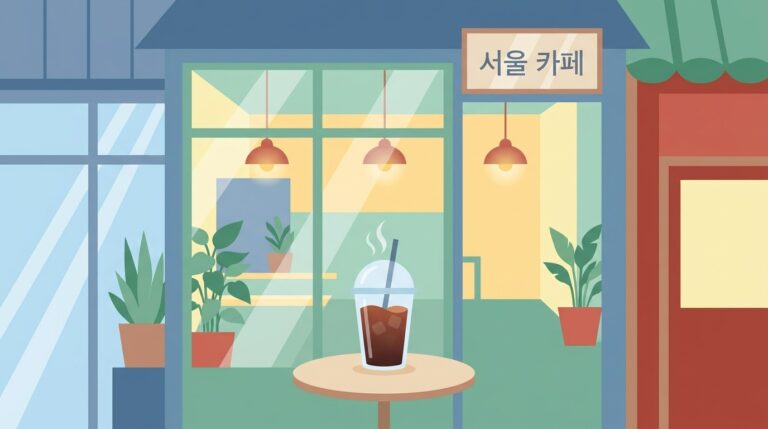
Phase 1: Empathy (Story-Driven Opening)
안녕하세요! 매일한글 에디터입니다.
Picture this: You are wandering down the chic, red-brick backstreets of Seongsu-dong or the quaint laneways of Yeonnam-dong. You are dreaming of that breathtaking cafe moment you have bookmarked on Instagram and seen in K-dramas like Our Beloved Summer—sunlight spilling across raw concrete, the hum of an espresso machine, and a gorgeous signature Einspänner waiting for its close-up.
Eager to find a table, you pull open Google Maps on your phone, only to hit a wall. In Korea, foreign navigation apps rarely reveal the trendiest neighborhood secrets tucked on third-floor walk-ups or behind quiet courtyard gates. You peek into a few places, but the menus look intimidating, the crowds look overwhelming, and before you know it, you settle for a generic commercial chain on the main street with bland coffee and zero atmosphere.
We have all experienced that exact disappointment! Searching for a “분위기 좋은 카페” (vibe-rich cafe) in Korea is not just about translating words in a dictionary; it is about tapping into the living, breathing language of Korea’s dynamic cafe culture. Built upon real feedback from hundreds of intermediate Korean learners, this guide will hand you the exact insider phrases, digital map habits, and unspoken etiquette rules you need to walk into any trendy hotspot like an authentic Seoulite.
Phase 2: In-Depth Analysis of 3 Key Expressions
1. 분위기 좋은 카페 추천해 주세요 (Bunwigi joeun kape chucheonhae juseyo)
- Pronunciation: Bun-wi-gi jo-eun ka-pe chu-cheon-hae ju-se-yo (boon-wee-gee joh-oon kah-feh choo-chuhn-hae joo-seh-yoh)
- Meaning: Literal: “Please recommend a cafe with good atmosphere.” vs Real Nuance: “Could you suggest an aesthetic, cozy, or stylish cafe where locals love to spend time?”
- K-Culture Moment: In contemporary K-dramas, whenever friends wrap up lunch and want to transition to a relaxed, intimate conversation, one character invariably turns to the local guide and asks for a “분위기 좋은 카페.”
- Editor’s Insight: “분위기” (ambience/vibe) is Korea’s golden keyword. Koreans value spatial design, curated playlists, and soft lighting just as much as the quality of the coffee bean roast.
- Situation Spectrum: Casual: ✅ | Semi-formal: ✅ | Formal: ⚠️
- 🤔 Think About It: In your home country, do you search for cafes primarily based on the taste of the coffee, or by the visual vibe and comfort of the space? Why does physical atmosphere hold such a sacred spot in modern urban life?
2. 인스타 감성 카페 어디예요? (Inseuta gamseong kape eodiyeyo?)
- Pronunciation: In-seu-ta gam-seong ka-pe eo-di-ye-yo? (een-seu-tah gahm-suhng kah-feh uh-dee-yeh-yoh?)
- Meaning: Literal: “Where is an Instagram-emotion cafe?” vs Real Nuance: “Where is that photogenic, trendy aesthetic cafe that everyone is talking about?”
- K-Culture Moment: You will hear twenty-somethings stepping out of Hongdae or Seongsu subway stations saying this as they search for minimalist spaces with artistic mirrors and photogenic desserts.
- Editor’s Insight: The term “감성” (emotion/sensibility) combined with “인스타” (Instagram) has blossomed into an entire design philosophy in Korea. It signals intentional mood, artistic tableware, and photogenic lighting.
- Situation Spectrum: Casual: ✅ | Semi-formal: ✅ | Formal: 🚫
- 🤔 Think About It: Does your native language have a single word that encapsulates aesthetic visual beauty and emotional mood as neatly as “감성” does?
3. 요즘 성수동에서 어디가 제일 핫해요? (Yojeum Seongsu-dong-eseo eodiga jeil hataeyo?)
- Pronunciation: Yo-jeum Seong-su-dong-e-seo eo-di-ga je-il hat-hae-yo? (yoh-jeum sung-soo-dong-eh-suh uh-dee-gah jeh-eel haht-hae-yoh?)
- Meaning: Literal: “These days in Seongsu-dong, where is the most hot?” vs Real Nuance: “What is the most popular, trendy spot in Seongsu-dong right now?”
- K-Culture Moment: Walking into a local boutique or asking a stylish friend for weekend tips, this sentence unlocks the freshest spots before mainstream travel guidebooks can even print them.
- Editor’s Insight: Using the adjective “핫하다” (to be hot/trendy) demonstrates an immediate grasp of living conversational Korean. It blends the English loanword “hot” with the native Korean ending “-하다”.
- Situation Spectrum: Casual: ✅ | Semi-formal: ✅ | Formal: 🚫
- 🤔 Think About It: Why do Seoul’s neighborhood trends evolve at such blinding speed compared to Western cities? How does mobile technology fuel this pace?
Phase 3: Textbook Korean vs Real Korean
Situation 1: Inquiring about a cafe’s ambience
- 📖 교과서 한국어: 그 카페는 분위기가 좋습니까? (Geu kapeneun bunwigiga joseumnikka? – Is that cafe’s atmosphere good?)
- 🗣️ 진짜 한국어: 거기 완전 감성 돋고 사진 잘 나와요! (Geogi wanjeon gamseong dotgo sajin jal nawayo! – That place has such great vibes and photos turn out amazing!)
- 💡 왜 다를까?: Native Korean speakers rarely use formal yes/no interrogatives like “-습니까” with friends. Instead, they share descriptive emotional reactions like “감성 돋다” (bursting with mood) and practical perks like “사진 잘 나오다” (taking flattering photos).
Situation 2: Suggesting where to search for spots
- 📖 교과서 한국어: 인터넷에서 유명한 커피숍을 검색하십시오. (Inteones-eseo yumyeonghan keopisyobeul geomsaekhasipsio. – Please search for famous coffee shops on the internet.)
- 🗣️ 진짜 한국어: 네이버 지도나 인스타에서 성수 핫플 검색해 봐. (Neibeo Jidona Inseuta-eseo Seongsu hatpeul geomsaekhae bwa. – Check out Seongsu hotspots on Naver Map or Instagram.)
- 💡 왜 다를까?: Generic terms like “인터넷” sound like an outdated computer manual. Real locals name the actual platforms they rely on and use everyday slang like “핫플” (hot-place).
Phase 4: K-Culture Deep Dive & Non-Verbal Manners
4-1. 눈치 (Nunchi) & Cafe Gestures
- The “Seat First, Order Second” Rule: Before approaching the counter or touch-screen kiosk, exercise your 눈치 (nunchi – social awareness). In Korean cafes, especially on busy weekends, table availability is limited. It is customary to walk in, locate an empty table, and claim it by placing your coat, a notebook, or even an umbrella on the chair before ordering. Korean society boasts remarkable public trust, so people frequently leave personal belongings to hold their spot.
- Camera Etiquette: Taking photos of your plated pastries and latte art is universally accepted, but be mindful of your surroundings. South Korean smartphones are legally built with audible camera shutter sounds to prevent unauthorized filming. Avoid panning your camera directly into the faces of other guests, and blur out backgrounds if uploading to public social platforms.
4-2. Cultural Code Analysis: The “Third Space”
Why are Korean cafes architectural wonders with minimalist gallery spaces, rooftop gardens, and curated background music? In densely populated urban centers like Seoul, apartments can be compact, and many young adults live with family until marriage. The cafe has naturally evolved into Korea’s communal “Third Space”—an essential living room away from home where people study, converse, date, and experience restful healing (“힐링”).
Phase 5: Real-Life Roleplay Scenario
Setting: A trendy industrial-chic cafe in Seongsu-dong with sunlight pouring through floor-to-ceiling glass. You approach the polished wooden counter where Min-woo, a friendly barista wearing an apron and stylish round glasses, welcomes you.
- Turn 1 (You): 🎭 [Smiling warmly, glancing at the dessert display]
안녕하세요! 혹시 여기 시그니처 메뉴가 뭐예요? (Annyeonghaseyo! Hoksi yeogi sigeunicheo menyuga mwoyeyo? – Hello! By any chance, what is your signature menu here?) - Turn 2 (Min-woo): 🎭 [Pointing enthusiastically at the handwritten card on the counter]
저희는 수제 바닐라빈 라떼랑 솔티드 크림 크루아상이 제일 인기 많아요! (Jeohuineun suje banillabin ratterang soltideu keurim keuruasangi jeil ingi manayo! – Our homemade vanilla bean latte and salted cream croissant are our most popular items!) - Turn 3 (You): 🎭 [Nodding with interest, admiring the open brickwork]
그렇군요! 사실 친구랑 분위기 좋은 카페 찾다가 왔는데, 내부가 정말 예뻐요. (Geureokunyo! Sasil chingurang bunwigi joeun kape chatdaga wanneunde, naebuga jeongmal yeppeoyo. – I see! Actually, my friend and I came here looking for an aesthetic cafe, and the interior is truly gorgeous.) - Turn 4 (Min-woo): 🎭 [Wiping the countertop with a modest grin]
감사합니다! 2층 올라가시면 테라스랑 통창 뷰가 있어서 사진도 잘 나와요. (Gamsahamnida! I-cheung ollagasimyeon teraseurang tongchang byuga isseoseo sajindo jal nawayo. – Thank you! If you head up to the second floor, there is a terrace and panoramic window view, so photos turn out great.) - Turn 5 (You): 🎭 [Checking the staircase area curiously]
우와, 2층에 지금 자리 남아 있나요? (Uwa, i-cheunge jigeum jari nama innayo? – Wow, are there seats available on the second floor right now?) - Turn 6 (Min-woo): 🎭 [Glancing up at the seating monitor]
네, 창가 쪽에 마침 두 자리 비어 있어요! 먼저 가방 두고 오셔도 돼요. (Ne, changga jjoge machim du jari bieo isseoyo! Meonjeo gabang dugo osyeodo dwaeyo. – Yes, two window seats just opened up! You can leave your bag up there first before ordering.) - Turn 7 (You): 🎭 [Handing payment card with both hands]
친절하게 알려주셔서 감사해요. 바닐라빈 라떼 두 잔 마시고 갈게요! (Chinjeolhage allyeojusyeoseo gamsahaeyo. Banillabin ratte du jan masigo galgeyo! – Thank you for letting me know so kindly. We will have two vanilla bean lattes for here!) - Turn 8 (Min-woo): 🎭 [Handing back the card and a small circular buzzer with both hands]
네, 맛있게 준비해 드릴게요. 진동벨 울리면 카운터로 와주세요! (Ne, mas-itge junbihae deurilgeyo. Jindongbel ullimyeon kaunteoro wajuseyo! – Sure, I will prepare them deliciously for you. Please pick them up at the counter when the buzzer vibrates!)
🔀 Interactive Branching Point
You have enjoyed your drinks and taken wonderful photos. Before leaving, you want to ask Min-woo for another trendy neighborhood spot. How do you ask?
* Choice A: 저기요, 혹시 근처에 인스타 감성 소품샵이나 디저트 핫플 추천해 주실 수 있나요? (Jeogiyo, hoksi geuncheoe inseuta gamseong sopumsyap-ina dijeoteu hatpeul chucheonhae jusil su innayo?)
* Choice B: 야, 다음 갈 만한 좋은 커피숍 당장 내놔봐. (Ya, daeum gal manhan joeun keopisyop dangjang naenwabwa.)
* Choice C: 네이버에서 제일 유명한 식당 웹사이트 주소를 즉시 출력해 주십시오. (Neibeo-eseo jeil yumyeonghan sikdang wepsa-iteu jusoreul jeuksi chullyeokhae jusipsio.)
Feedback:
* Choice A [Best]: Natural, warm, and extremely polite. Using terms like “소품샵” (lifestyle prop shop) and “핫플” shows high conversational fluency. Baristas love sharing their neighborhood favorites!
* Choice B [Bad]: Extremely rude and abrasive informal language (banmal). You will sound like an angry movie villain demanding lunch money!
* Choice C [Risk]: Stiff and unnatural robotic phrasing. Asking a barista to “immediately print out a website address” will result in sheer confusion.
Phase 6: 10-Second Emotional Shadowing Drill
Read these three natural phrases out loud with their pauses (marked by /) and designated emotions!
- [😊 Excited & Curious]
“혹시 근처에 / 사진 잘 나오는 / 분위기 좋은 카페 / 있을까요?”
(Hoksi geuncheoe / sajin jal naoneun / bunwigi joeun kape / isseulkkayo?)
“By any chance, is there an aesthetic cafe nearby where photos turn out great?” -
[✨ Impressed & Delighted]
“우와, / 여기 인테리어 / 완전 인스타 감성이에요!”
(Uwa, / yeogi interi-eo / wanjeon inseuta gamseong-ieyo!)
“Wow, the interior design here completely nails the Instagram aesthetic!” -
[☕ Polite & Considerate]
“창가 자리에 / 먼저 가방 두고 / 주문해도 될까요?”
(Changga jarie / meonjeo gabang dugo / jumunhaedo doelkkayo?)
“May I leave my bag at the window seat before placing our order?”
Phase 7: K-Culture Mini Dictionary
-
감성 (Gamseong / gahm-suhng) | Noun | Sensibility / Aesthetic Vibe
Used constantly in modern life to describe settings, lighting, music, and travel photos that spark an emotional or artistic feeling (e.g., “한옥 감성” – traditional hanok aesthetic). -
핫플 (Hat-ple / haht-peul) | Noun | Hot Place / Trendy Venue
A popular compound blending the English word “Hot” with “Place.” Refers to viral dessert shops, exhibition spaces, or trendy streets across Seoul. -
카공족 (Ka-gong-jok / kah-gohng-johk) | Noun | Cafe Study Tribe
Combines “카페” (cafe) and “공부족” (studying group). Refers to students or telecommuters who work on laptops in cafes. Some cafes welcome them with desk plugs, while others establish “No-Laptop Zones” on weekends. -
뷰맛집 (Byu-mat-jib / byoo-maht-jeeb) | Noun | Scenic View Spot
A playful combination of “View” and “맛집” (flavorful restaurant). Used to praise cafes celebrated for breathtaking Han River panoramas, mountain skylines, or scenic ocean views.
Phase 8: Traveler’s Survival Kit
Survival Expressions TOP 3
- 와이파이 비밀번호가 뭐예요? (Wa-i-pa-i bimilbeonhoga mwoyeyo? – What is the Wi-Fi password?)
Pro Tip: Always look at the bottom of your printed paper receipt or near the pickup counter before asking; Korean cafes print Wi-Fi credentials directly on receipts! - 화장실 비밀번호 몇 번이에요? (Hwajangsil bimilbeonho myeot beonieyo? – What is the restroom door code?)
Pro Tip: Seoul cafes frequently protect their restrooms with digital door locks. The four-digit passcode is usually scribbled on the napkin station or on the receipt. - 남은 음료 테이크아웃 잔에 담아 주실 수 있나요? (Nameun eumryo teikeu-aut jane dama jusil su innayo? – Could you put my leftover drink in a to-go cup?)
Pro Tip: Korean environmental laws ban disposable plastic cups for dine-in patrons, but baristas will gladly repackage your unfinished beverage in a takeout cup when you leave.
Editor’s Travel Note
Do not rely on Google Maps for walking routes in South Korea due to national data restrictions. Instead, use the [Naver Map navigation application for iOS and Android] or explore the [KakaoMap transit guide in English]. Type hashtags like #성수카페 (Seongsu cafe) or #분위기좋은카페 (aesthetic cafe) directly into Naver Map to review real-time visitor photos and floor locations. For payments, international credit cards and transit cards (T-Money, WOWPASS) are accepted seamlessly everywhere.
Phase 9: “A Step Deeper” (Reflective Essay)
In South Korea’s fast-paced urban rhythm, finding an aesthetic cafe is not mere leisure—it is a treasured cultural ritual. Because dense high-rise apartments leave many young urbanites with limited private personal territory, the cafe acts as an accessible public sanctuary where one can recalibrate one’s state of mind. Choosing a cafe for its “분위기” is an intentional choice to claim quiet breathing room and celebrate artistic visual craftsmanship amidst everyday pressures.
💬 Your Turn: What creates the ultimate cafe atmosphere for you? Is it gentle jazz, floor-to-ceiling windows, or the aroma of fresh baking? Tell us in the comments below!
Phase 10: FAQ & Avoiding Misunderstandings
Q: Why do Korean cafes serve dine-in drinks in heavy glassware instead of paper or plastic cups?
A: South Korea strictly enforces municipal environmental statutes that prohibit disposable single-use cups inside sit-down dining spaces. If you plan to drink inside, you must use reusable glassware or ceramic mugs by law.
Q: How do I find hidden cafes located on higher floors or down residential alleyways?
A: Search on Naver Map using neighborhood names followed by “카페” (e.g., 연남동 카페). Tap the “Photos” (사진) tab and look at the building entrance photos, as many of Seoul’s trendiest specialty roasters operate on the 2nd to 4th floors of nondescript residential buildings.
Q: Can I spend several hours studying with my laptop at any Korean cafe?
A: If the cafe is an independent dessert boutique or small roasting atelier with few tables, lingering over a laptop during peak hours is frowned upon. Look for cafes advertising spacious seating, or check if they have posted laptop time limits.
🚨 Common Mistakes Alert
- Mistake: Asking passersby “맛있는 커피숍 어디예요?” (Where is a delicious coffee shop?)
Correct Action: Say: “근처에 분위기 좋은 카페 있어요?” (Is there an aesthetic cafe nearby?). It sounds far more contemporary and natural. - Mistake: Ordering your drinks at the counter before confirming if tables are available upstairs.
Correct Action: Scope out the seating area first, set down a personal item to claim your spot, and then head to the counter. - Mistake: Searching on Korean map apps using English keywords.
Correct Action: Search with combined Korean terms such as성수 감성카페(Seongsu aesthetic cafe) or망원 디저트 핫플(Mangwon dessert hotspot) for the most accurate results.
Phase 11: Action Mission & Engagement
- 🥉 Bronze Mission (Solo Practice): Look into your mirror and practice asking smoothly: “분위기 좋은 카페 추천해 주세요!” three times.
- 🥈 Silver Mission (Social Media): Take a photo of your current coffee or workspace, post it on social media, and add the caption: “오늘의 감성 카페 투어 ☕️ #분위기좋은카페”.
- 🥇 Gold Mission (Real-World Test): Next time you visit a Korean cafe, approach the counter and ask the barista: “여기 시그니처 메뉴가 뭐예요?” before ordering!
- 🎮 K-Culture Mission: Watch an episode of a recent K-drama (like King the Land or Business Proposal), pause during a cafe scene, and identify whether the characters are drinking an Iced Americano (아아) or a signature cream latte!
Phase 12: Interactive Quiz Challenge
Question 1 (Situational Judgment):
You have arrived in Ikseon-dong and want to politely ask a local passerby for a stylish cafe recommendation. Which expression is the most natural?
1) 야, 맛있는 커피숍 당장 찾아봐.
2) 저기요, 혹시 이 근처에 분위기 좋은 카페 있을까요?
3) 즉시 인터넷 유명 커피숍 주소를 검색해 주십시오.
4) 당신은 커피숍을 소유하고 있습니까?
🔍 Click to Reveal Answer & Explanation
Answer: 2) 저기요, 혹시 이 근처에 분위기 좋은 카페 있을까요?
Explanation: This option includes a polite opening hook (“저기요”), a gentle conversational hedge (“혹시” – by any chance), and the natural intermediate inquiry ending (“-을까요?”). Option 1 is impolite banmal, Option 3 sounds like a machine command, and Option 4 asks if they own a cafe!
Question 2 (Fill in the Blank):
Fill in the missing buzzword used across Korea to describe trendy, photogenic aesthetic spaces:
“여기 인테리어가 완전 인스타 (________)이에요!”
1) 소음 (So-eum)
2) 감성 (Gam-seong)
3) 계약 (Gye-yak)
4) 공장 (Gong-jang)
🔍 Click to Reveal Answer & Explanation
Answer: 2) 감성 (Gam-seong)
Explanation: “인스타 감성” (Instagram sensibility / aesthetic mood) is the indispensable phrase used across Korean social media to describe beautifully styled, photogenic spaces.
Question 3 (True or False Cultural Quiz):
True or False? In South Korea, if you intend to sit inside a cafe, the staff is legally permitted to serve your latte in a disposable plastic cup if you request it nicely.
🔍 Click to Reveal Answer & Explanation
Answer: False!
Explanation: South Korean national recycling regulations strictly forbid single-use plastic cups for dine-in patrons. Cafes face substantial municipal fines for violations, so drinks enjoyed indoors must be served in washable cups or glassware.







