

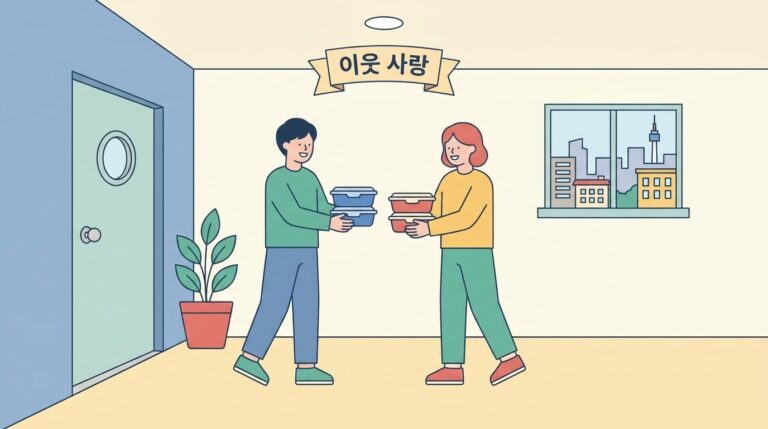
Phase 1: Empathy (Welcome to the Neighborhood!)
안녕하세요! 매일한글 에디터입니다. (Hello! I’m your Daily Hangul editor.)
Picture this: You are walking up the narrow stairs of your cozy villa (빌라, low-rise apartment building) in Seoul after a long day of studying or working. Just ahead of you, your sweet elderly neighbor, Mrs. Park, is struggling to carry two massive boxes packed with fresh apples and seasonal cabbage from her hometown. You want to step in and help, but your heart suddenly starts racing. “What if my Korean sounds rude? What if I use the wrong honorifics and make her uncomfortable? Should I just look down at my phone and slip past?”
If you have ever frozen in your tracks inside a Seoul elevator or apartment hallway, you are not alone! Over 80% of our Daily Hangul learners tell us that interacting with local Korean neighbors feels intimidating. But here is the secret: Koreans have a deeply ingrained sense of connection called 정 (Jeong)—a warm, unconditional bond that turns strangers into family. When you reach out a helping hand, you aren’t just practicing textbook grammar; you are unlocking the beating heart of Korean society. Today, we will guide you through simple, foolproof A2-level phrases and cultural etiquette so you can build warm neighborly bonds with zero awkwardness!
Phase 2: Top 3 Core Expressions in Depth
1. 제가 도와드릴까요? (Jega dowadeurilkkayo?)
- Pronunciation: [Je-ga do-wa-deu-ril-kka-yo?] (Think of saying: “Jay-gah dough-wah-doo-reel-kkah-yo?”)
- Meaning: “Shall I help you?” (Polite offer of assistance)
- K-Culture Moment: Seen in nearly every slice-of-life K-drama when a thoughtful main lead rushes across an apartment complex to take a heavy parcel from an elder.
- Editor’s Insight: Instead of asking “도와줘요?” (which can sound too blunt), using the polite humble auxiliary verb ~드릴까요? (~deurilkkayo?) shows deep respect and genuine care for the other person.
- Situation Spectrum: Casual: ⚠️ (too formal for close friends) | Semi-formal: ✅ (Ideal for neighbors!) | Formal: ✅
- 🤔 Think About It: In English, we often ask “Need any help?” quite casually. Why does Korean culture place such emphasis on using humble verbs like 드리다 (deurida) when offering support to neighbors?
2. 무거우시죠? (Mugeousijyo?)
- Pronunciation: [Mu-geo-u-si-jyo?] (Sounds like: “Moo-guh-oo-she-jyo?”)
- Meaning: “That looks heavy, doesn’t it?” / “It must be heavy!”
- K-Culture Moment: The classic ice-breaker used when catching the elevator door for someone hauling bulky Coupang parcels or grocery bags.
- Editor’s Insight: Koreans rarely jump straight into demanding action. Instead, they first validate the other person’s physical state or struggle with empathy using the honorific ending ~시죠? (~sijyo?). It softens the atmosphere instantly.
- Situation Spectrum: Casual: ⚠️ | Semi-formal: ✅ (Perfect neighbor empathy line) | Formal: ✅
- 🤔 Think About It: Notice how acknowledging someone’s effort or burden before offering a solution builds immediate psychological safety.
3. 이거 좀 드셔보세요. (Igeo jom deusyeoboseyo.)
- Pronunciation: [I-geo jom deu-syeo-bo-se-yo?] (Sounds like: “Ee-guh johm doo-shuh-boh-say-yoh”)
- Meaning: “Please try some of this.” (Friendly food sharing)
- K-Culture Moment: Just like the famous neighborhood food-swapping scenes in Reply 1988, where families exchange side dishes before dinner.
- Editor’s Insight: The tiny word 좀 (jom – a little bit) is your magic wand in Korean! It makes your gift humble, implying: “It is just a small, modest treat, so please don’t feel burdened to return the favor.”
- Situation Spectrum: Casual: ⚠️ | Semi-formal: ✅ (Top banchan-sharing phrase) | Formal: ✅
- 🤔 Think About It: Sharing food is the ultimate manifestation of Jeong. How does food sharing in your home country compare to gifting homemade side dishes to neighbors?
Phase 3: Textbook Korean vs Real-Life Korean
Scenario 1: Offering to carry heavy items in the hallway
- 📖 Textbook Korean: 저에게 그 짐을 주십시오. (Jeo-e-ge geu ji-meul ju-sip-si-o. / “Give those luggage items to me.”)
- 🗣️ Real-Life Korean: 제가 들어드릴게요! (Je-ga deu-reo-deu-ril-ge-yo! / “Let me carry that for you!”)
- 💡 Why the difference? Textbook imperatives like ~십시오 sound like a security checkpoint command. Real-life Korean expresses your warm personal willingness using ~ㄹ게요 (~lgeyo), creating instant camaraderie.
Scenario 2: Declining help politely when someone offers
- 📖 Textbook Korean: 아니요, 필요 없습니다. (A-ni-yo, pil-yo eop-seum-ni-da. / “No, it is not necessary.”)
- 🗣️ Real-Life Korean: 괜찮아요, 혼자 할 수 있어요! 감사합니다! (Gwaen-chan-a-yo, hon-ja hal su iss-eo-yo! Gam-sa-ham-ni-da! / “I’m alright, I can handle it myself! Thank you!”)
- 💡 Why the difference? Saying 필요 없습니다 cuts off the emotional connection cold. Native speakers soften refusals with 괜찮아요 (I’m okay) followed by gratitude for the kind thought.
Phase 4: K-Culture Deep Dive & Non-Verbal Manners
4-1. 눈치 (Nunchi) & Polite Gestures
When interacting with neighbors in hallways, corridors, or elevator lobbies, your non-verbal cues communicate 70% of your message:
* The Two-Hand Rule: Whenever you take a box from an elder or hand over a small treat, support your right wrist or elbow with your left hand, or hold the item with both hands. It instantly signals respect.
* The 15-Degree Nod-Bow (목례 – Mok-rye): You don’t need a deep 90-degree formal bow. A gentle 15-degree tilt with soft eye contact conveys warmth.
* Elevator Door Courtesy (배려): If you see a neighbor carrying bags from afar, keep your hand pressing the 열림 (Open) button rather than relying on sensor doors.
4-2. Cultural Code: The Banchan Economy & “Jeong”
In Korea, food is connection. If you have watched Reply 1988 or Hometown Cha-Cha-Cha, you know that neighbors don’t merely say hello; they exchange banchan (반찬, side dishes). If an older neighbor gives you a plastic container filled with kimchi or fresh fruit, here is the golden unwritten rule of Jeong: Never return an empty container. Even if you fill it with simple store-bought mandarins, bakery bread, or juice boxes, returning it with something sweet inside closes the loop of mutual affection.
Phase 5: Interactive Role-Play Scenario
Setting: The 3rd-floor elevator lobby of a quiet apartment building on a rainy Saturday afternoon.
Character: Mrs. Park (박 아주머니), an energetic 60-year-old neighbor holding a heavy box dripping with moisture from the supermarket.
- Turn 1 (Mrs. Park): 🎭 Sighing heavily while setting down a wet box. 아이고, 허리야… 비가 와서 그런지 박스가 젖어서 더 무겁네. (Aigo, heoriya… biga waseo geureonji bakseuga jeojeoseo deo mugeomne. / “Oh my back… Maybe because of the rain, this wet box feels twice as heavy.”)
- Turn 2 (You): 🎭 Stepping forward with a gentle smile. 아주머니, 안녕하세요! 무거우시죠? (Ajumeoni, annyeonghaseyo! Mugeousijyo? / “Hello, Mrs. Park! It looks really heavy, doesn’t it?”)
- Turn 3 (Mrs. Park): 어머, 302호 학생! 마트 다녀왔는데 생각보다 많이 샀지 뭐야. (Eomeo, 302-ho haksaeng! Mateu danyeowanneunde saenggakboda mani satji mwoya. / “Oh my, the student from Apt 302! I just came back from the mart, and I ended up buying way too much.”)
- Turn 4 (You): 🎭 Reaching out both hands. 제가 집 앞까지 들어드릴까요? (Jega jip apkpaji deureodeurilkkayo? / “Shall I carry it to your front door for you?”)
- Turn 5 (Mrs. Park): 🎭 Waving one hand shyly while smiling. 아이구, 비도 맞았는데 미안해서 어쩌나… 괜찮아요? (Aigu, bido majanneunde mianhaeseo eojjeona… Gwaenchanayo? / “Oh dear, it’s wet from the rain, I feel bad troubling you… Are you really okay with that?”)
- Turn 6 (You): 네, 전혀 안 무거워요! 조심해서 올라가세요. (Ne, jeonhyeo an mugeowoyo! Josimhaeseo ollagaseyo. / “Yes, it’s not heavy at all! Please watch your step going up.”)
- Turn 7 (Mrs. Park): 🎭 Unlocking her digital door lock, beaming with pride. 정말 고마워요. 잠깐만 기다려봐요! 사과 몇 개 가져가요. (Jeongmal gomawoyo. Jamkkanman gidaryeobwayo! Sagwa myeot gae gajyeogayo. / “Thank you so much. Wait just a second! Take a few of these fresh apples.”)
- Turn 8 (You): 🎭 Receiving the apples with both hands and bowing. 와, 사과 정말 맛있겠네요! 감사히 잘 먹겠습니다. (Wa, sagwa jeongmal masitgenneyo! Gamsahi jal meokgetseumnida. / “Wow, these apples look delicious! I will enjoy them gratefully.”)
🔀 Interactive Choice Point
Mrs. Park tries to give you a heavy bag of homemade kimchi in addition to apples, but your tiny one-room mini fridge is completely packed. How do you respond?
* Choice A: “김치 싫어해요. 냉장고에 자리 없어요.” (Gimchi sileohaeyo. Naengjanggo-e jari eopseoyo. / “I hate kimchi. There’s no space in my fridge.”)
* Choice B: “너무 감사하지만, 저희 집 냉장고가 너무 작아서 다 못 먹을 것 같아요. 사과만 감사히 받을게요!” (Neomu gamsahajiman, jeohui jip naengjanggoga neomu jagaseo da mot meogeul geot gatayo. Sagwaman gamsahi badeulgeyo!)
* Choice C: Silently take the kimchi container with a frown and dump it in the trash later.
- Feedback:
- Choice A (Bad): Extremely blunt! Saying you “hate” food directly crushes neighborly Jeong.
- Choice B (Best!): Perfect harmony. It praises her generosity, explains your realistic situation without offending her cooking, and accepts the fruit gratefully.
- Choice C (Risk): High cultural risk! Throwing away kimchi is culturally seen as a waste of heart (정), and Mrs. Park will surely ask how it tasted the next time she sees you.
Phase 6: 10-Second Emotional Shadowing Drill
Practice these natural rhythm pauses (/) and embody the matching emotional cues:
[😊 Warm and helpful]
제가 / 들어드릴까요? / 편하게 말씀하세요.
(Je-ga / deu-reo-deu-ril-kka-yo? / Pyeon-ha-ge mal-ssuem-ha-se-yo.)
“Shall I / carry that for you? / Please feel free to tell me.”-
[🥰 Sweet and modest]
이거 / 시골에서 받은 귤인데요, / 좀 드셔보세요.
(I-geo / si-gol-e-seo ba-deun gyul-in-de-yo, / jom deu-syeo-bo-se-yo.)
“These are / mandarins from the countryside, / please try some.” -
[🥺 Empathic and considerate]
짐이 / 너무 많으시죠? / 엘리베이터 문 / 잡아드릴게요!
(Ji-mi / neo-mu man-eu-si-jyo? / El-li-be-i-teo mun / jab-a-deu-ril-ge-yo!)
“You have / so many bags, right? / Let me hold / the elevator door for you!”
Phase 7: K-Culture Mini Dictionary
- 정 (Jeong) | Deep relational affection | The invisible emotional adhesive of Korean society; an innate warmth formed through shared space, meals, and mutual care over time.
- 이웃사촌 (Iutsachon) | Neighbor-cousin | A beloved Korean proverb meaning “A close neighbor is better than a distant relative,” highlighting how immediate neighbors often rescue you first in emergencies.
- 반찬 나눔 (Banchan Nanum) | Sharing side dishes | The cultural practice of preparing generous amounts of side dishes and packaging portions in Tupperware for elderly neighbors or college students living alone.
- 품앗이 (Pumasi) | Communal labor exchange | Traditional reciprocal communal work (like harvesting or building) that has modernized into apartment tasks like joint package retrieval or neighborhood cleanups.
Phase 8: Traveler’s Survival Kit
Top 3 Survival Phrases
- 문 잡아주셔서 감사합니다! (Mun jab-a-ju-syeo-seo gam-sa-ham-ni-da!)
- Meaning: “Thank you for holding the door!”
- Pro Tip: Use this anytime a resident holds the lobby or elevator door for you.
- 먼저 타세요. (Meon-jeo ta-se-yo.)
- Meaning: “Please get on first.”
- Pro Tip: Perfect when you are waiting at a crowded subway elevator or apartment lift with an elder.
- 좋은 하루 보내세요! (Jo-eun ha-ru bo-nae-se-yo!)
- Meaning: “Have a wonderful day!”
- Pro Tip: The warmest parting phrase when stepping out of the elevator.
Editor’s Travel Note
- When staying in residential Airbnbs or villas, locating tricky entrance codes and recycling stations is crucial. Make sure you use the Naver Map App Download Guide to pinpoint your exact villa building number.
- Recycling Etiquette: Always ask your building host or watch the security guard (경비아저씨, Gyeongbi-ajeossi). Sorting recyclables properly is the #1 way to stay in your neighbors’ good graces!
Phase 9: “One Step Deeper” (Humanities Reflection)
In our fast-paced digital era, high-rise apartment living in Seoul can sometimes feel anonymous and secluded behind thick digital door locks. Yet beneath the high-tech facade, the ancient spirit of 정 (Jeong) constantly seeks an opening. Offering to hold a heavy cardboard box or passing two persimmons over the stair railing is not about transactional politeness; it is a gentle affirmation that says, “We share this space, and you matter.” Even as an international guest or beginner speaker, your willingness to speak up bridges generational and cultural divides faster than any textbook ever could.
💬 Your Turn: Have you ever experienced a touching act of unexpected kindness from a stranger or neighbor in Korea or your home country? Share your story in the comments below!
Phase 10: FAQ & Common Mistakes
Q: What should I call my middle-aged female neighbor if I don’t know her name?
A: Avoid calling her 아줌마 (Ajumma) directly to her face, as some may find it slightly unrefined. Instead, use the softer, warmer term 아주머니 (Ajumeoni), or refer to her by her apartment unit if known, such as 어머님 (Eomeonim) for seniors or 이웃 주민분 (Iut juminbun).
Q: If a neighbor brings me food, do I have to return something immediately on the spot?
A: Not at all! Do not panic. Keep the dish, wash the container thoroughly after eating, and return it a few days later with a small replacement snack (like bakery cookies or seasonal fruit).
Q: Can I use “도와줄까?” (Dowajulka?) with an older neighbor?
A: Absolutely not! That is 반말 (informal/casual language). Always use 제가 도와드릴까요? (Jega dowadeurilkkayo?) to ensure respectful communication.
🚨 Common Mistakes Warning Board
- Mistake: Handing back an empty food container.
- Correct Action: Place a small token (even single candies or juice pouches) inside before returning it.
- Mistake: Saying “수고하세요!” (Sugo-haseyo) to elderly neighbors.
- Correct Action: 수고하세요 can sound condescending from a younger person to an elder. Instead, say 좋은 하루 보내세요! (Jo-eun ha-ru bo-nae-se-yo!) or 들어가세요! (Deu-reo-ga-se-yo!).
- Mistake: Avoiding eye contact and pretending to look at your phone in the elevator.
- Correct Action: Give a polite 15-degree nod with a cheerful 안녕하세요! (Annyeonghaseyo!).
Phase 11: Action Missions & Engagement
- 🥉 Bronze Mission (Solo Practice): Stand in front of your mirror and practice saying 제가 들어드릴게요! (Jega deureodeurilgeyo!) with a smile and two hands outstretched 5 times.
- 🥈 Silver Mission (Social Share): Leave a comment below using the phrase 이거 좀 드셔보세요! along with your favorite home-country dish name in Korean.
- 🥇 Gold Mission (Real Life Action): The next time you see someone carrying packages or entering the door behind you, hold the door and say: 먼저 들어가세요! (Meonjeo deureogaseyo! / Please go in first!).
- 🎮 K-Culture Mission: Watch Episode 1 of Reply 1988 and count how many times neighbor kids run across the alleyway to deliver side dishes before dinnertime!
Phase 12: Interactive Quiz Challenge
Test your Jeong skills before you head out! Choose your answers, then toggle to check the explanations.
1. Situation Judgment: You see an elderly grandfather struggling with two grocery bags at the stairs. What is the most natural, polite way to offer help?
* A) 가방 이리 줘. (Gabang iri jwo.)
* B) 어르신, 제가 들어드릴까요? (Eoreusin, jega deureodeurilkkayo?)
* C) 왜 그렇게 많이 샀어요? (Wae geureoke mani sasseoyo?)
2. Fill-in-the-Blank: When handing home-baked bread to your neighbor, complete the sentence:
* “맛있게 만들었으니 ______ 좀 드셔보세요.” (Please try some of this…)
* (A) 저것 (jeogeot)
* (B) 이거 (igeo)
* (C) 누구 (nugu)
3. True or False: In Korea, returning an empty Tupperware container to a neighbor who gave you homemade kimchi is considered warm and polite etiquette.
* [True / False]
👉 Click to reveal answers & explanations!
- Question 1 Answer: B
- Explanation: 어르신, 제가 들어드릴까요? uses the honorable term of address (어르신) and the humble helper verb (~드릴까요), which is peak A2 polite Korean! Option A is rude informal speech, and Option C sounds critical.
- Question 2 Answer: B (이거)
- Explanation: 이거 좀 드셔보세요 means “Please try some of this.” 이거 (this item close to speaker) is the exact natural pronoun to use.
- Question 3 Answer: False
- Explanation: Returning an empty container is seen as lacking Jeong. You should always fill it with a modest treat or snack in return!
- Explanation: Returning an empty container is seen as lacking Jeong. You should always fill it with a modest treat or snack in return!







