

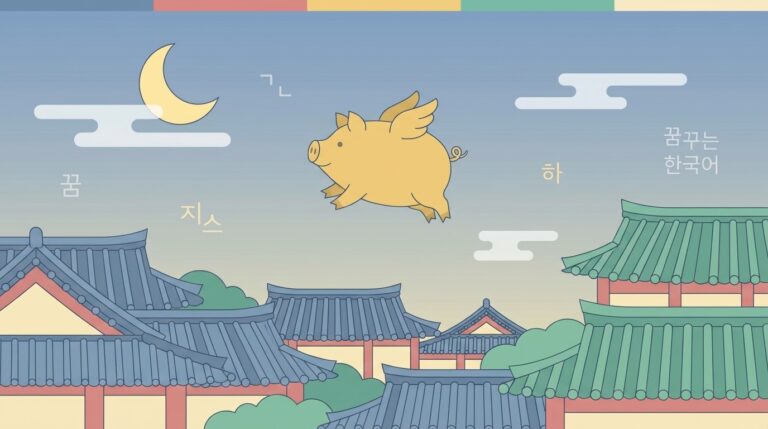
Decoding Korean Dreams: Why a Pig in Your Sleep Means It is Time to Buy a Lottery Ticket
Phase 1: Empathy (Welcome to the World of Korean Haemong)
안녕하세요! 매일한글 에디터입니다. (Annyeonghaseyo! I’m your Daily Hangul editor.)
Have you ever watched a K-drama where a character bolts upright in bed, eyes wide with pure shock, and immediately sprints to the nearest convenience store to buy a lottery ticket because they saw a muddy pig? Or perhaps you witnessed a scene where a mother-in-law smiles mysteriously over morning tea, announcing she saw a silver carp leap into her apron, sending the entire family into tears of joy. If your immediate reaction was, “Wait, did I miss an episode? Why are farm animals and fish sparking family milestones?”—you are definitely not alone.
Dream interpretation, or 해몽 (haemong), is deeply woven into the Korean subconscious. For intermediate Korean learners (B2), grasping these symbols is the ultimate bridge between textbook vocabulary and true cultural fluency. When you understand why Koreans either celebrate or guard their dreams like state secrets, you unlock a hidden layer of daily humor, office small talk, and social empathy. Today’s guide is built from hundreds of real classroom conversations with learners who wanted to decode the superstitious charm of modern Korea. By the end of this post, you’ll know exactly what to say when your Korean friend whispers about their wild nocturnal adventures!
Phase 2: Core Expressions 3 Deep-Dive
1. 돼지꿈 꿨어요 (Dwaeji-kkum kkwosseoyo)
- Pronunciation: [Dwae-ji-kkum kko-sseo-yo] (Sounds like “dway-jee-koom kwo-so-yo”—rhymes with a swift “whoosh” on kwo)
- Meaning: Literal: “I dreamed of a pig.” | Nuance: “I had a dream foretelling massive financial luck or unexpected wealth!”
- K-Culture Moment: Seen frequently in comedy and slice-of-life dramas when an office worker silently walks away from their desk at lunch to find an authorized lotto retailer.
- Editor’s Insight: In Korea, pigs historically symbolized abundance and livestock wealth. Additionally, the Chinese character for pig (Don, 豚) shares the exact same sound as the native Korean word for money (Don, 돈). It’s the ultimate linguistic pun turned cultural superstition!
- Situation Spectrum: Casual: ✅ | Semi-formal: ✅ | Formal: ⚠️ (Use cautiously in business presentations unless used as a light icebreaker)
- 🤔 Think About It: In Western idioms, pigs often represent greed or dirtiness. Why do you think Korean agrarian history transformed this animal into the supreme emblem of fortune?
2. 태몽 (Taemong)
- Pronunciation: [Tae-mong] (Sounds like “teh-mong”, with a crisp “T” like in “table”)
- Meaning: Literal: “Womb/Conception dream.” | Nuance: “A prophetic dream predicting the pregnancy, gender, or future personality/destiny of an unborn child.”
- K-Culture Moment: When a K-pop idol reveals on a variety show that their mother dreamed of a majestic dragon coiling around a mountain peak before they were born.
- Editor’s Insight: Taemong is rarely dreamed only by the expectant mother. Often, aunts, grandmothers, close friends, or even colleagues dream it first and “gift” or notify the parents before a medical test confirms pregnancy!
- Situation Spectrum: Casual: ✅ | Semi-formal: ✅ | Formal: ✅ (A respectful, universally accepted cultural concept across all ages)
- 🤔 Think About It: Does your native culture have any mystical omens associated with birth, or is the arrival of a child strictly framed through modern medicine?
3. 길몽 vs 흉몽 (Gilmong vs Hyungmong)
- Pronunciation: [Gil-mong / Hyung-mong] (Gil like “gild”, Hyung like “h-young”)
- Meaning: Literal: “Lucky dream” vs. “Unlucky dream.” | Nuance: “An auspicious omen that brings prosperity” vs. “A cautionary nightmare that warns you to lie low today.”
- K-Culture Moment: A character drops their coffee mug in the morning and mutters: “어젯밤에 흉몽을 꿔서 그런가…” (Maybe it’s because I had an ominous dream last night…)
- Editor’s Insight: The beauty of Korean haemong lies in counter-intuitive reversals. Dreaming of your own death or a house burning down into roaring flames is actually a roaring gilmong (symbolizing explosive growth!), whereas dreaming of clear water turning murky is a hyungmong.
- Situation Spectrum: Casual: ✅ | Semi-formal: ✅ | Formal: ⚠️
- 🤔 Think About It: How does categorizing dreams into binary omens affect daily psychological resilience? Does calling a scary dream a gilmong help Koreans shake off morning anxiety?
Phase 3: Textbook Korean vs Real Korean
Situation 1: Reacting to an incredible dream
- 📖 교과서 한국어 (Textbook): 어젯밤에 아주 좋은 꿈을 꾸었습니다. (Eojetbame aju joeun kkumeul kkueotseumnida. / “I had a very good dream last night.”)
- 🗣️ 진짜 한국어 (Real-life): 나 대박 꿈 꿨잖아, 오늘 복권 한 장 사야겠어! (Na daebak kkum kkwotjana, oneul bokgwon han jang sayagesseo! / “I had an insane jackpot dream—I totally have to buy a lottery ticket today!”)
- 💡 왜 다를까? (Why the difference?): Native speakers rarely say “좋은 꿈” when describing omens. They use punchy slang like 대박 꿈 (daebak kkum) and tie it immediately to the cultural reflex of purchasing a lottery ticket (Lotto).
Situation 2: Inquiring about a pregnancy rumor
- 📖 교과서 한국어 (Textbook): 당신의 아기가 생길 것이라는 꿈을 꾸었습니까? (Dangsinui agiga saenggil geosiraneun kkumeul kkueotseumnikka? / “Did you have a dream that you will have a baby?”)
- 🗣️ 진짜 한국어 (Real-life): 혹시 주변에 누구 태몽 꿔준 사람 있어? (Hoksi jubyeone nugu taemong kkoejun saram isseo? / “Did anyone around you happen to have a conception dream for you?”)
- 💡 왜 다를까? (Why the difference?): Because taemong can be dreamed by proxy, Koreans ask if someone dreamed it on your behalf using the beneficial helper verb form ~어/아 주다 (to do for someone).
Phase 4: K-Culture Deep Dive & Non-verbal Manners
4-1. 눈치 (Nunchi) & Non-Verbal Etiquette: Dream Trading
In Korea, there is a fascinating rule regarding gilmong (lucky dreams): Keep your mouth shut until the afternoon!
If you tell someone about your pig dream or money dream before midday, superstition says the fortune “evaporates” or escapes (복이 달아난다). If someone asks why you look unusually cheerful during the 9 AM team meeting, you don’t boast out loud. You maintain subtle eye contact, tap your lips with an index finger, and smile slyly. Furthermore, Koreans actually buy and sell dreams! If your coworker had an amazing dream of catching a flying dragon, you can hand them a 1,000 KRW bill and say: “그 꿈 나한테 팔아!” (Geu kkum nahante para! / Sell that dream to me!). Once money changes hands, the luck is officially transferred. Never try to buy a dream for free—it breaks the whimsical cosmic contract!
4-2. Cultural Code: The Biology of Taemong
In K-dramas, Taemong functions as the ultimate plot device. But it is also a living custom. Traditional Korean folk belief categorizes symbols into perceived masculine and feminine energies (though modern parents take this lightly):
* Fiery, bold symbols: Tigers, dragons, red peppers, and giant chestnuts often hinted at a son or a fiercely ambitious child.
* Delicate, radiant symbols: Golden rings, flowers, small silver fish, and peaches hinted at a daughter or an artistic, empathetic soul.
Even today, when a Korean child asks, “Mom, where did I come from?”, mothers often bypass biological lectures and start with: “Well, grandma dreamed that a giant golden carp jumped straight into her skirt…”
Phase 5: Real-Life Roleplay Scenario
Setting: 2:15 PM, a sunlit pantry at a tech startup in Pangyo. You notice your colleague, Minji, staring at her phone screen, searching for something with intense concentration.
- Minji (민지): (주위를 두리번거리며 목소리를 낮춘다) 저기… 혹시 오늘 점심 먹고 편의점 갈 일 있어?
(Jeogi… hoksi oneul jeomsim meokgo pyeon-uijeom gal il isseo?)
🎭 Looking around cautiously, dropping her voice to a whisper.
“Hey… do you happen to have an errand at the convenience store after lunch?” - You: 편의점이요? 커피 사러 갈 건데, 왜요?
(Pyeon-uijeomi-yo? Keopi sareo gal geonde, waeyo?)
🎭 Tilting your head with casual curiosity.
“The convenience store? I’m going to grab a coffee, why?” - Minji: 나 어젯밤에 진짜 생생한 돼지꿈을 꿨거든. 황금 돼지가 내 품으로 쑥 들어왔어!
(Na eojetbame jinjja saengsaenghan dwaeji-kkumeul kkwotgeodeun. Hwanggeum dwaejiga nae pumeuro ssuk deureowasseo!)
🎭 Eyes gleaming with suppressed excitement, clenching both fists.
“I had such a vivid pig dream last night. A golden pig literally bounded right into my arms!” - You: 대박! 황금 돼지면 완전 길몽이잖아요!
(Daebak! Hwanggeum dwaejimyeon wanjeon gilmong-ijanh-ayo!)
🎭 Clapping hands softly in genuine delight.
“Jackpot! If it was a golden pig, that’s a total lucky omen!” - Minji: 그러니까! 원래 점심 전에는 말 안 하려고 꾹 참았잖아. 복 날아갈까 봐.
(Geureonikka! Wonrae jeomsim jeon-eneun mal an haryeogo kkuk cham-atjana. Bok naragalkka bwa.)
🎭 Sighing with relief, letting out a bubbly laugh.
“Exactly! I held it in all morning and didn’t utter a word. Didn’t want the fortune to fly away.” - You: 참느라 고생하셨네요. 그럼 편의점에서 로또 사시게요?
(Chamneura gosaenghasyeotneyo. Geureom pyeon-uijeom-eseo rotto sasigeyo?)
🎭 Nodding with a knowing, playful smile.
“Must have been hard keeping that secret. So you’re hitting the convenience store to buy a Lotto ticket?” - Minji: 당근이지! 당첨되면 내가 너한테 소고기 쏠 테니까 같이 가자.
(Dang-geun-iji! Dangcheom-doemyeon naega neohante sogogi ssol tenikka gachi gaja.)
🎭 Winking confidently while grabbing her wallet.
“You bet! If I win, I’ll treat you to premium Korean beef, so let’s go together.” - You: 약속 잊으시면 안 돼요! 영수증 뒤에 서명해 둘게요.
(Yaksok ijeusimyeon an dwaeyo! Yeongsujeung dwie seomyeonghae dulgeyo.)
🎭 Chuckling warmly as you lead the way.
“Don’t you forget that promise! I’m making you sign the back of the receipt.”
🔀 Interactive Branching Moment
How would you reply to Minji’s invitation? Choose your path:
* Option A: “돼지꿈 그거 다 미신이에요. 돈 낭비하지 마세요.” (Pig dreams are pure superstition. Don’t waste money.)
* Option B: “우와, 1등 당첨되면 회사 그만두시는 거 아니에요? 축하해요!” (Whoa, if you win first place, aren’t you quitting the company? Congrats!)
* Option C: “민지 씨, 그 꿈 기운 너무 좋은데 저한테 천 원에 파실래요?” (Minji, that dream’s aura is incredible—wanna sell it to me for 1,000 won?)
Feedback:
* Choice A [Bad]: Total mood killer (분위기 파악 못함). In Korea, light superstition is celebrated as a fun micro-ritual. Blunt skepticism breaks social rapport.
* Choice B [Risk]: A bit too intense! While funny, jumping straight to quitting work skips the customary banter, and superstitious folk might worry that loud congratulations jinx the unbought ticket.
* Choice C [Best!]: Pure native intuition! By proposing to buy the dream (꿈 사기), you demonstrate deep cultural mastery, flattery, and humor in one single sentence.
Phase 6: 10-Second Emotion Shadowing Drill
Practice these lines out loud. The slashes / indicate natural micro-pauses for rhythmic breath control:
[🤑 들뜨고 은밀하게 - Excited & conspiratorial]- 나 어젯밤에 / 황금 돼지꿈 꿨잖아! / 오늘 퇴근길에 / 복권 무조건 산다.
(Na eojetbame / hwanggeum dwaeji-kkum kkwotjana! / Oneul toegeunkkire / bokgwon mu-jogeon sanda.) - “I had a golden pig dream last night! / On my way home from work / I’m buying a lottery ticket without fail.”
- 나 어젯밤에 / 황금 돼지꿈 꿨잖아! / 오늘 퇴근길에 / 복권 무조건 산다.
[😮 감탄하며 부러운 톤으로 - Amazed & envious]- 진짜요? / 그거 완전 특급 길몽인데 / 그 행운 / 저한테 좀 나눠주세요!
(Jinjja-yo? / Geugeo wanjeon teukgeup gilmong-inde / geu haeng-un / jeohante jom nanwojuseyo!) - “Really? / That’s a top-tier lucky dream / Please share / a little bit of that luck with me!”
- 진짜요? / 그거 완전 특급 길몽인데 / 그 행운 / 저한테 좀 나눠주세요!
[👶 다정하고 조심스럽게 - Gentle & affectionate]- 복숭아 태몽이라니 / 아기가 엄마 닮아서 / 정말 사랑스럽겠네요.
(Boksung-a taemong-irani / agiga eomma dalmaseo / jeongmal sarangseureopgenneyo.) - “A peach conception dream? / The baby will take after the mother / and be truly lovely.”
- 복숭아 태몽이라니 / 아기가 엄마 닮아서 / 정말 사랑스럽겠네요.
Phase 7: K-Culture Mini Dictionary
- 해몽 (Haemong) | Dream interpretation
- Usage: Used widely across digital portals (e.g., “무료 해몽 사이트” – Free dream decoding sites). It is the act of unraveling symbolic metaphors from sleep.
- 복권 (Bokgwon) | Lottery ticket
- Usage: Often substituted casually with “로또” (Lotto). Culturally linked to moments of unexpected good fortune or weird dreams.
- 돈방석 (Don-bang-seok) | A cushion made of money (Extreme wealth)
- Usage: Common celebratory idiom. For example: “돼지꿈 꿨으니 이제 돈방석에 앉겠네!” (You had a pig dream, you’re about to sit on a cushion of cash!).
- 삼재 (Samjae) | The three-year cycle of minor misfortunes
- Usage: Traditional astrology belief. When someone has persistent nightmares or bad luck, elders often check if they entered their samjae cycle.
Phase 8: Traveler’s Survival Kit
Survival Phrases for the Street
- 복권 명당이 어디예요? (Bokgwon myeongdangi eodiyeyo?)
- Meaning: “Where is the famous high-winning lottery store around here?”
- Pro Tip: Korea has famous kiosks known for selling multiple first-prize tickets. These spots are called myeongdang (명당), and people queue for hours!
- 개꿈이었어요. (Gae-kkum-ieosseoyo.)
- Meaning: “It was just a nonsense/silly dream.”
- Pro Tip: The prefix gae- (개) means dog, but here it acts as a diminutive meaning “trivial or worthless.” If your dream was confusing and pointless, laugh it off with this phrase.
- 좋은 꿈 꾸세요! (Joeun kkum kkuseyo!)
- Meaning: “Sweet dreams!”
- Pro Tip: The standard, polite bedtime greeting for friends, hosts, and colleagues staying overnight.
Editor’s Travel Note: Spotting Lucky Spots in Seoul
If you find yourself waking up in an Airbnb in Hongdae or Jongno after an unusually vivid dream, take a walk! Look for small street-corner booths with green and blue signs reading “Lotto 6/45”. Before you head out, check the exact route using the 네이버 지도 앱 다운로드 to search for authorized retailers (복권판매점). Remember: in Korea, lottery tickets can only be purchased with physical cash! Credit cards, Apple Pay, and foreign debit cards are strictly prohibited by law at lottery registers to prevent speculative credit debt. Keep a 5,000 KRW bill in your pocket just in case fortune strikes!
Phase 9: “One Step Deeper” (Critical Thinking)
In Western psychology heavily influenced by Freud and Jung, dreams are generally parsed as mirrors of individual subconscious anxiety, repressed desires, or cognitive consolidation. In Korea, however, dreams frequently function as a collective asset.
A dream is not private mental property; it can be bought with small pocket money, gifted to an infertile sibling, or shared to uplift a stressed-out coworker’s spirits. This shows how deeply the Korean concepts of Jeong (정, communal affection) and Gongdongche (공동체, community) permeate even the solitary landscape of sleep. When a Korean asks to buy your dream, they aren’t merely being greedy for cash—they are inviting you into a playful social ritual of shared destiny.
💬 Your Turn: Have you ever experienced a dream that predicted a real-life event, or do you have a unique dream superstition in your home country? Share your stories in the comments below!
Phase 10: FAQ & Avoiding Misunderstandings
Q: Does every animal in a Korean dream bring good luck?
A: Not at all! While pigs, cows, and dragons represent prosperity and noble birth, animals like snakes (뱀) have dual meanings (often strong wisdom or passion in taemong, but treachery if bitten with venom), and dreaming of stray cats or injured dogs is historically viewed as an omen of petty gossip or minor health snags.
Q: Can a man dream a Taemong (conception dream)?
A: Absolutely! Expectant fathers, maternal grandfathers, or even male colleagues frequently have taemong. The emotional bond and cultural anticipation transcend gender. In fact, fathers who dream vivid conception dreams are jokingly praised for having deep empathy with their partners.
Q: If I dream of someone dying, should I be terrified?
A: Quite the contrary! In Korean dream logic, death symbolizes rebirth, complete transformation, and the eradication of long-standing debts. If you dream that you or your boss passed away, it is universally interpreted as a powerful gilmong, signaling a huge career promotion or problem resolution.
🚨 Common Mistakes Alert
| Mistake | Why It Happens | Correct Action |
|---|---|---|
| ❌ Saying “돼지 같아요” to someone who had a pig dream | Translating “You are like a pig” literally, which is a harsh insult about body weight. | Say: “돼지꿈 기운 받으셨네요!” (You received the energy of a pig dream!). |
| ❌ Revealing your lucky dream at 8:00 AM breakfast | Forgetting the midday taboo rule. | Wait until after lunch (12:00 PM) before sharing lucky details with friends. |
| ❌ Taking someone’s good dream without giving anything | In folk tradition, “stealing” luck without symbolic trade brings bad karma. | Hand over a 500 KRW coin or buy them an iced Americano in exchange! |
Phase 11: Action Missions
- 🥉 Bronze Tier (Solo Practice): Stand in front of your mirror and practice the phrase: “나 어젯밤에 진짜 신기한 꿈 꿨어!” (I had such a fascinating dream last night!) with wide, expressive eyes.
- 🥈 Silver Tier (Community Connection): Head to your language exchange app (Hellotalk, Tandem) or Instagram story. Post: “한국에서는 돼지꿈을 꾸면 복권을 산다면서요? 여러분은 최근에 무슨 꿈을 꿨어요?” and see what Korean natives reply!
- 🥇 Gold Tier (Real-world Challenge): Next time a Korean friend or tutor mentions they feel tired or had an odd night, naturally ask: “길몽이에요, 흉몽이에요?” (Was it an auspicious dream or an ominous dream?).
- 🎮 K-Culture Mission: Watch an episode of a family K-drama (like Reply 1988 or Crash Landing on You) and listen closely for any mention of the word 태몽 (Taemong) when a character announces surprising news.
Phase 12: Interactive Quiz Challenge
Test your cultural fluency! Click on each toggle below to reveal the answer and expert commentary.
1. Situational Judgment
Your Korean friend Jinho arrives at work looking exhausted but grinning from ear to ear. He whispers: “나 간밤에 온 집안이 활활 불타는 꿈을 꿨어!” (I dreamed our entire house burned down with roaring flames!). How should you respond?
* A) “어떡해요! 오늘 외출하지 말고 집에 일찍 가세요.” (Oh no! Don’t go out today, go home early.)
* B) “대박! 불 꿈은 사업이 크게 번창하는 길몽이래요. 축하해요!” (Jackpot! Fire dreams are auspicious omens for booming success. Congrats!)
* C) “소방서에 신고했어?” (Did you call the fire department?)
🔍 View Answer & Explanation
Correct Answer: B
Explanation: In Korean haemong, fire (불) represents explosive energy, passion, and rapid expansion of wealth. The bigger the fire in your dream, the bigger your business or personal fortune will grow! Option A misinterprets it as a real hazard, while Option C takes the dream far too literally.
2. Fill-in-the-Blank
Complete the natural Korean dialogue:
“언니, 임신 축하해! 혹시 무슨 ( ) 꿨어? 복숭아? 호랑이?”
🔍 View Answer & Explanation
Correct Answer: 태몽 (Taemong)
Explanation: When asking an expectant mother what symbolic omen foretold her baby’s arrival, the exact cultural term is 태몽.
3. True or False Cultural Trivia
True or False: If you have an exceptionally auspicious dream in Korea, it is considered polite and lucky to brag about it to as many coworkers as possible before sunrise.
🔍 View Answer & Explanation
Correct Answer: False
Explanation: Traditional Korean etiquette and superstition dictate that you must keep a gilmong secret until at least midday (or after lunch). Sharing it too early is believed to cause the fortune to fly away (복이 날아간다)!







