

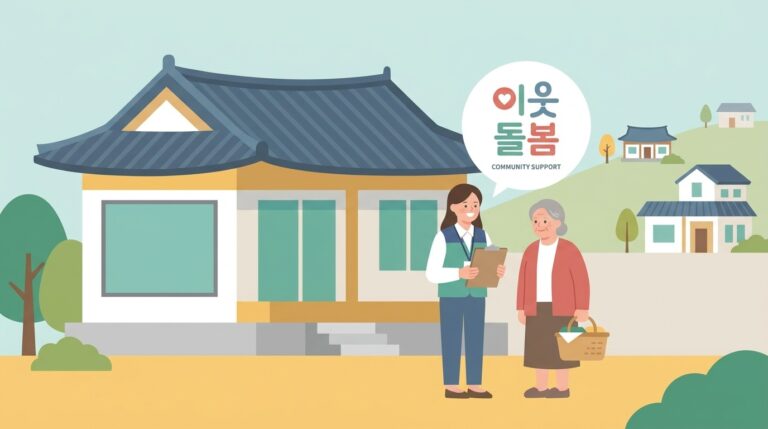
Beyond the Paperwork: Navigating Korea’s Welfare Blind Spots with Fluency and Heart
Phase 1: 공감 (Story-Driven Opening)
안녕하세요! 매일한글 에디터입니다.
If you have ever watched the acclaimed drama My Mister (나의 아저씨) or the poignant docudrama Move to Heaven (무브 투 헤븐), you are likely familiar with the quiet, shadows-draped side of South Korea’s hyper-modern landscape. Picture an elderly grandmother living in an ancient, hillside daldongne (달동네) in Ahyeon-dong, or an isolated young person struggling inside a two-pyeong gosiwon (고시원) in Sillim-dong. In these small urban pockets, the electric meters quietly stop spinning, uncollected utility notices pile up in rusted mailboxes, and yet, on official government databases, these individuals technically “do not qualify” for state benefits due to archaic bureaucratic metrics—such as having an estranged child who legally counts as a supporter, even if they have not spoken in twenty years.
This heartbreaking phenomenon is known in Korea as a “복지 사각지대” (welfare blind spot). Many advanced Korean language learners reach a sudden linguistic and cultural wall when confronting these real, civic realities. You might already know how to order food, debate economic trends, or write a university term paper on modern history, but when discussing genuine human vulnerability, poverty, and grassroots community safety nets, textbook phrases like “가난한 사람을 도와주세요” (Help poor people) feel painfully crude, condescending, and administratively inaccurate.
Speaking about social welfare in Korean requires an intricate balance of human warmth (jeong, 정), systemic precision, and social tact (nunchi, 눈치). In real civic life, whether you are volunteering with an NGO, interning at an administrative agency, analyzing societal issues for the TOPIK II exam, or simply looking out for an elderly neighbor who has suddenly vanished from morning walks, you need words that uphold human dignity while identifying systemic cracks. Today’s guide is built on authentic feedback from advanced learners and local social workers (sahoe bokjisa). We will unpack the exact socio-political vocabulary, empathetic euphemisms, and diplomatic nuances necessary to speak about social inequality and welfare intervention with the precision and grace of a native community advocate.
Phase 2: 핵심 표현 3선 심층 분석 (Core Expressions)
1. 복지 사각지대를 발굴하다 (Bokji sagakjidaereul balgulhada)
- Pronunciation: [Bok-jee sah-gahk-jee-dae-reul bahl-gool-hah-dah] (Think of ‘bok’ like the crisp snap in ‘bok choy’, and ‘balgul’ sounding like unearthing a deep fossil).
- Meaning: Literal: “To excavate welfare blind spots.” / Real Nuance: To proactively track down, identify, and register marginalized individuals who are legally or practically invisible to the state’s welfare grid.
- K-Culture Moment: Seen in documentary investigative programs like SBS’s Unanswered Questions (그것이 알고 싶다) or news segments where community leaders search old villa districts to prevent solitary deaths (godoksa).
- Editor’s Insight: Notice the archaeological verb 발굴하다 (to excavate/unearth). In Korean administrative discourse, vulnerable citizens are conceptualized as being “buried” beneath procedural paperwork and algorithmic oversight. Using this verb shows that help is not merely waiting in an office—it requires active digging into the community.
- Situation Spectrum: Casual ⚠️ | Semi-formal ✅ | Formal ✅
- 🤔 Think About It: Does your home country treat welfare identification as a citizen’s personal duty to apply, or does the government proactively “excavate” those in crisis? How does this verb shift the burden of responsibility?
2. 돌봄 공백을 메우다 (Dolbom gongbaegeul me-uda)
- Pronunciation: [Dohl-bohm gong-baek-eul meh-oo-dah] (Pronounce ‘dolbom’ with rounded lips like ‘dole-bowl’, and ‘me-uda’ smoothly like ‘may-oo-dah’).
- Meaning: Literal: “To fill up the care vacuum.” / Real Nuance: To bridge the gap where neither family members nor formal municipal services are providing basic human care.
- K-Culture Moment: Frequently highlighted in modern K-Dramas depicting single-parent families, latchkey children, or dementia patients whose primary caretakers must work long hours.
- Editor’s Insight: 돌봄 (care/tending) is one of the most significant buzzwords in contemporary Korean social policy. It carries a deeply collective, relational warmth that cold words like service (서비스) or management (관리) completely lack. 메우다 evokes filling a dangerous chasm before someone falls through.
- Situation Spectrum: Casual ⚠️ | Semi-formal ✅ | Formal ✅
- 🤔 Think About It: Notice the difference between “financial aid” and “relational care.” Why has “care gap” become a defining national dilemma in hyper-aged societies like Korea?
3. 주변의 위기가구를 살피다 (Jubyeonui wigigagureul salpida)
- Pronunciation: [Joo-byun-ui wee-gee-gah-goo-reul sahl-pee-dah] (A gentle cadence; ‘salpida’ has a soft, attentive glide at the end).
- Meaning: Literal: “To examine crisis households in one’s surroundings.” / Real Nuance: Keeping a discreet, caring neighborhood watch over vulnerable residences to ensure early intervention.
- K-Culture Moment: Found on civic banners hanging outside community centers (Haengjeong Bokji Center) reminding apartment residents to alert authorities if milk deliveries or mail pile up.
- Editor’s Insight: Using 위기가구 (household in crisis) is the refined C1 alternative to outdated, stigmatizing labels. Paired with 살피다 (to look after with care and vigilance), this phrase perfectly encapsulates civic nunchi—caring for others without invading their personal boundary.
- Situation Spectrum: Casual ✅ | Semi-formal ✅ | Formal ✅
- 🤔 Think About It: Where is the line between community solidarity (jeong) and invasion of privacy (sasaenghwal chimgwae) in modern apartment-centric Korea?
Phase 3: 교과서 한국어 vs 진짜 한국어 (Textbook vs. Real Korean)
Situation 1: Reporting an isolated neighbor experiencing severe hardship
- 📖 교과서 한국어:
“이웃집에 가난한 사람이 있으니 도와주십시오.”
(Iutjibe gananhan sarami isseuni dowajusipsio. / There is a poor person next door, so please help them.) - 🗣️ 진짜 한국어:
“저희 라인 이웃분이 복지 위기가구에 해당하시는 것 같아 조심스럽게 조회 요청을 드려보려고요.”
(Jeohui rain iutbuni bokji wigigague haedanghasineun geot gata josimseureopge johwe yocheong-eul deuryeoboryeogoyo. / It seems our neighbor on our floor might fall into the crisis household category, so I’d like to discreetly request a status check.) - 💡 왜 다를까? (Why the difference?):
Calling someone “가난한 사람” (poor person) is socially abrasive and strips the individual of their dignity (jajonsim). Advanced speakers use administrative, considerate terminology like 복지 위기가구 and soften their inquiry with 조심스럽게 조회 요청을 드리다 to avoid sounding sensationalist or accusatory.
Situation 2: Critiquing structural limitations in public welfare programs
- 📖 교과서 한국어:
“법 때문에 복지 혜택을 못 받는 사람이 여전히 많습니다.”
(Beop ttaemune bokji hyetaegeul mot banneun sarami yeojeonhi manseumnida. / Many people still cannot receive welfare benefits because of laws.) - 🗣️ 진짜 한국어:
“까다로운 수급 기준에 걸려 정작 실질적인 지원을 받지 못하는 복지 사각지대가 여전하네요.”
(Kkadareoun sugeup gijune geollyeo jeongjak siljiljeogin jiwoneul batji mothaneun bokji sagakjidaega yeojeonhaneyo. / Welfare blind spots persist as people get tripped up by stringent eligibility thresholds, failing to receive practical support.) - 💡 왜 다를까? (Why the difference?):
At a C1 level, saying “법 때문에” sounds rudimentary. Employing 수급 기준에 걸려 (caught on eligibility thresholds) and contrasting theoretical aid with 실질적인 지원 (tangible, substantive aid) showcases an analytical grasp of systemic inequality.
Phase 4: K-Culture 딥다이브 & 비언어적 매너 (Deep Dive & Non-Verbal Manners)
4-1. 눈치 (Nunchi) & Gestures: Handling Vulnerability without Shaming
In South Korea, poverty is often carried with extreme personal concealment due to the cultural emphasis on che-myeon (체면, social face) and family pride. If you suspect an acquaintance or a neighbor is trapped in a welfare blind spot, overt displays of pity will immediately cause them to withdraw.
* Lower the Vocal Projection: When discussing personal circumstances at a Community Service Center (행정복지센터), keep your voice lowered to an intimate murmur. Never announce someone’s hardships across the service counter.
* Subtle Hand Placement: When handing over handwritten notes, documentation, or pointing out an address on a residential map, use both hands (yangson, 양손) with elbows tucked close to your body. Avoid single-finger pointing toward someone’s door or home.
* Empathetic Neutrality: Keep facial expressions serene rather than overly shocked or pitying. Pity (dongsang, 동정) is perceived as patronizing; genuine communal consideration (baeryeo, 배려) is calm, respectful, and procedural.
4-2. Cultural Code: The Evolution from “반상회” to “복지통장”
Historically, Koreans monitored their immediate communities through the 반상회 (bansanghoe, monthly neighborhood meetings). While urbanization in modern high-rise apartments broke down this organic intimacy, municipal districts (gu-cheong) recreated it through 복지통장 (Welfare Neighborhood Heads) and community sensors.
In everyday Korean society today, local convenience store part-timers, Yakguk (community pharmacies), and Yakult delivery ladies (Fresh Managers) are officially trained as “Welfare Watchers.” If an elderly resident who normally purchases pain relief patches stops visiting, or if a tenant purchases only dry instant ramen for weeks with coins, these informal community hubs notify the local social workers. Understanding this dynamic gives you profound insight into how modern Korea blends hyper-efficient digital surveillance with traditional neighborhood jeong.
Phase 5: 실전 롤플레이 시나리오 (Real Role-Play Scenario)
Setting: You are visiting the 종로구 행정복지센터 (Jongno-gu Community Service Center). You have noticed that the elderly neighbor living downstairs in your multi-family villa (dasedae jutae) has not left their room for days, and multiple water shut-off notices are taped to the door. You approach Park Ji-won (박지원), the civic welfare coordinator.
- Turn 1 (You):
“저기, 사회복지 담당 주무관님 계실까요? 조심스럽게 상의드릴 일이 있어서요.”
(Jeogi, sahoebokji damdang jumugwannim gyesilkkayo? Josimseureopge sang-uideuril iri isseoseoyo.)
“Excuse me, is the welfare coordinator available? I have something I’d like to consult on discreetly.”
🎭 Action: You step up to the counter, leaning in slightly and keeping your tone soft and respectful. -
Turn 2 (Park Ji-won):
“네, 제가 담당자입니다. 무슨 일이신가요? 이쪽 상담석으로 앉으시죠.”
(Ne, jega damdangjaimnida. Museun irisingayo? Ijjok sangdamseogeuro anjeusijyo.)
“Yes, that’s me. What’s going on? Please, take a seat over here at the consultation desk.”
🎭 Action: She pulls out a private consultation log and offers a warm, receptive nod. -
Turn 3 (You):
“저희 빌라 아래층 어르신 댁인데요, 최근 며칠간 인기척도 없고 단수 예고장까지 붙어 있어서요.”
(Jeohui billa araecheung eoreusin daegindeyo, choegeun myeochilgan inkicheokdo eopgo dansu yegojangkkaji buteo isseoseoyo.)
“It’s regarding the elderly resident living downstairs in our villa. There has been no sign of life for days, and there is even a water shut-off notice posted.”
🎭 Action: You present a discreet photo on your phone showing the uncollected notices without dramatizing. -
Turn 4 (Park Ji-won):
“아, 그러셨군요. 혹시 기존에 기초생활수급자나 차상위계층으로 등록되어 있으신지 확인이 필요해 보입니다.”
(A, geureosyeotgunyo. Hoksi gijone gichosaenghwalsugeupjana chasang-wigycheungeuro deungrokdoe-eo isseusinji hwagani piryohae boimnida.)
“Ah, I see. It appears we need to check if they are already registered as a Basic Livelihood recipient or near-poverty tier.”
🎭 Action: She swiftly opens her administrative terminal to inspect the district crisis monitoring map. -
Turn 5 (You):
“혹시 제도적 요건 때문에 지원에서 누락된 복지 사각지대 가구는 아닐까 염려됩니다.”
(Hoksi jedojeok yogeon ttaemune jiwoneseo nurakdoen bokji sagakjidae gaguneun anilkka yeomryeodoemnida.)
“I am concerned that this might be a welfare blind-spot household that slipped through due to bureaucratic requirements.”
🎭 Action: You maintain eye contact with a focused, measured expression to convey civic responsibility. -
Turn 6 (Park Ji-won):
“주소를 확인해 보니 전산상으로는 부양의무자가 있어서 일반 관리 대상에서 빠져 있었네요.”
(Jusoreul hwaginhae boni jeonsansang-euroneun buyang-uimujaga isseoseo ilban gwanri daesang-eseo ppajyeo isseotneyo.)
“Looking at the address on our system, there is a legal dependent listed, which excluded them from regular monitoring.”
🎭 Action: She sighs lightly, frustrated by the bureaucratic limitations, and jots down notes. -
Turn 7 (You):
“실제로는 전혀 왕래가 없는 걸로 알아요. 찾아가는 복지 전담팀에서 현장 동행 실사를 나가주실 수 있을까요?”
(Siljereoneun jeonhyeo wangraega eomneun geollo arayo. Chajaganeun bokji jeondamtimeseo hyeonjang donghaeng silsareul nagajusil su isseulkkayo?)
“In reality, I understand there is no contact at all. Could the Outreach Welfare Team carry out an on-site joint inspection?”
🎭 Action: You gently request municipal intervention using accurate institutional terminology. -
Turn 8 (Park Ji-won):
“네, 긴급 위기가구 발굴 차원에서 오늘 오후에 바로 방문 점검을 진행하겠습니다. 제보해 주셔서 정말 다행입니다.”
(Ne, gingeup wigigagu balgul chawoneseo oneul ohue baro bangmun jeomgeomeul jinhaenghageseumnida. Jebohae jusyeoseo jeongmal dahaeng-imnida.)
“Yes, as an urgent crisis identification measure, we will conduct an on-site visit this afternoon. Thank you so much for bringing this to light.”
🎭 Action: She stands up, bowing politely, and fast-tracks an emergency home-visit slip.
🔀 인터랙티브 분기점 (Interactive Choice)
How do you follow up when the official asks for your contact information as the reporter?
- Choice A: “개인정보니까 제 번호는 묻지 마시고 그냥 알아서 처리해 주세요.”
(It’s personal data, so don’t ask for my number; just handle it yourself.) - Choice B: “어르신께서 자존심 상해하실 수도 있으니, 제 인적사항은 비공개로 유지해 주시고 진행 상황만 공유해 주시면 감사하겠습니다.”
(As the elder’s pride could be hurt, I’d appreciate it if my identity remained confidential, and you only shared the status update.) - Choice C: “그냥 지나가다 본 거라 잘 몰라요. 경찰에 넘길게요.”
(I just saw it in passing and don’t really know. I’ll just pass it to the police.)
Selection Feedback:
* Choice A (Risk): Very confrontational. While privacy is vital, social workers need informant collaboration to confirm entry codes or daily routines.
* Choice B (Best): Flawless C1 diplomacy. It shields your neighbor’s che-myeon (social face), ensures whistle-blower anonymity (ik-myeong-seong), and maintains a constructive bridge with the social worker.
* Choice C (Bad): Counterproductive. Police officers handle criminal emergencies, whereas administrative welfare centers resolve welfare blind spots through systemic relief.
Phase 6: 10초 감정 섀도잉 드릴 (Emotion Shadowing Drill)
Read these sentences aloud, matching the emotional tone and strictly pausing at the / marks!
- [😟 안타깝고 조심스럽게 – Concerned & Disagreeing with Stigma]
“우편물이 며칠째 쌓여 있는 걸 보니까 / 혹시 모를 돌봄 공백이 생긴 건 아닌지 / 걱정이 앞서더라고요.”
(Upyeonmuri myeochiljjae ssahyeo inneun geol bonikka / hoksi moreul dolbom gongbaegi saenggin geon aninji / geokjeongi apseodeoragoyo.)
“Seeing the mail pile up for days / made me worry / that a care vacuum might have developed.” -
[🏛️ 단호하고 지적인 논리 – Firm & Articulate Civic Critique]
“행정적인 잣대만 들이댈 게 아니라 / 복지 사각지대에 놓인 취약계층을 / 선제적으로 발굴해야 합니다.”
(Haengjeongjeogin jatdaeman deuridael ge anira / bokji sagakjidae-e no-in chwiyakgyecheungeul / seonjejeogeuro balgulhaeya hamnida.)
“Rather than merely applying administrative yardsticks / we must preemptively identify / vulnerable groups trapped in welfare blind spots.” -
[🤝 따뜻하고 연대감 넘치게 – Warm, Deep Empathy]
“우리의 작은 관심 하나가 / 벼랑 끝에 선 이웃에게는 / 다시 일어설 동아줄이 될 수 있어요.”
(Uriui jageun gwansim hanaga / byeorang kkeute seon i-usegeneun / dasi ireoseol dong-ajuri doel su isseoyo.)
“A single ounce of our attentive care / can become the lifeline to stand back up / for a neighbor standing on the edge of a cliff.”
Phase 7: K-Culture 미니 사전 (Mini Dictionary)
- 위기가구 (Wigi-gagu) [Crisis Household]
- Everyday usage: Used by media and municipal workers to respectfully denote households at imminent risk of eviction, starvation, or solitary death due to sudden debt or illness.
- 고독사 (Godoksa) [Solitary / Lonely Death]
- Everyday usage: An acute demographic tragedy in Korea where individuals living alone pass away unnoticed. Discussed in municipal policy and modern sociopolitical essays.
- 부양의무자 기준 (Buyang-uimuja Gijun) [Support Obligator Criterion]
- Everyday usage: A frequent hot topic in Korean welfare debates; the legal clause stating that if a person has wealthy living family, they cannot receive poverty benefits regardless of whether they are estranged.
- 찾아가는 복지전담팀 (Chajaganeun Bokji Jeondam-tim) [Outreach Welfare Team]
- Everyday usage: The official mobile unit of civil service social workers who personally drive to semi-basement apartments (banjiha) and remote rural homes to provide hands-on assistance.
Phase 8: 여행자 & 체류자를 위한 생존 키트 (Survival Kit)
Top 3 Real-Life Survival Expressions
- “주변에 위기 이웃이 계셔서 도움을 연계해 드리고 싶어요.”
(Jubyeone wigi i-usi gyesyeoseo doumeul yeon-gyehae deurigo sipeoyo.)- Pro Tip: Use the phrase 도움을 연계하다 (to bridge/connect help). It sounds vastly more professional than just saying “도와주고 싶어요.”
- “복지 긴급지원 상담 전화가 몇 번인가요?”
(Bokji gingeupjiwon sangdam jeonhwaga myeot beon-ingayo?)- Pro Tip: In Korea, the magical emergency welfare number is 129 (Ministry of Health and Welfare Call Center).
- “외국인 주민도 이용할 수 있는 긴급 구호 프로그램이 있나요?”
(Oeguk-in jumindo iyonghal su inneun gingeup guho peurogeuraemi innayo?)- Pro Tip: If you or an expat friend encounter sudden destitution or medical emergencies, municipal programs often provide emergency grants regardless of nationality.
Editor’s Civic Travel Note
If you are living in Korea or staying long-term, bookmark the official 129 보건복지상담센터 안내 포털 on your browser. For real-time location mapping of local public facilities, open the 네이버 지도 앱 다운로드 to easily search for 행정복지센터 (Administrative Welfare Centers) or 종합사회복지관 (Community Welfare Centers) in your neighborhood. Remember that public administrative centers operate on weekdays from 09:00 to 18:00.
Phase 9: “한 발 더 깊이” (Stepping Deeper: Cultural Essay)
In traditional agricultural Korea, survival was rooted in Dure (두레, collective farming cooperatives) and Pumasi (품앗이, reciprocal labor exchange)—systems where an individual’s private crisis was automatically cushioned by the entire village clan. However, rapid post-war industrialization compressed centuries of Western urban development into a mere four decades, tearing these ancient safety nets apart and confining citizens to high-rise concrete apartments. The modern bureaucratic state introduced massive safety nets, yet algorithms and financial criteria inevitably produce blind spots (sagakjidae). Today, Korea’s struggle to revitalize community watch systems represents an existential endeavor to resurrect communal jeong (정) without sacrificing modern civil privacy. When you learn to speak about welfare blind spots in Korean, you are participating in this vital national conversation: how can a hyper-modern society ensure that no human being remains invisible?
💬 Your Turn: Does your native society rely more on institutional welfare safety nets or organic neighborhood vigilance? How would you describe the concept of “a welfare blind spot” in your native culture? Share your thoughts below in Korean!
Phase 10: FAQ & 오해 방지 (FAQ Schema & Common Mistakes)
Q: Can foreign residents in Korea report suspected welfare blind spots to local authorities?
A: Yes, absolutely! Anyone residing in South Korea can notify a local Haengjeong Bokji Center or dial 129 to request an outreach check on a neighbor. You do not need to possess citizenship to alert community workers to someone in distress.
Q: Why do Koreans refer to this issue as a “사각지대” (blind spot) instead of simply “소외계층” (marginalized class)?
A: “소외계층” refers to people who are socially and economically marginalized as a group. In contrast, “복지 사각지대” emphasizes the flaw in the systemic vision—individuals who legitimately need help but are obscured from the government’s radar due to legal, administrative, or bureaucratic blind spots.
Q: Is calling someone “불우이웃” (underprivileged neighbor) acceptable in modern conversations?
A: It is increasingly avoided. While common in 1990s charity drives, modern Koreans view “불우이웃” (underprivileged/unfortunate neighbor) as patronizing. In C1 level discourse, prefer terms like 취약계층 (vulnerable demographic) or 위기가구 (crisis household).
🚨 흔한 실수 (Common Mistakes) Warning Board
- Mistake 1: Translating “poor people” directly as 가난뱅이 (slur) or 가난한 사람.
- Correct Action: Use 저소득층 (low-income bracket) or 취약계층 (vulnerable tier).
- Mistake 2: Using the verb 구하다 (to rescue from physical drowning) when discussing bureaucratic relief.
- Correct Action: Use 지원하다 (to support), 구제하다 (to grant institutional relief), or 연계하다 (to link services).
- Mistake 3: Assuming 복지관 and 주민센터 are identical.
- Correct Action: A 주민센터 (행정복지센터) is an official government civil registry and administrative office. A 복지관 is a specialized social welfare community facility offering programs, meals, and social work.
Phase 11: 액션 미션 & 참여 유도 (Action Missions)
- 🥉 Bronze Mission (Solo Practice): Read the Phase 6 Shadowing Drill out loud three times, paying close attention to the
/pause points and maintaining an empathetic yet formal tone. - 🥈 Silver Mission (Community Engagement): Write a 2-sentence post on your language exchange platform (HelloTalk, Tandem) using the phrase “복지 사각지대” and “돌봄 공백” to discuss a social issue in your home country.
- 🥇 Gold Mission (Real-Life Application): Search for a recent editorial from a Korean newspaper (such as 한겨레, 조선일보, or 경향신문) containing the keyword “복지 사각지대 발굴” and summarize the core policy problem in three bullet points in Korean.
- 🎮 K-Culture Mission: Re-watch Episode 1 of My Mister or Move to Heaven. Spot the scenes where characters interact with local neighborhood coordinators and identify the subtle non-verbal cues they use.
Phase 12: 인터랙티브 퀴즈 챌린지 (Interactive Quiz Challenge)
1. 상황 판단 퀴즈 (Context Judgment)
You are attending a civic forum discussing social inequality in Seoul. Which statement represents the most polished, natural C1 Korean?
* A. 법이 나빠서 불쌍한 사람들이 밥을 굶고 있습니다.
* B. 까다로운 수급 자격 요건으로 인해 복지 사각지대가 지속적으로 발생하는 실정입니다.
* C. 행정센터 공무원들이 일을 안 해서 사람들이 죽어가고 있어요.
2. 빈칸 채우기 (Fill-in-the-Blank)
“지역사회가 함께 나서서 소외된 이웃의 ( )을/를 메우고 위기가구를 선제적으로 ( )해야 합니다.”
* Hints: [care vacuum] / [excavate/unearth]
3. True / False 문화 퀴즈
- Statement: In South Korea, local convenience store staff and Yakult delivery managers can legally play an active role as informal community sensors to report potential crisis households.
- (True / False)
👉 정답 및 해설 보기 (Click to Reveal Answers)
1. 상황 판단 퀴즈 정답: B
* 해설: Option B showcases advanced political/administrative register: 수급 자격 요건 (eligibility requirements) and 실정입니다 (such is the current reality). Options A and C are emotionally crude and linguistically unrefined.
2. 빈칸 채우기 정답: 돌봄 공백 / 발굴
* 완성 문장: “지역사회가 함께 나서서 소외된 이웃의 돌봄 공백을 메우고 위기가구를 선제적으로 발굴해야 합니다.”
3. True / False 문화 퀴즈 정답: True
* 해설: Exactly right! Under modern community safety initiatives, local neighborhood businesses (convenience stores, pharmacies, home delivery workers) often sign MOUs with municipal districts to act as an early-detection frontline for welfare blind spots.







